How I found an SSRF in yahoo guesthouse (recon wins)
A cookie named BouncerSAMLRemoteSessionHost contained a hostname that the server used to make a request, allowing an attacker to supply an arbitrary host and port and cause the server to connect to it. This could be used to perform SSRF, as demonstrated by receiving a request on an attacker-controlled server.
 Published on medium.com
As i said before sharing is caring, here i am describing one of my findings that was closed 2 weeks ago in yahoo Guesthouse https://gh.bouncer.login.yahoo.com/ and i am describing in details, how recon helped me finding a vulnerable endpoint where i achieved the SSRF.
The full write-up lives on its author's site
It belongs to its author, so we link to it rather than copy it. The other two tabs are our own rewrites, checked against it.
Context
Yahoo! Guesthouse is a set of administration tools that Yahoo! staff use daily. According to the public description quoted in the report, they let Yahoo! administrators control all aspects of the Yahoo! network, from mail and hosting accounts to server settings and hosting management, and some parts, such as error reporting tools, are also available to the customer services team. The entry point discussed here is https://gh.bouncer.login.yahoo.com/.
When you open many Yahoo! subdomains in a browser, you are redirected to the Guesthouse login page, where a Yahoo! employee username and password are required. After a successful login you are sent on to the subdomain you originally asked for.
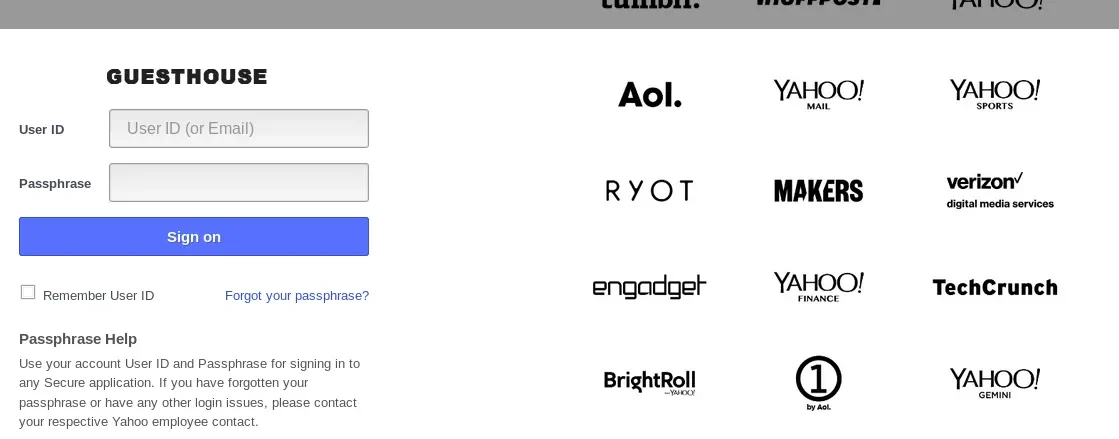
The Guesthouse login page that fronts protected subdomains.
The researcher had scanned this target before, hunting for vulnerable endpoints and hidden folders or files, without result, and had no credentials to log in. The bug was eventually found from a different subdomain.
Setup
The work was pure reconnaissance against Yahoo! assets, with no accounts or credentials. The tools involved were:
- a browser, including view source on the login page;
dirsearchfor content discovery;- Burp Suite to inspect requests, and Burp Collaborator as an alternative to a self-hosted listener;
- a VPS with
netcatlistening, used as the out-of-band receiver.
The only precondition was the ability to reach the Yahoo! subdomains involved and to receive inbound connections on a host the researcher controlled.
Finding it
During normal recon the researcher came across https://alpha.keyserver.yahoo.com/, which returned a not found response.
The not found response on alpha.keyserver.yahoo.com.
Running dirsearch against that host took time but paid off: it found a SAML endpoint, https://alpha.keyserver.yahoo.com/saml, which redirected to the Guesthouse login page. The login page carried a new detail: after a successful login the user would be redirected to a SAML endpoint. That endpoint was new to the researcher in the Guesthouse context.
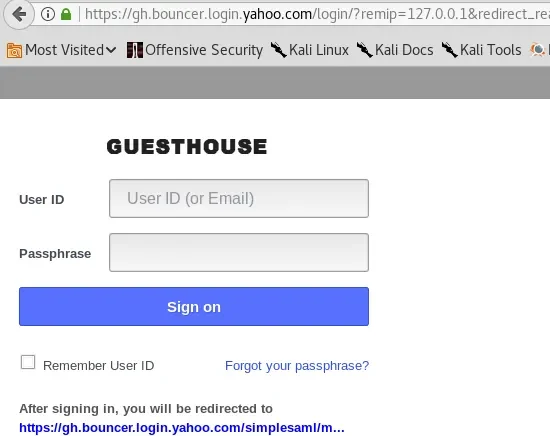
The login page stating that after login you are redirected to a SAML endpoint.
Viewing the source of the page revealed the full endpoint:
https://gh.bouncer.login.yahoo.com/simplesaml/saml2/idp/SSOService.php?SAMLRequest=nFjXkuJI073vpyDYS6JbBgkkYnu%2BkAMECJCQkLmTKXmHSv7p%2F4Aew8zO9r%2B7Vx1deTLrZObJLODP%2F%2FVZOmlBBaMif59ib%[redacted]%[redacted]%2FdoFR8D4N67pcIUjXdW%2Fd%2FK2oAgRHURRBaaTPUg9GwR%2FTici%[redacted]%2BhiOrl%2Byxy%2FZ37%2BypON8o8CfEbR%2BQDB1VZVz6%[redacted]%[redacted]%[redacted]%[redacted]%2Fn6GYe6B%2Fn6LTCVPXVeQ0NfhARHnwK%2BTLy2QymXxoavW4vnoW0z9Vxpd%2FVdA%2Fkef7nimUq6OdAZE%2FF2nkDhMmTYuOq4Bdg%2FdpXTXgUbXMrj%2FndT%2BJvFf%2FAV3VlZ3DCOT1FPn5qq%2FDA7xHE7gir0H%2F30aJK7LSriJ4lwfobbf%2BWtfvt62er%2BBSG0IF%[redacted]%2B9F6Esqvqj9r%[redacted]%2Bn3%2F7Bf8%2F%2BGBZ6Y%[redacted]%2BcF5B7766GJH%2F8a3Rv6XwIPgPQ%2F%2B0yypov8LQxv42ugJ8UIHcBRNNEd%2Bnf%2FyjtfdzrJ%2FiPXp2FzH8K%2Bj3wH%2BXEMhbkBYl8F7ht7r8mtsPQfx%2FhL6T4aMAwPq%[redacted]%2F2D87PHy%2B6S%2Bd%[redacted]%2FTkOjzKUJP4mRUlyvZ2o%[redacted]%2FH%2FryjN2o%[redacted]%[redacted]%[redacted]%2BclTymJebkciKhTsS3sw%2F5JTYCTecUKOIznBrPhud%[redacted]%[redacted]%2FBI99OeKRkWYegSz%2Br0vaFuuGojRS3pKC3Ob6%[redacted]%2FrPWn%[redacted]%2BZFr1%[redacted]%[redacted]%[redacted]%[redacted]%2FcoqWZ3UkX88ZeXMf1%[redacted]%2B2UNrr%2BrpwcCq46GR8iAVfYtEPWy%[redacted]%2Brmx9DRu8bFr%2Fc9UVo4mVr3nl3EX%[redacted]%2B1awR3shp%[redacted]%2BYt6f8Os2ZalKOZoisuDB%[redacted]%2BJqZx6whEcYsm84hXdGEGKhL%[redacted]%[redacted]%[redacted]%2FqeOLxDIPG9tLO21%2BbZw8xU29T5%[redacted]%2BDi69rhyNHS%2B8zF09zJrkkQJEy5Za%2Fs7KxokPndTuIf%[redacted]%[redacted]%[redacted]%2FcMpYQ%[redacted]%[redacted]%2Fvl4iLCXacj8xkB0ad36ddX428%2Bx%2F31%2Fflh%2B%2Bnl%2Bs2L9%2BXl%2B7ee559VvvxfAAAA%2F%2F8%3D
SAMLRequest and SAMLResponse are base64 encoded XML. The researcher decoded it and tested for XXE and SSRF inside the XML request, a technique documented in a write-up by @seanmeals on out-of-band XML external entity injection via SAML, which had worked for the researcher on another private program. On this endpoint the exploitation attempt failed.
Bypassing the SSO itself was also attempted, without success. The researcher kept digging.
Exploitation
Step 1: inspect the request in Burp
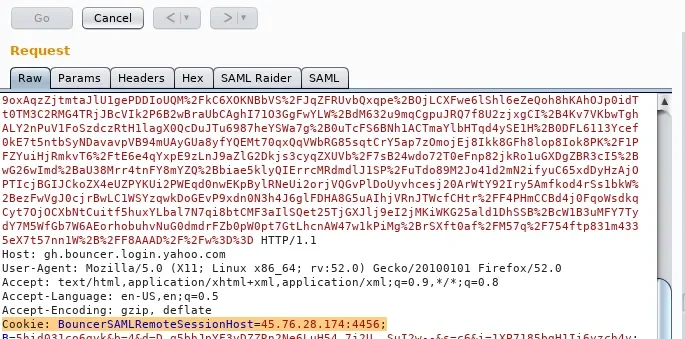
While checking the GET request for the SSOService endpoint in Burp, the researcher noticed a cookie:
BouncerSAMLRemoteSessionHost=bouncer12-os.gh.bf2.yahoo.com;
The cookie value is a hostname, a Yahoo! subdomain. A cookie whose value is a host that the server presumably contacts is a strong SSRF candidate, so the researcher tested it.
Step 2: point the cookie at a controlled host
The value was replaced with the researcher's VPS IP address and port 4566, with netcat listening on that port on the VPS.
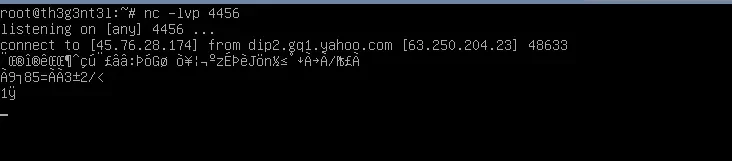
The VPS received a request from dip2.gq1.yahoo.com ([redacted]) on port 48633. The server had taken the host from the cookie and made an outbound connection to it, which confirms server-side request forgery.
Step 3: confirm without a VPS
A VPS is not required. Burp Collaborator can be used instead: the researcher also confirmed that the host is vulnerable to external DNS interactions in the X-Forwarded-For header, so the same value Burp sends could have been placed in the cookie to confirm the issue without any self-hosted listener.
Step 4: attempt escalation
Reading files or otherwise escalating the SSRF was attempted and did not succeed. The issue was reported to Yahoo! and triaged immediately. At the time of writing the bounty had not been received.
Root cause
The BouncerSAMLRemoteSessionHost cookie carries a hostname that the Guesthouse SAML component uses to reach a remote session host. The server took the host from the client-supplied cookie value and made an outbound request to it. Because the value is fully attacker-controlled, any host that can reach the application can direct the server to connect to an arbitrary address and port. The report does not describe the server-side code, so the exact validation that was missing is not stated; likely there was no allowlist of permitted session hosts.
Impact
An attacker who can reach the SSOService endpoint can make the Yahoo! server issue a request to a host and port supplied in the cookie. In the demonstrated case this produced an inbound connection from a Yahoo! host to the researcher's VPS, proving the outbound request. The researcher could not read files or escalate further, so the practical impact shown is limited to the SSRF itself: reachability probing of internal networks and interaction with internal services from a Yahoo!-origin host. The report does not describe any data exposure or further compromise.
Fix
The measure the finding calls for is to stop trusting the cookie value as a destination: restrict BouncerSAMLRemoteSessionHost to a fixed allowlist of known session hosts, or derive the host server-side from the authenticated session rather than from client input, and reject anything else before any outbound connection is made.
Variants to test
- Cookie values that look like hostnames. On any SSO or SAML flow, inspect cookies such as
*RemoteSessionHost,*Backend,*Upstreamor similar. A positive result is an outbound connection to a Collaborator or VPS host when the cookie is changed. - SAML endpoints found by content discovery. Run
dirsearchagainst hosts that return not found, looking for paths such as/saml. A positive result is a redirect into an SSO flow that exposes new parameters or cookies. - Decoded SAMLRequest and SAMLResponse XML. Test for XXE and SSRF inside the decoded XML. A positive result is an out-of-band interaction from the target when an external entity or URL is referenced.
X-Forwarded-Forand similar forwarding headers. Point them at a Collaborator host. A positive result is a DNS or HTTP interaction from the target, which also gives a way to confirm SSRF without owning infrastructure.- Redirect parameters in SSO flows. Try to bypass the SSO itself by manipulating where the flow sends the user after login. A positive result is a redirect or request to a host you control.
What happened, in plain words
A security researcher found a bug in a Yahoo! system called Yahoo! Guesthouse. Guesthouse is a set of administration tools that Yahoo! staff use every day. According to the public description quoted in the report, these tools let Yahoo! administrators control all aspects of the Yahoo! network, from mail and hosting accounts to server settings and hosting management. Some parts, such as error reporting tools, are also available to the customer services team.
The entry point discussed here is https://gh.bouncer.login.yahoo.com/. When you open many Yahoo! subdomains in a browser, you are redirected to the Guesthouse login page, where a Yahoo! employee username and password are required. After a successful login you are sent on to the subdomain you originally asked for.
The Guesthouse login page that fronts protected subdomains.
The researcher had scanned this target before, hunting for vulnerable endpoints and hidden folders or files, without result, and had no credentials to log in. The bug was eventually found from a different subdomain.
The bug is called SSRF, which stands for Server-Side Request Forgery. In plain words: a website has some feature where its own server goes out and fetches something, for example it contacts another computer to check on a session. If the website lets the visitor choose which address the server contacts, the visitor can make the server knock on doors it should never knock on, including doors inside Yahoo!'s private network that the visitor cannot reach directly. Think of a receptionist who will phone any number you write on a form: harmless if the form is only meant for internal extensions, dangerous if you can write any number in the world.
Setup
The work was pure reconnaissance against Yahoo! assets, with no accounts or credentials. Reconnaissance (recon) means quietly looking around a target to map what exists before trying anything: which subdomains exist, which pages answer, which paths are hidden. It is like walking around a building and noting the doors before trying any handle.
The tools involved were:
- a browser, including view source on the login page. View source shows the raw HTML that the browser received, which often contains links and parameters that are not visible on the page;
dirsearchfor content discovery. dirsearch is a program that tries a long list of common folder and file names against a website and reports which ones exist, a bit like trying every key on a keyring;- Burp Suite to inspect requests, and Burp Collaborator as an alternative to a self-hosted listener. Burp Suite is a tool that sits between your browser and the website so you can read and edit every request before it is sent. Burp Collaborator is a service that gives you a unique address you can put into a request; if the target server ever contacts that address, Collaborator tells you, which proves the server made the connection;
- a VPS with
netcatlistening, used as the out-of-band receiver. A VPS is a rented computer on the internet that you control. netcat is a small program that waits for incoming connections on a port and prints what arrives. Out-of-band means the proof of the bug arrives through a different channel than the normal response: the website's reply looks ordinary, but your own server suddenly receives a connection.
The only precondition was the ability to reach the Yahoo! subdomains involved and to receive inbound connections on a host the researcher controlled.
Finding it
During normal recon the researcher came across https://alpha.keyserver.yahoo.com/, which returned a not found response. A not found response (HTTP status 404) means the server is answering but has nothing at that address. Many people stop there; the researcher treated it as a starting point.
The not found response on alpha.keyserver.yahoo.com.
Running dirsearch against that host took time but paid off: it found a SAML endpoint, https://alpha.keyserver.yahoo.com/saml, which redirected to the Guesthouse login page. SAML is a standard way for one website to hand a logged-in user over to another website, carrying a signed statement that says who the user is. A redirect is the server telling your browser "go to this other address instead".
The login page carried a new detail: after a successful login the user would be redirected to a SAML endpoint. That endpoint was new to the researcher in the Guesthouse context.
The login page stating that after login you are redirected to a SAML endpoint.
Viewing the source of the page revealed the full endpoint:
https://gh.bouncer.login.yahoo.com/simplesaml/saml2/idp/SSOService.php?SAMLRequest=nFjXkuJI073vpyDYS6JbBgkkYnu%2BkAMECJCQkLmTKXmHSv7p%2F4Aew8zO9r%2B7Vx1deTLrZObJLODP%2F%2FVZOmlBBaMif59ib%[redacted]%[redacted]%2FdoFR8D4N67pcIUjXdW%2Fd%2FK2oAgRHURRBaaTPUg9GwR%2FTici%[redacted]%2BhiOrl%2Byxy%2FZ37%2BypON8o8CfEbR%2BQDB1VZVz6%[redacted]%[redacted]%[redacted]%[redacted]%2Fn6GYe6B%2Fn6LTCVPXVeQ0NfhARHnwK%2BTLy2QymXxoavW4vnoW0z9Vxpd%2FVdA%2Fkef7nimUq6OdAZE%2FF2nkDhMmTYuOq4Bdg%2FdpXTXgUbXMrj%2FndT%2BJvFf%2FAV3VlZ3DCOT1FPn5qq%2FDA7xHE7gir0H%2F30aJK7LSriJ4lwfobbf%2BWtfvt62er%2BBSG0IF%[redacted]%2B9F6Esqvqj9r%[redacted]%2Bn3%2F7Bf8%2F%2BGBZ6Y%[redacted]%2BcF5B7766GJH%2F8a3Rv6XwIPgPQ%2F%2B0yypov8LQxv42ugJ8UIHcBRNNEd%2Bnf%2FyjtfdzrJ%2FiPXp2FzH8K%2Bj3wH%2BXEMhbkBYl8F7ht7r8mtsPQfx%2FhL6T4aMAwPq%[redacted]%2F2D87PHy%2B6S%2Bd%[redacted]%2FTkOjzKUJP4mRUlyvZ2o%[redacted]%2FH%2FryjN2o%[redacted]%[redacted]%[redacted]%2BclTymJebkciKhTsS3sw%2F5JTYCTecUKOIznBrPhud%[redacted]%[redacted]%2FBI99OeKRkWYegSz%2Br0vaFuuGojRS3pKC3Ob6%[redacted]%2FrPWn%[redacted]%2BZFr1%[redacted]%[redacted]%[redacted]%[redacted]%2FcoqWZ3UkX88ZeXMf1%[redacted]%2B2UNrr%2BrpwcCq46GR8iAVfYtEPWy%[redacted]%2Brmx9DRu8bFr%2Fc9UVo4mVr3nl3EX%[redacted]%2B1awR3shp%[redacted]%2BYt6f8Os2ZalKOZoisuDB%[redacted]%2BJqZx6whEcYsm84hXdGEGKhL%[redacted]%[redacted]%[redacted]%2FqeOLxDIPG9tLO21%2BbZw8xU29T5%[redacted]%2BDi69rhyNHS%2B8zF09zJrkkQJEy5Za%2Fs7KxokPndTuIf%[redacted]%[redacted]%[redacted]%2FcMpYQ%[redacted]%[redacted]%2Fvl4iLCXacj8xkB0ad36ddX428%2Bx%2F31%2Fflh%2B%2Bnl%2Bs2L9%2BXl%2B7ee559VvvxfAAAA%2F%2F8%3D
Reading this line by line:
https://is the scheme, meaning the connection is encrypted with TLS;gh.bouncer.login.yahoo.comis the host, the specific Yahoo! machine that answers;/simplesaml/saml2/idp/SSOService.phpis the path to a program on that machine.simplesamlis the name of a common SAML software package,idpstands for identity provider, the side that vouches for who the user is, andSSOService.phpis the script that handles the single sign-on step;?starts the query string, the part that carries parameters;SAMLRequest=is the parameter name, and everything after the equals sign is its value, a long blob of characters. The%2B,%2Fand%3Dsequences are URL encoding: characters such as+,/and=are written in a safe form so they survive the trip through the browser and server.
SAMLRequest and SAMLResponse are base64 encoded XML. Base64 is a way of writing arbitrary data using only ordinary letters, digits and a few symbols, so it can travel inside a URL or a form field without breaking. XML is a text format that uses tags in angle brackets to describe structured data. The researcher decoded the blob and tested for XXE and SSRF inside the XML request. XXE stands for XML External Entity: XML has a feature where a document can declare a reference to an outside file or URL, and a careless parser will fetch it. The technique is documented in a write-up by @seanmeals on out-of-band XML external entity injection via SAML, which had worked for the researcher on another private program. On this endpoint the exploitation attempt failed.
Bypassing the SSO itself was also attempted, without success. SSO is single sign-on, the shared login that lets one account open many systems. Bypassing it would mean getting past the login without valid employee credentials. The researcher kept digging.
Exploitation
Step 1: inspect the request in Burp
While checking the GET request for the SSOService endpoint in Burp, the researcher noticed a cookie:
BouncerSAMLRemoteSessionHost=bouncer12-os.gh.bf2.yahoo.com;
A cookie is a small piece of text that a website stores in your browser and that your browser sends back with every later request to that site. It is how a site remembers you between page loads, for example that you are logged in. A cookie has a name, here BouncerSAMLRemoteSessionHost, and a value, here bouncer12-os.gh.bf2.yahoo.com. The name suggests the server uses this value to find a remote session host, that is, another machine where the user's session lives.
The cookie value is a hostname, a Yahoo! subdomain. A cookie whose value is a host that the server presumably contacts is a strong SSRF candidate, so the researcher tested it. The reasoning is simple: if the server reads this value and connects to it, then whoever can set the cookie can choose where the server connects.
Step 2: point the cookie at a controlled host
The value was replaced with the researcher's VPS IP address and port 4566, with netcat listening on that port on the VPS. An IP address is the numeric address of a machine on a network, and a port is a numbered door on that machine; a server program listens on a port and accepts connections there. By putting his own address in the cookie, the researcher arranged that any connection the Yahoo! server made would arrive at his own machine, where he could see it.
The VPS received a request from dip2.gq1.yahoo.com ([redacted]) on port 48633. The server had taken the host from the cookie and made an outbound connection to it, which confirms server-side request forgery. In other words, the receptionist really did dial the number written on the form.
Step 3: confirm without a VPS
A VPS is not required. Burp Collaborator can be used instead: the researcher also noted that the host is vulnerable to external DNS interactions in the X-Forwarded-For header, so the same value Burp sends could have been placed in the cookie to confirm the issue without any self-hosted listener. DNS is the system that turns names like example.com into IP addresses; an external DNS interaction means the target looked up a name that only you control, which proves it followed your input. X-Forwarded-For is an HTTP header, a line of extra information sent with a request, that proxies use to record the original client address; if a server trusts it blindly, it can be abused the same way as the cookie.
Step 4: attempt escalation
Reading files or otherwise escalating the SSRF was attempted and did not succeed. Escalation means turning a small capability into a bigger one, for example using the ability to make requests to also read files or reach more sensitive systems. The issue was reported to Yahoo! and triaged immediately. Triaged means the security team reviewed the report and accepted it as a real issue. At the time of writing the bounty had not been received.
Root cause
The BouncerSAMLRemoteSessionHost cookie carries a hostname that the Guesthouse SAML component uses to reach a remote session host. The server took the host from the client-supplied cookie value and made an outbound request to it. Because the value is fully attacker-controlled, any host that can reach the application can direct the server to connect to an arbitrary address and port. The report does not describe the server-side code, so the exact validation that was missing is not stated; likely there was no allowlist of permitted session hosts. An allowlist is a fixed list of things that are permitted, with everything else refused.
Impact
An attacker who can reach the SSOService endpoint can make the Yahoo! server issue a request to a host and port supplied in the cookie. Unauthenticated means without logging in. In the demonstrated case this produced an inbound connection from a Yahoo! host to the researcher's VPS, proving the outbound request. The researcher could not read files or escalate further, so the practical impact shown is limited to the SSRF itself: reachability probing of internal networks and interaction with internal services from a Yahoo!-origin host. Reachability probing means using the server as a sensor to learn which internal addresses answer and which do not. The report does not describe any data exposure or further compromise.
Fix
The measure the finding calls for is to stop trusting the cookie value as a destination: restrict BouncerSAMLRemoteSessionHost to a fixed allowlist of known session hosts, or derive the host server-side from the authenticated session rather than from client input, and reject anything else before any outbound connection is made.
Variants to test
- Cookie values that look like hostnames. On any SSO or SAML flow, inspect cookies such as
*RemoteSessionHost,*Backend,*Upstreamor similar. A positive result is an outbound connection to a Collaborator or VPS host when the cookie is changed. - SAML endpoints found by content discovery. Run
dirsearchagainst hosts that return not found, looking for paths such as/saml. A positive result is a redirect into an SSO flow that exposes new parameters or cookies. - Decoded SAMLRequest and SAMLResponse XML. Test for XXE and SSRF inside the decoded XML. A positive result is an out-of-band interaction from the target when an external entity or URL is referenced.
X-Forwarded-Forand similar forwarding headers. Point them at a Collaborator host. A positive result is a DNS or HTTP interaction from the target, which also gives a way to confirm SSRF without owning infrastructure.- Redirect parameters in SSO flows. Try to bypass the SSO itself by manipulating where the flow sends the user after login. A positive result is a redirect or request to a host you control.
Glossary
- SSRF (Server-Side Request Forgery): a bug where a server can be tricked into making a request to an address chosen by the attacker.
- Yahoo! Guesthouse: a set of Yahoo! administration tools used by staff to manage the Yahoo! network, with some parts available to customer services.
- Reconnaissance (recon): the information-gathering phase of testing, mapping hosts, paths and parameters before attacking.
- Subdomain: a name that sits under a main domain, such as
alpha.keyserver.yahoo.comunderyahoo.com. - Not found response (404): the server's answer that nothing exists at the requested address.
- dirsearch: a tool that tries many common folder and file names against a website to discover hidden content.
- Endpoint: a specific address on a server that accepts requests, such as a script path.
- SAML: a standard for passing a signed statement about a user's identity from one system to another.
- SAMLRequest / SAMLResponse: the parameters that carry the SAML message, base64 encoded XML.
- Base64: an encoding that represents arbitrary data using ordinary characters so it can travel in URLs and forms.
- XML: a text format for structured data using tags in angle brackets.
- XXE (XML External Entity): a bug where an XML parser fetches an external file or URL declared inside the document.
- SSO (single sign-on): a shared login that lets one account access many systems.
- Redirect: the server telling the browser to go to a different address.
- View source: showing the raw HTML a browser received, including links and parameters not visible on the page.
- Burp Suite: a tool that intercepts and lets you edit requests between your browser and a website.
- Burp Collaborator: a service that provides a unique address and reports any interaction with it, used to confirm out-of-band bugs.
- VPS: a rented computer on the internet that you control.
- netcat: a small program that listens on a port and shows incoming connections.
- Out-of-band: proof of a bug that arrives through a separate channel, such as your own server receiving a connection.
- Cookie: a small piece of text stored by the browser and sent back with later requests to the same site.
- Hostname: a name that identifies a machine, such as
bouncer12-os.gh.bf2.yahoo.com. - IP address: the numeric address of a machine on a network.
- Port: a numbered door on a machine where a program listens for connections.
- Header: an extra line of information sent with an HTTP request or response.
- X-Forwarded-For: a header used by proxies to record the original client address, sometimes trusted by servers.
- DNS: the system that translates names into IP addresses.
- Allowlist: a fixed list of permitted values, with everything else refused.
- Unauthenticated: without logging in.
- Escalation: turning a limited capability into a larger one.
- Triaged: reviewed and accepted as a valid issue by the security team.




