Clickjacking @ Main Domain[www.yelp.com]
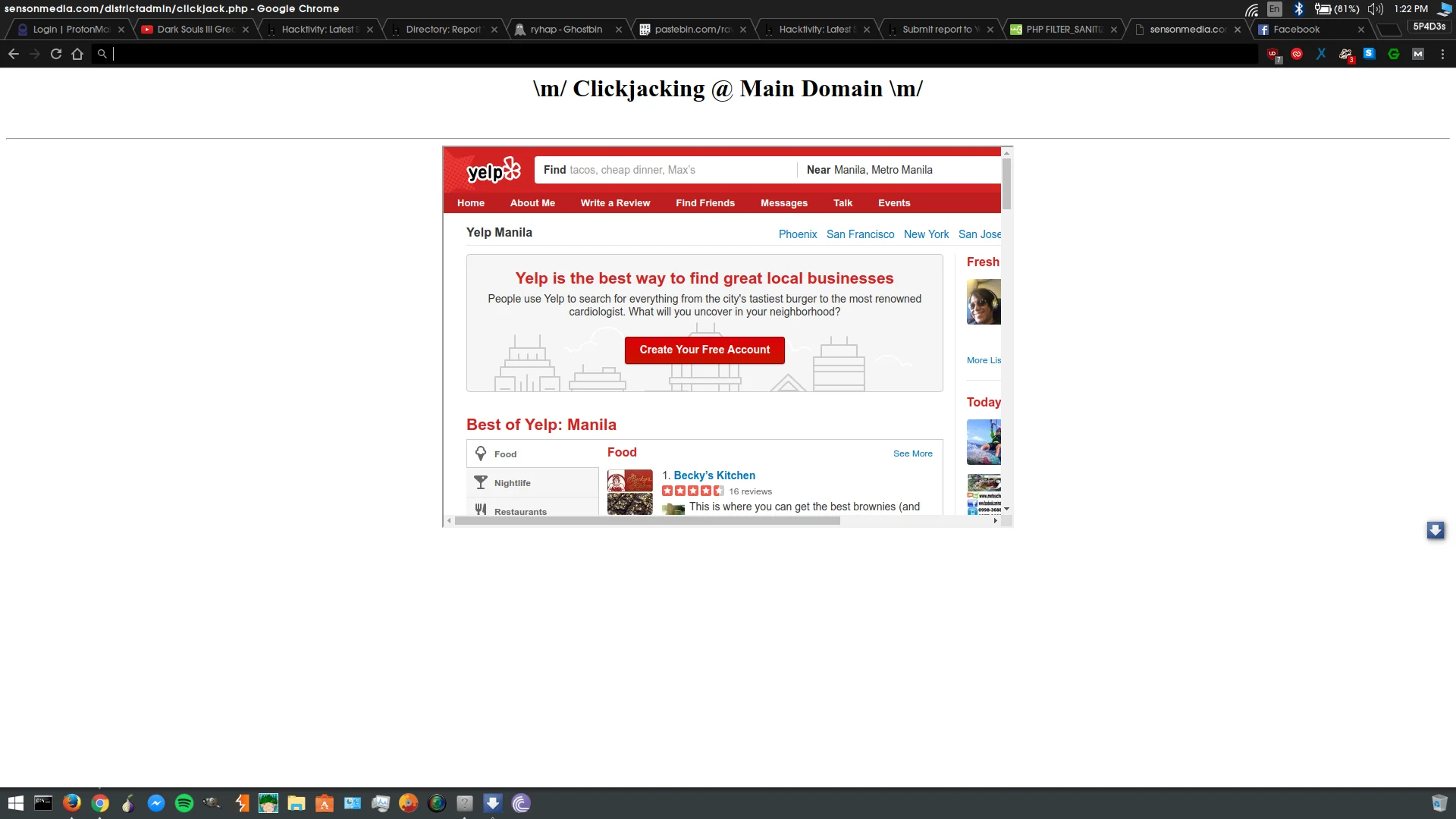
The main Yelp domain could be embedded in an iframe, allowing an attacker to overlay it with a decoy page and trick users into clicking buttons on the real site. The report provides only a screenshot as proof and does not demonstrate a specific sensitive action being triggered.

- Disclosed after 10 months
Hello Yelp Security Team,
I Just want to submit a report Clickjacking on your Main Domain, I Know that this is a Low Risk But may i know if your aware of it.
PoC: See Atachments.
Impact:
For example, imagine an attacker who builds a web site that has a button on it that says "click here for a free iPod". However, on top of that web page, the attacker has loaded an iframe with your mail account, and lined up exactly the "delete all messages" button directly on top of the "free iPod" button. The victim tries to click on the "free iPod" button but instead actually clicked on the invisible "delete all messages" button. In essence, the attacker has "hijacked" the user's click, hence the name "Clickjacking".
One of the most notorious examples of Clickjacking was an attack against the Adobe Flash plugin settings page. By loading this page into an invisible iframe, an attacker could trick a user into altering the security settings of Flash, giving permission for any Flash animation to utilize the computer's microphone and camera.
Clickjacking also made the news in the form of a Twitter worm. This clickjacking attack convinced users to click on a button which caused them to re-tweet the location of the malicious page, and propagated massively.
There have also been clickjacking attacks abusing Facebook's "Like" functionality. Attackers can trick logged-in Facebook users to arbitrarily like fan pages, links, groups, etc.
Request: if you think the reported issues have acceptable risk and you are not going to make changes then kindly request to mark as Informative or let me close it.
Attachments
Not written yet. The AI write-up for this report has not been written yet. The Original tab links to the source.
How it worked
Impact
An attacker could trick a logged-in user into clicking on Yelp interface elements, but the report does not show that any sensitive action can be performed this way.
What the attacker needed
Victim visits attacker's page
Explained by bugbounty.wiki with AI from the original and checked against quotes from it; it can still be wrong. Read the original before relying on a detail.
Not written yet. The AI write-up for this report has not been written yet. The Original tab links to the source.
Clickjacking is when a malicious site loads a real site in an invisible frame and places fake buttons on top, so your clicks go to the real site without you knowing. Here, the researcher says Yelp's main page can be framed, but they only show a screenshot and do not prove that a dangerous action (like deleting messages) can actually be triggered.
What is UI spoofing?
The interface lies to the user: a framed page catches their clicks, or a browser shows the wrong address or a fake prompt. Paid when it leads to a sensitive action or convincing phishing.


