Clickjacking: X-Frame Header Missing
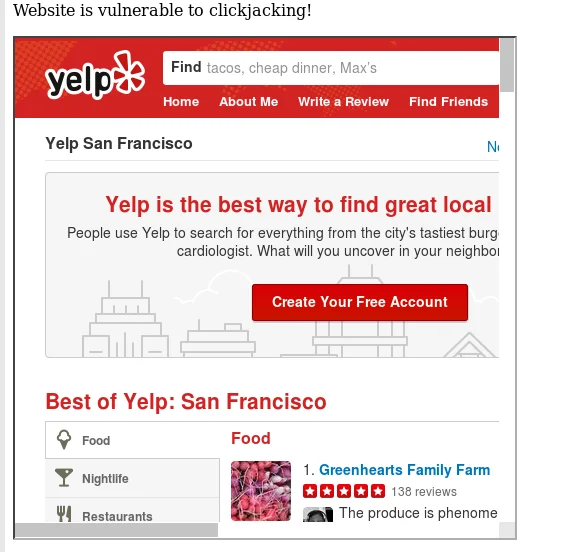
The report claims that a website can be embedded in an iframe because the X-Frame-Options header is missing, which would allow a clickjacking attack. An attacker could trick a user into clicking on something different from what the user perceives, potentially revealing confidential information or taking control of their computer.

- Disclosed after 14 months
Clickjacking (User Interface redress attack, UI redress attack, UI redressing) is a malicious technique of tricking a Web user into clicking on something different from what the user perceives they are clicking on, thus potentially revealing confidential information or taking control of their computer while clicking on seemingly innocuous web pages.
CODE:
<html> <head> <title>Clickjack test page</title> </head> <body> <p>Website is vulnerable to clickjacking!</p> <iframe src="http://yelp.com" width="500" height="500"></iframe> </body> </html>For More : https://www.owasp.org/index.php/Testing_for_Clickjacking_(OWASP-CS-004)
Proof attatched !
Attachments
Not written yet. The AI write-up for this report has not been written yet. The Original tab links to the source.
How it worked
Impact
An attacker could trick a user into clicking on something different from what the user perceives, potentially revealing confidential information or taking control of their computer.
What the attacker needed
Victim visits attacker page; target page can be framed
Explained by bugbounty.wiki with AI from the original and checked against quotes from it; it can still be wrong. Read the original before relying on a detail.
Not written yet. The AI write-up for this report has not been written yet. The Original tab links to the source.
Clickjacking tricks you into clicking something different from what you perceive. This report shows the site can be loaded in a frame, suggesting it lacks framing protection. A user might be tricked into clicking something harmful.
What is UI spoofing?
The interface lies to the user: a framed page catches their clicks, or a browser shows the wrong address or a fake prompt. Paid when it leads to a sensitive action or convincing phishing.


