No CSRF protection when creating new community points actions, and related stored XSS
The community points action creation form lacked CSRF protection, and the stored action name and handle were not sanitised on output. An attacker could craft a malicious POST request to create a new action containing a script payload, which would execute when an administrator viewed the actions page.

- Fixed in 14 days
- Disclosed after 3 months
crayons
The functionality to create a new community points action does not have anti-CSRF protection, and the administrator page displaying actions for which a user can be awarded community points does not have XSS protection
An attacker could craft a malicious POST request to index.php/dashboard/users/points/actions/save, which can use the credentials of a logged-in administrator to create a new action for granting points. Further, the input to the upaName and upaHandle parameters are not sanitized when being stored. For example:
<form action="http://www.jmpalktest.com/concrete5742/index.php/dashboard/users/points/actions/save" method="post">

  <input type="hidden" name="upaID" value="" />
  <input type="hidden" name="upaIsActive" value="1" />
  <input type="hidden" name="upaHandle" value="<sVg/OnLOaD=prompt(1)>" />
  <input type="hidden" name="upaName" value="XSS the admin2" />
  <input type="hidden" name="upaDefaultPoints" value="1000" />
  <input type="hidden" name="gBadgeID" value="" />

  <button type="submit">Csrf your site here!</button>

</form>
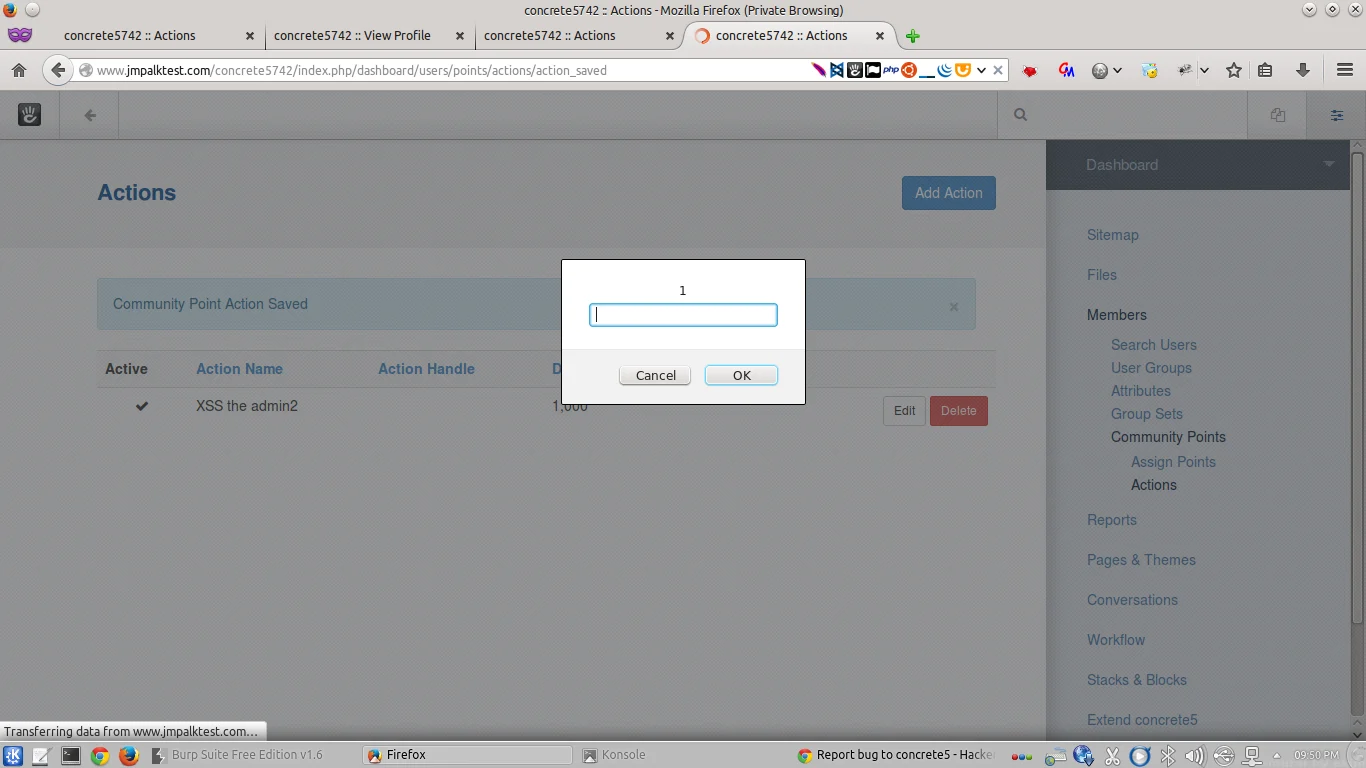
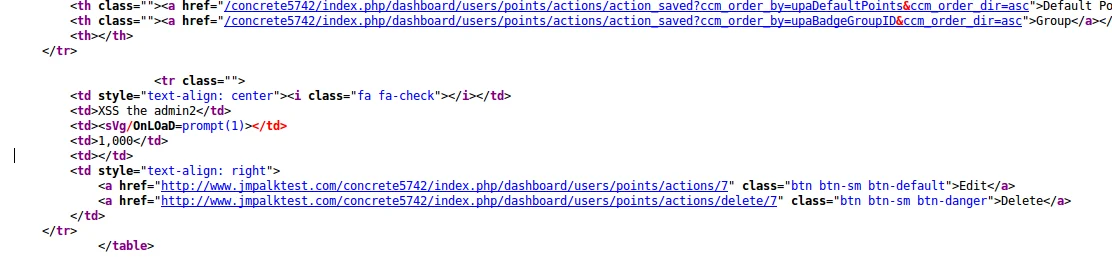
When the resultant data is displayed at on the Community Points page at index.php/dashboard/users/points/actions/action_saved, the stored malicious content in either upaHandle or upaName is not sanitized on output (see attached images), resulting in a stored XSS attack (with an administrator as the most likely victim), which could then be used to exploit other parts of the concrete5 control panel.
Attachments
Not written yet. The AI write-up for this report has not been written yet. The Original tab links to the source.
How it worked
Root cause
Likely the save endpoint lacked a CSRF token check, and the stored upaName and upaHandle values were output without HTML encoding.
Impact
An attacker could create a new points action and execute script in an administrator's browser, potentially exploiting other parts of the control panel.
What the attacker needed
Victim is a logged-in administrator; victim visits attacker-controlled page or link
How it was found
- Craft a malicious POST request to the save endpoint for community points actions.
- Include a script payload in the upaHandle or upaName parameter.
- Cause a logged-in administrator to submit the request, creating the action.
- When the administrator views the actions page, the stored payload executes.
Explained by bugbounty.wiki with AI from the original and checked against quotes from it; it can still be wrong. Read the original before relying on a detail.
Not written yet. The AI write-up for this report has not been written yet. The Original tab links to the source.
This report describes two linked security problems. First, a form that creates a 'community points action' could be submitted from another website without the administrator's knowledge, because it had no protection against cross-site request forgery (CSRF). Second, the values saved by that form were later shown on an admin page without being made safe, so a script hidden in those values would run in the administrator's browser (stored cross-site scripting, or XSS).
What is XSS?
Script an attacker supplies runs in another user's browser, on the target's origin, with that user's session.





