The Art of IDOR: 7 IDORs in Edm0d0
The report describes seven IDOR vulnerabilities in Edmodo that allowed an attacker to access and modify other users' data, including quiz files, badges, schedules, student accounts, library files, grades, and class names. The attacker could perform actions such as resetting a student's password or assigning grades to arbitrary students.
 Published on medium.com
Hi! Guys Hope so everyone is doing well and are safe staying at home as the world is fighting against this COVID-19 pandemic.
The full write-up lives on its author's site
It belongs to its author, so we link to it rather than copy it. The other two tabs are our own rewrites, checked against it.
Context
Edmodo is an education platform where teachers create classes (groups), set assignments, grade students, share files in a library, and manage schedules and badges. The researcher, Pratyush Anjan Sarangi, went hunting on Edmodo with one goal: find a single IDOR and earn the shaker goodies. He ended up with seven IDOR-class issues, three of which were closed as duplicates and four of which were rewarded.
The write-up covers seven separate findings across different features of the product: quiz files, badges, schedules, the invite-by-email module, the library, grading, and the student planner. Each one abuses an object identifier that the server accepts from the client without checking that the caller owns the object.
Setup
The researcher used Burp Suite to intercept and modify requests, and created several accounts to model the different roles:
- Sam Anjan, a Teacher account, with a group called Hacker and a badge of his own.
- Sam Victim, a second Teacher account, used as the victim for the schedule and library tests.
- Student_User, a Student account enrolled under a different class (the Sam Victim teacher created earlier), so it is not under Sam Anjan.
A student account was also used for the planner test. The invite-by-email issue is explicitly limited to the Student access level and cannot be used against anyone with Teacher access.
Finding it
The pattern across all seven bugs is the same: a numeric identifier that names an object (a quiz file, a badge, a user, a file, a library, a submission, a group) is sent by the client and trusted by the server. The researcher's habit was to look at the raw response in Burp's Response tab rather than the rendered browser output, because the API often returns sensitive data that the client-side filters out. He checked the raw response in Burp's Response tab rather than the rendered browser output, because the API often returns sensitive data that the client-side filters out.
Exploitation
1. Quiz files across accounts
An IDOR in the quiz file functionality allowed the researcher to access any quiz files from anyone's account, and also to save changes to their documents. The report describes this one as a simple IDOR and does not include the intercepted request; the video proof of concept is referenced but not reproduced here.
2. Assigning badges from anyone's account
With the Sam Anjan teacher account, the researcher created the group Hacker and a badge of his own. The add-badge function accepts a badge_id; changing it to a random numeric id reveals the badge information and assigns that badge to his group.
Burp interception:
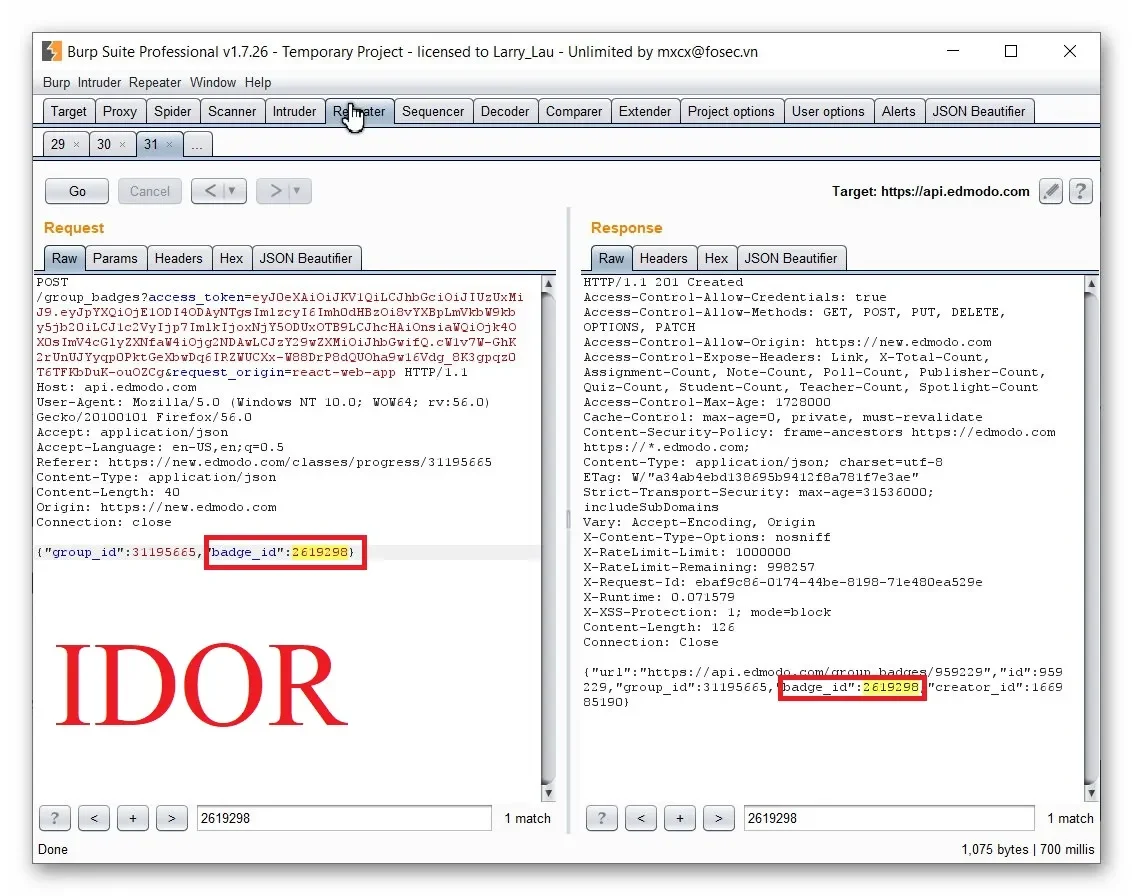
Image proof of concept, showing the badge details returned:
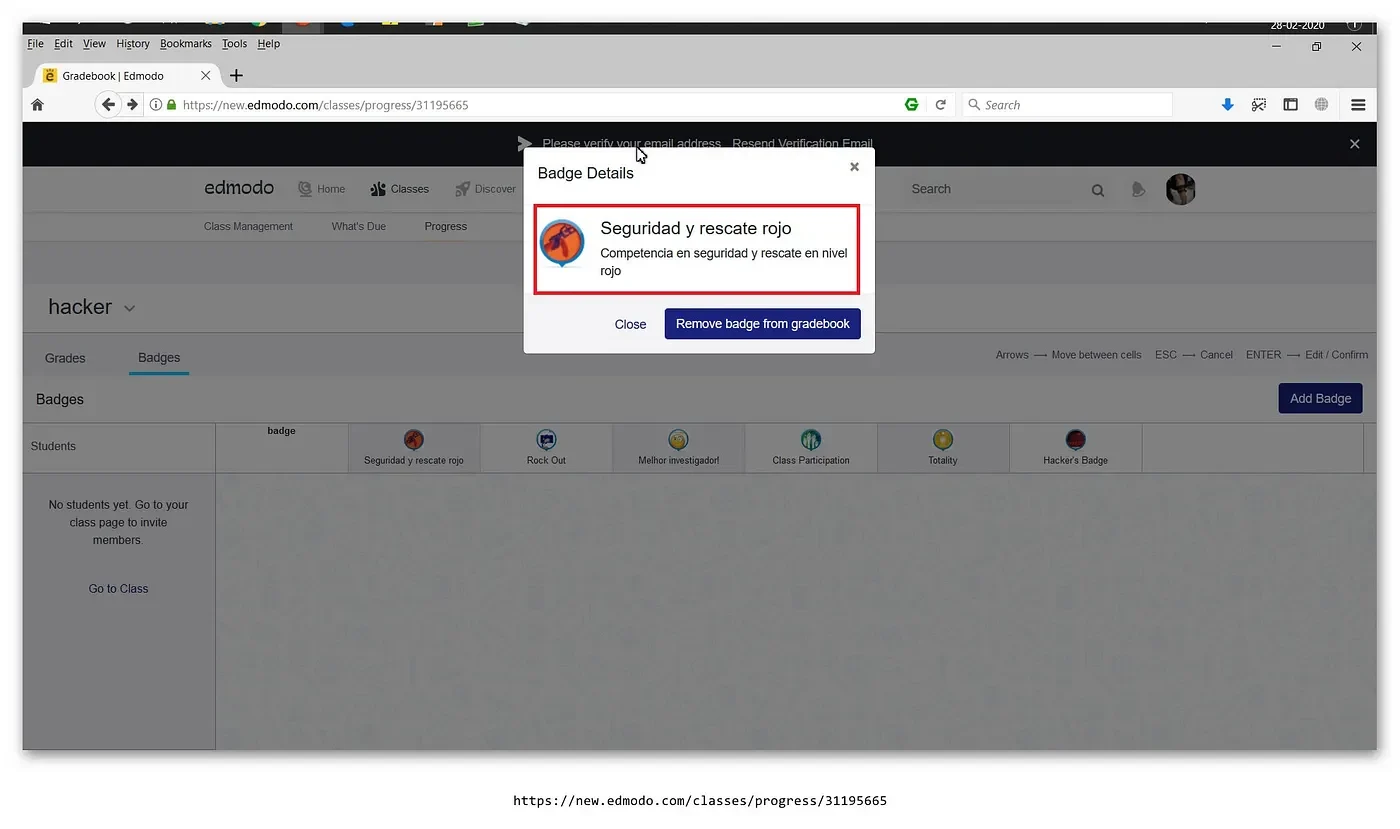
Badge_details
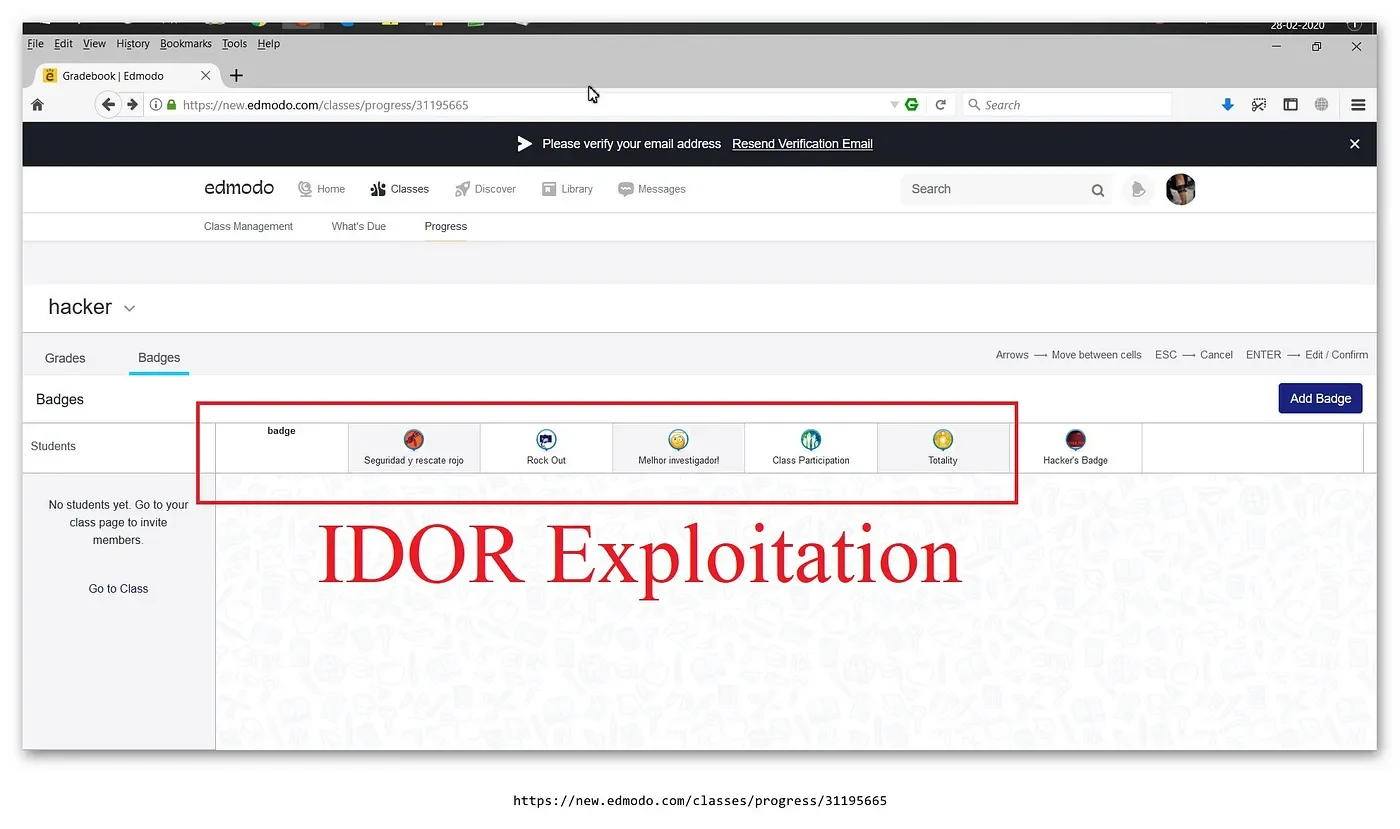
Badge_IDOR Exploitation
3. Adding schedules to anyone's account
Two teacher accounts were used, Sam Anjan and Sam Victim. The researcher added a schedule to Sam Anjan's account, then edited it and changed the user_id to Sam Victim's. Manipulating user_id to any random number lets him create new schedules for anyone on Edmodo. The report asks where the user_id can be found and shows the interception below.
Burp interception:
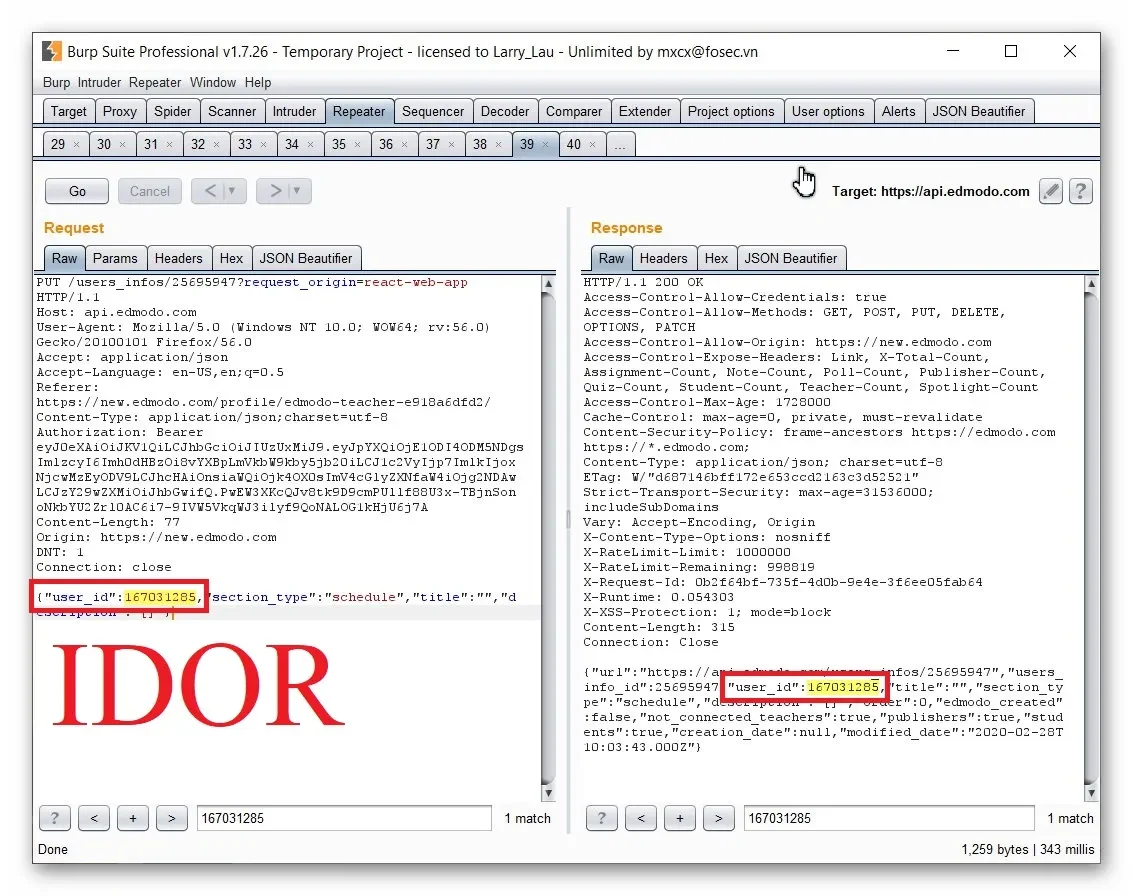
4. Inviting any student and taking over the account
In the invite-by-email functional module, the researcher could randomly add any student to his class and then reset their password and other details. This is limited to the Student access level; it cannot be used against anyone with Teacher access.
Burp interception:
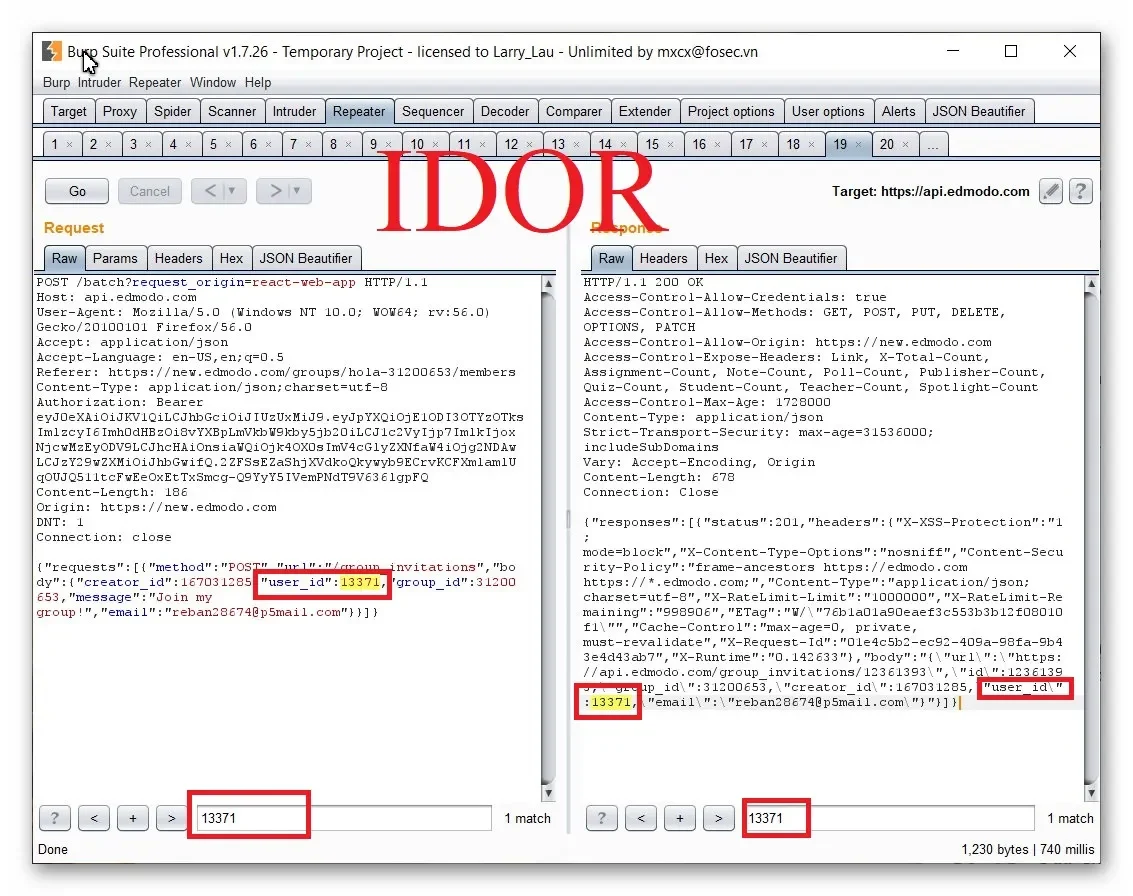
student_Account_takeover
Image proof of concept:
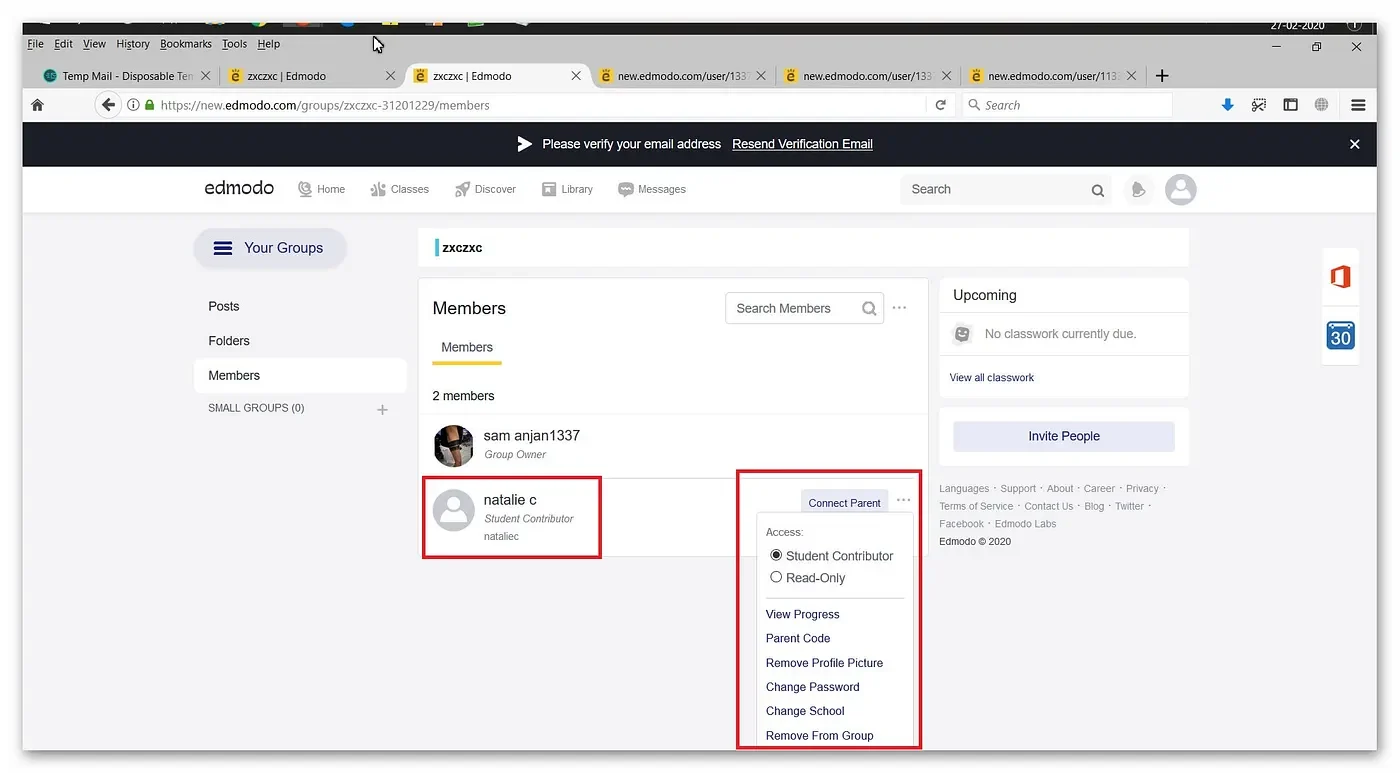
Student Acc Takeover scenario
5. Logical IDOR in the library
The library module has a logical flaw that behaves as an IDOR. Two teacher accounts were created, Sam Anjan and Sam Victim, and a few files were added to each account's library. If the file_id and library_id are supplied correctly, the files can be reached across accounts. The researcher confirms that the second teacher's account was not added as a co-account on the first.
Burp interception:
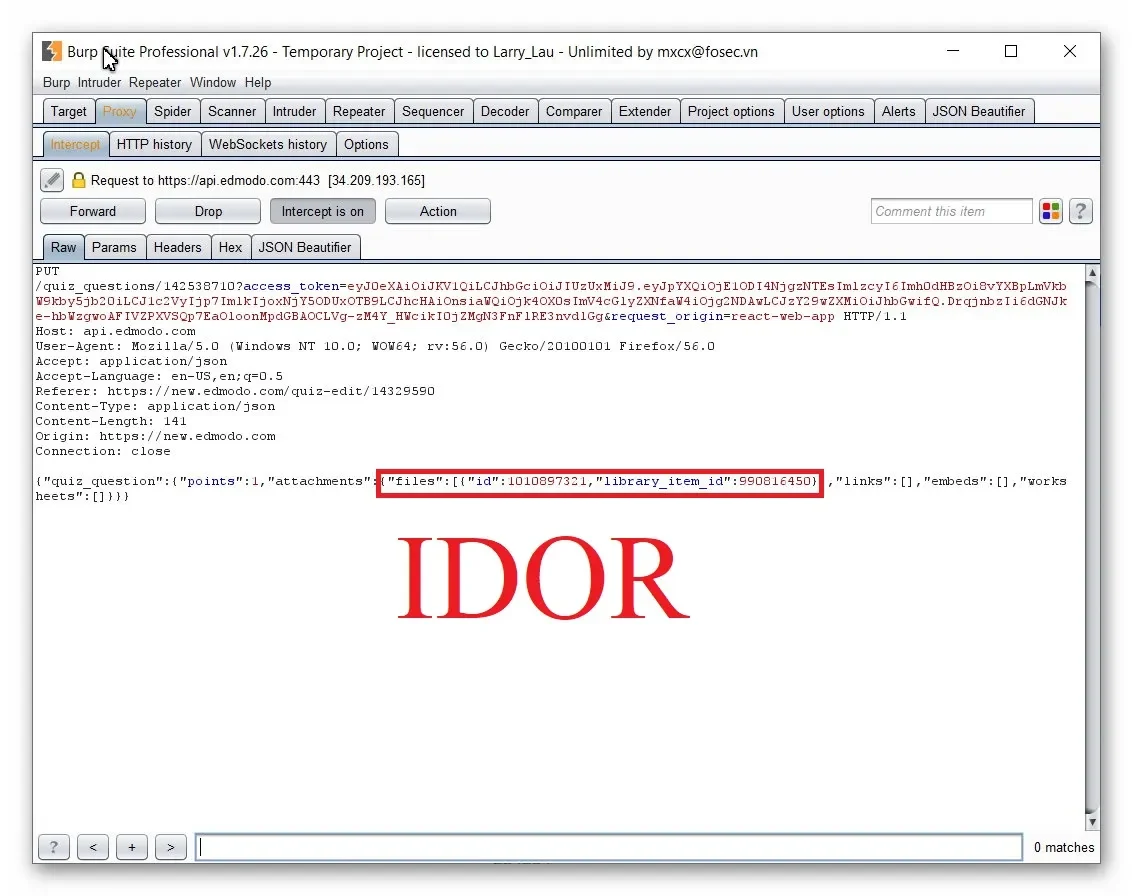
Logical_IDOR to exploit files in other accounts
Image proof of concept:
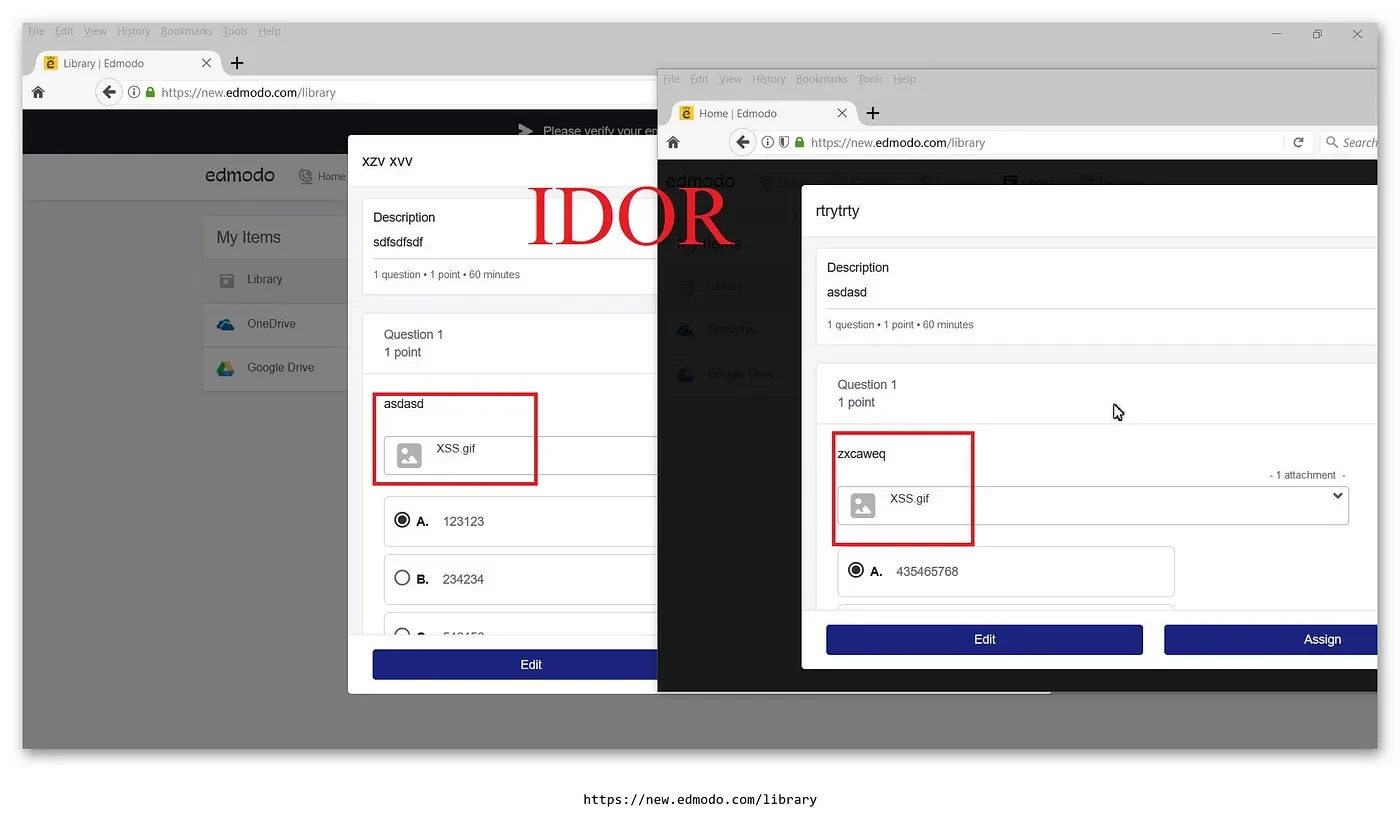
Logical_IDOR Exploitation
6. Grading any student
Sam Anjan (Teacher) and Student_User (Student) were used. Student_User is enrolled under a different class, the Sam Victim teacher created earlier, so the student is not under Sam Anjan. The researcher created an assignment for himself and could grade himself; changing the submitter_id lets him assign a grade to any random student or teacher.
To verify the impact, the targeted student received a notification, which confirms the grade was actually applied. The report calls this a good example of abusing the functionality.
Burp interception:
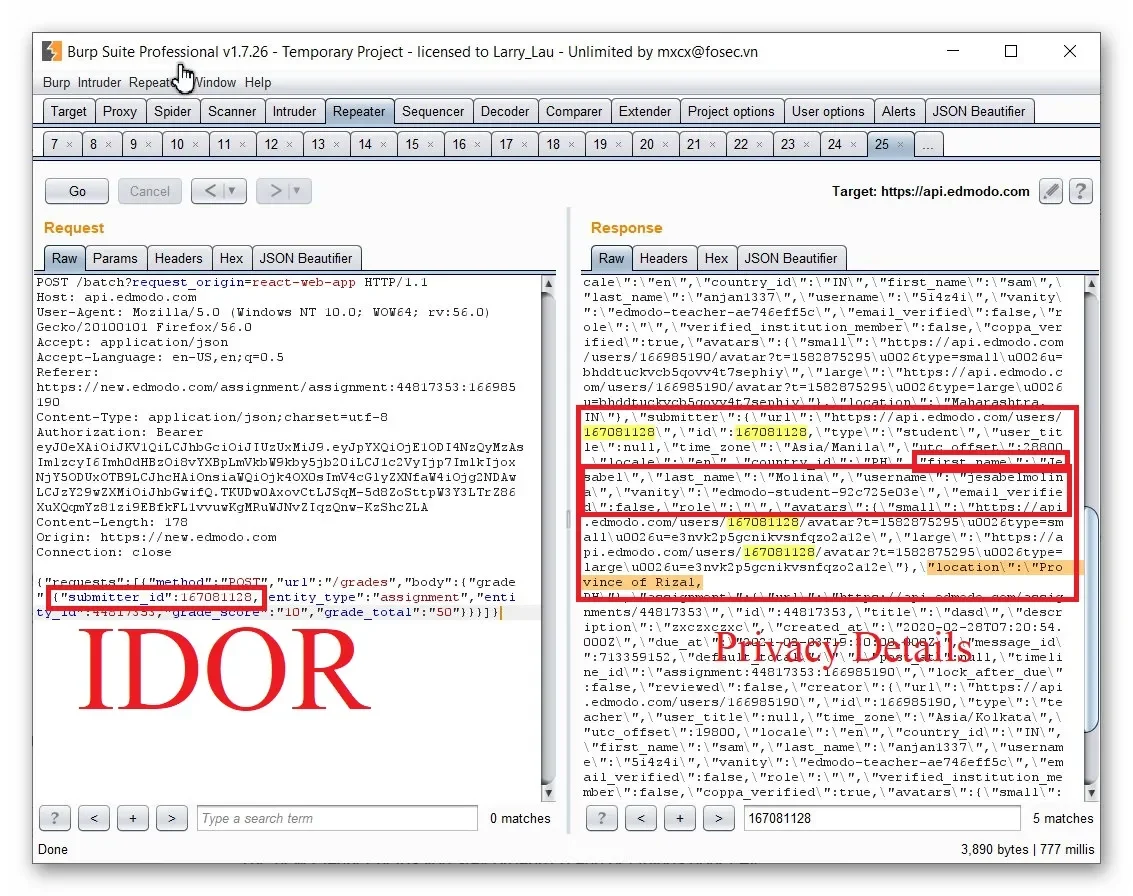
grade_idor to info disclosure
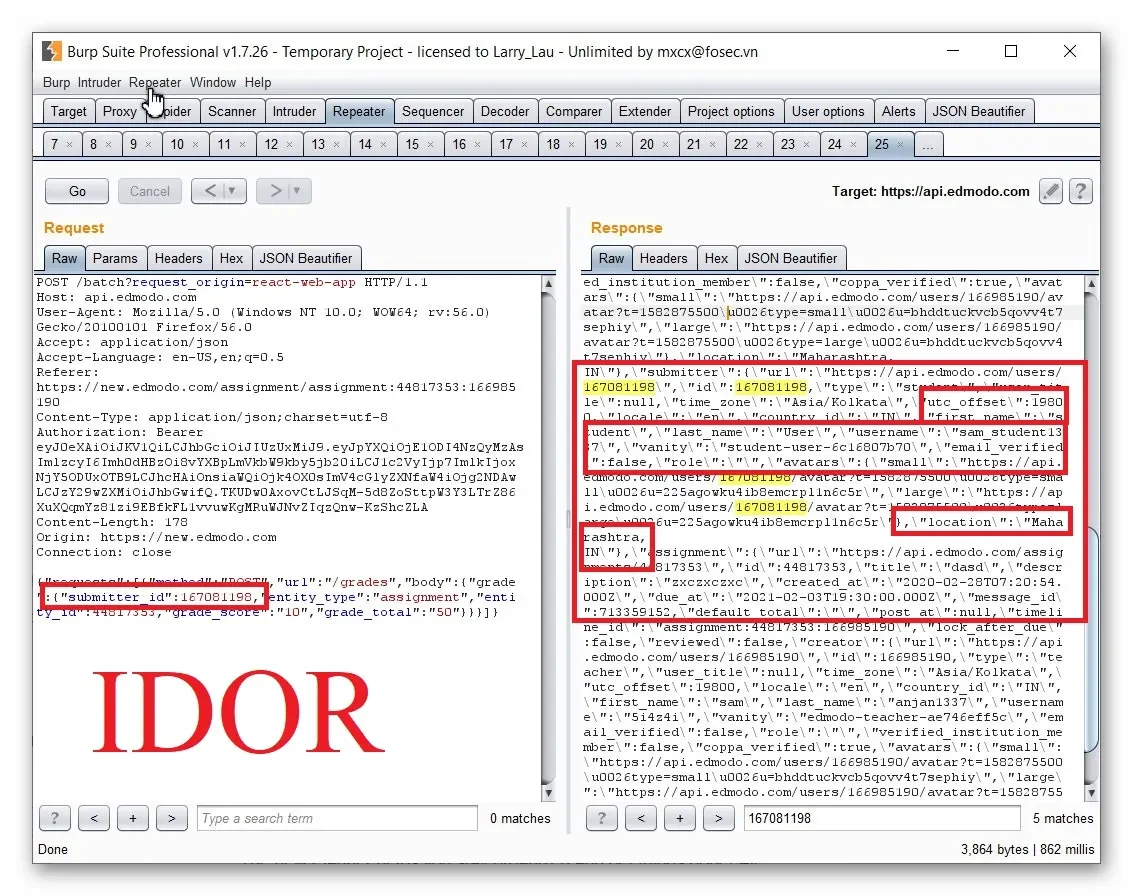
Image proof of concept:
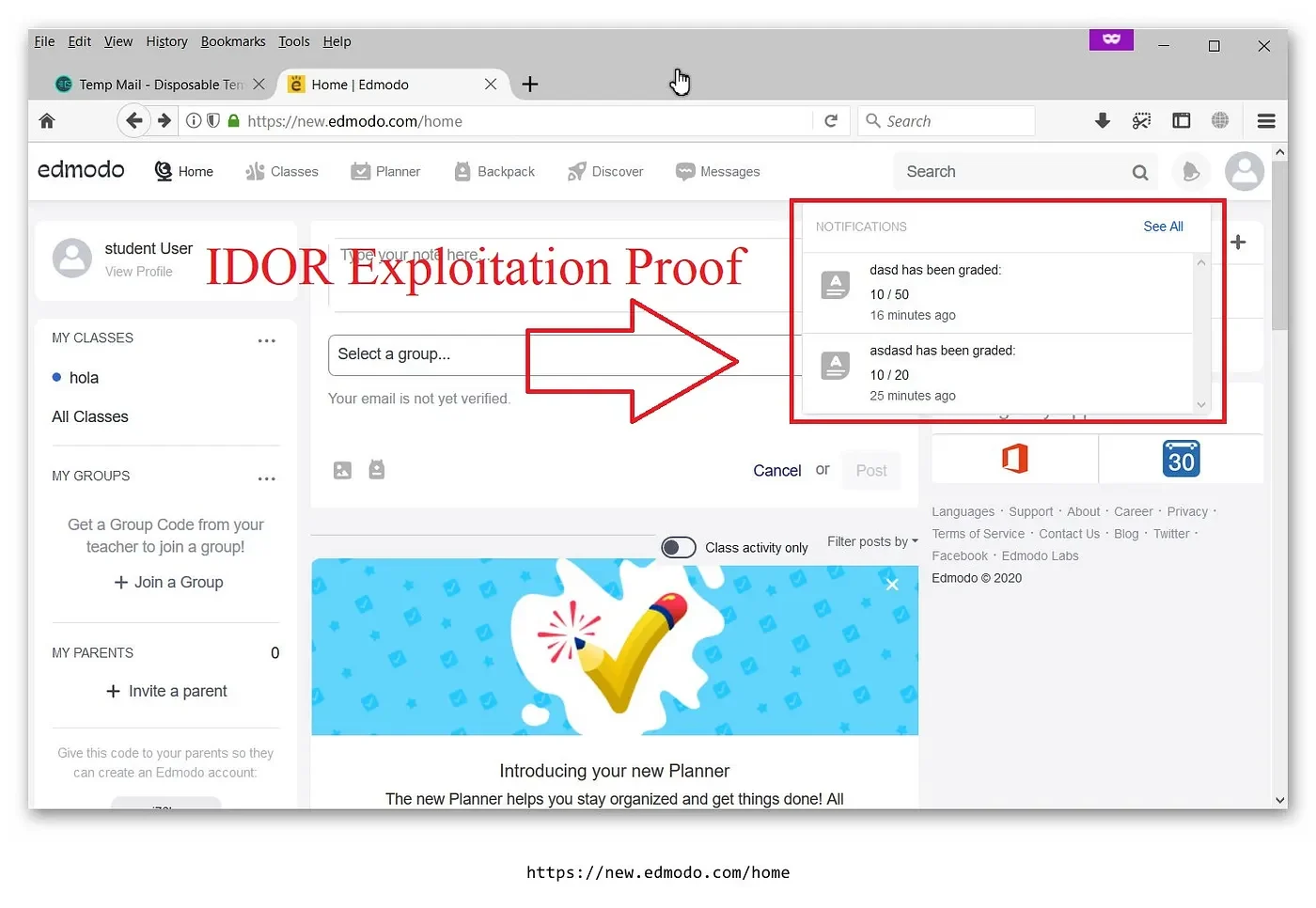
Grade_IDOR Exploitation
7. Enumerating and assigning classes through the student planner
With a student account, the researcher used the Student planner to create a New Task. While creating the task, changing the group_id assigns the task to, and shows the name of, other registered users' classes. This allows enumeration of class names and assignment to them.
Burp interception:
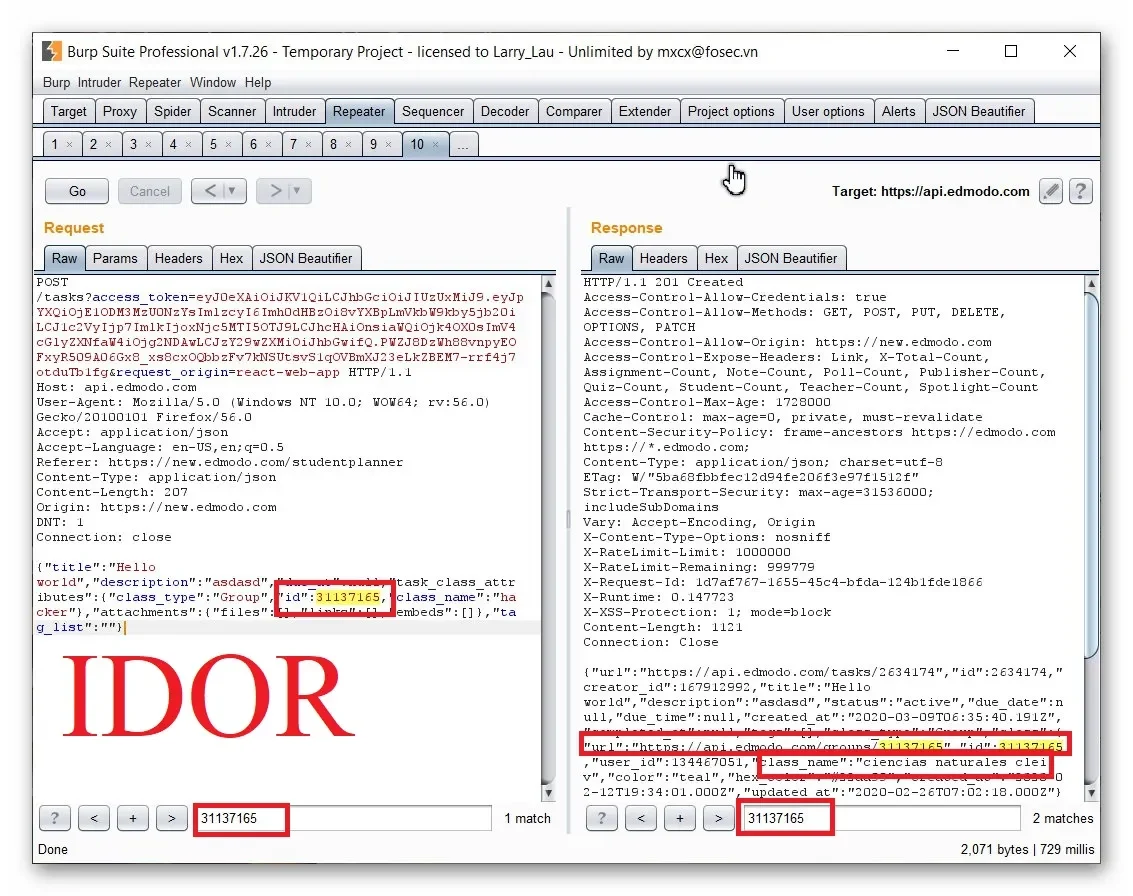
Student_planner IDOR
Image proof of concept:
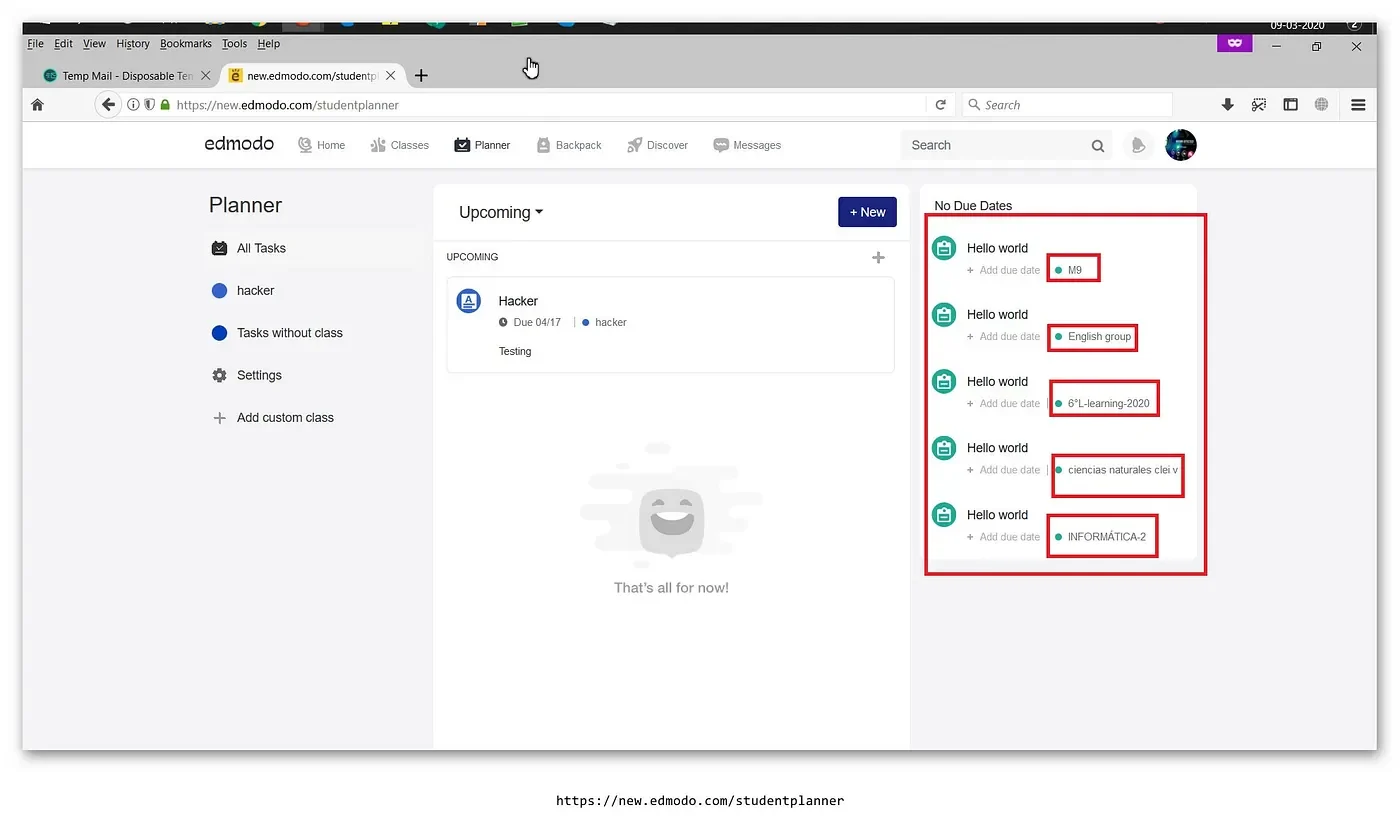
Student_planner Exploitation
Root cause
The server accepts object identifiers from the client and acts on them without verifying that the authenticated user owns or is authorised for the referenced object. In each case the identifier is a plain numeric value (badge_id, user_id, file_id and library_id, submitter_id, group_id), so guessing or incrementing it reaches other tenants' data. The library case is described as a logical flaw rather than a pure missing check, but the effect is the same: correct identifiers for another account's objects are honoured.
Impact
Depending on the feature, an authenticated user could:
- read and modify other users' quiz files;
- assign badges from other accounts to their own group;
- create schedules in anyone's account;
- add any student to a class and reset their password and details, limited to Student-level accounts;
- reach files in another teacher's library;
- assign grades to any student or teacher, with the student receiving a real notification;
- enumerate class names and assign tasks to other users' classes.
The account takeover path is the most severe, but it is explicitly restricted to Student access level and cannot touch Teacher accounts.
Fix
The report does not describe the fix that was applied. The change required is server-side authorisation on every object reference: check that the authenticated user owns or is permitted to act on the badge_id, user_id, file_id/library_id, submitter_id and group_id before returning data or applying the change, rather than trusting the identifier supplied by the client.
Timeline
| Date | Event |
|---|---|
| Feb. 20, 2020 | Initial report |
| Mar. 10, 2020 | Report triaged |
| Mar. 10, 2020 | Bug fixed and rewarded |
Three of the reports were closed as duplicates and four were rewarded.

Rewards from Edmodo for IDORs
Variants to test
- Numeric object identifiers in create/update calls. Change
badge_id,user_id,submitter_idorgroup_idto neighbouring values. A positive result is a response that returns another user's object details or applies the change to their account. - Paired identifiers in file modules. Supply a
file_idtogether with alibrary_idthat belongs to another account. A positive result is file content or metadata from the other account being returned. - Invite and password-reset flows. Try inviting a user outside your class and resetting their credentials. A positive result is a reset that succeeds for an account you do not control, within the role limits the product enforces.
- Raw response inspection. Compare the Burp Response tab with what the browser renders; APIs often return fields the UI hides. A positive result is sensitive data present in the raw body but absent from the page.
What happened, in plain words
Edmodo is a website that schools use. Teachers create classes (Edmodo calls them groups), give out assignments, put marks on students' work, keep a library of files, set schedules and hand out badges (little digital stickers that show an achievement). Every one of those things lives on Edmodo's servers, and the website asks the server for them using numbers: this file is number 1234, this badge is number 5678, this user is number 9012.
A researcher, Pratyush Anjan Sarangi, went looking for a single bug of a type called IDOR. He found seven of them, in seven different features. Three of his reports were closed as duplicates and four were rewarded.
An IDOR (Insecure Direct Object Reference) is easy to understand with an everyday comparison. Imagine a hotel where your room key is just the room number written on a card, and the door opens for anyone who writes a number on it. You booked room 214, but nothing stops you writing 215 on the card and walking into a stranger's room. The hotel trusted the number on the card instead of checking that the card belonged to the person holding it. On a website, the "room number" is an identifier such as user_id or file_id, and the "door" is the server handing back data or applying a change. If the server never checks that the thing you are asking for belongs to you, you can ask for someone else's.
To see and change those numbers while they travel between his browser and Edmodo's servers, the researcher used a tool called Burp Suite. Think of it as a removable glass panel in the pipe between your browser and the website: the request goes out, Burp holds it, you can read it, edit it, and then let it continue. Without such a tool you only see the finished web page; with it you see the raw conversation.
That raw conversation matters because of how modern websites work. A website like Edmodo is really two things: the pages you see, and an API behind them. An API is the waiter in a restaurant. Your browser (the customer) does not walk into the kitchen; it tells the waiter what it wants, the waiter goes to the kitchen (the server) and brings back a plate (the data). The plate often contains more than the waiter puts on your table: the browser may hide fields before showing them to you, but the raw response from the kitchen still contains them. The researcher's habit was to read the raw response in Burp's Response tab instead of trusting the rendered page, and He read the raw response in Burp's Response tab instead of trusting the rendered page.
He also needed several accounts to play both sides: the attacker and the victim. He created:
- Sam Anjan, a Teacher account, with a group called Hacker and a badge of his own.
- Sam Victim, a second Teacher account, used as the victim for the schedule and library tests.
- Student_User, a Student account enrolled under a different class (the Sam Victim teacher created earlier), so it is not under Sam Anjan.
A student account was also used for the planner test. The invite-by-email issue is explicitly limited to the Student access level and cannot be used against anyone with Teacher access.
Across all seven bugs the pattern is identical: a number that names an object (a quiz file, a badge, a user, a file, a library, a submission, a group) is sent by the browser and trusted by the server. The server never asks "does this person own this object?" before answering.
The seven bugs, one by one
1. Quiz files across accounts
An IDOR in the quiz file functionality let the researcher open any quiz files from anyone's account, and also save changes to their documents. The report calls this a simple IDOR and does not include the intercepted request; the video proof of concept is referenced but not reproduced here.
Why this matters: a quiz file is a teacher's work. Reading it is a privacy leak; saving changes to it means an outsider can alter what students are given.
2. Assigning badges from anyone's account
With the Sam Anjan teacher account, the researcher created the group Hacker and a badge of his own. The add-badge function accepts a badge_id. A parameter is simply one of the labelled values the browser sends along with a request, like the fields on a form. badge_id is the number that says which badge to add. Changing it to a random numeric id reveals the badge information and assigns that badge to his group.
Why this step: he first used his own badge so he could see a normal, working request and learn exactly where the number sits. Then he replaced his number with someone else's. Changing it to a random numeric id revealed the badge information and assigned that badge to his group.
Burp interception:
Image proof of concept, showing the badge details returned:
Badge_details
Badge_IDOR Exploitation
3. Adding schedules to anyone's account
Two teacher accounts were used, Sam Anjan and Sam Victim. The researcher added a schedule to Sam Anjan's account, then edited it and changed the user_id to Sam Victim's. user_id is the number that identifies a person's account. Manipulating it to any random number lets him create new schedules for anyone on Edmodo.
Why this step: editing his own schedule gave him a legitimate request containing his own user_id. Swapping in the victim's number let him create schedules for anyone on Edmodo. The report notes that the user_id has to be found first, and points to the interception below as the place it appears.
Burp interception:
4. Inviting any student and taking over the account
In the invite-by-email functional module, the researcher could randomly add any student to his class and then reset their password and other details. This is limited to the Student access level; it cannot be used against anyone with Teacher access.
Why this is the most serious one: a password reset means the real owner can be locked out while someone else signs in as them. Account takeover is the name for exactly that. The role limit is important: the issue is limited to Student access level and cannot exploit anyone with Teacher access.
Burp interception:
student_Account_takeover
Image proof of concept:
Student Acc Takeover scenario
5. Logical IDOR in the library
The library module has a logical flaw that behaves as an IDOR. Two teacher accounts were created, Sam Anjan and Sam Victim, and a few files were added to each account's library. If the file_id and library_id are supplied correctly, the files can be reached across accounts. file_id names one file; library_id names the shelf it sits on. The researcher confirms that the second teacher's account was not added as a co-account on the first, so there was no legitimate sharing route.
Why "logical": the report describes it as an IDOR caused by a logical flaw in the library module. It is like a storage unit that asks for the unit number and the padlock number, and accepts any matching pair without asking whether you rent that unit.
Burp interception:
Logical_IDOR to exploit files in other accounts
Image proof of concept:
Logical_IDOR Exploitation
6. Grading any student
Sam Anjan (Teacher) and Student_User (Student) were used. Student_User is enrolled under a different class, the Sam Victim teacher created earlier, so the student is not under Sam Anjan. The researcher created an assignment for himself and could grade himself; changing the submitter_id lets him assign a grade to any random student or teacher. submitter_id is the number of the person whose work is being marked.
Why this step: grading his own submission produced a normal request. Replacing his own number with someone else's let him assign a grade to any random student or teacher.
To verify the impact, the targeted student received a notification, which confirms the grade was actually applied and not merely displayed. The report calls this a good example of abusing the functionality: the feature worked as designed, it was simply pointed at the wrong person.
Burp interception:
grade_idor to info disclosure
Image proof of concept:
Grade_IDOR Exploitation
7. Enumerating and assigning classes through the student planner
With a student account, the researcher used the Student planner to create a New Task. While creating the task, changing the group_id assigns the task to, and shows the name of, other registered users' classes. group_id is the number that names a class. Enumeration means walking through numbers one after another to list things that were not meant to be listed: 1, 2, 3 and so on, collecting whatever names come back.
Why this step: the planner is meant to let a student organise their own work inside their own class. Changing the group_id assigned the task to, and showed the name of, other registered users' classes.
Burp interception:
Student_planner IDOR
Image proof of concept:
Student_planner Exploitation
Why it worked
The server accepts object identifiers from the browser and acts on them without verifying that the signed-in user owns or is authorised for the referenced object. In each case the identifier is a plain numeric value (badge_id, user_id, file_id and library_id, submitter_id, group_id), so guessing or incrementing it reaches other people's data. The library case is described as a logical flaw rather than a pure missing check, but the effect is the same: correct identifiers for another account's objects are honoured.
A session is the server's memory of "this browser is signed in as this person", usually carried by a cookie, which is a small piece of data the browser stores and sends back with every request. Assuming from the session that the person is allowed to touch whatever number they send is the mistake: the session proves who you are, not what you may open.
What an attacker could do
Depending on the feature, a signed-in user could:
- read and modify other users' quiz files;
- assign badges from other accounts to their own group;
- create schedules in anyone's account;
- add any student to a class and reset their password and details, limited to Student-level accounts;
- reach files in another teacher's library;
- assign grades to any student or teacher, with the student receiving a real notification;
- enumerate class names and assign tasks to other users' classes.
The account takeover path is the most severe, but it is explicitly restricted to Student access level and cannot touch Teacher accounts.
How to fix it
The report does not describe the fix that was applied. The change required is server-side authorisation on every object reference: check that the signed-in user owns or is permitted to act on the badge_id, user_id, file_id/library_id, submitter_id and group_id before returning data or applying the change, rather than trusting the identifier supplied by the browser. In hotel terms: the door must check the name on the booking, not just the number written on the card.
Timeline
| Date | Event |
|---|---|
| Feb. 20, 2020 | Initial report |
| Mar. 10, 2020 | Report triaged |
| Mar. 10, 2020 | Bug fixed and rewarded |
Three of the reports were closed as duplicates and four were rewarded.
Rewards from Edmodo for IDORs
Things worth trying yourself
- Numeric object identifiers in create and update calls. Change
badge_id,user_id,submitter_idorgroup_idto neighbouring values. A positive result is a response that returns another user's object details or applies the change to their account. - Paired identifiers in file modules. Supply a
file_idtogether with alibrary_idthat belongs to another account. A positive result is file content or metadata from the other account being returned. - Invite and password-reset flows. Try inviting a user outside your class and resetting their credentials. A positive result is a reset that succeeds for an account you do not control, within the role limits the product enforces.
- Raw response inspection. Compare the Burp Response tab with what the browser renders; APIs often return fields the interface hides. A positive result is sensitive data present in the raw body but absent from the page.
Glossary
- API: the part of a website that answers requests for data, separate from the pages you see; the waiter between your browser and the server.
- Authorisation: the check that a signed-in person is allowed to do a particular thing, as opposed to authentication, which is only about who they are.
- Badge: a small digital award on Edmodo that a teacher can give to a group.
- Burp Suite: a tool that sits between your browser and a website so you can read, pause and edit the requests and responses.
- Cookie: a small piece of data a website stores in your browser and receives back with each request, often used to keep you signed in.
- Duplicate: a bug report closed because the same issue had already been reported.
- Enumeration: walking through identifiers one after another (1, 2, 3) to list objects that were not meant to be listed.
- Group: Edmodo's word for a class.
- IDOR (Insecure Direct Object Reference): a bug where the server accepts an identifier from the browser and returns or changes an object without checking that the person owns it.
- Identifier: a number or string that names one specific object, such as a user, file or class.
- Library: the file storage area of an Edmodo account.
- Logical flaw: a bug where the checks exist but can be satisfied in a way the designer did not intend, rather than being absent entirely.
- Parameter: a labelled value sent along with a request, like a field on a form, for example
badge_idoruser_id. - Proof of concept (POC): evidence that a bug really works, such as a screenshot or video of the result.
- Request: the message your browser sends to a server asking for something or asking it to do something.
- Response: the message the server sends back, containing data or a confirmation.
- Session: the server's memory of which person a browser is signed in as.
- Severity: how damaging a bug is judged to be.
- Triaged: reviewed by the programme and confirmed as a real, valid report.
- Account takeover: a bug that lets one person sign in as another and control their account.
badge_id: the number naming a specific badge.file_id: the number naming a specific file.group_id: the number naming a specific class (group).library_id: the number naming a specific account's library.submitter_id: the number naming the person whose work is being graded.user_id: the number naming a specific user account.