A specially crafted Markdown file uploaded to a GitLab repository causes the server-side Markdown renderer to consume 100% CPU for over half a minute when viewed. Multiple simultaneous views can occupy all CPU cores, leading to denial of service.
NOTE! Thanks for submitting a report! Please replace all the (parenthesized) sections below with the pertinent details. Remember, the more detail you provide, the easier it is for us to triage and respond quickly, so be sure to take your time filling out the report!
Summary
I really appreciate the help fom GitLab security group in verifying the existence of the bug.
An attacker prepares the attack by uploading a special Markdown file to a repository in a deployed GitLab server or GitLab.com. When any user tries to view the Markdown file in the browser, the server-side can consume 100% CPU usage for more than half a minute in the particular CPU core that handles the job. When multiple such Markdown file views happen simultaneously, all CPU cores can be occupied, which finally leads to DoS.
Steps to reproduce
Known vulnerable attack surfaces. 1) Self-deployed GitLab server instance, version 13.7.3 (on Linux Debian 9); and 2) GitLab.com. Probably there exist many other vulnerable cases I haven't tested.
2 The attacker is privileged to edit a repository that belongs to the victim server. The attacker uploads special Markdown files. Multiple users (can also be attackers) try to visit and view the page at the same time, CPU cores can be all occupied. No user authentication is needed if the repository is set as publicly accessible.
To reproduce
A special Markdown file is uploaded to the victim GitLab server. For example, the 600000.md in https://gitlab.com/ppnuts/PoC
The user shall observe a loading shape on the screen without actually get the rendered content. Check screenshot below. loading.pngFrom the original on GitLab.
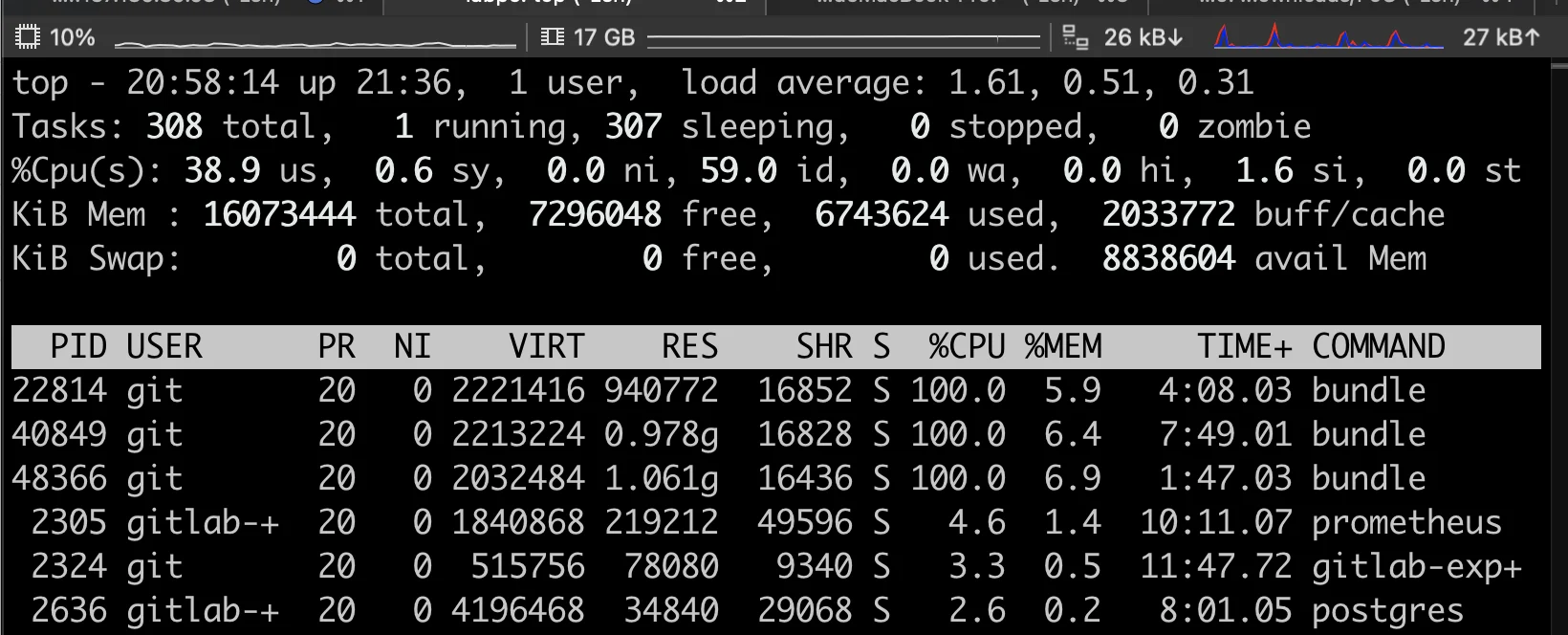
However, at this moment, the CPU on the server-side is 100% consumed. For example, when I do a top on the server-side, I can observe the process takes 100% CPU usage. Check screenshot below.
If multiple users view the Markdown file simultaneously, all CPU cores can be occupied. Or simply just several browser instances.
After a long time, the client-side might show Error loading viewer. Check screenshot below. error.pngFrom the original on GitLab.
And the server-side CPU is then released.
Impact
If all CPU cores are occupied, other resources become unavailable.
Client-side cannot load/render the Markdown file on time; Server-side CPU is over-consumed. The whole services can be down if all CPU cores are occupied.
What is the expected correct behavior?
The Markdown file shall be rendered correctly on time.
Relevant logs and/or screenshots
See above.
Output of checks
This bug happens on GitLab.com
Results of GitLab environment info
Installed using apt-get. Host environment:
$uname -a
Linux labpc 4.9.0-11-amd64 #1 SMP Debian 4.9.189-3+deb9u2 (2019-11-11) x86_64 GNU/Linux
System information
System:		Debian 9.13
Current User:	git
Using RVM:	no
Ruby Version:	2.7.2p137
Gem Version:	3.1.4
Bundler Version:2.1.4
Rake Version:	13.0.1
Redis Version:	5.0.9
Git Version:	2.29.0
Sidekiq Version:5.2.9
Go Version:	unknown

GitLab information
Version:	13.7.3
Revision:	1ef3b81f122
Directory:	/opt/gitlab/embedded/service/gitlab-rails
DB Adapter:	PostgreSQL
DB Version:	12.4
URL:		http://137.189.89.174
HTTP Clone URL:	http://137.189.89.174/some-group/some-project.git
SSH Clone URL:	[email protected]:some-group/some-project.git
Using LDAP:	no
Using Omniauth:	yes
Omniauth Providers:

GitLab Shell
Version:	13.14.0
Repository storage paths:
- default: 	/var/opt/gitlab/git-data/repositories
GitLab Shell path:		/opt/gitlab/embedded/service/gitlab-shell
Git:		/opt/gitlab/embedded/bin/git
Impact
Turn down the GitLab server, and make all services unavailable, i.e., DoS.
Attachments
Warning: Attachments received through HackerOne, please exercise caution!
The original report as published on GitLab. Images and videos are our own copies; raw HTML is shown as text. View it on GitLab.
Not written yet. The AI write-up for this report has not been written yet. The Original tab links to the source.
Generating the AI write-up for this report.
This usually takes about 50 seconds. You can read the original meanwhile; this page updates itself.
Writing the technical write-up
Writing the version for beginners
Checking every passage against the original
How it worked
Root cause
Likely the Markdown parser has a performance flaw that allows a crafted input to cause excessive CPU consumption.
Impact
If all CPU cores are occupied, other resources become unavailable, potentially taking down the entire GitLab service.
What the attacker needed
Attacker can edit a repository; victim views the Markdown file; multiple simultaneous views for full DoS
How it was found
Upload a special Markdown file to a repository on the victim GitLab server.
A user views the Markdown file by clicking on its name.
The user sees a loading indicator while the server-side CPU is fully consumed.
Multiple simultaneous views can occupy all CPU cores.
After a long time, the client may show an error and the CPU is released.
Explained by bugbounty.wiki with AI from the original and checked against quotes from it; it can still be wrong. Read the original before relying on a detail.
Not written yet. The AI write-up for this report has not been written yet. The Original tab links to the source.
Generating the AI write-up for this report.
This usually takes about 50 seconds. You can read the original meanwhile; this page updates itself.
Writing the technical write-up
Writing the version for beginners
Checking every passage against the original
A Markdown file is a simple text file used for formatting documents. GitLab converts these files to HTML on its servers when someone views them. The attacker uploads a file that is designed to make this conversion take a very long time, using up the server's processing power. If enough people view such files at once, the server can become too busy to respond to anyone.
What is DoS?
A request that exhausts resources or crashes a component. Many programs forbid testing it; reports usually show it from code, not by attacking.