Dependecy Confusion via Lookup Request Forwarding to PyPi.org
GitLab's PyPI package registry forwards requests for unknown packages to pypi.org, and its suggested install command uses --extra-index-url, so an attacker could register a malicious package on PyPI with the same name as an internal dependency and achieve remote code execution when a victim installs it.
usd-responsible-disclosure Follow
 Originally disclosed on HackerOne
- Disclosed after 3 months
Summary
pip is probably the most popular Python package manager and can be used to install packages from the publicly available Python Package Index (PyPi) at pypi.org or form internal package repositories. In the beginning of 2021, a vulnerability type called Dependency Confusion attracted some attention in the information security scene. Several high profiled companies were identified to accidentally load internal dependencies from the public available index at PyPi. This could have allowed any PyPi user to register packages with the accidentally requested names and to achieve remote code execution on the affected systems.
The underlying reason for the vulnerability was the usage of the --extra-index-url parameter when installing packages
via pip. This parameter adds additional packages sources where pip checks for the desired installation candidate. That
being said, the publicly available index at PyPi remains within the sources and will be used if the requested version
of the desired package can be found. In case of no version was specified, pip installs the most recent version it finds
among all configured repositories.
After the Dependency Confusion got publicly known, the general recommendation was to use --index-url instead of
--extra-index-url, which replaces pypi.org as the default package registry. GitLab, however, still advises it's
users to use --extra-index-url within the web overview of a projects package registry. Therefore, users that are not
aware of Dependency Confusion, might accidentally install internal GitLab packages from the publicly available index
at PyPi.
Moreover, with version 14.2, GitLab made even usage of --index-url not fail save. According to the
documentation:
In GitLab 14.2 and later, when a PyPI package is not found in the Package Registry, the request is forwarded to pypi.org.
This configuration can lead to dangerous side effects when installing internal packages with other internal dependencies
or when using --index-url with another internal URL in the --extra-index-url parameter. GitLab defines package registries on
the project and group level. If package dependecies cross these project or group boundaries, dependecy confusion is possible.
Steps to reproduce
First, we create a simple python project usd-example-package and make it available over the projects package
registry within GitLab. Viewing the webpage of the newly created package, it shows the following installation command:
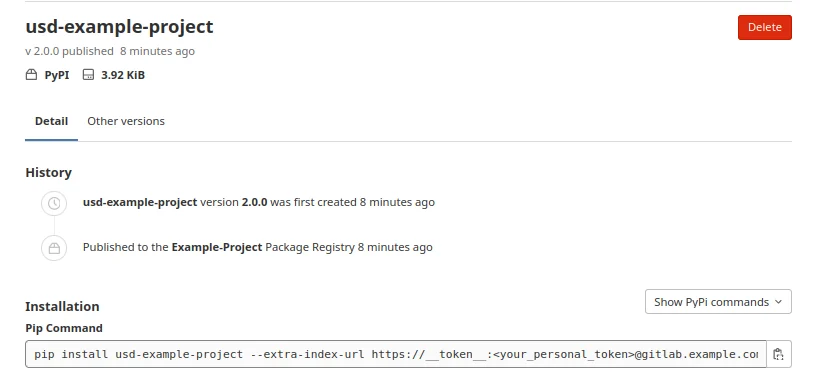
As one can see, the suggested install command uses the --extra-index-url by default, which makes it vulnerable to
dependency confusion.
Now lets go one step further. Within our example package, we add an internal dependency usd-example-dependecy. This
dependency is contained within another project and we add --extra-index-url to include this within the repository sources.
The installation command now looks like this:
$ pip install usd-example-project --index-url https://gitlab.example.com/api/v4/projects/10/packages/pypi/simple --extra-index-url https://gitlab.example.com/api/v4/projects/11/packages/pypi/simple
Since --index-url was used, pypi.org should not be considered when searching for packages and the installation command
should be safe, right? Well, after launching the command, pip first loads usd-example-project from the URL specified
as --index-url:
GET /api/v4/projects/10/packages/pypi/simple/usd-example-dependecy/ HTTP/1.1
Host: gitlab.example.com
Afterwards, the --extra-index-url is checked as described above, but since it belongs to our internal
trusted GitLab instance, this should be fine:
GET /api/v4/projects/11/packages/pypi/simple/usd-example-project/ HTTP/1.1
Host: gitlab.example.com
However, since usd-example-package is only distributed within the project
with ID 10, the registry for project ID 11 will not find the requested package and forward the request to PyPi:
HTTP/1.1 302 Found
Location: https://pypi.org/simple/usd-example-project/
Now, although we used --index-url, we are again vulnerable to dependency confusion.
Fix
The reported issue should be fixed by making the following adjustments:
- The insecure installation command suggested by the repository webpages should be replaced. Instead of
--extra-index-url, the--index-urlcommand line option should be chosen. - Forwarding of requests for unknown packages to pypi.org should be disabled by default. This setting can have dangerous side effects and should not be enabled by default. Administrators that understand the consequences could still enable the feature for their instance.
We are aware that automatic forwarding of unknown packages to PyPi increases the usability of internal package registries quite a lot. Installation of internal tools and dependencies usually also requires installation of packages that are available on PyPi. Restricting the index to an internal repository makes automatic installation of these external dependencies fail, which creates some additional installation effort. That being said, the accidental installation of potentially malicious software from a public package registry represents a high security risk for organisations and should be classified as more important as usability.
Another possible solution would be to only allow forwarding requests to PyPi for packages that are not available within the whole internal GitLab instance.
References
- https://medium.com/@alex.birsan/dependency-confusion-4a5d60fec610
- https://docs.gitlab.com/ee/user/packages/pypi_repository/
- https://docs.gitlab.com/ee/user/admin_area/settings/continuous_integration.html#pypi-forwarding
Credits
This security vulnerability was identified by Tobias Neitzel of usd AG.
Impact
Dependency Confusion can lead to remote code execution (RCE) on systems that use the insecure installation command. This usually affects developer machines or GitLab runners, but also endusers can be affected.
Not written yet. The AI write-up for this report has not been written yet. The Original tab links to the source.
How it worked
Root cause
Likely the combination of GitLab's default --extra-index-url install command and its automatic forwarding of unknown package requests to pypi.org, which lets a public package shadow an internal one.
Impact
Dependency confusion could lead to remote code execution on developer machines, GitLab runners, and potentially end users who install the affected packages.
What the attacker needed
GitLab instance with PyPI forwarding enabled; Victim uses the suggested install command; Attacker can publish to pypi.org
The fix
GitLab should change its suggested install command to use --index-url and disable forwarding of unknown packages to pypi.org by default, though the text does not state that this was fixed.
How it was found
- Create a Python project and publish it to a GitLab project package registry.
- Note that the web page suggests an install command using --extra-index-url.
- Add an internal dependency from another project and use --index-url for the first project and --extra-index-url for the second.
- Run the pip install command; pip requests the dependency from the first project's registry.
- The second project's registry does not find the package and responds with a redirect to pypi.org.
- Because the request is forwarded, pip can fetch a public package with the same name, enabling dependency confusion.
Explained by bugbounty.wiki with AI from the original and checked against quotes from it; it can still be wrong. Read the original before relying on a detail.
Not written yet. The AI write-up for this report has not been written yet. The Original tab links to the source.
When you install a Python package, pip can be told to look in more than one place. If an internal package is missing from your private registry, GitLab quietly asks the public PyPI instead, and anyone can upload a package with that name there. Your computer then downloads and runs the attacker's code.
What is Misconfiguration?
Settings left unsafe: exposed panels, open storage buckets, debug modes, default credentials.