Uncontrolled Resource Consumption in any Markdown field using Mermaid
The 5000-character limit on Mermaid code blocks could be bypassed by splitting a large payload into many blocks, causing the browser to freeze or crash when rendering the page. An attacker could make any page with Markdown and Mermaid unusable for all users.

- Triaged in 5 days
- Fixed in 55 days
- Paid in 55 days
- Disclosed after 4 months
Summary
I found a bypass for the mitigation of DoS via Mermaid (CVE-2019-9220). As the mitigation for CVE-2019-9220, the input limit of 5000 characters is currently applied to a Mermaid code block, but it can be bypassed by simply splitting the longer payload to many code blocks.
Steps to reproduce
- Sign in to GitLab.
- Open any page where you can input Markdown text using Mermaid into the form.
- Copy and paste the contents of the attached file ("payload-5Kchars-x-100blocks.txt") to the input form.
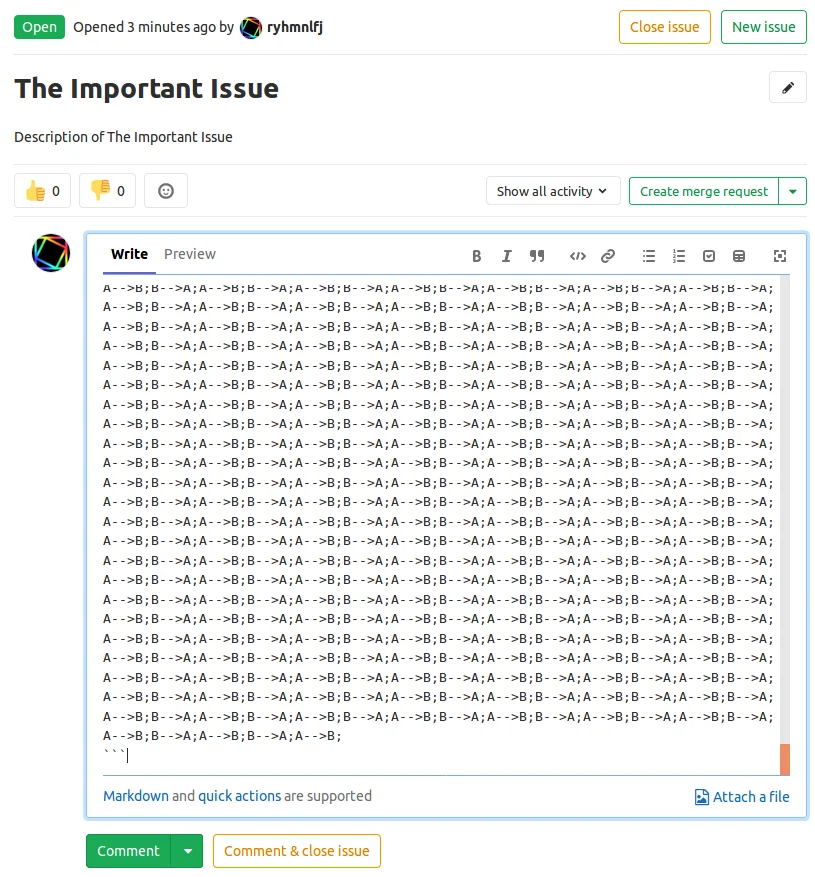
- Save the Markdown text on the page you opened. (For example, click "Comment" on "Issue" page. Please see "Example_on_Issue_page_Firefox.png")
- Wait a few seconds for many Mermaid graphs to begin rendering.
What is the current bug behavior?
When rendering of the Mermaid graphs starts, the browser tab displaying the page freezes. This behavior prevents browsing and editing the page that have been added the Mermaid graphs. Also, the resources used by the browser tab will increase as rendering continues. In the worst case, the entire browser also freezes or crashes.
What is the expected correct behavior?
We need a mechanism to stop rendering in advance by detecting if the user's input contains a large number of Mermaid code blocks.
Relevant logs and/or screenshots
- "payload-5Kchars-x-100blocks.txt" : This text contains 100 sets of Mermaid code blocks. Each code block contains approximately 5000 characters.
- "Example_on_Issue_page_Firefox.png" : Screenshot when pasting the payload on "Issue" page.
Output of checks
This bug happens on the official Docker installation of GitLab Enterprise Edition 12.1.4-ee.
The browsers used for testing are Firefox 68 and Chromium 76 on Ubuntu.
Results of GitLab environment info
Output of sudo gitlab-rake gitlab:env:info:
System information
System:
Proxy:		no
Current User:	git
Using RVM:	no
Ruby Version:	2.6.3p62
Gem Version:	2.7.9
Bundler Version:1.17.3
Rake Version:	12.3.2
Redis Version:	3.2.12
Git Version:	2.21.0
Sidekiq Version:5.2.7
Go Version:	unknown

GitLab information
Version:	12.1.4-ee
Revision:	4ea82400e72
Directory:	/opt/gitlab/embedded/service/gitlab-rails
DB Adapter:	PostgreSQL
DB Version:	10.7
URL:		http://gitlab.example.com
HTTP Clone URL:	http://gitlab.example.com/some-group/some-project.git
SSH Clone URL:	[email protected]:some-group/some-project.git
Elasticsearch:	no
Geo:		no
Using LDAP:	no
Using Omniauth:	yes
Omniauth Providers:

GitLab Shell
Version:	9.3.0
Repository storage paths:
- default: 	/var/opt/gitlab/git-data/repositories
GitLab Shell path:		/opt/gitlab/embedded/service/gitlab-shell
Git:		/opt/gitlab/embedded/bin/git
Impact
This vulnerability is effective not only on Issue pages but also on all pages using Markdown with Mermaid.
The following impacts exist on the attacked page:
- All users can not view the attacked page. (In some situations, the users may see incomplete rendering of the attacked page, but the user's viewing is still significantly blocked.)
- All users can not take any action on the attacked page.
- Depending on the user's environment, crashing or freezing the entire browser may cause user data being edited to be lost.
These impacts are almost the same as CVE-2019-9220. These are more malicious than other issues that can be handled with 500 errors.
Not written yet. The AI write-up for this report has not been written yet. The Original tab links to the source.
How it worked
Impact
The browser tab freezes, preventing users from viewing or interacting with the page, and in the worst case the entire browser may freeze or crash, potentially causing loss of unsaved data.
What the attacker needed
Ability to post Markdown with Mermaid; Victim views the page
The fix
A mechanism should be added to detect and stop rendering when the input contains a large number of Mermaid code blocks.
How it was found
- Sign in to GitLab.
- Open any page where you can input Markdown text using Mermaid into the form.
- Copy and paste the contents of the attached file to the input form.
- Save the Markdown text on the page you opened.
- Wait a few seconds for many Mermaid graphs to begin rendering.
Explained by bugbounty.wiki with AI from the original and checked against quotes from it; it can still be wrong. Read the original before relying on a detail.
Not written yet. The AI write-up for this report has not been written yet. The Original tab links to the source.
Mermaid is a tool that turns text into diagrams. GitLab limited each diagram's text to 5000 characters to prevent slowdowns, but an attacker could paste many diagrams at once, overwhelming the browser so the page freezes. This is a denial-of-service attack: it doesn't steal data but stops people from using the page.
What is DoS?
A request that exhausts resources or crashes a component. Many programs forbid testing it; reports usually show it from code, not by attacking.



