Comment Goes From Page Profile Instead of Personal Profile
A flaw in Facebook's Android app caused comments made by a user's personal profile to be posted as their page profile instead. This could reveal the link between a personal account and a page, deanonymising the user.
 Published on whoisaasis.medium.com
Facebook Bug Bounty
The full write-up lives on its author's site
It belongs to its author, so we link to it rather than copy it. The other two tabs are our own rewrites, checked against it.
Context
Facebook's Android app lets a single account hold both a personal profile and one or more Pages, and lets the user act as either identity. The control that switches between them, which the report calls the voice selector, decides which identity a post or comment is attributed to. The bug described here is an identity mix-up in that selector: a comment written while acting as the personal profile was published under the Page instead.
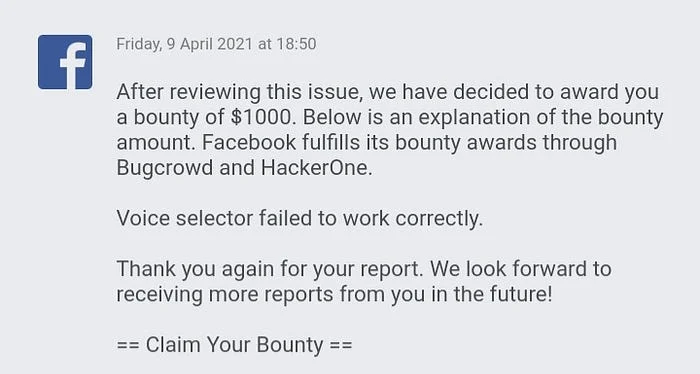
The researcher filed it under the title COMMENT GOES FROM PAGE PROFILE INSTEAD OF PERSONAL PROFILE, with vulnerability type Identification / Deanonymization and product area Facebook, Android. It was accepted by the Meta (Facebook) bug bounty programme and paid $1,000.
Setup
The report defines three actors and one precondition:
- UserOne: the personal profile.
- PageOne: a Page owned by UserOne.
- GroupOne: a group that both UserOne and PageOne belong to.
- Environment: Facebook for Android, with UserOne logged in and both identities present in the same group.
No special tooling is mentioned; the reproduction is done entirely through normal app use.
Finding it
The researcher came to bug hunting through page administration rather than through security work. He had been an admin of a Facebook page called Nepal Educational Hub since 24 March 2020, and had run into errors while managing it without realising they could be reported. After learning about bug bounties he submitted his first report on 24 November 2020, which was closed as a duplicate, as were several more before this one.
The observation behind this report is simple: while commenting through a personal profile linked to a Page, the comment was attributed to the Page. The two identities are meant to be distinct, and the selector exists to keep them apart. The report files this under Identification / Deanonymization and states the impact as interaction occurring through the page profile instead of the personal profile.
Exploitation
Step 1: sign in as the personal profile
- Log in to Facebook as UserOne.
- Post in GroupOne, interacting as UserOne.
At this point the post in the group belongs to the personal profile, and UserOne is a member of GroupOne while PageOne is also a member.
Step 2: let other users comment
Random users comment on that post. This produces notifications addressed to UserOne of the form:
Someone commented on your post in GroupOne
Step 3: reply from the notification
When UserOne clicks that notification and writes a reply, the comment is published through PageOne's profile rather than UserOne's. The report adds that commenting randomly on the post, outside the notification flow, also goes through PageOne.
There is no request, payload or command in the report: the whole reproduction is UI-level, and the only artefact shown is the notification text above. The result in both paths is the same: a comment intended to come from the personal profile is attributed to the Page.
Root cause
The report describes the fault as a breakdown in the interaction between personal and Page profiles: the voice selector, the tool used to switch between posting as yourself or as a Page, failed to function correctly while commenting through a personal profile linked to a Page. The system did not keep the two identities separate when resolving which one should author the comment.
The report does not describe the underlying code, so the precise mechanism is not known. The report does not describe the underlying code, so this remains an inference.
Impact
The impact as stated is that interaction occurs through the page profile instead of the personal profile. In practice a comment the user believes is personal is published under a Page they own, in a group where both identities are members. The report does not go beyond this: it does not claim that other users' identities can be impersonated, that the Page can be made to act without the owner, or that any data beyond the comment's authorship is exposed.
Fix
The timeline lists the fix on 24 March 2021 and confirmation of the fix the same day.
Timeline
| Event | Date |
|---|---|
| Initial report | 18 December 2020 |
| Reproduced | 22 December 2020 |
| Triaged | 23 December 2020 |
| Fixed | 24 March 2021 |
| Confirmation of fix | 24 March 2021 |
| Rewarded | 9 April 2021 |
Variants to test
- Other entry points into the composer. Open the comment box from a notification, from the group feed, and from a direct link to the post, with a Page linked to the account. A positive result is a comment authored by the Page when the personal profile was active.
- Other actions with the same selector. Try replies to comments, mentions, and posts in groups where both identities are members. A positive result is any action attributed to the wrong identity.
- Switching identity mid-flow. Change the voice selector after opening the composer but before submitting. A positive result is the submission ignoring the last selection.
- Accounts with several Pages. Repeat with more than one Page linked to the profile. A positive result is attribution to a Page other than the one selected, which would show the selector state is not tied to the chosen Page.
- Platform parity. Run the same steps on other clients of the same product. A positive result is the same misattribution where the fix has not reached that client.
What happened, in plain words
Facebook lets one account hold two kinds of identity at once. There is your personal profile, the one with your own name and photo, and there are Pages, which are like public profiles for a business, a school club or a community project. A single login can own both, and the app gives you a small control, which this report calls the voice selector, to choose which identity you are speaking as before you post or comment.
The bug in this report is that the selector got it wrong. In the report's scenario, a user comments in a group while acting as their personal profile, but the comment appears under their Page instead. The report states the impact as interaction occurring through the page profile instead of the personal profile. The report calls this kind of issue identification / deanonymization, which simply means the link between an action and the real person behind it is wrong or revealed.
The researcher is Aashish Kunwar from Dhangadhi, Nepal, a Grade 11 student at the time. He found the bug on the Facebook for Android app, reported it to Meta's bug bounty programme, and was paid $1,000. A bug bounty programme is a scheme where a company pays people outside the company for reporting security mistakes responsibly instead of exploiting them.
How he got into bug hunting
He did not start as a security researcher. During the first wave of the pandemic he began using a smartphone and met Saurav Subedi on Facebook. On 24 March 2020 (Chaitra 11, 2076) he was invited to become an admin of a Facebook page called Nepal Educational Hub. With schools closed, the page became a place to share notes and solutions under the motto "Help and Be Helped".
While managing that page he kept running into errors, but did not know they could be reported. He learned about bug bounties from Saugat Pokharel. His first report, on 24 November 2020, was marked as a duplicate, meaning someone else had already reported the same issue. Several more duplicates followed before he found this one.
The report he submitted
He filed it with these details:
- Title: COMMENT GOES FROM PAGE PROFILE INSTEAD OF PERSONAL PROFILE.
- Vulnerability type: Identification / Deanonymization.
- Product area: Facebook, Android.
The setup
The report uses three made-up actors so the steps are easy to follow:
| Name | What it is |
|---|---|
| UserOne | the personal profile |
| PageOne | a Page owned by UserOne |
| GroupOne | a group that both UserOne and PageOne belong to |
A group on Facebook is a shared space where members post and comment, separate from a personal timeline. The important precondition is that both identities, the person and the Page, are members of the same group. No special tools are used: everything happens through normal use of the Android app.
The steps, and why each one matters
- Log in to Facebook as UserOne. This puts the app in the state of the personal profile, which is the identity that should be doing the commenting.
- Post in GroupOne, interacting as UserOne. This creates a post owned by the personal profile. It also sets up the situation where other people will reply, which is what produces the notification used later.
- Random users comment on that post. Their comments generate a notification for UserOne. The report gives its wording exactly:
Someone commented on your post in GroupOne
This line is the text of the notification the app shows. The next step depends on it: UserOne clicks this notification to open the comment box.
- Reply from the notification. When UserOne clicks that notification and writes a reply, the comment is published through PageOne's profile instead of UserOne's. The report adds that commenting randomly on the post, without going through the notification, also goes through PageOne.
There are no requests, URLs or payloads in this report. The whole reproduction is done by tapping through the app's screens, and the notification text above is the only artefact shown. Both paths end the same way: a comment meant to come from the person is credited to the Page.
Why it happens
The report describes the fault as a breakdown in how personal and Page profiles interact: the voice selector, the tool for switching between posting as yourself or as a Page, did not work correctly while commenting through a personal profile that is linked to a Page. The system failed to keep the two identities apart when deciding who should author the comment.
The report does not describe the code, so the precise mechanism is not known. The report does not describe the code, so this is only an inference.
What the impact is, and what it is not
The stated impact is that the interaction happens through the Page profile instead of the personal profile. A comment the user believes is personal is published under a Page they own, in a group where both identities are members.
The report goes no further. It does not claim that other people's identities can be impersonated, that a Page can be made to act without its owner, or that anything beyond the authorship of the comment is exposed.
The fix and the timeline
The timeline lists the fix on 24 March 2021 and confirmation of the fix the same day.
| Event | Date |
|---|---|
| Initial report | 18 December 2020 |
| Reproduced | 22 December 2020 |
| Triaged | 23 December 2020 |
| Fixed | 24 March 2021 |
| Confirmation of fix | 24 March 2021 |
| Rewarded | 9 April 2021 |
Triaged means the security team looked at the report, confirmed it was a real issue and passed it on to the engineers who fix it.
Other places worth testing
If you want to look for similar mistakes, these are the variations the technical version suggests. Each one changes a single thing and checks whether the identity still comes out wrong.
- Other ways into the comment box. Open it from a notification, from the group feed, and from a direct link to the post, with a Page linked to the account. A positive result is a comment authored by the Page when the personal profile was active.
- Other actions that use the same selector. Try replies to comments, mentions, and posts in groups where both identities are members. A positive result is any action credited to the wrong identity.
- Switching identity mid-flow. Change the voice selector after opening the comment box but before sending. A positive result is the send ignoring the last choice.
- Accounts with several Pages. Repeat with more than one Page linked to the profile. A positive result is attribution to a Page other than the one selected, which would show the selector state is not tied to the chosen Page.
- Other clients. Run the same steps on other apps or versions of the same product. A positive result is the same misattribution where the fix has not reached that client.
Glossary
- Bug bounty programme: a scheme where a company pays outside researchers for reporting security problems responsibly.
- Bounty: the money paid for an accepted report; here $1,000.
- Duplicate: a report of an issue that has already been reported by someone else, so it is closed without a reward.
- Triaged: reviewed and confirmed as a real issue by the security team, then passed to the engineers.
- Personal profile: the identity tied to a person's own name and account.
- Page: a public profile for a business, organisation or community, which an account can own and act as.
- Group: a shared space on Facebook where members post and comment.
- Voice selector: the control that chooses whether you are acting as your personal profile or as a Page.
- Identification / deanonymization: a class of bug where the link between an action and the real identity behind it is wrong or revealed.
- Impact: what an attacker or a bug can actually affect; here, the authorship of a comment.
- Root cause: the underlying reason a bug happens, as opposed to its visible symptom.
- Reproduction (repro): the exact steps that make a bug happen again.
- Notification: an alert inside the app telling you something happened, such as someone commenting on your post.
- Client: the app or program a person uses to reach a service, such as Facebook for Android.




