Admin ,Editor can disclose personnel email of other editor, admin on page(who created shop)
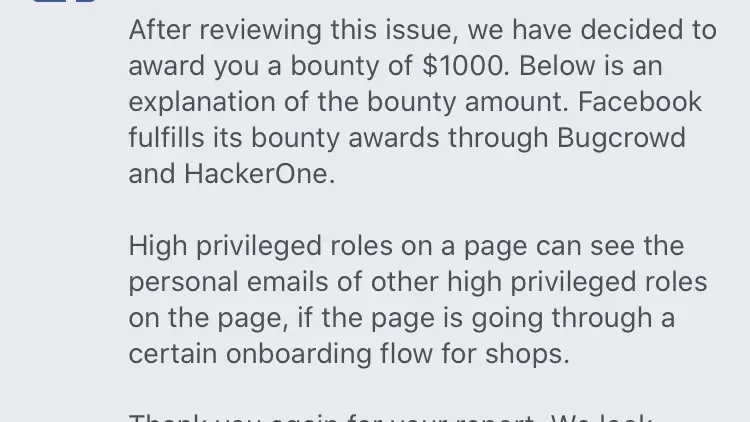
An editor on a Facebook page could retrieve the personal email address of the admin who created the shop by requesting a specific field through the Graph API. This exposed private contact information to a lower-privileged user.
The 3 Day Account Takeover Follow
 Published on medium.com
Admin ,Editor can disclose personnel email of other editor, admin on page(who created shop)
The full write-up lives on its author's site
It belongs to its author, so we link to it rather than copy it. The other two tabs are our own rewrites, checked against it.
What the report shows
The target is a Facebook Page feature: the commerce merchant settings attached to a Page, specifically the store that a Page admin creates. The researcher found that an Editor on the same Page could read the personal email address of the person who created the store, even though that person was an Admin.
The setup is two accounts on one Page:
- userA is an Admin on page1 and creates a shop on that Page.
- userB is an Editor on page1.
With a whitelisted access token belonging to userB, the researcher could retrieve userA's personal email by requesting the Page's commerce merchant settings:
GET /page1_id?fields=commerce_merchant_settings&access_token=accesstoken_userB
The image appears next to the report's title.
The report attributes the leak to the contact_email field being present in the response. Facebook's fix was to remove that field from the response.
The timeline given is:
| Date | Event |
|---|---|
| May 03, 2020 | Report sent |
| May 28, 2020 | Acknowledged by Facebook |
| July 08, 2020 | Fixed by Facebook |
| July 16, 2020 | 1000 USD bounty awarded |
No severity rating or weakness classification is given in the report.
Root cause
Impact
The impact is disclosure of a personal email address: the person who created the store, an Admin, has their email exposed to an Editor on the same Page. The report frames it exactly that way, as disclosure of the store creator's personal email. It does not claim account takeover, further privilege escalation or access to other fields, and nothing in the text supports those claims. The practical risk is that a lower-privileged collaborator on a Page learns the private contact address of a higher-privileged one.
How this kind of bug works
This is a broken object-level or field-level authorisation issue in an API that returns structured objects. Graph-style APIs let a client ask for a named set of fields on an object, and the server decides, per field, whether the caller may see it. Bugs appear when that decision is made once for the object rather than per field, or when a field is added to a serialiser without a matching permission rule. Role hierarchies make it worse: an Editor and an Admin may both be authorised to read the object, but only the Admin should see fields that belong to another user's identity, such as a personal email.
Defences are field-level authorisation checks tied to the caller's role on the object, an allowlist of fields per role rather than a denylist, and tests that compare responses across every role pair on the same object.
How to test for it
A general method for this class:
- Identify objects with multiple roles attached, such as Pages, organisations, projects or teams, and note which roles are lower privilege.
- Create two accounts: a high-privilege owner who sets up the sensitive resource, and a low-privilege member on the same object.
- Capture a request from the high-privilege account that returns the object with its full field set, and note fields that contain personal data: emails, phone numbers, addresses, billing details.
- Replay the same request with the low-privilege account's token, and also try explicitly requesting those fields by name, since some APIs return fewer fields by default than when asked.
- Compare the two responses field by field. A positive result is a field present in the low-privilege response that should belong only to the owner, or a field the low-privilege account can request by name that the UI never shows it.
Common false positives: the email is a public business contact address rather than a personal one; the low-privilege account was actually granted an admin role; the field is visible in the UI to that role anyway; or the value is a placeholder or the caller's own data echoed back. Confirm the role difference and the personal nature of the data before reporting.
How it is fixed
The fix here was to remove the sensitive field from the response: contact_email was dropped. More generally, enforce field-level authorisation per role on the server, keep an explicit allowlist of fields for each role, and add regression tests that request the object as every role and assert that owner-only fields are absent.
Hunting notes
These bugs tend to hide in features where one user sets something up on behalf of a group: stores, payment and merchant settings, business managers, ad accounts, integrations and webhooks. Recon signals include APIs that accept a fields parameter, responses that mix public profile data with billing or contact data, and role models with more than two levels. To get a report accepted, show the two-account setup clearly, include the exact request and the response field that leaks, state which role should not see it, and keep the impact claim to what the data actually enables.
What happened, in plain words
Facebook Pages can have a shop attached to them, and the shop is set up by one of the people who manage the Page. Facebook Pages also let several people work together, each with a different level of power. An Admin is the most powerful role; an Editor is a lower role that can help run the Page but should not be able to see everything an Admin can.
The researcher found that an Editor on a Page could read the personal email address of the Admin who created the shop on that same Page. The underlying system handed the email over when asked in the right way.
To show this, the researcher used two accounts on one Page:
- userA is an Admin on page1 and creates a shop on that Page.
- userB is an Editor on page1.
With an access token belonging to userB, the researcher sent a request for the Page's commerce merchant settings, the block of data that describes the shop and its merchant details:
GET /page1_id?fields=commerce_merchant_settings&access_token=accesstoken_userB
Line by line:
GETis the HTTP method, the verb a browser uses when it simply asks a server for something without changing it. Think of it as asking to look at a page rather than filling in a form./page1_idis the address of the Page object on Facebook's servers.page1_idstands for the Page's identifier, the unique number that names that Page.?fields=commerce_merchant_settingsis a parameter. A parameter is a small piece of information added to the end of an address after a question mark, like a note on an envelope telling the recipient which part of the contents you want. Here it asks the server to return only the commerce merchant settings part of the Page.&access_token=accesstoken_userBis a second parameter, joined with&. An access token is a long string that acts like a temporary key or wristband: it proves to the server which account is making the request, so the server does not need a password each time. This one belongs to userB, the Editor.
The image sits next to the report's title.
The report says the leak came from a field called contact_email being included in the response. A field is one named piece of data inside a larger answer, like one labelled box on a form. Facebook's fix was to remove that field from the response.
The timeline was:
| Date | Event |
|---|---|
| May 03, 2020 | Report sent |
| May 28, 2020 | Acknowledged by Facebook |
| July 08, 2020 | Fixed by Facebook |
| July 16, 2020 | 1000 USD bounty awarded |
No severity rating or weakness classification is given in the report.
Why it matters
The person who created the shop is an Admin, the higher role. The person reading the email is an Editor, the lower role. The whole point of having roles is that the lower one sees less. Here the Editor learned a private contact address that belongs to a more privileged colleague.
The report claims exactly this disclosure and nothing more. It does not claim account takeover, further privilege escalation or access to other fields.
In general, how this kind of bug works
This is a broken authorisation bug in an API. An API is the door a program or a page uses to talk to a server and exchange data, as opposed to the visual interface a person clicks. Authorisation is the server's decision about whether the caller is allowed to do or see a particular thing; authentication, by contrast, is only about proving who the caller is.
Facebook's API lets a client ask for a named list of fields on an object, which is why the request above contains fields=. The server is supposed to decide, field by field, whether the caller may see each one. Bugs appear when that decision is made once for the whole object instead of per field, or when a new field is added to the answer without a matching permission rule. Role hierarchies make it worse: an Editor and an Admin may both be allowed to read the Page object, but only the Admin should see fields that belong to another person's identity, such as a personal email.
In general, how to test for it
A method that works for this class of bug:
- Find objects that have several roles attached, such as Pages, organisations, projects or teams, and note which roles are lower privilege.
- Create two accounts: a high-privilege owner who sets up the sensitive resource, and a low-privilege member on the same object.
- Capture a request from the high-privilege account that returns the object with its full set of fields, and note fields holding personal data: emails, phone numbers, addresses, billing details.
- Replay the same request with the low-privilege account's token, and also try asking for those fields by name, because some APIs return fewer fields by default than when asked explicitly.
- Compare the two responses field by field. A positive result is a field present in the low-privilege response that should belong only to the owner, or a field the low-privilege account can request by name that the interface never shows it.
Common false positives: the email is a public business contact address rather than a personal one; the low-privilege account was actually granted an admin role; the field is visible in the interface to that role anyway; or the value is a placeholder or the caller's own data echoed back. Confirm the role difference and the personal nature of the data before reporting.
In general, how it is fixed
The fix here was to remove the sensitive field from the response: contact_email was dropped. More broadly, enforce field-level authorisation per role on the server, keep an explicit allowlist of fields for each role rather than a denylist, and add regression tests that request the object as every role and assert that owner-only fields are absent.
In general, where to look
These bugs tend to hide in features where one person sets something up on behalf of a group: stores, payment and merchant settings, business managers, ad accounts, integrations and webhooks. Signals worth watching are APIs that accept a fields parameter, responses that mix public profile data with billing or contact data, and role models with more than two levels. To get a report accepted, show the two-account setup clearly, include the exact request and the response field that leaks, state which role should not see it, and keep the impact claim to what the data actually enables.
Glossary
- API: the interface a program or page uses to exchange data with a server, separate from the visual interface a person clicks.
- HTTP method: the verb in a request, such as
GET, that says what kind of action is being asked for. - GET: the HTTP method used to ask a server for data without changing it.
- Parameter: a small piece of information appended to an address after a question mark, telling the server what you want.
- Access token: a string that proves which account is making a request, like a temporary key or wristband, so a password is not needed each time.
- Field: one named piece of data inside a larger response, like one labelled box on a form.
- Object: a single item on the server, such as a Page, that has many fields attached to it.
- Authentication: proving who you are.
- Authorisation: the server's decision about whether you are allowed to do or see something.
- Broken authorisation: a bug where the server lets a caller do or see something their role should not permit.
- Role: a named level of power on an object, such as Admin or Editor.
- Admin: the highest role on a Page, able to manage it fully.
- Editor: a lower role on a Page that can help run it but should see less than an Admin.
- Commerce merchant settings: the block of data describing a Page's shop and its merchant details.
- Allowlist: a list of things explicitly permitted, with everything else refused.
- Denylist: a list of things explicitly refused, with everything else permitted.
- Regression test: an automated check that keeps passing to make sure a fixed bug does not come back.
- Phishing: a fake message designed to trick someone into handing over information.
- Privilege escalation: gaining more power on a system than your role should allow.
- False positive: a finding that looks like a bug but is not one.
- Bounty: a payment a company makes to someone who reports a valid security bug.



