Facebook Group Members Disclosure
A non-member could determine if someone is a member of a private Facebook group by sending a GraphQL request with the victim's actorID and the group's groupID, and observing whether the response contained 'StrongEntityReference' (member) or 'WeakEntityReference' (non-member). Separately, after leaving a private group, a user could still see the membership dates of other members via the FbLite group member posts endpoint.
 Published on spongebhav.medium.com
Hello bug bounty family, In this article I will be sharing about two of my bugs on Facebook. $4500 each, a total of $9000.
The full write-up lives on its author's site
It belongs to its author, so we link to it rather than copy it. The other two tabs are our own rewrites, checked against it.
Context
This write-up covers two separate information disclosure bugs on Facebook, each paid at $4500, for a total of $9000. Both concern private Facebook groups and the membership information that surrounds them.
The first bug is in the GraphQL layer. Facebook's Comet front end uses a query called CometHovercardQueryRendererQuery, with doc ID 4997502340291357, to render the hovercard that appears when you hover over a user. The researcher found that a non-member could use this query to determine whether a user is a member of a private group.
The second bug is in FbLite, the lightweight version of Facebook. It was possible to disclose the members of a private group via the FbLite endpoint responsible for showing group member posts.
Setup
For the first bug the only precondition is an account that is not a member of the target private group. The attacker supplies the victim's actor ID and the group ID as GraphQL variables.
For the second bug the researcher used accounts referred to as User A, User B and User C. The testing was done on a phone in FbLite, with accounts leaving the group to observe what the membership dates did.
Finding it
The first bug came from looking at the hovercard query. The response contains an entity reference for the relationship between the actor and the group, and the researcher noticed that the value of that reference changes depending on whether the actor is a member. That difference is observable from an account that is not in the group at all, which is what makes it a disclosure.
The second bug came from a much more manual observation. After leaving a private group, the researcher could still open member profiles and see membership dates, even though the group posts themselves were no longer visible. That mismatch between what should be visible to a non-member and what was actually returned is what prompted the step-by-step confirmation with multiple accounts.
Exploitation
Bug 1: membership check via CometHovercardQueryRendererQuery
- From a non-member's account, send the hovercard request, replacing the
actorIDvariable with the victim's actor ID and thegroupIDvariable with the ID of the group you want to test against.
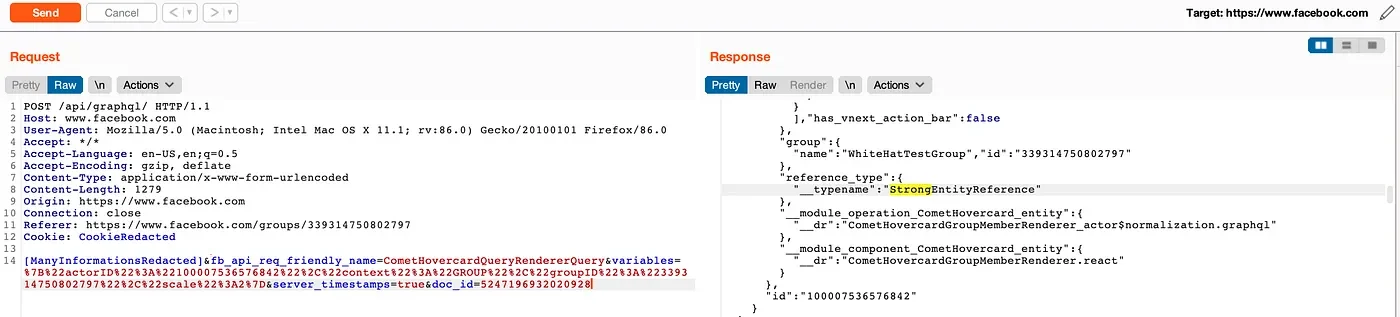
- Read the entity reference in the response. If it is
StrongEntityReference, the victim is a member of the group. If it isWeakEntityReference, the victim is not a member. The report spells the second valueWeekEntityReferencein the step text, but the description gives it asWeakEntityReference.
That is the whole technique: one query, sent from an account outside the group, returns an answer about a user's membership in a private group.
Bug 2: membership dates via FbLite
- From User A's account in FbLite, while a member of the group, open the group.
- From User A's account on a PC, leave the group.
- Click on a member's profile. Group posts are no longer visible, but the membership dates are.
- Observe the membership date of User B and User C after leaving the group.
- From User B's account on the PC, leave the group.
- The membership date for User B disappears, because User B is no longer a member, but the membership date for User C is still shown.
- To confirm, leave the group from User C's account on the PC.
- The membership date for User C now disappears as well, confirming the vulnerability.
In the test, the membership date was shown for users who were still members and disappeared as each one left. A non-member can therefore enumerate the current membership of a private group by checking which profiles still carry a membership date.
Root cause
For the first bug, the hovercard query returns an entity reference whose strength depends on the relationship between the actor and the group, and that strength is computed and returned without checking whether the requester is entitled to know the relationship. The query is reachable by a non-member, and the response distinguishes member from non-member, so the authorisation check that should gate the information is missing or applied at the wrong layer. The report does not describe the server-side code, so the exact location of the mistake is not stated.
For the second bug, the FbLite endpoint that serves group member posts appears to return membership dates without re-checking the requester's current membership in the group. The UI hides the posts after leaving, but the underlying data about membership dates is still returned. Again, the report does not show the code, so this is inferred from the observed behaviour.
Impact
Both bugs disclose private group membership. A non-member can determine whether a user is a member of a private group. The second bug additionally exposes membership dates.
Fix
Both bugs were paid at $4500 each. In general terms, the hovercard query should only return the entity reference strength to a requester who is authorised to know the relationship, and the FbLite member endpoint should check the requester's current membership before returning membership dates.
Variants to test
- Other GraphQL queries that return entity references or relationship strengths between a viewer and a private object. A positive result is a response whose value changes depending on the target's membership, observable from an account outside the object.
- Hovercard and preview endpoints on other products that render relationship information. A positive result is a preview that reveals membership, role or connection status for a private group or page.
- Lightweight or legacy clients of the same product, such as FbLite here. A positive result is a field that remains populated after the requester leaves the group, while the main client hides it.
- Membership dates, join dates and role labels on member profiles. A positive result is a date that is present for current members and absent for former members, when viewed by a non-member.
- Cached or stale responses after a state change such as leaving a group. A positive result is data that should have been invalidated but is still served.
What happened, in plain words
A security researcher found two separate bugs on Facebook, both about private groups. A private group is a group whose posts are meant to be visible only to its members. Both bugs let someone who is not in the group learn things about who is in it. Facebook paid $4500 for each bug, $9000 in total.
The first bug was in the part of Facebook that draws the little pop-up card you see when you hover your mouse over someone's name. That card is built by asking Facebook's servers a question, and the answer to that question changes depending on whether the person you hovered over is a member of a particular group. The researcher found that anyone, even someone outside the group, could ask that question about any person and any private group, and read the answer. So a stranger could check whether somebody belongs to a private group.
The second bug was in FbLite, the light version of Facebook made for slow connections and simple phones. After the researcher left a private group, the group's posts disappeared as they should, but the profile pages of the members still showed the dates on which those people had joined the group. By leaving the group from one account at a time and watching which dates vanished, the researcher could work out exactly who was still a member.
The background you need
Before the two bugs make sense, here are the ideas they rely on.
A server and a client. When you use a website, your browser (the client) sends requests over the internet to a computer owned by the company (the server). The server decides what to send back. Every rule about who may see what has to be enforced on the server, because the browser is under the user's control and can be made to send anything.
An API. An API is the set of questions a server agrees to answer for a program, as opposed to the pages it sends for a human to look at. Think of a restaurant: the menu is the API, the kitchen is the server, and you can only order what is on the menu. Facebook's own web pages and apps are built on top of such an API, so the same questions the official interface asks can also be asked by hand.
GraphQL. GraphQL is a way of designing an API where the client sends one request describing exactly the pieces of data it wants, and the server sends back just those pieces. Facebook's main web interface uses GraphQL heavily. Each saved question has a name and an identifier called a doc ID, so the client can refer to a known query without resending its whole text.
A query variable. A GraphQL query is often a template with blanks in it, and the blanks are filled by values called variables. For example, a query might say "tell me about this person and this group", where the person and the group are variables supplied with each request. Whoever sends the request chooses those values.
An ID. Facebook refers to people, groups and other objects by long numbers called IDs. Your account has an ID, and so does every group. If you know someone's ID, you can name them in a request.
A hovercard. When you move your mouse over a name or picture on Facebook, a small card pops up with a summary of that person. That card is not part of the page you loaded; it is fetched separately when you hover, which means a request goes to the server at that moment.
An entity reference. In some Facebook responses, a relationship between two things (here, between a person and a group) is described by a label rather than by the raw data. The label says how strong or direct that relationship is. The researcher found that this label differs depending on whether the person is in the group.
Information disclosure. This is the name for a bug where data that should be kept private is handed to someone who is not allowed to have it. Nothing is changed or broken; the harm is that a secret leaks. It is often the first step towards something worse, because knowing who belongs to a group can be used for targeting or social engineering.
FbLite. This is a lightweight version of Facebook, designed to load quickly on slow networks and basic phones. It has fewer features and simpler pages, and because it is a separate interface it can have its own separate mistakes.
Membership date. On a member's profile, Facebook can show the date the person joined a group. It is a small piece of data, but it is enough to answer the question "is this person in this group right now?".
Authorisation. Authentication is proving who you are (logging in). Authorisation is what you are then allowed to do. Most disclosure bugs are authorisation failures: the server knows who is asking but does not check whether that person is entitled to the answer.
Bug 1: checking membership through the hovercard query
What the researcher was looking at
Facebook's main web interface uses a GraphQL query called CometHovercardQueryRendererQuery, with doc ID 4997502340291357, to build the hovercard. The researcher looked at what that query returns and noticed that the response contains an entity reference describing the relationship between the person being hovered over and a group. The value of that reference changes depending on whether the person is a member of the group.
The important part is that this difference can be seen from an account that is not in the group at all. A non-member should not be able to learn anything about the relationship between a private group and one of its members, but the query answers anyway.
The steps
- From an account that is not a member of the target private group, send the hovercard request, replacing the
actorIDvariable with the victim's actor ID and thegroupIDvariable with the ID of the group you want to test against.
Why this step: the query is a template with two blanks. actorID is the person whose relationship with the group you want to learn about, and groupID is the group itself. By filling in someone else's ID and a private group's ID, you are asking the server a question about two things that are not yours. The account you send it from is deliberately outside the group, because the whole point is to show that membership is not required.
- Read the entity reference in the response. If it is
StrongEntityReference, the victim is a member of the group. If it isWeakEntityReference, the victim is not a member. The report spells the second valueWeekEntityReferencein the step text, but the description gives it asWeakEntityReference.
Why this step: the server's answer is not a plain yes or no. It is a label, and the label is the leak. A strong reference means the person is tied to the group; a weak one means the tie is not there. Either way, the non-member now knows something about a private group that they should not know.
That is the whole technique: one query, sent from an account outside the group, returns a boolean-equivalent answer about any user's membership in any private group. Repeat it with different actorID values and you can check as many people as you like.
Bug 2: membership dates in FbLite
This one was found by hand, without crafting a request. The researcher used accounts called User A, User B and User C. The testing was done on a phone in FbLite, with accounts leaving the group and watching what the membership dates did.
The steps
- From User A's account in FbLite, while a member of the group, open the group.
Why this step: this establishes the normal state. As a member, User A can see the group and its content, and the pages are loaded in FbLite so that the requests FbLite makes are the ones being tested.
- From User A's account on a PC, leave the group.
Why this step: leaving changes User A from a member into a non-member. The question is whether FbLite still behaves as if User A were a member.
- Click on a member's profile. Group posts are no longer visible, but the membership dates are.
Why this step: the posts disappearing is the correct behaviour, and it shows the server knows User A has left. The membership dates still being there is the mismatch. If the server knows you are out of the group, it should not keep telling you who is in it.
- Observe the membership date of User B and User C after leaving the group.
Why this step: this is the observation that something is wrong. A non-member is seeing join dates for people in a private group.
- From User B's account on the PC, leave the group.
Why this step: this is the control. If the date is really about current membership, it should vanish when the person it belongs to is no longer a member.
- The membership date for User B disappears, because User B is no longer a member, but the membership date for User C is still shown.
Why this step: this confirms the pattern. The date is not a fixed piece of profile information; it tracks whether the person is currently in the group.
-
To confirm, leave the group from User C's account on the PC.
-
The membership date for User C now disappears as well, confirming the vulnerability.
Why this step: with the last member gone, the last date goes too. The pattern holds for every account, so it is not a one-off glitch.
In the test, the membership date was shown for users who were still members and disappeared as each one left. A non-member could therefore see membership dates for users still in the group.
Why the bugs happened
For the first bug, the hovercard query returns an entity reference whose strength depends on the relationship between the actor and the group, and that strength is computed and returned without checking whether the requester is entitled to know the relationship. The query is reachable by a non-member, and the response distinguishes member from non-member, so the authorisation check that should gate the information is missing or applied at the wrong layer. The report does not describe the server-side code, so the exact location of the mistake is not stated.
For the second bug, the FbLite endpoint that serves group member posts appears to return membership dates without re-checking the requester's current membership in the group. The interface hides the posts after leaving, but the underlying data about membership dates is still returned. Again, the report does not show the code, so this is inferred from the observed behaviour.
A useful way to think about both: hiding something in the interface is like putting a curtain in front of a window. It stops you seeing in, but it does not stop anyone walking round the back. The server has to refuse to answer, not just stop drawing the answer on screen.
What the impact was
Both bugs disclose private group membership. A non-member can determine whether a user is a member of a private group. The second bug additionally exposes membership dates.
That is why Facebook treats it as private data even though it is only a yes or no.
How it was fixed
Both bugs were paid at $4500 each. In general terms, the hovercard query should only return the entity reference strength to a requester who is authorised to know the relationship, and the FbLite member endpoint should check the requester's current membership before returning membership dates.
Similar things worth testing
If you want to look for bugs of this shape yourself, these are patterns worth testing. In each case, the sign of a real bug is a value that changes with someone else's private state, or that stays visible after you should have lost access.
- Other GraphQL queries that return entity references or relationship strengths between a viewer and a private object. A positive result is a response whose value changes depending on the target's membership, observable from an account outside the object.
- Hovercard and preview endpoints on other products that render relationship information. A positive result is a preview that reveals membership, role or connection status for a private group or page.
- Lightweight or legacy clients of the same product, such as FbLite here. A positive result is a field that remains populated after the requester leaves the group, while the main client hides it.
- Membership dates, join dates and role labels on member profiles. A positive result is a date that is present for current members and absent for former members, when viewed by a non-member.
- Cached or stale responses after a state change such as leaving a group. A positive result is data that should have been invalidated but is still served.
Glossary
- API: the set of questions a server agrees to answer for a program, as opposed to the pages it shows a person.
- Actor ID: the numeric identifier Facebook uses for the person a request is about.
- Authorisation: the check of whether the person asking is allowed to receive the answer, as opposed to authentication, which is proving who they are.
- Client: the program making requests, usually your browser or phone app.
- CometHovercardQueryRendererQuery: the name of the GraphQL query Facebook's web interface uses to build the pop-up card shown when you hover over a name.
- Doc ID: the numeric identifier for a saved GraphQL query, so the client can refer to it without resending its full text.
- Entity reference: a label in a response describing how strongly two things are related, here a person and a group.
- FbLite: the lightweight version of Facebook built for slow connections and simple phones.
- GraphQL: a style of API where the client sends one request describing exactly which pieces of data it wants.
- Group ID: the numeric identifier Facebook uses for a group.
- Hovercard: the small summary card that appears when you hover over a name or picture.
- Information disclosure: a bug where private data is given to someone not allowed to have it, without anything being changed.
- Membership date: the date shown on a profile for when that person joined a group.
- Non-member: someone who does not belong to the group in question.
- Private group: a group whose content and membership are meant to be visible only to its members.
- Query variable: a value supplied with a GraphQL request to fill a blank in the query template.
- Server: the company's computer that receives requests and decides what to send back.
- StrongEntityReference: the value returned when the person is a member of the group.
- WeakEntityReference: the value returned when the person is not a member of the group; the report also spells it
WeekEntityReferencein one step.




