Improper Data Deletion on Meta AI
Deleted Meta AI chats remained accessible through their identifiers, allowing an attacker to retrieve private content after deletion. The attacker could view images and chat history that the victim believed were permanently removed.

Meta Bug Bounty
The full write-up lives on its author's site
It belongs to its author, so we link to it rather than copy it. The other two tabs are our own rewrites, checked against it.
Context
Meta AI is Meta's assistant inside its apps, and it keeps conversations with the assistant as chats. A chat can contain text and generated images. When a user deletes a chat, the expectation is that the content is gone permanently: the author states that deleting chat history in Meta AI removes it "permanently without the ability to retrieve any content from the chat (photos or chat that was with Meta AI)".
The report is about what happens to that promise when a chat is deleted while another chat still holds a reference to it. The class of bug is improper data deletion: an application accepts a deletion request but leaves the data reachable through an identifier, a link, a cache or a backup.

Setup
The write-up describes two accounts: a victim account that creates and deletes chats, and an attacker account that keeps a saved item pointing at a chat. The only tool mentioned is an intercepting proxy, used to modify a request in flight. No versions, endpoints, parameter names or headers are given in the report.
The precondition is that the attacker holds a saved reference to a chat before it is deleted. The author's scenario is built so that the attacker holds a saved reference to a chat before it is deleted.
Finding it
The starting observation is the normal behaviour: a deleted Meta AI chat cannot be retrieved, not even partially, through the product. The author then asked whether a different scenario could recover even a small part of deleted content, and set up two chats to test it.

Exploitation
Step 1: create two chats
Two conversations with Meta AI are created, each asking for a specific image, and they are named A and B. Chat A is the one that will be deleted; chat B is the one the attacker keeps using.
Step 2: request and share images
In each chat, images are requested to be created and then shared with someone. This is what puts content into the chats that is worth recovering later.
Step 3: delete chat A
After waiting a few minutes, the conversation is deleted permanently from the victim side.
Step 4: keep a reference to the deleted chat
From the attacker's account, a link or ID to the deleted chat is retained. Separately, the attacker saves any private chat they own, so that a saved item exists that can later be pointed at another chat.
Step 5: swap the ID in the saved item
The private ID in the saved item is replaced with the ID of the deleted chat. The author's description of the result: going to the saved items shows the chat that was deleted by the victim.
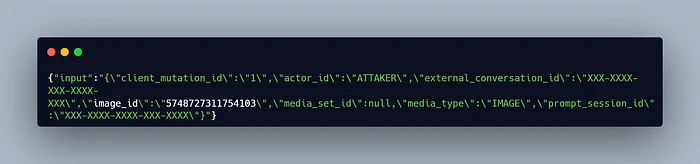
Step 6: swap the ID in the image animation request
The author then moves to chat B. Meta AI has a feature that animates images. An image from chat B is animated, the request is intercepted, and the ID in it is replaced with the ID saved from the deleted chat A. The report does not include the raw request or response, so the exact parameter carrying the ID is not shown.
Root cause
The report frames the flaw as a failure of the data deletion process in Meta AI: content that has been deleted remains retrievable when a request references it by ID. The author lists the usual causes of this class of bug, which match what the scenario exercises:
- a soft delete, where data is hidden rather than removed;
- retention in logs or backup systems;
- failure to invalidate cached or CDN-stored data;
- access control issues that allow retrieval of deleted data by ID.
The last one is the mechanism the steps exercise: the saved-item and image-animation flows returned content for an ID of a deleted chat. The report does not show server-side code, so which of these applies at the storage layer is not stated. The missing defence is data access validation on identifiers that point at deleted objects.
Impact
The author recovered content from a chat after it was deleted, including photos and chat content, by substituting the ID into a saved item or into an image animation request. The author describes this as a privacy risk and a compliance problem under data protection regulations. The report does not state how an attacker would obtain the ID in the first place, so the scenario assumes the reference is already held.
Fix
It states that secure deletion policies and data access validation are needed: deletion should remove the content rather than hide it, and requests that carry an ID should be validated so that deleted or unauthorised content cannot be returned.
Reward
The author reports being rewarded with $525 USD.

A video proof of concept is linked in the report: https://drive.google.com/file/d/1OcTf-ErLORWsivW2mHLPgylS4rMp9yp1
- Saved items on other assistants. Save a chat, delete the original, then swap the saved reference to the deleted ID. A positive result is the deleted chat's content appearing in the saved list.
- Media generation and animation endpoints. Intercept any request that takes a chat or message ID for image generation, animation or sharing, and substitute the ID of a deleted chat. A positive result is generated or animated output derived from deleted content.
- Direct object references after deletion. Take IDs of deleted messages, images or attachments and request them directly. A positive result is a 200 response with the deleted object rather than a not-found or forbidden response.
- Cached and CDN copies. Request media URLs captured before deletion after the chat is gone. A positive result is the asset still being served from cache.
- Cross-account checks. Repeat the swaps with an ID belonging to a different account. A positive result is content returned to an account that never owned the chat, which would show the validation is missing on ownership as well as on existence.
What happened, in plain words
Meta AI is the assistant built into Meta's apps (Facebook, Instagram, WhatsApp and so on). You talk to it in a chat window, and the chat can hold both text and pictures that the assistant generates for you. When you delete one of those chats, you expect it to be gone for good. The author of this report says exactly that: deleting chat history in Meta AI removes it "permanently without the ability to retrieve any content from the chat (photos or chat that was with Meta AI)".
The bug is that this promise did not hold in the author's test: with a link or ID pointing at a deleted chat, content could be pulled back out of it. The author showed this by saving a reference to a chat, deleting the chat, and then swapping that reference into a saved item and into an image animation request.
This kind of bug is called improper data deletion. In plain terms: the app says "deleted", but the data is still sitting somewhere reachable. It is like shredding a letter but leaving a photocopy in a drawer that anyone with the drawer number can open.
The vulnerability class, explained from zero
Before the steps, it helps to understand what "improper data deletion" actually means, because the whole report is about that one idea.
When you press delete in an app, several things could happen behind the scenes:
- The data could really be removed from storage. This is what users expect.
- The data could be hidden from your view but still stored. This is called a soft delete. The row is still in the database, just marked as deleted.
- The data could be removed from the main store but still live in logs, backups or a cache.
- The data could be removed, but any request that names it by its ID (a unique label, like a ticket number) could still return it, because nothing checks whether the thing still exists or whether the person asking is allowed to see it.
The author lists these as the common causes:
- Performing a "soft delete" (hiding data instead of deleting it).
- Retaining data in logs or backup systems.
- Failure to invalidate cached or CDN-stored data.
- Access control issues allowing retrieval of deleted data by ID.
The last one is the mechanism this report exercises. The other three are context: they explain why this class of bug is common and why "delete" is not always what it sounds like.
A quick word on two terms used above:
- A cache is a temporary copy kept somewhere close to the user so pages load faster. If you delete the original but the cache still has a copy, the copy is still served.
- A CDN (content delivery network) is a network of servers around the world that hold copies of files so they can be delivered quickly. Same idea as a cache, at a larger scale.
Setting the scene
The report describes two accounts:
- A victim account. This is the account that creates chats and then deletes them.
- An attacker account. This is the account that keeps a saved item pointing at a chat, and later swaps the reference inside it.
The only tool mentioned is an intercepting proxy. A proxy is a program that sits between your browser and the website. Normally your browser talks directly to the server. With a proxy in the middle, every request passes through the proxy first, and the proxy can pause it, show it to you, let you edit it, and then forward it. Security testers use this to change what the browser sends without having to rebuild the page.
A request is what your browser sends to a server when you click something: a small message saying "please give me this" or "please do this". A response is what the server sends back. When you edit a request in a proxy, you are changing the message before it leaves your machine.
The report does not give versions, endpoint names, parameter names or headers. So the steps below describe the shape of the attack, not the exact bytes on the wire.
The precondition is important: the attacker must already have, or have had, a link or an ID for a chat that the victim later deletes. The author's scenario is built so that the attacker holds a saved reference to a chat before it is deleted. The report does not explain how an attacker would obtain that ID in the first place, so the scenario assumes the reference is already held.
Finding it
The starting observation is the normal behaviour. A deleted Meta AI chat cannot be retrieved through the product, not even partially. That is the promise the author wanted to test.
The author then asked a simple question: could a different scenario recover even a small part of deleted content? To test it, two chats were set up.
Exploitation, step by step
Step 1: create two chats
Two conversations with Meta AI are created. Each one asks for a specific image. They are named A and B.
Why two? Because the attack needs one chat to be deleted (chat A) and another chat to stay alive and usable (chat B). Chat B is where the attacker keeps working after the deletion. Chat A is the one whose content is supposed to be gone.
Step 2: request and share images
In each chat, images are requested to be created and then shared with someone.
Why? Because the point of the test is to see whether content can be recovered after deletion. If the chats were empty, there would be nothing to recover. Putting generated images and shared content into the chats gives the test something concrete to look for later.
Step 3: delete chat A
After waiting a few minutes, the conversation is deleted permanently from the victim side.
After waiting a few minutes, the conversation is deleted permanently. The author's claim is that the deletion is supposed to be permanent, so the test is whether it really is.
Step 4: keep a reference to the deleted chat
From the attacker's account, a link or ID to the deleted chat is retained. Separately, the attacker saves any private chat they own, so that a saved item exists that can later be pointed at another chat.
Two ideas here need unpacking:
- An ID is a unique label the system uses to refer to a specific object, like a chat, a message or an image. It is usually a long string of letters and numbers. If you know the ID, you can often ask the system for that object directly.
- A saved item is a feature where you bookmark or save something so you can find it again later. Behind the scenes, the saved item stores a reference to the original object, usually by its ID.
The attacker's trick is to have a saved item that they own, and to know the ID of the deleted chat A. The next step is to make the saved item point at the wrong chat.
Step 5: swap the ID in the saved item
The private ID in the saved item is replaced with the ID of the deleted chat. The author's description of the result: going to the saved items shows the chat that was deleted by the victim.
In plain words: the saved item is a bookmark. The bookmark normally points at your own chat. By editing the ID inside the bookmark, the attacker makes it point at the deleted chat. If the system does not check that the chat still exists and that the person asking owns it, the bookmark happily shows the deleted content.
This is the first demonstration of the bug. The deleted chat's content is visible again, through a saved item that was never supposed to reference it.
Step 6: swap the ID in the image animation request
The author then moves to chat B. Meta AI has a feature that animates images. An image from chat B is animated, the request is intercepted, and the ID in it is replaced with the ID saved from the deleted chat A.
Why this second test? Because the saved-item path is only one place where an ID is accepted. If the bug is really about missing validation on IDs, then any other feature that takes an ID should show the same problem. The image animation feature takes an ID to know which image to animate. If that ID is swapped for the deleted chat's ID, and the system still returns content, the bug is confirmed in a second place.
The report does not include the raw request or response, so the exact parameter carrying the ID is not shown. What we know is the shape: a request that carries an ID, intercepted in a proxy, with the ID replaced.
Why it works: the root cause
The report frames the flaw as a failure of the data deletion process in Meta AI. Content that has been deleted remains retrievable when a request references it by ID.
The author lists the usual causes of this class of bug, and they match what the scenario exercises:
- a soft delete, where data is hidden rather than removed;
- retention in logs or backup systems;
- access control issues that allow retrieval of deleted data by ID.
The last one is the mechanism the steps rely on. The saved-item and image-animation flows returned content for the ID of a deleted chat. In everyday terms: the door asks for a ticket number, and if you show any ticket number it opens, without checking whether the ticket is still valid or whether it belongs to you.
What is clear is the missing defence: data access validation on identifiers that point at deleted objects. Validation here means a check on the server, before returning anything, that the object exists and that the person asking is allowed to see it.
Impact
The author recovered content from a chat after it was deleted, including photos and chat content, by substituting the ID into a saved item or into an image animation request.
The author describes this as a privacy risk and a compliance problem under data protection regulations. In plain terms: users are told their data is deleted, and it is not. That breaks the promise the product makes, and it can matter legally in places where data protection law requires deletion to actually mean deletion.
Fix
It states that secure deletion policies and data access validation are needed. In plain words:
- deletion should remove the content rather than hide it;
- requests that carry an ID should be validated, so that deleted or unauthorised content cannot be returned.
Both halves matter. Even if deletion is thorough, a request that names a deleted object should be rejected. And even if requests are validated, deletion should still actually remove the data rather than just hide it.
Reward
The author reports being rewarded with $525 USD.
A video proof of concept is linked in the report: https://drive.google.com/file/d/1OcTf-ErLORWsivW2mHLPgylS4rMp9yp1
If you want to look for the same class of bug in other places, these are the variations the report suggests. Each one is a way of asking the same question: does this feature check that the ID it receives points at something that still exists and belongs to the caller?
- Saved items on other assistants. Save a chat, delete the original, then swap the saved reference to the deleted ID. A positive result is the deleted chat's content appearing in the saved list.
- Media generation and animation endpoints. Intercept any request that takes a chat or message ID for image generation, animation or sharing, and substitute the ID of a deleted chat. A positive result is generated or animated output derived from deleted content.
- Direct object references after deletion. Take IDs of deleted messages, images or attachments and request them directly. A positive result is a 200 response with the deleted object rather than a not-found or forbidden response.
- Cached and CDN copies. Request media URLs captured before deletion after the chat is gone. A positive result is the asset still being served from cache.
- Cross-account checks. Repeat the swaps with an ID belonging to a different account. A positive result is content returned to an account that never owned the chat, which would show the validation is missing on ownership as well as on existence.
A note on the terms in that list:
- An endpoint is a specific address on a server that does a specific job. When you click "animate", your browser sends a request to an endpoint that handles animation.
- A 200 response is the standard HTTP status code for "OK, here is what you asked for". A not-found response (404) means the server has nothing at that address. A forbidden response (403) means the server knows what you asked for but will not give it to you.
- A direct object reference is when a request names an object by its ID directly, rather than going through a search or a list. If the server does not check ownership, changing the ID in such a request can expose someone else's object. This is a well-known pattern called IDOR (insecure direct object reference).
Glossary
- API: the set of addresses and rules a program uses to talk to a server. When a page loads data or performs an action, it usually calls an API behind the scenes.
- Attacker account: in this report, the account that keeps a saved reference and performs the ID swaps.
- Cache: a temporary copy of data kept close to the user so it can be served faster. If the original is deleted but the cache is not cleared, the copy can still be served.
- CDN (content delivery network): a network of servers around the world that hold copies of files so they can be delivered quickly. Like a cache at a larger scale.
- Chat: a conversation with Meta AI, which can contain text and generated images.
- Compliance: meeting the rules set by laws or regulations, such as data protection law.
- Data access validation: a check on the server, before returning data, that the object exists and that the person asking is allowed to see it.
- Deleted content: content the user has asked the system to remove. The report is about content that is supposed to be gone but is still reachable.
- Direct object reference: a request that names an object by its ID directly. If ownership is not checked, changing the ID can expose another user's object.
- Endpoint: a specific address on a server that handles a specific action, such as animating an image.
- Forbidden (403): an HTTP status meaning the server will not give you what you asked for.
- ID: a unique label the system uses to refer to a specific object, such as a chat, message or image.
- Improper data deletion: a vulnerability where an app accepts a deletion request but leaves the data reachable through a link, an ID, a cache or a backup.
- Intercepting proxy: a tool that sits between your browser and the server, letting you pause, inspect and edit requests before they are sent.
- Meta AI: Meta's assistant inside its apps, which keeps conversations as chats that can contain text and generated images.
- Not-found (404): an HTTP status meaning the server has nothing at that address.
- OK (200): an HTTP status meaning the request succeeded and the server is returning the result.
- Parameter: a named value inside a request, such as an ID telling the server which object to act on.
- Privacy risk: the chance that personal data is exposed to someone who should not see it.
- Request: the message your browser sends to a server when you click something or a page loads data.
- Response: the message the server sends back.
- Saved item: a bookmark feature that stores a reference, usually by ID, to something you want to find again later.
- Secure deletion policy: a rule that deletion must actually remove data rather than hide it, including from caches, logs and backups.
- Soft delete: marking data as deleted while keeping it in storage, so it is hidden from the user but still present.
- Victim account: in this report, the account that creates chats and deletes them.
- Vulnerability: a weakness in a system that someone can use to do something the system was not meant to allow.




