Poll Setting Bypass in Facebook Groups Post Editing
A poll setting in Facebook Groups that restricts adding options to the creator was bypassed after the poll post was edited. Any group member could then add new options, including images, despite the setting remaining off.

Cench Sec
The full write-up lives on its author's site
It belongs to its author, so we link to it rather than copy it. The other two tabs are our own rewrites, checked against it.
Context
Facebook Groups let members create poll posts. When composing a poll, the creator can choose whether other members may add their own options. The setting is labelled "Allow anyone to add options". When it is left on, members can extend the poll. When it is turned off before posting, the poll is meant to be locked: only the creator should be able to add options, and everyone else should be blocked.
This write-up is about a logic flaw in that control. It is not a deep technical bug; the author says so directly. It is a state-handling problem that appears once a poll post is edited after publication.
Setup
The report does not describe any special tooling, proxy interception, test accounts or software versions. The precondition is simply a Facebook group in which the researcher can create a poll post. The whole test is done through the normal group posting and editing interface.
Finding it
The researcher noticed the issue while travelling home from college, not during a focused technical hunt. The observation is straightforward: the "Allow anyone to add options" setting is honoured when the poll is first posted, but the restriction is not preserved when the post is subsequently edited. Editing the post, even without touching the poll settings, reopens the poll so that any group member can add new options, including options with images, while the setting still displays as off.
That mismatch between the displayed setting and the actual behaviour is what makes it a bug rather than a feature: the interface tells the creator the poll is locked, and the backend then behaves as if it were open.
Exploitation
The reproduction is short and needs no payloads. The report gives it as a numbered sequence.
Step 1: Create a poll post in a Facebook group
Start a normal poll post in a group where you are a member.
Step 2: Turn off "Allow anyone to add options" before posting
Set the poll so that only the creator may add options. This must be done before the poll is published.
Step 3: Post the poll
Publish the poll with the setting off. At this point the restriction behaves as intended.
Step 4: Edit the poll post without changing the poll settings
Edit the post, for example by changing the text. The poll settings are left untouched, so "Allow anyone to add options" remains off.
Step 5: Save the edited poll
Saving the edit is the trigger. The report does not show the underlying request or response, so the exact field that is dropped or reset on save is not documented.
Step 6: Any group member can now add options
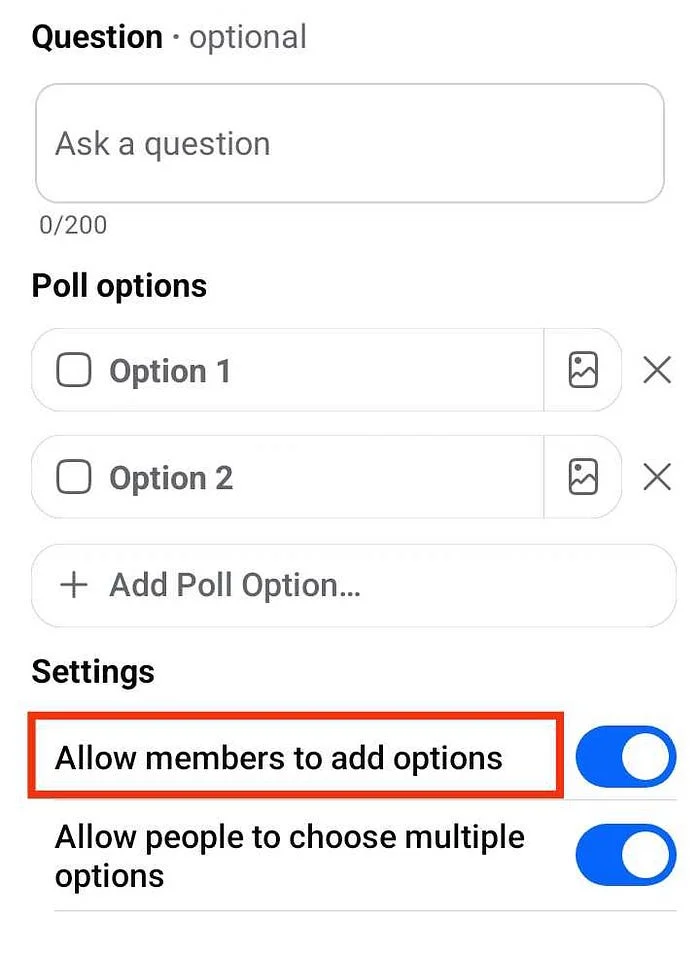
After the edit, any group member can add new poll options, including options with photos, even though the setting is still off. The screenshot below shows the vulnerable state, with the option to add choices available to a member despite the restriction.
Root cause
The report does not include code, requests or responses, so the root cause is not demonstrated. What the behaviour implies is that the edit path for a poll post does not carry over, or does not re-apply, the "Allow anyone to add options" flag when the post is saved. The report does not demonstrate the cause; the behaviour only shows that the restriction does not survive an edit. The existing control therefore only protects the initial publication, not later modifications of the same object.
Impact
The bug lets anyone add new options to locked polls once the post has been edited, which breaks poll control. In the researcher's words, it can lead to unwanted or misleading content, reduce admin control, and increase the risk of spam or misinformation in Facebook groups. The effect is on group members and moderators: a poll the creator believed was fixed can be changed by others, and the displayed setting no longer reflects reality. The report does not attach a severity rating or CVSS score.
Fix
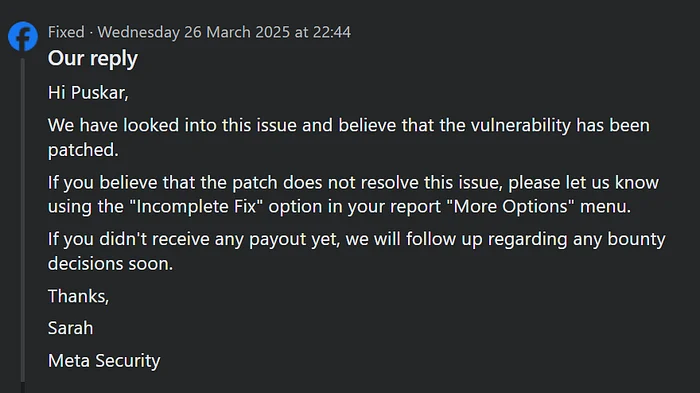
Meta Security confirmed on 26 March 2025 that the vulnerability had been patched.
Timeline
| Date | Event |
|---|---|
| 12 February 2025 | Bug reported to Meta Security |
| 13 February 2025 | Initial evaluation by the Meta Security team |
| 17 February 2025 | Additional details and a video demonstration provided |
| 27 February 2025 | Meta Security confirmed the report was forwarded to the engineering team |
| 5 March 2025 | Bounty awarded |
| 26 March 2025 | Meta Security confirmed the vulnerability was patched |
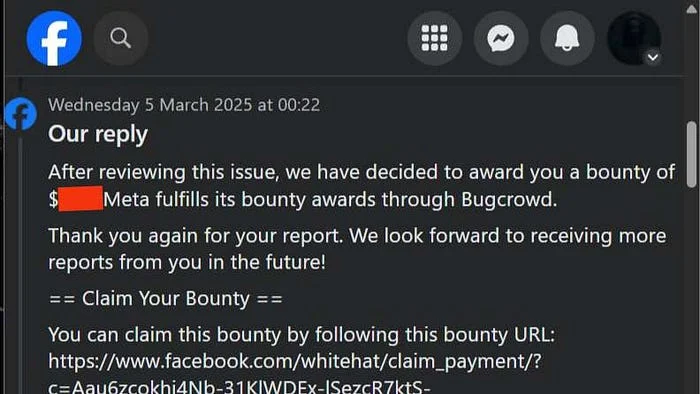
The bounty amount is redacted in the write-up as $×××. The two screenshots below record the award and the fix confirmation.
Variants to test
The pattern to look for elsewhere is a setting that is enforced on creation but not on update. Concrete things to try:
- Other poll-like objects with per-object settings. Create a post, event, quiz or form with a restrictive option (who may respond, who may add entries, who may edit), then edit an unrelated field and check whether the restriction still holds. A positive result is that another user can perform the action the setting was meant to block.
- Edit paths that do not touch the setting. Change only the text or media of the post and save. A positive result is that the setting silently reverts to its permissive default while still displaying as restricted.
- Settings that gate content types. The report notes that members could add options with images. Test whether a bypass also unlocks richer content types (media, links, attachments) that the setting was meant to prevent.
- Draft and scheduled posts. If a poll can be saved as a draft or scheduled, check whether publishing after an edit produces the same reset. A positive result is the same mismatch between the displayed setting and the enforced behaviour.
- Re-editing after the first edit. Check whether a second edit restores the restriction or keeps the poll open. A positive result is that the poll stays open across further edits, widening the window for abuse.
The verdict in the report is that the issue is not highly technical but affects user trust and group moderation, and that fixing it matters for the integrity of polls and the overall experience in Facebook groups.
What happened, in plain words
Facebook Groups are shared spaces on Facebook where people with a common interest can post, comment and vote. One of the things you can post in a group is a poll: a question with a list of answers that members pick from, like "Which day works best for the meetup?" with options such as Monday, Tuesday and Wednesday.
When someone creates a poll, Facebook gives them a choice about who may add extra answers to it. The choice is a small on/off switch labelled "Allow anyone to add options". If it is left on, any member of the group can add their own answer to the list. If it is turned off before the poll is posted, the poll is supposed to be locked: only the person who created it can add answers, and everyone else is blocked.
This write-up is about a way to get around that lock. It is not a deep technical bug, and the researcher says so directly. It is a problem with how Facebook remembers a setting after a post has been changed. Once a poll post is edited after it has been published, the lock stops working, even though the switch still shows as off.
A quick comparison: imagine a meeting room with a sign on the door saying "staff only". The sign is put up when the room is booked. But if someone later changes the booking (say, moves the meeting by an hour), the sign falls off, while the booking system still shows "staff only". The rule was applied when the room was first booked, but not when the booking was updated. That is the shape of this bug.
The setting and what it is meant to do
Facebook Groups let members create poll posts. When composing a poll, the creator can choose whether other members may add their own options. The setting is labelled "Allow anyone to add options". When it is left on, members can extend the poll. When it is turned off before posting, the poll is meant to be locked: only the creator should be able to add options, and everyone else should be blocked.
This write-up is about a logic flaw in that control. It is not a deep technical bug; the author says so directly. It is a state-handling problem that appears once a poll post is edited after publication.
"State" here just means the information a system is holding about something at a given moment. A poll's state includes its question, its options, and whether the "Allow anyone to add options" switch is on or off. "State-handling" means how the system stores and updates that information. The bug is that one piece of the state (the switch) is not carried over correctly when the post is updated.
Setup
The report does not describe any special tooling, proxy interception, test accounts or software versions. The precondition is simply a Facebook group in which the researcher can create a poll post. The whole test is done through the normal group posting and editing interface.
In plain terms: you need a Facebook account, membership of a group where you are allowed to post, and a second person in the same group. No hacking tools, no special browser extensions, no command line. Everything happens through the ordinary buttons and forms that any Facebook user sees.
Finding it
The researcher noticed the issue while travelling home from college, not during a focused technical hunt. The observation is straightforward: the "Allow anyone to add options" setting is honoured when the poll is first posted, but the restriction is not preserved when the post is subsequently edited. Editing the post, even without touching the poll settings, reopens the poll so that any group member can add new options, including options with images, while the setting still displays as off.
That mismatch between the displayed setting and the actual behaviour is what makes it a bug rather than a feature: the interface tells the creator the poll is locked, and the backend then behaves as if it were open.
"Backend" means the part of Facebook that runs on its servers, out of sight, and decides what actually happens when you click something. The "interface" is what you see in the browser. A bug like this is a disagreement between the two: the screen says one thing, the server does another.
Exploitation
The reproduction is short and needs no payloads. A payload is the specially crafted piece of data an attacker sends to make a system misbehave, such as a strange string typed into a form. Here there is nothing to craft: the steps are ordinary clicks. The report gives the reproduction as a numbered sequence.
Step 1: Create a poll post in a Facebook group
Start a normal poll post in a group where you are a member. This is the same "create a poll" button any group member uses. The purpose of this step is simply to have a poll to test.
Step 2: Turn off "Allow anyone to add options" before posting
Set the poll so that only the creator may add options. This must be done before the poll is published. The timing matters: the setting has to be in place at the moment the poll is first created, because that is the moment the restriction is supposed to be recorded.
Step 3: Post the poll
Publish the poll with the setting off. At this point the restriction behaves as intended. This step is the control in the experiment: it confirms that the lock works normally before anything unusual is done. If other members were already able to add options here, there would be no bug to report.
Step 4: Edit the poll post without changing the poll settings
Edit the post, for example by changing the text. The poll settings are left untouched, so "Allow anyone to add options" remains off. The point of changing only the text is to isolate the cause: if the setting is not touched, then any change in behaviour must come from the act of editing itself, not from the setting being flipped.
Step 5: Save the edited poll
Saving the edit is the trigger. The report does not show the underlying request or response, so the exact field that is dropped or reset on save is not documented.
A "request" is the message your browser sends to Facebook's servers when you click Save, and a "response" is the message the server sends back. A "field" is one named piece of data inside that message, for example a value saying whether the poll is locked. The report does not capture these messages, so we cannot point to the exact field that goes missing. We only know the visible result.
Step 6: Any group member can now add options
After the edit, any group member can add new poll options, including options with photos, even though the setting is still off. The screenshot below shows the vulnerable state, with the option to add choices available to a member despite the restriction.
The image is captioned "(Vulernable option)" and shows the poll in the state where a member can still add choices even though the setting is off.
Root cause
The report does not include code, requests or responses, so the root cause is not demonstrated. What the behaviour implies is that the edit path for a poll post does not carry over, or does not re-apply, the "Allow anyone to add options" flag when the post is saved. The report does not demonstrate the cause; the behaviour only shows that the restriction does not survive an edit. The existing control therefore only protects the initial publication, not later modifications of the same object.
Unpacking that: a "flag" is a simple on/off value stored alongside the poll, like a light switch recorded in a database. The "create path" is the sequence of actions the server takes when a poll is first made; the "update path" is the sequence it takes when the poll is edited. The create path checks the flag and locks the poll. The update path appears to rebuild the poll from scratch and forget the flag, or to fall back to the default, which is "anyone may add options". So the lock only exists at the moment of creation, and any later edit wipes it.
Impact
The bug lets anyone add new options to locked polls once the post has been edited, which breaks poll control. In the researcher's words, it can lead to unwanted or misleading content, reduce admin control, and increase the risk of spam or misinformation in Facebook groups. The effect is on group members and moderators: a poll the creator believed was fixed can be changed by others, and the displayed setting no longer reflects reality. The report does not attach a severity rating or CVSS score.
"Severity" is a rough measure of how serious a bug is, and "CVSS" is a standard scoring system for it. The report gives neither, so we cannot quote a number. What we can say is what the researcher says: the practical harm is to trust and moderation inside groups, not to private data or accounts.
Fix
Meta Security confirmed on 26 March 2025 that the vulnerability had been patched.
"Patched" means the company changed its systems so the bug no longer happens. We know the result (the behaviour was corrected) but not the method (which lines of code changed).
Timeline
| Date | Event |
|---|---|
| 12 February 2025 | Bug reported to Meta Security |
| 13 February 2025 | Initial evaluation by the Meta Security team |
| 17 February 2025 | Additional details and a video demonstration provided |
| 27 February 2025 | Meta Security confirmed the report was forwarded to the engineering team |
| 5 March 2025 | Bounty awarded |
| 26 March 2025 | Meta Security confirmed the vulnerability was patched |
The bounty amount is redacted in the write-up as $×××. A "bounty" is a payment a company makes to someone who reports a valid security bug, as an incentive to report rather than exploit it. The two screenshots below record the award and the fix confirmation.
The first screenshot is captioned "Bounty awarded :)" and the second "And fixed :)", matching the two timeline entries above.
Variants to test
The pattern to look for elsewhere is a setting that is enforced on creation but not on update. Concrete things to try:
- Other poll-like objects with per-object settings. Create a post, event, quiz or form with a restrictive option (who may respond, who may add entries, who may edit), then edit an unrelated field and check whether the restriction still holds. A positive result is that another user can perform the action the setting was meant to block.
- Edit paths that do not touch the setting. Change only the text or media of the post and save. A positive result is that the setting silently reverts to its permissive default while still displaying as restricted.
- Settings that gate content types. The report notes that members could add options with images. Test whether a bypass also unlocks richer content types (media, links, attachments) that the setting was meant to prevent.
- Draft and scheduled posts. If a poll can be saved as a draft or scheduled, check whether publishing after an edit produces the same reset. A positive result is the same mismatch between the displayed setting and the enforced behaviour.
- Re-editing after the first edit. Check whether a second edit restores the restriction or keeps the poll open. A positive result is that the poll stays open across further edits, widening the window for abuse.
A "variant" here means another feature that might share the same weakness. The idea is to take the lesson from this one bug (a setting that is checked when something is created but not when it is changed) and look for the same shape elsewhere. A "draft" is a post saved but not yet published, and a "scheduled" post is one set to publish automatically at a later time; both involve a save followed by a later change, which is exactly the pattern that broke here.
The verdict in the report is that the issue is not highly technical but affects user trust and group moderation, and that fixing it matters for the integrity of polls and the overall experience in Facebook groups.
Glossary
- Backend: the part of a service that runs on the company's servers and decides what actually happens, as opposed to the interface you see in the browser.
- Bounty: a payment a company makes to someone who reports a valid security bug.
- Create path: the sequence of actions a server performs when an object such as a poll is first made.
- CVSS: a standard scoring system used to rate the severity of a security vulnerability.
- Draft: a post that has been saved but not yet published.
- Edit path (update path): the sequence of actions a server performs when an existing object is changed and saved.
- Field: one named piece of data inside a request or response, for example a value saying whether a poll is locked.
- Flag: a simple on/off value stored alongside an object, such as whether a poll is locked.
- Interface: what you see and click in the browser.
- Logic flaw: a bug where the code does what it was written to do, but the rule it enforces is wrong or incomplete, rather than a crash or memory error.
- Patch: a change to a company's systems that fixes a bug.
- Payload: the specially crafted data an attacker sends to make a system misbehave.
- Permissive default: the setting a system falls back to when no explicit value is present, here "anyone may add options".
- Poll: a post containing a question and a list of answers that members choose from.
- Request: the message your browser sends to a server when you take an action such as saving an edit.
- Response: the message a server sends back to your browser after a request.
- Scheduled post: a post set to publish automatically at a later time.
- Severity: a rough measure of how serious a bug is.
- State: the information a system holds about something at a given moment, such as a poll's question, options and lock setting.
- State-handling: how a system stores and updates that information.
- Variant: another feature that might share the same weakness as the one reported.




