[fileview] Inadequate Output Encoding and Escaping
The fileview module did not sanitise filenames, so a file named with HTML and JavaScript could execute script when the directory listing was viewed in a browser. An attacker could run arbitrary JavaScript in the context of the file server.
 Originally disclosed on HackerOne
- Triaged in 3 hours
- Fixed in 10 months
- Disclosed after 10 months
I would like to report stored xss in fileview module It allows an attacker to embed malicious js code in filename there was no sanitization performed.
Module
**module name:**fileview version: 0.1.6 npm page: https://www.npmjs.com/package/fileview
Module Description
File browsers on web. It's easy to browser your local file.
Vulnerability
Vulnerability Description
since there was no sanitizations performed on filenames ,an attacker can include filenames with malicious js code which gets executed when browsed to the file over the web browser
Steps To Reproduce:
1.install fileview: npm install fileview -g
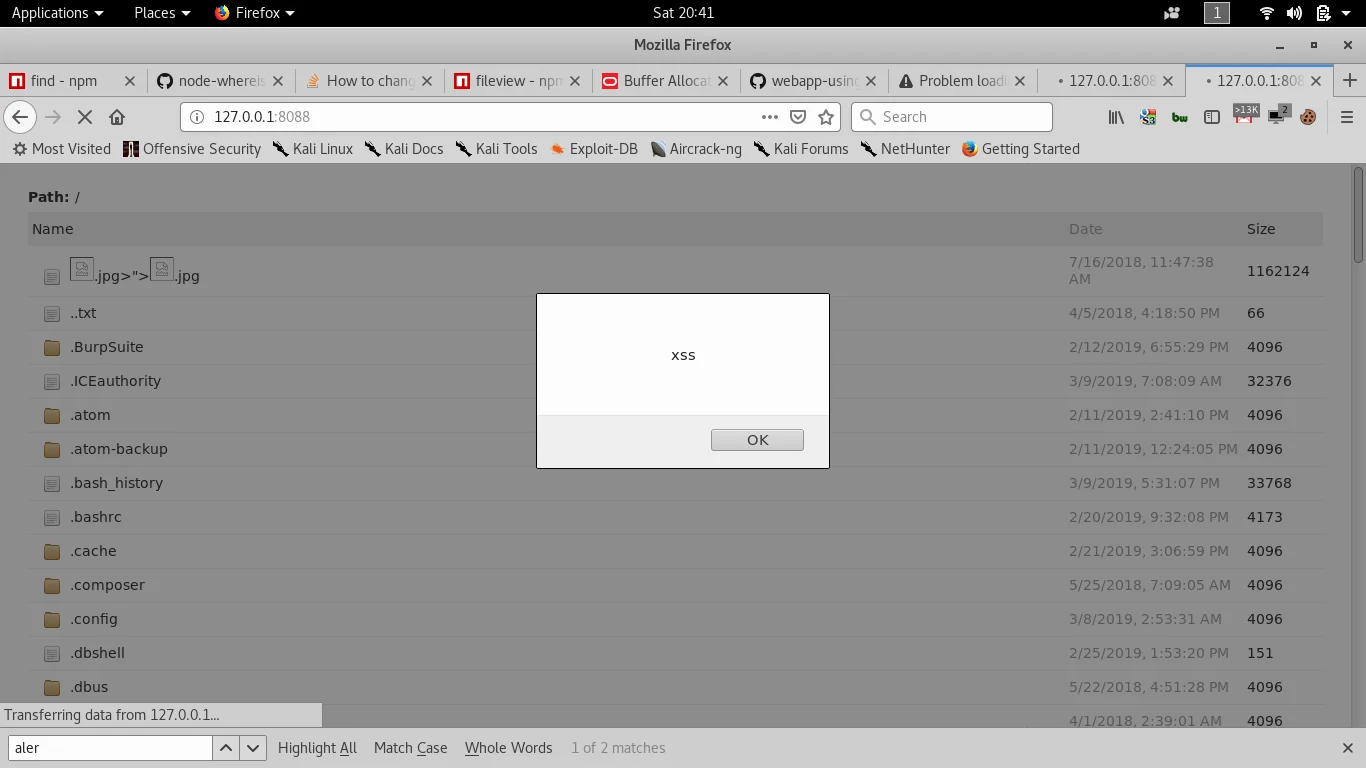
2:now create a file with xss payload as follows: "><img src=x onerror=alert("xss")>.jpg
3.running below command on terminal will start a file server at port 8080
fileview -p /root/ -P 8080
4.now goto http://127.0.0.1:8080/
you will see the xss got executed
Patch
If you're able to provide a patch with the fix please post it in this section
Supporting Material/References:
State all technical information about the stack where the vulnerability was found
- [OPERATING SYSTEM VERSION] KALI LINUX
- [NODEJS VERSION] 11.8.0
- [NPM VERSION] 6.5.0
Wrap up
Select Y or N for the following statements:
- I contacted the maintainer to let them know: [N]
- I opened an issue in the related repository: [N]
Impact
this could have allowed an attacker to embed malicious js code in filename and executes it when victim browse to file over the web browser
Attachments
Not written yet. The AI write-up for this report has not been written yet. The Original tab links to the source.
How it worked
Root cause
Likely the file listing page inserted filenames into HTML without escaping special characters.
Impact
An attacker could embed JavaScript in a filename that executes when a victim browses the file listing.
What the attacker needed
Ability to create a file with a crafted name; victim browses the file listing
How it was found
- Install the fileview package globally.
- Create a file whose name contains an HTML image tag with an error handler.
- Start the fileview server on a chosen port.
- Open the server's address in a browser and observe the script executing.
Explained by bugbounty.wiki with AI from the original and checked against quotes from it; it can still be wrong. Read the original before relying on a detail.
Not written yet. The AI write-up for this report has not been written yet. The Original tab links to the source.
A file server shows a list of files in a web page. If a filename contains HTML code, the browser may treat it as part of the page instead of plain text. Here, a filename with an image tag and an error handler ran JavaScript when the page loaded, which is called stored cross-site scripting because the malicious content is saved as a filename.
What is XSS?
Script an attacker supplies runs in another user's browser, on the target's origin, with that user's session.




