Paragonie Airship Admin CSRF on Extensions Pages
The admin endpoints for installing and managing extensions in Airship lack CSRF protection, so a malicious page could make a logged-in admin submit requests. If the install logic worked, this could potentially lead to remote code execution.

- Fixed in 3 months
- Paid in 4 months
- Disclosed after 4 months
Summary
The /bridge/admin/skyport/install endpoint, as well as some of the endpoints around it, are vulnerable to Cross-Site Request Forgery.
Description
The functions in src/Cabin/Bridge/Controller/Skyport.php in the Airship project appear to all be vulnerable to Cross-Site Request Forgery.
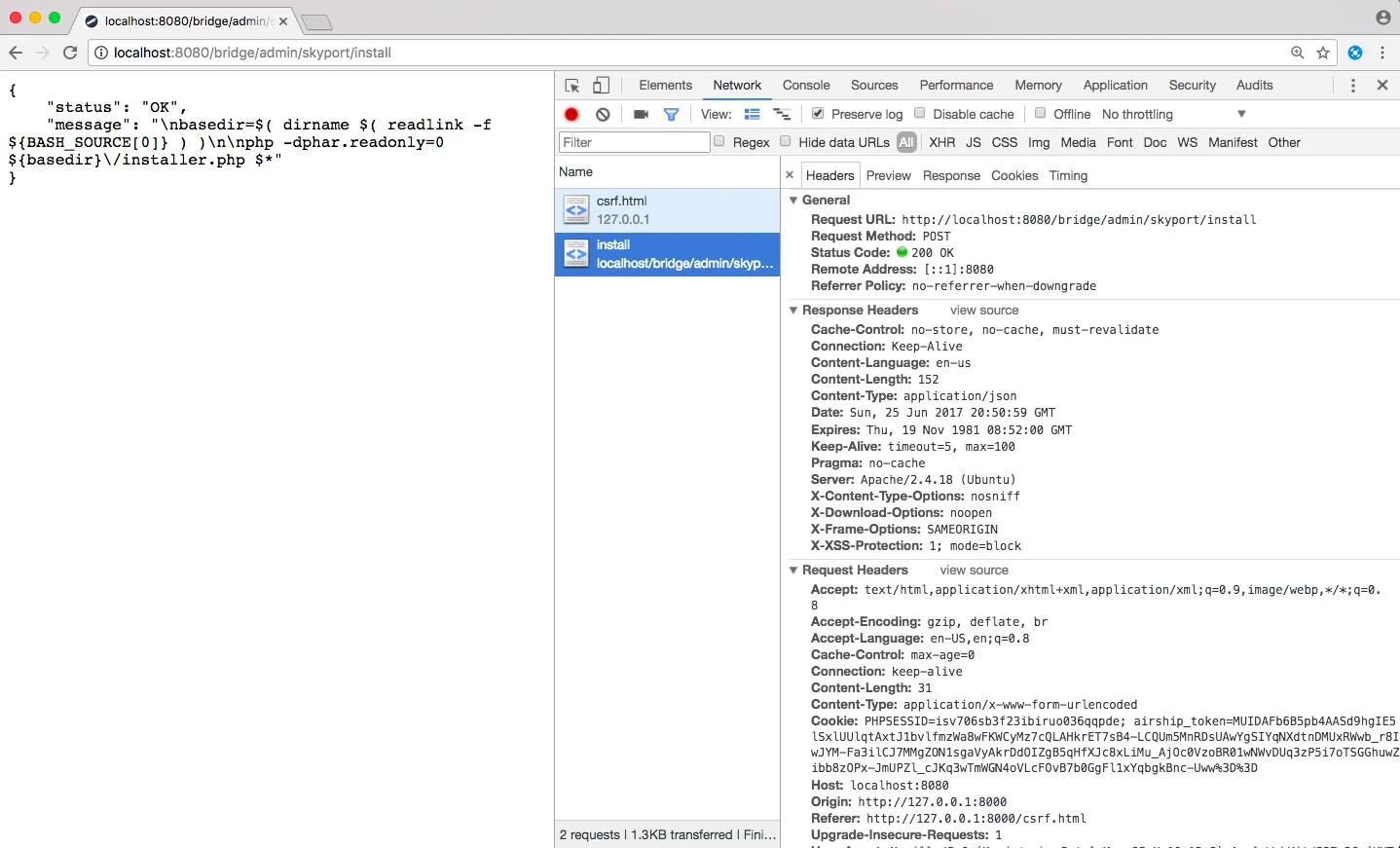
I would have put this as a high, but from my code review it appears that not all of these functions actually work - for example, the installPackage function appears to passing a bash script to the "php" command, which just ends up printing the bash script. Code review can be misleading, so I may be wrong about it not working.
I put this as a medium because, if the logic actually does work (or works sometime in the future), then the ability to install packages is the kind of thing that has the potential to be converted into an RCE.
Please revise the severity as you see fit - I don't know your product well enough to do a proper assessment.
Proof of Concept
I have attached a simple file which I was able to use to demonstrate the CSRF against airship running in a docker instance. It appears that the extra password-protection of extensions is not enabled by default, although that may be just my developer setup.
See the attached csrf.html. The attached screenshot shows the result that was returned from the server after clicking the submit button in the attached file.
Attachments
Not written yet. The AI write-up for this report has not been written yet. The Original tab links to the source.
How it worked
Impact
An attacker could perform admin actions such as installing packages, which may lead to remote code execution if the install logic works.
What the attacker needed
Victim is a logged-in admin; victim visits attacker page; extension password protection disabled
How it was found
- Host a malicious HTML page that submits a request to the install endpoint.
- Get a logged-in admin to open the page and click the submit button.
- The server processes the request as if the admin made it.
Explained by bugbounty.wiki with AI from the original and checked against quotes from it; it can still be wrong. Read the original before relying on a detail.
Not written yet. The AI write-up for this report has not been written yet. The Original tab links to the source.
Cross-Site Request Forgery (CSRF) is when a malicious website tricks your browser into sending a request to another site where you are already logged in. Here, an attacker could make an admin's browser install or change extensions without the admin knowing. The reporter thinks this might even let an attacker run their own code on the server.
What is CSRF?
Another site makes a signed-in user's browser perform an action they did not intend.