Stored Cross-Site-Scripting in CMS Airship's authors profiles
 Originally disclosed on HackerOne
- Fixed in under an hour
- Paid in under an hour
- Disclosed after under an hour
Summary by the program
For an in-depth analysis, check out the post-mortem posted on CSPR.NG.
Lessons learned:
- If you rely on auto-escaping, make sure it's being applied everywhere. Where it's not applied, escape manually.
- Be more skeptical of patterns intended to promote i18n.
- Turn off
Content-Security-Policyheaders when testing locally so it's easier to catch these failures.
The report
I'm just checking out CMS Airship and some of the security features look pretty nice. Awesome job on that!
After clicking around a bit I stumbled however upon a stored XSS vulnerability in the Bridge. As per /bridge/help I use 1.1.0 version (installed via Docker), as I couldn't find any reference with regard to this in the 1.1.1 changelog from https://github.com/paragonie/airship/commit/29dc60a1b0178222c3c984915f2eda6322ca3453 I believe that it probably is affected as well.
To reproduce this:
- Install CMS Airship
- Make sure to use the default settings (or at least do not uncheck "Enable registration")
- Take another browser tab and go to http://localhost:8081/bridge/board to register a new account
- Login with that account at http://localhost:8081/bridge/login
- Go to http://localhost:8080/bridge/author/new
- Create a new author with the name "<script>alert(1)</script>"
- Send the author edit link to another user, such as the captain user (e.g. http://localhost:8080/bridge/author/edit/3)
- Open it as captain
Then you see the XSS executed, or well, if your browser supports CSP a decent CSP warning in your browser console :-)
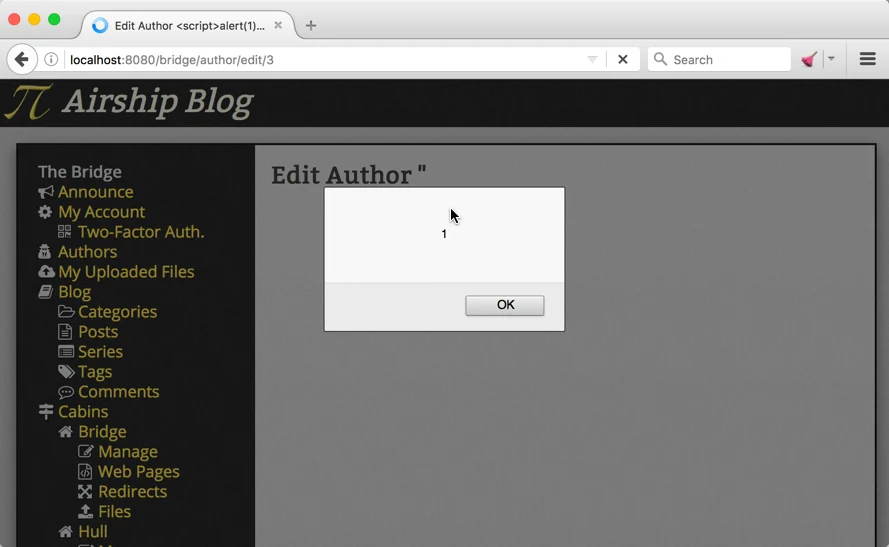
The HTML in question is:
<div id="bridge_main"> <h2>Edit Author "<script>alert(1)</script>" Details</h2>
<form method="post"><input type="hidden" name="_CSRF_TOKEN" value="ijYiRqBM1DKBw9Kevvn4zjEw:frKdBMZxXK3VUgI0ZEuQHdHerw9NnVwTx8a62QiJhiY3" />
<div class="table full-width table-pad-1">
<div class="table-row">
<div class="table-cell table-label">
<label for="author_name">Author Name:</label>
</div>
<div class="table-cell">
<input class="full-width" id="author_name" name="name" placeholder="e.g. Information Technology Department" value="<script>alert(1)</script>" type="text" />
</div>
</div>
Since I don't have libsodium and PECL installed locally on my dev machine I couldn't include a tested patch for this. Sorry :-)
Not written yet. The AI write-up for this report has not been written yet. The Original tab links to the source.
What is known
A XSS bug in Paragon Initiative Enterprises. HackerOne made it public on 1 July 2016.
About XSS
Script an attacker supplies runs in another user's browser, on the target's origin, with that user's session.
Not written yet. The AI write-up for this report has not been written yet. The Original tab links to the source.
What is XSS?
Script an attacker supplies runs in another user's browser, on the target's origin, with that user's session.




