CSP : Inline scripts can be inserted
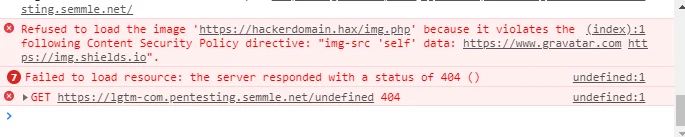
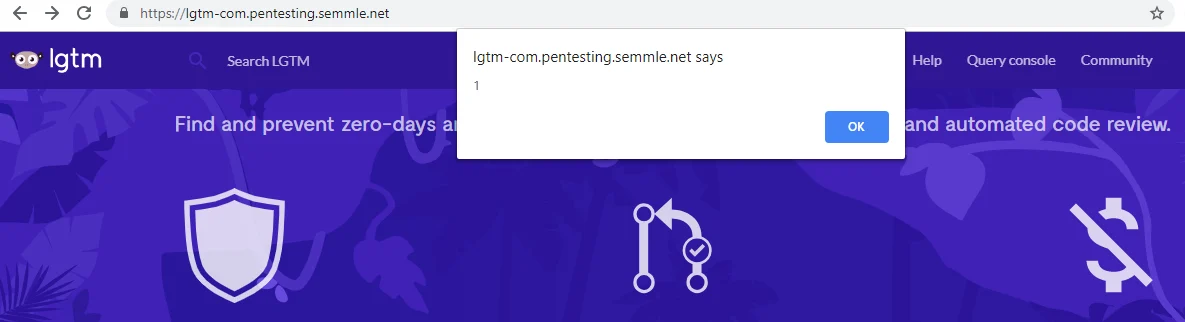
The Content Security Policy includes the 'unsafe-inline' directive, which allows inline scripts and event handlers to execute. An attacker who can inject HTML could therefore run malicious JavaScript, although the report does not demonstrate an actual injection point.

- Disclosed after 7 hours
Vulnerable URL:- https://lgtm-com.pentesting.semmle.net/
#Summery Content Security Policy (CSP) is a client-side security model which allows developers to specify where different types of resources should be loaded, executed and embedded from. With CSP you can instruct the browser only to load javascript resources from a specific domain as well as block inline javascript running on the website. This is very helpful against XSS since most attacks requires inline javascript.
#Issue detail The configuration removes the XSS sandboxing feature of Content Security Policy. The 'unsafe-inline' directive allows scripts to be inserted inline in the HTML page. An attacker will be able to use script html tag (<script>...</script>) or event handlers (onload, onerror, ...) to load malicious scripts.
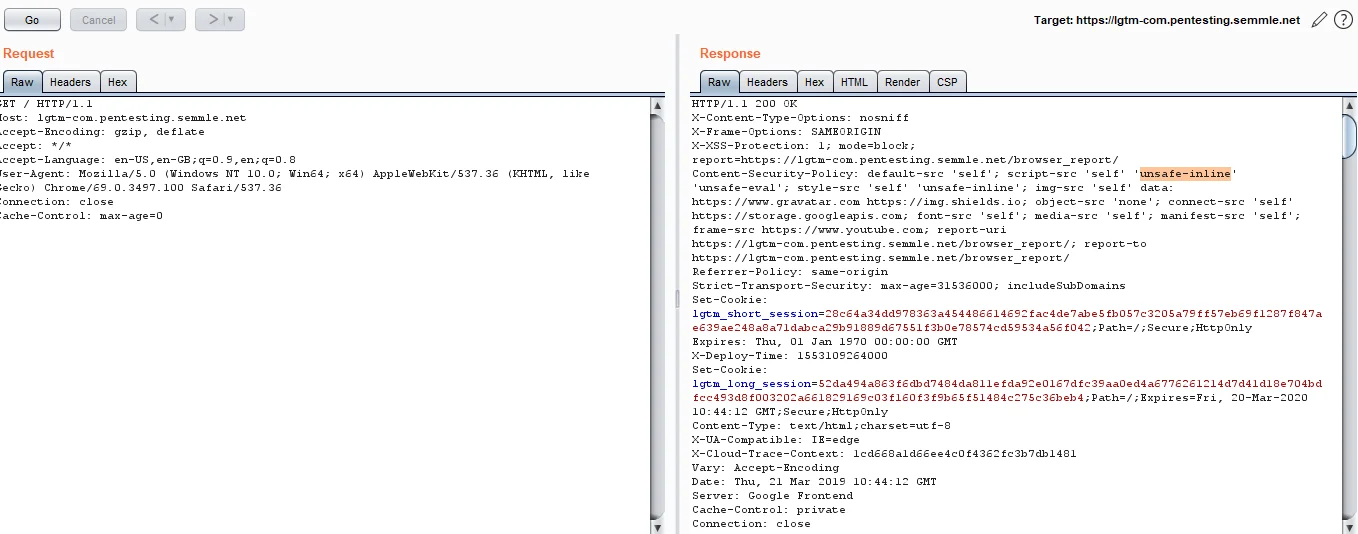
#Weak configuration script-src: 'unsafe-inline'
#Brup Responce HTTP/1.1 200 OK X-Content-Type-Options: nosniff X-Frame-Options: SAMEORIGIN X-XSS-Protection: 1; mode=block; report=https://lgtm-com.pentesting.semmle.net/browser_report/ Content-Security-Policy: default-src 'self'; script-src 'self' 'unsafe-inline' 'unsafe-eval'; style-src 'self' 'unsafe-inline'; img-src 'self' data: https://www.gravatar.com https://img.shields.io; object-src 'none'; connect-src 'self' https://storage.googleapis.com; font-src 'self'; media-src 'self'; manifest-src 'self'; frame-src https://www.youtube.com; report-uri https://lgtm-com.pentesting.semmle.net/browser_report/; report-to https://lgtm-com.pentesting.semmle.net/browser_report/ Referrer-Policy: same-origin Strict-Transport-Security: max-age=31536000; includeSubDomains X-Deploy-Time: 1553109264000 Content-Type: text/html;charset=utf-8 X-UA-Compatible: IE=edge X-Cloud-Trace-Context: b1a4900e9ad24c8d5eca45b4c3acc726;o=1 Vary: Accept-Encoding Date: Thu, 21 Mar 2019 07:06:31 GMT Server: Google Frontend Cache-Control: private Connection: close Content-Length: 11525
#Refrences https://developer.mozilla.org/en-US/docs/Web/HTTP/Headers/Content-Security-Policy/script-src http://www.html5rocks.com/en/tutorials/security/content-security-policy/ https://developer.mozilla.org/en-US/docs/Web/API/Window/postMessage https://speakerdeck.com/mikispag/making-csp-great-again-michele-spagnuolo-and-lukas-weichselbaum https://dubell.io/exploiting-weak-content-security-policy-csp-rules-for-fun-and-profit/ https://www.netsparker.com/web-vulnerability-scanner/vulnerabilities/content-security-policy-csp-not-implemented/ https://www.netsparker.com/blog/web-security/content-security-policy/
Impact
There is no direct impact of not implementing CSP on your website. However, if your website is vulnerable to a Cross-site Scripting attack CSP can prevent successful exploitation of that vulnerability. By not implementing CSP you’ll be missing out this extra layer of security.
Attachments
Not written yet. The AI write-up for this report has not been written yet. The Original tab links to the source.
How it worked
Root cause
Likely the CSP was configured with 'unsafe-inline' in the script-src directive, which permits inline scripts and event handlers.
Impact
There is no direct impact from the weak CSP alone; it only removes a defence that could have blocked an XSS attack if one existed.
What the attacker needed
An XSS vulnerability on the site
The fix
The CSP should be changed to remove 'unsafe-inline' from script-src.
Explained by bugbounty.wiki with AI from the original and checked against quotes from it; it can still be wrong. Read the original before relying on a detail.
Not written yet. The AI write-up for this report has not been written yet. The Original tab links to the source.
A Content Security Policy (CSP) is a set of rules a website sends to your browser to say where scripts and other resources may come from. One rule, 'unsafe-inline', tells the browser to allow scripts written directly inside the page, which weakens the protection against cross-site scripting (XSS), where an attacker slips their own script into a page. This report only notes that the rule is present; it does not show a way to actually insert a script.
What is XSS?
Script an attacker supplies runs in another user's browser, on the target's origin, with that user's session.




