[h1-2102] [PLUS] User with Store Management Permission can Make enforceSamlOrganizationDomains call - that should be limited to User Management Only
A user holding only the Store Management permission could call a GraphQL mutation that enforces SAML on an organisation's domains, an action meant to be reserved for users with User Management permission. This let a lower-privileged user change the organisation's SAML domain enforcement settings.

- Disclosed after 15 months
Summary:
[PLUS] User with Store Management Permission can Make enforceSamlOrganizationDomains call - that should be limited to User Management Only
Description:
User with Store management permission as shown in below screenshot
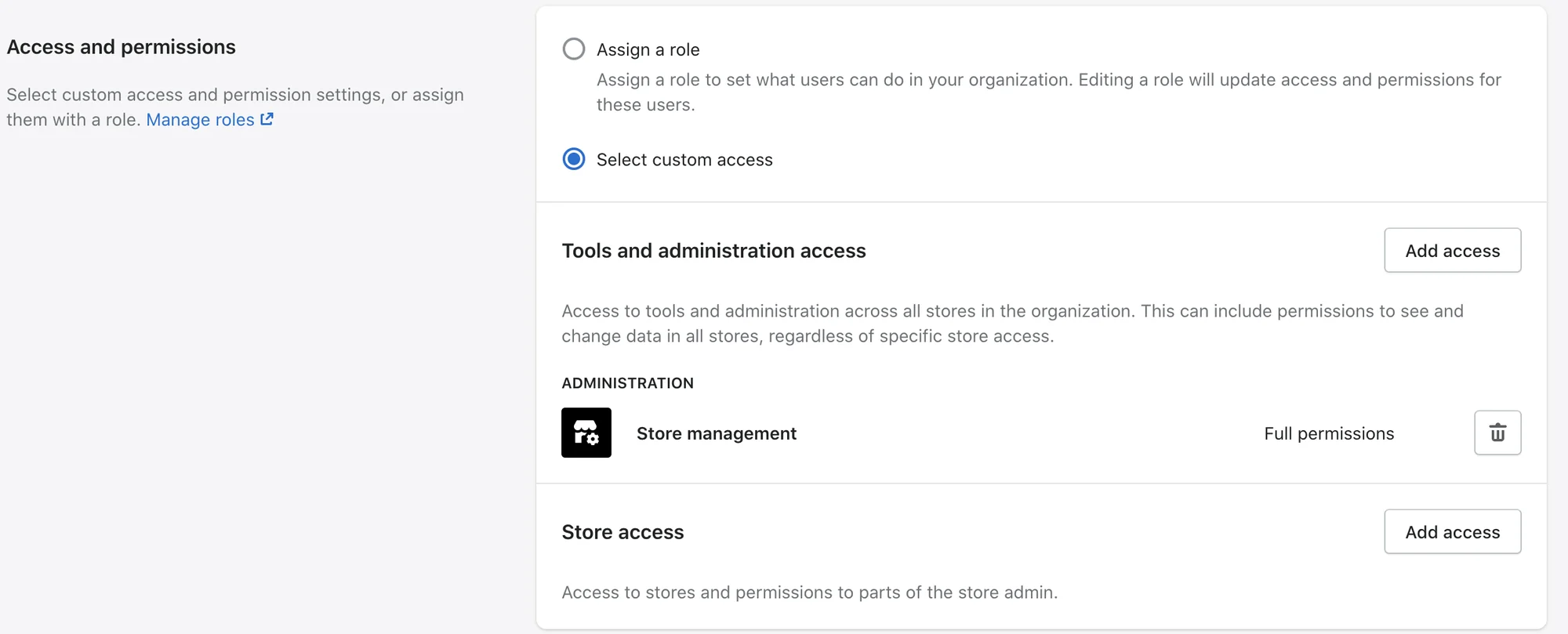
Should not have the ability to enforce SAML organization domains, because this should be limited to user with User Management permission only.
Steps To Reproduce:
- As an org plus admin, visit https://shopify.plus/:org_plus_id/users/invite and invite an user to have store management permission - (The purpose is to enable the low-privileged user to have access to https://shopify.plus/:plus_org_id/stores/api
- As an org plus admin, create a Org domain, by visiting
https://shopify.plus/:id/users/securityandAdd Domain - Now login as the low-privileged user we created in the first step
- Make this call to figure out the domain id of your organization as a low privileged user
POST /34946971/stores/api HTTP/1.1
Host: shopify.plus
User-Agent: Mozilla/5.0 (Macintosh; Intel Mac OS X 10.15; rv:83.0) Gecko/20100101 Firefox/83.0
Accept: application/json
Accept-Language: en-US,en;q=0.5
...

{"query":"query{organization{domains{id}}}"}
- Click around until you see the call to
POST https://shopify.plus/34946971/stores/api, send that to repeater and make the GraphQL call below - Make this GraphQL call to enforce SAML integration with that domain, with
REPLACE_MEreplaced by the user id you got from above steps
POST https://shopify.plus/34946971/stores/api
...
...

{"query":"mutation  {\n  enforceSamlOrganizationDomains(domainIds:[\"REPLACE_ME\"]) {\n   userErrors{message} }}\n"}
Impact
This action should not be carried out by users with Store management permission, although the impact is limited, this should still be restricted.
Not written yet. The AI write-up for this report has not been written yet. The Original tab links to the source.
How it worked
Root cause
Likely the GraphQL mutation enforceSamlOrganizationDomains lacked a permission check for User Management, so any user able to reach the stores API endpoint could invoke it.
Impact
A user with only Store Management permission could change the organisation's SAML domain enforcement, though the reporter notes the impact is limited.
What the attacker needed
An org plus account; admin invites a store-management user; an organisation domain exists
The fix
The mutation should be restricted to users holding the User Management permission.
How it was found
- As an org plus admin, invite a user with only store management permission so they can reach the stores API.
- As an org plus admin, add an organisation domain under the users security page.
- Log in as the low-privileged user.
- Send a GraphQL query to the stores API to read the organisation's domain id.
- Send a GraphQL mutation to the same endpoint to enforce SAML on that domain id.
Explained by bugbounty.wiki with AI from the original and checked against quotes from it; it can still be wrong. Read the original before relying on a detail.
Not written yet. The AI write-up for this report has not been written yet. The Original tab links to the source.
A company account has different roles, and each role is supposed to allow only certain actions. Here a role meant only to manage stores could also turn on a security setting that ties the company's email domains to SAML login, which should need a stronger role. The check on who may perform that action was missing or too loose.
What is Access control?
A user can do something their role should not allow: reach an admin function, act on a feature they have not paid for, or skip a permission check. IDOR is the special case where the object belongs to someone else.





