Critical IDOR - Delete any rule of any organization remotely
An IDOR flaw let any authenticated user delete any organisation's rule by changing the rule identifier in a DELETE request. The attacker could remove rules belonging to organisations they do not belong to.

- Triaged in under an hour
- Fixed in 2 hours
- Disclosed after 3 months
Hello Team,
I have found a critical IDOR issue which escalates a user privilege and allows and attacker to delete any rule of any organization remotely through his own account by just changing the [rule id] in DELETE Request.
This is again similar to previously reported critical IDORs to delete a member,group and venue. Thus, I am not writing steps again as they are same but just to perform under venue section.
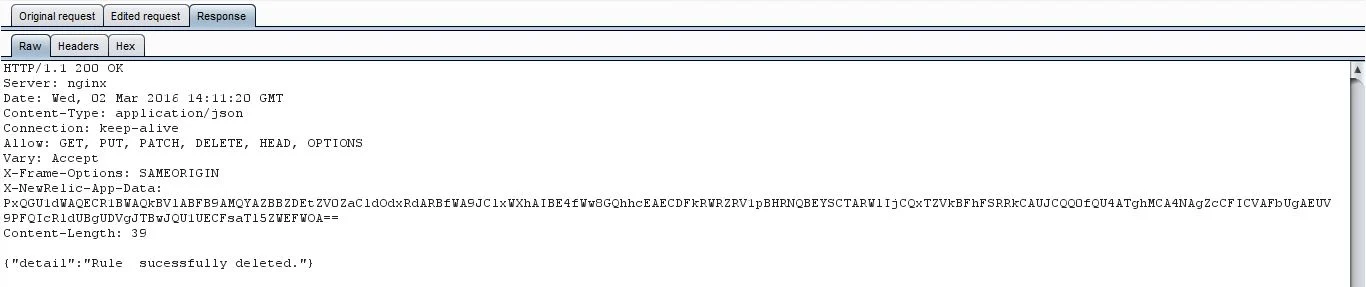
Proof of Concept: Please find the attached screenshots.
Best Regards,
Hely H. Shah
Attachments


Not written yet. The AI write-up for this report has not been written yet. The Original tab links to the source.
How it worked
Root cause
Likely the delete endpoint authorised the request only by the user being logged in, without checking that the rule belonged to an organisation the user had rights over.
Impact
Any authenticated user could delete rules belonging to any organisation, which could disrupt that organisation's configuration.
What the attacker needed
An account of your own; knowledge of a target rule identifier
How it was found
- Log in with your own account and go to the venue section.
- Send a DELETE request for a rule, then change the rule identifier to one belonging to another organisation.
- Check the screenshots showing the other organisation's rule is deleted.
Explained by bugbounty.wiki with AI from the original and checked against quotes from it; it can still be wrong. Read the original before relying on a detail.
Not written yet. The AI write-up for this report has not been written yet. The Original tab links to the source.
An IDOR (Insecure Direct Object Reference) happens when a website uses an identifier, like a number, to pick which item to act on but never checks that the person asking is allowed to touch that item. Here the delete request trusted the rule identifier alone, so anyone logged in could delete another organisation's rule by swapping in a different number.
What is Access control?
A user can do something their role should not allow: reach an admin function, act on a feature they have not paid for, or skip a permission check. IDOR is the special case where the object belongs to someone else.

