A Big company Admin Panel takeover $4500
An admin panel was protected by OAuth login, but adding a path traversal sequence (/;/) before the admin URL bypassed authentication. An attacker could access the admin panel and read all configurations, potentially exposing sensitive customer data.

It’s always starts with Shodan ( Again) and it was simply a dork :
The full write-up lives on its author's site
It belongs to its author, so we link to it rather than copy it. The other two tabs are our own rewrites, checked against it.
Context
This is a write-up of an admin panel takeover on a large company's production estate, found through internet-wide scanning and a path handling quirk in a Grails application. The affected software is the Grails Spring Security Core (GSSC) plugin, and the security team later confirmed the issue as CVE-2022-41923, described in the report as improper privilege management. The researcher's own summary of the bypass is:
CVE-2022–41923

bypass : /;/role/show/1 or /;/admin

Shodan : http.title:"Welcome to Grails"
The target normally behaves like any OAuth-protected admin application: browsing to the host redirects to Google login, and the admin and dashboard paths send you back to the OAuth login page. The report attributes the bypass to CVE-2022-41923 in the Grails Spring Security Core plugin.
Setup
The researcher was already a member of the company's private bug bounty program on HackerOne, so no new account or role was needed to report. The tools used were Shodan for discovery, a browser for manual browsing, Burp for crafting requests, and SecurityTrails for mapping the host to a subdomain. No versions of Grails, the GSSC plugin or the application are given in the report.
The precondition for the whole chain is an internet-facing Grails host that answers to the Shodan dork and sits behind OAuth login.
Finding it
The starting point was a Shodan search, described as a simple dork:
ssl:redacted.com "200"
About 18 IPs came back. The researcher picked one at random and browsed to it. The IP redirected to Google login every time.
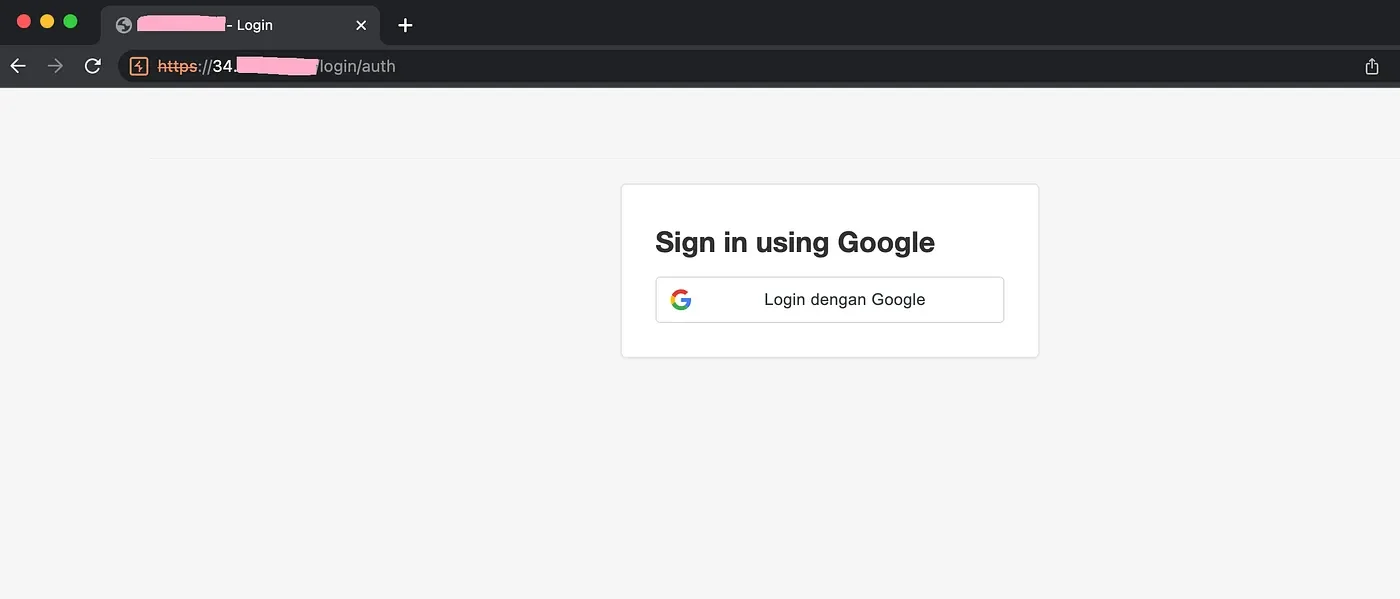
At this stage the researcher says they were not aware that the CVE mentioned later was related to this vulnerability. Two paths were then tested manually:
- redacted.com/admin
- redacted.com/dashboard
Both redirected back to the OAuth login page. The next test was the one that changed things: a /;/ was added in front of the admin page. The page rendered instead of redirecting.
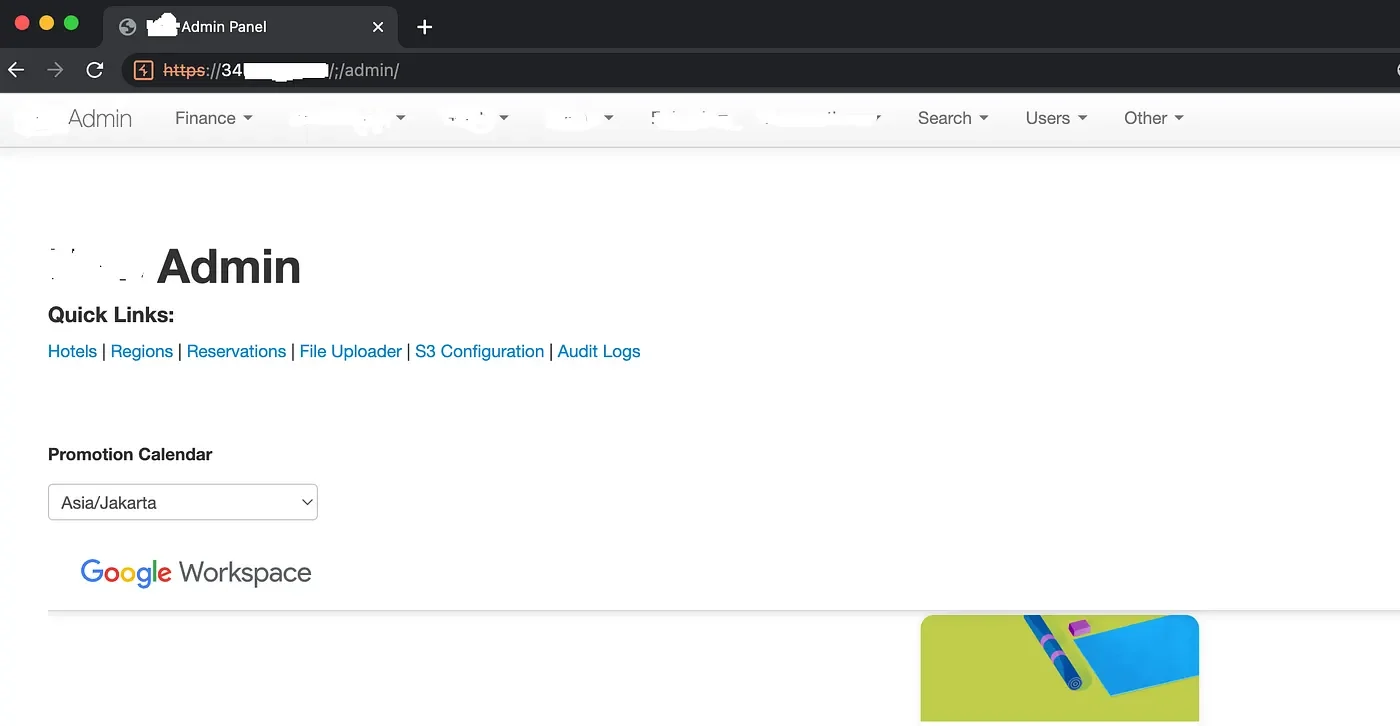
The researcher checked whether this was only a page display or a real bypass. Clicking another page sent the URL path back to /auth/login, which made the result ambiguous again. A request was then built in Burp to settle it.
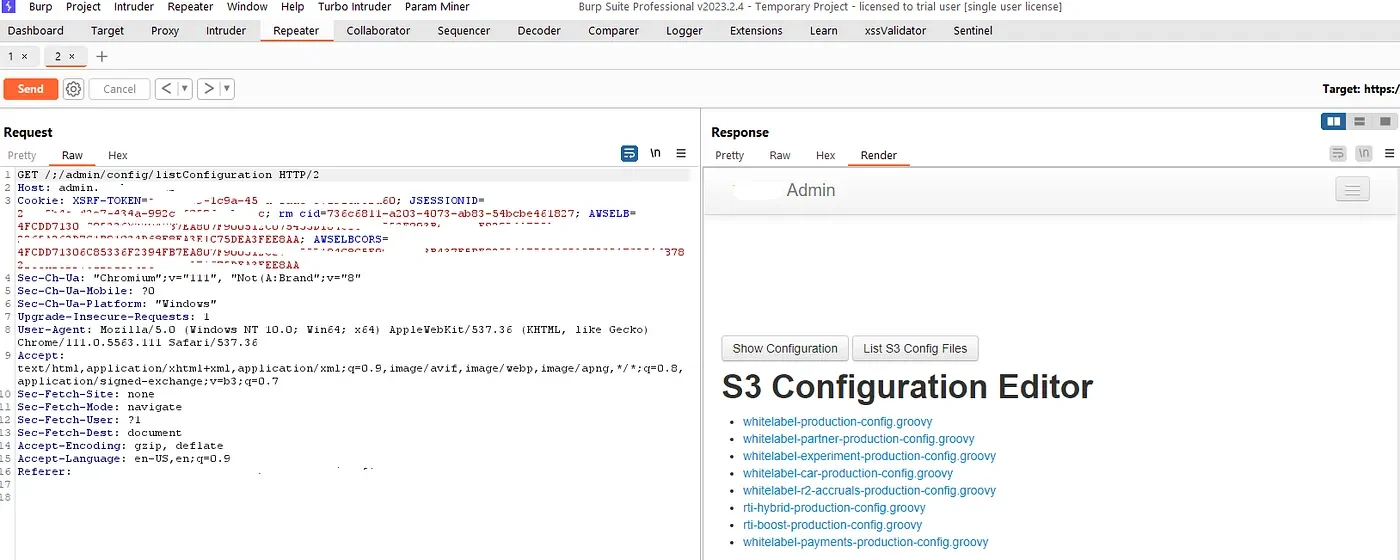
Before that request, the host was checked on SecurityTrails. The subdomain pointed at the host/IP was the IP of an admin subdomain of the company, so the Burp request was aimed at the subdomain rather than the IP.
Exploitation
Step 1: discover candidate hosts
The Shodan dork above returned roughly 18 IPs. One was picked at random. Browsing it redirected to Google login, which is the expected OAuth gate.
Step 2: probe the admin paths
Browsing redacted.com/admin and redacted.com/dashboard both redirected to the OAuth login page. Nothing unusual yet.
Step 3: insert the path parameter
Adding /;/ in front of the admin page returned the admin page instead of a redirect. The report does not give the exact URL used at this point beyond the /;/admin form shown in the summary. The page rendered, but following a link moved the path back to /auth/login, so the bypass looked partial in the browser.
Step 4: confirm with Burp against the real subdomain
SecurityTrails showed that the subdomain pointing at the host was an admin subdomain of the company. The Burp request was therefore sent to that subdomain, not the IP. The report shows the result as a screenshot rather than as a raw request or response.
With the request sent to the subdomain, the bypass held: the researcher could read all the configurations in the admin panel. The report does not reproduce the request line, headers or response body, so the exact form of the confirmed request is not available here.
Step 5: report and triage
The finding was reported through the private program. The HackerOne triage team processed it and forwarded it to the company's security team.
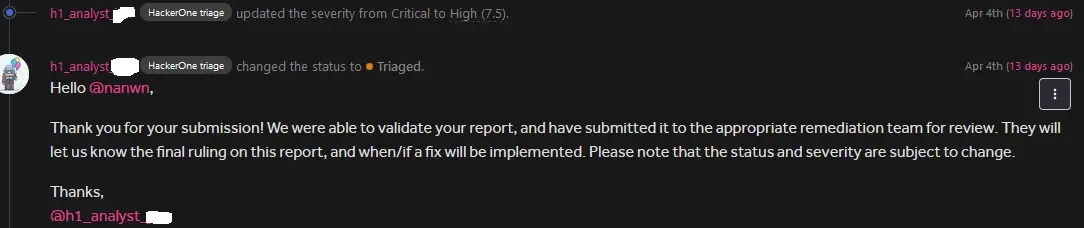
It was triaged. The researcher then read the program rules and questioned why the score had been set to HIGH rather than Critical, and set out the program's own Critical criteria:
- Unauthorized access to gain full control over any systems, sub-systems, end-user account
- Ability to access or modify end-user's financial information (credit card) or PII Information
- Code execution on production systems housing sensitive data and functionality
- Unauthorized access to administrative portals used in production
- SQL Injection with significant impact on production systems or mobile applications
- Authentication bypass to access production system or database
The argument was that points 1, 2, 4 and 6 were met, which in the researcher's view made a Critical 10.0 score appropriate. The CVSS vector quoted is:
3.1 AV:N/AC:L/PR:N/UI:N/S:U/C:H/I:H/A:H
The security team confirmed the severity.

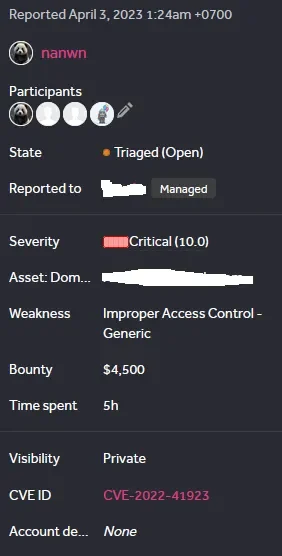
The researcher states that the maximal CVSS score was granted.
Step 6: CVE confirmation and patch
The security team confirmed the vulnerability was CVE-2022-41923, in the unpatched Grails Spring Security Core (GSSC) plugin, which can result in improper privilege management. The report links to the public advisory repository for the CVE.
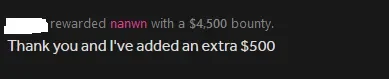
One to two weeks after triage, the company paid the maximal bounty. The team also confirmed the patch had been deployed, and after trying to log in again the researcher could no longer reach the admin panel.
Root cause
The report attributes the issue to CVE-2022-41923 in the unpatched Grails Spring Security Core plugin, which it describes as improper privilege management. The observable behaviour is that adding /;/ in front of the admin page returned the admin page instead of redirecting to login. In other words, the security layer and the application disagree about what the path is.
The report does not include the plugin's code or the application's filter configuration, so the precise matching logic is not shown here. In the browser, clicking another page returned the path to /auth/login, so a Burp request was used to confirm the bypass.
Impact
With the bypass working, the researcher could read all the configurations in the admin panel of a large company holding millions of customer records. The report states that, in the wrong hands, this could have led to a major data breach starting in 2023, and lists the data at risk as customer data including credit cards, virtual cards, a 21 million record database, 5 million transactions, company server configurations and other important data. Those figures are the researcher's description of what the environment held; the report does not show the data itself.
Fix
The fix was the patch for CVE-2022-41923 in the Grails Spring Security Core plugin. The company confirmed the patch deployment was completed, and the researcher verified afterwards that the admin panel was no longer reachable.
Variants to test
- Try
/;/adminand/;/role/show/1on other Grails hosts found withhttp.title:"Welcome to Grails". A positive result is the protected page rendering instead of a redirect to login. - Try the same path parameter in front of other protected segments, such as dashboard or role management paths. A positive result is content from the protected area appearing in the response.
- Confirm any browser-only success with a direct request in Burp against the subdomain rather than the IP, as the report did. A positive result is a response containing admin configuration rather than an OAuth redirect.
- Check whether the bypass survives navigation between pages. In the report, clicking through returned the path to
/auth/login, so a bypass that only renders the first page should be treated as unconfirmed until a direct request proves otherwise.
What happened, in plain words
A security researcher found a way to walk straight into the administration area of a large company's website without logging in. The admin area was supposed to be protected by Google login: you visit the page, you are bounced to Google, you sign in, and only then are you let through. The researcher discovered that by putting a small piece of text, /;/, in front of the admin page address, the login check was skipped and the admin page loaded anyway.
The security team confirmed the vulnerability was related to CVE-2022-41923 in the Grails Spring Security Core (GSSC) plugin. The problem has a public identifier, CVE-2022-41923, and the report describes it as improper privilege management, meaning the software got confused about who is allowed to do what. The company fixed it, paid the researcher the maximum bounty, and afterwards the admin page could no longer be reached.
This article walks through the whole story from zero. You only need to know how to use a browser. Every technical word is explained the first time it appears, and there is a glossary at the end.
Some background before the story
What an admin panel is
Almost every website has two faces. One is the public face that visitors see: product pages, articles, a login form. The other is the control room, usually called the admin panel or dashboard, where staff manage the site: they edit content, look at customer records, change settings. The control room is far more powerful than the public pages, so it is normally kept behind a login.
A useful comparison is a hotel. The lobby is open to anyone. The back office, where the booking system and the keys live, is behind a locked door that only staff can open. An admin panel is that back office.
What OAuth and Google login are
Many sites do not store your password themselves. Instead they let you sign in with an account you already have, such as your Google account. This arrangement is called OAuth. When you click "Sign in with Google", the site sends your browser to Google, Google asks you to confirm, and then Google sends you back to the site with proof that you signed in. The site trusts that proof and lets you in.
The everyday comparison is a members' club that accepts a passport as proof of identity instead of issuing its own membership card. The club does not check your identity itself; it trusts the passport office.
What a redirect is
A redirect is when a web page tells your browser "not here, go over there instead". You type one address, and the browser silently loads a different page. In this story, visiting the admin address redirected the browser to Google's login page. That redirect is the gate: if you never come back with proof of sign-in, you never see the admin page.
What a path is
Every web address has a path, the part after the site name. In redacted.com/admin, the path is /admin. In redacted.com/dashboard, it is /dashboard. Servers use the path to decide which page or feature you are asking for, and security software often uses the path to decide whether you are allowed in. For example, a rule might say "anything starting with /admin requires a logged-in user".
What a security filter is
Before a request reaches the actual application, it usually passes through a security filter, a piece of software that inspects the request and either lets it through or blocks it. Think of a receptionist who checks your name against a list before letting you into the building. The application behind the receptionist is the office itself.
The receptionist reads the address one way and decides you are not asking for the protected area, so she waves you through. The office reads the same address another way and hands you the protected files.
What Shodan is
Shodan is a search engine for internet-connected devices and servers rather than for web pages. Instead of indexing page text, it records what services are running on which addresses. Security researchers use it to find servers that share a characteristic, for example a particular page title or a particular piece of software.
A Shodan search is often called a dork: a query built from filters such as ssl: (the site's security certificate) or http.title: (the title shown in the browser tab).
What Burp is
Burp, short for Burp Suite, is a tool that sits between your browser and a website and lets you see and edit every request before it is sent. A browser hides a lot from you: it follows redirects automatically, adds headers, and does not let you easily change the address in the middle of a request. Burp lets you write a request by hand and read the raw answer. It is the equivalent of being able to open an envelope, change the letter inside, and reseal it before delivery.
What SecurityTrails is
SecurityTrails is a service that keeps records about domain names: which subdomains exist, and which IP address each one points to. A subdomain is a prefix on a domain, such as admin.example.com versus www.example.com. An IP address is the numeric address of a server, like a street address, while a domain name is the friendly name people type.
What a bug bounty program is
A bug bounty program is an arrangement in which a company invites outside researchers to look for security problems in its systems and pays them for valid findings. A private program is one you can only join by invitation. The company in this story ran a private program on HackerOne, a platform that hosts such programs. When a researcher submits a report, a triage team first checks that the finding is real and in scope, and then forwards it to the company's own security team.
What a CVE and CVSS are
A CVE is a public catalogue number for a known security flaw, so that everyone can refer to the same problem unambiguously. CVE-2022-41923 is the number for this flaw in the Grails Spring Security Core plugin.
CVSS is a scoring system that turns the characteristics of a flaw into a number from 0 to 10, where 10 is the most severe. The score is built from a vector, a short string of codes describing the conditions. A score of 10.0 is the maximum.
How the story goes
The researcher's own summary of the bypass, as given in the report, is:
CVE-2022–41923

bypass : /;/role/show/1 or /;/admin

Shodan : http.title:"Welcome to Grails"
Line by line:
CVE-2022–41923is the catalogue number of the flaw. The year 2022 is part of the number, which tells you when it was catalogued.bypass : /;/role/show/1 or /;/adminlists the two address forms that got past the login check. The first points at a role management page, the second at the admin page itself. The unusual part is the/;/at the start of the path.Shodan : http.title:"Welcome to Grails"is a search query for Shodan. It looks for servers whose page title is "Welcome to Grails". Grails is the web framework, a set of building blocks for making web applications, that the affected sites were built with. The title is a default page that such applications often show.
Starting with Shodan
The researcher began, as the report puts it, with Shodan again, using a simple dork:
ssl:redacted.com "200"
Line by line:
ssl:redacted.comrestricts the search to servers that present a security certificate for the company's domain. Certificates are what make the padlock appear in your browser; they are tied to a domain name, so this filter finds servers belonging to that organisation."200"is a quoted search term. In this context it narrows the results to servers that answered with the HTTP status code 200, which means "OK, here is the page". A server that returns 200 is alive and serving content.
Why start here? Because the researcher wanted a list of the company's internet-facing servers, without knowing any of their addresses in advance. Shodan does the finding for you.
About 18 IPs came back. The researcher picked one at random and browsed to it. Every time, the browser was redirected to Google login.
That redirect is the expected behaviour: the server is protected by OAuth, so an unknown visitor is sent to sign in. At this point the researcher notes they were not yet aware that the CVE mentioned later had anything to do with this.
Probing the admin paths
Two addresses were then tried by hand in the browser:
- redacted.com/admin
- redacted.com/dashboard
Both redirected back to the OAuth login page. Nothing unusual yet: the gate was doing its job.
The test that changed things
The next attempt added /;/ in front of the admin page. Instead of redirecting, the page rendered.
A semicolon in a path is a leftover from older web standards, where it could carry extra parameters. Some software treats everything after a semicolon as extra information and ignores it when matching rules, while other software treats the whole string as the path. If the filter ignores the semicolon segment and the application does not, the two disagree, and a request can slip past a rule that was meant to block it.
The researcher was surprised and immediately checked whether this was only a visual trick or a real bypass. Clicking another link inside the page sent the address back to /auth/login. That made the result ambiguous: perhaps only the first page had rendered, and the session was not really open.
Confirming with Burp
To settle the question, a request was built by hand in Burp. Before sending it, the researcher looked the host up on SecurityTrails. The subdomain that pointed at the host was an admin subdomain of the company, so the request was aimed at that subdomain rather than at the bare IP address.
Many sites host several subdomains on one machine and decide what to show based on the name in the request. The bare IP may not be configured the same way as the official admin subdomain.
With the request sent to the subdomain, the bypass held: the researcher could read all the configurations in the admin panel. The report shows the result as a screenshot rather than as a raw request or response, so the exact request line, headers and response body are not reproduced here.
Reporting and triage
The researcher reported the finding through the company's private bug bounty program. The HackerOne triage team processed it and forwarded it to the company's security team.
It was triaged, meaning the platform accepted it as a valid finding. The researcher then read the program's rules and questioned why the severity had been set to HIGH rather than Critical. The program's own list of what counts as Critical was quoted:
- Unauthorized access to gain full control over any systems, sub-systems, end-user account
- Ability to access or modify end-user's financial information (credit card) or PII Information
- Code execution on production systems housing sensitive data and functionality
- Unauthorized access to administrative portals used in production
- SQL Injection with significant impact on production systems or mobile applications
- Authentication bypass to access production system or database
The argument was that points 1, 2, 4 and 6 were met. In plain words: the researcher had reached an administrative portal used in production (point 4), without authorisation (point 1), by getting past the login check (point 6), and the environment held customer financial and personal data (point 2). PII means personally identifiable information, data that can identify a specific person.
The CVSS vector quoted in the report is:
3.1 AV:N/AC:L/PR:N/UI:N/S:U/C:H/I:H/A:H
Line by line, each code describes one property of the flaw:
3.1is the version of the CVSS scoring system being used.AV:Nmeans the attack vector is network: the attacker can reach the target over the internet, not only by sitting at the machine.AC:Lmeans attack complexity is low: no special conditions or lucky timing are needed.PR:Nmeans no privileges are required: the attacker does not need an account.UI:Nmeans no user interaction is required: nobody has to click anything for the attack to work.S:Umeans the scope is unchanged: the impact stays within the vulnerable component.C:Hmeans confidentiality impact is high: data can be read.I:Hmeans integrity impact is high: data can be changed.A:Hmeans availability impact is high: the service can be disrupted.
All three impacts at high, with no account needed and no user interaction, is what pushes the score to the maximum of 10.0.
The security team confirmed the severity.
The researcher states that the maximal CVSS score was granted.
CVE confirmation and the patch
The security team confirmed that the vulnerability was CVE-2022-41923, in the unpatched Grails Spring Security Core (GSSC) plugin, which can result in improper privilege management. The report links to the public advisory repository for the CVE.
One to two weeks after triage, the company paid the maximal bounty. The team also confirmed that the patch had been deployed, and after trying to log in again the researcher could no longer reach the admin panel. The gate was closed.
Why it worked
The report attributes the issue to CVE-2022-41923 in the unpatched Grails Spring Security Core plugin, described as improper privilege management. The observable behaviour is that adding /;/ in front of the admin page returned the admin page instead of redirecting to login. In other words, the security layer and the application disagree about what the path is.
The report does not include the plugin's code or the application's filter configuration, so the precise matching logic is not shown here. In the browser, clicking another page returned the path to /auth/login, so a Burp request was used to confirm the bypass. That is why the hand-built Burp request was needed to confirm it.
What was at risk
With the bypass working, the researcher could read all the configurations in the admin panel of a large company holding millions of customer records. The report states that, in the wrong hands, this could have led to a major data breach starting in 2023, and lists the data at risk as customer data including credit cards, virtual cards, a 21 million record database, 5 million transactions, company server configurations and other important data. Those figures are the researcher's description of what the environment held; the report does not show the data itself.
How it was fixed
The fix was the patch for CVE-2022-41923 in the Grails Spring Security Core plugin. The company confirmed the patch deployment was completed, and the researcher verified afterwards that the admin panel was no longer reachable. The report does not describe any additional mitigation beyond upgrading the plugin.
Things worth trying on other sites
These are the variants the report suggests testing, written for someone learning. Only ever test systems you own or have explicit permission to test; testing someone else's site without permission is illegal in most countries.
- Try
/;/adminand/;/role/show/1on other Grails hosts found withhttp.title:"Welcome to Grails". A positive result is the protected page rendering instead of a redirect to login. - Try the same path parameter in front of other protected segments, such as dashboard or role management paths. A positive result is content from the protected area appearing in the response.
- Confirm any browser-only success with a direct request in Burp against the subdomain rather than the IP, as the report did. A positive result is a response containing admin configuration rather than an OAuth redirect.
- Check whether the bypass survives navigation between pages. In the report, clicking through returned the path to
/auth/login, so a bypass that only renders the first page should be treated as unconfirmed until a direct request proves otherwise.
Timeline
| Event | Date |
|---|---|
| Reported | Apr 3rd |
| Triaged | Apr 4th |
| Bounty paid | Apr 12th |
Glossary
- Admin panel: the private control area of a website where staff manage content, users and settings.
- Authentication: proving who you are, usually by signing in.
- Authorisation: deciding what a proven user is allowed to do.
- Bug bounty program: an arrangement where a company pays outside researchers for valid security findings.
- Burp Suite: a tool that intercepts and lets you edit the requests your browser sends to a website.
- Cookie: a small piece of data a website stores in your browser to remember you between requests.
- Critical: the highest severity band in many bug bounty programs.
- CVE: a public catalogue number for a known security flaw.
- CVSS: a scoring system that rates a flaw from 0 to 10 based on its characteristics.
- CVSS vector: the short string of codes that describes those characteristics and produces the score.
- Dashboard: another name for an admin or management area.
- Dork: a search query built from filters, often used on Shodan or Google to find specific systems.
- Filter (security filter): software that inspects a request before it reaches the application and decides whether to allow it.
- Grails: a web framework, a set of building blocks for making web applications.
- GSSC (Grails Spring Security Core): a plugin for Grails that handles login and access control.
- HackerOne: a platform that hosts bug bounty programs and triages reports.
- Header: extra information sent alongside a web request or response, such as the browser type or a cookie.
- HTTP status code: a number a server returns to say how a request went, such as 200 for OK or 302 for a redirect.
- IP address: the numeric address of a server on the internet.
- OAuth: a way to sign in to a site using an account from another provider, such as Google.
- Path: the part of a web address after the site name, such as
/admin. - Path confusion: a bug where two pieces of software read the same path differently, so one applies a security rule and the other does not.
- PII: personally identifiable information, data that can identify a specific person.
- Private program: a bug bounty program you can only join by invitation.
- Production: the live systems real users and customers use, as opposed to a test environment.
- Redirect: an instruction from a server telling the browser to load a different address instead.
- Request: the message a browser sends to a server asking for a page or action.
- Response: the message a server sends back.
- SecurityTrails: a service that records which subdomains exist and which IP addresses they point to.
- Severity: how serious a flaw is judged to be, often expressed as a band such as Low, Medium, High or Critical.
- Shodan: a search engine for internet-connected servers and devices.
- Subdomain: a prefix on a domain name, such as
admin.example.com. - Token: a piece of data proving you signed in, sent with requests so the server recognises you.
- Triage: the first review of a bug bounty report, checking that the finding is real and in scope.
- Unpatched: software that has not yet had a known security fix applied.
- Vector (attack vector): in CVSS, how the attacker reaches the target, such as over the network.
- Vulnerability: a weakness in software that can be used to break its security.


