How can I obtain a $2k bounty solely based on curiosity?
A Cisco router exposed a Telnet service on port 7500 that allowed unauthenticated access to a restricted command interface. An attacker could connect and run limited commands, but the program rated the impact as minimal.

This is a good day to write a write-up. How can I earn a $2k bounty just by being curious about what is displayed in the search banner for ports, IP on Shodan, hunter.how or Censys.
The full write-up lives on its author's site
It belongs to its author, so we link to it rather than copy it. The other two tabs are our own rewrites, checked against it.
Context
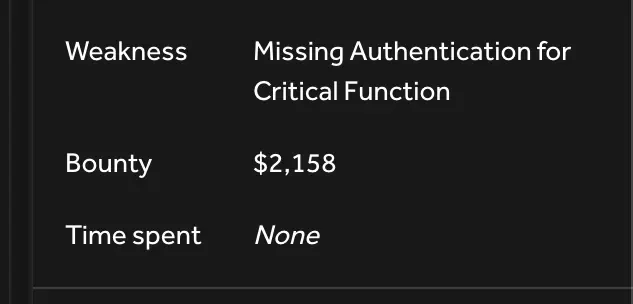
This write-up is about finding an exposed Cisco router management service through internet-wide scanning services, rather than through a web application. The researcher, nanwn, was browsing search results on Shodan, hunter.how and Censys, looking at the banners returned for ports and IP addresses. The weakness is classified as Missing Authentication. The bounty was 2158.00 USD, disclosed on 2023-10-13.
The feature in question is the router's vty-authd service, listening on port 7500. In a normal deployment this service should require authentication before it accepts commands. Here it did not.
Setup
The report does not describe any accounts, roles or special tooling beyond a terminal with telnet and access to Shodan, hunter.how and Censys. The precondition was simply a search query that surfaced the device.
Finding it
The researcher started from ordinary Shodan searches, using organisation and certificate filters:
org: "redacted inc"orssl:redacted.com
After looking up the IP address result on screen, the researcher examined the banner output from the results. The banner contained the string vty-authd# on an interesting port, 7500. Because the product was a Cisco router, the researcher decided to try Telnet first. As the researcher later explained, the banner and product pointed to Cisco Telnetd or a router, and only the port felt different.
Exploitation
Step 1: Connect over Telnet
The researcher connected to the IP on port 7500:
NAN:~/ $ telnet <redactedip> 7500 [14:41:32]Trying redactedip...Connected to redactedip.Escape character is '^]'.vty-authd# show ?show <carriage return> Completes command <number> verbosityvty-authd# show vty-authd# vty-authd# ? send send message set set authd debug settings show show information about AUTHD
The connection succeeded without any credential prompt. The prompt vty-authd# was returned directly, and the ? help output listed the available commands: send, set and show. The show ? output described the show command's arguments, including a carriage return to complete the command and a number for verbosity.
Step 2: Report and triage
The researcher wrote up the reports and received a triage response from the program staff, who assessed and triaged the finding. The same day, the bounty was paid.
Step 3: Severity discussion
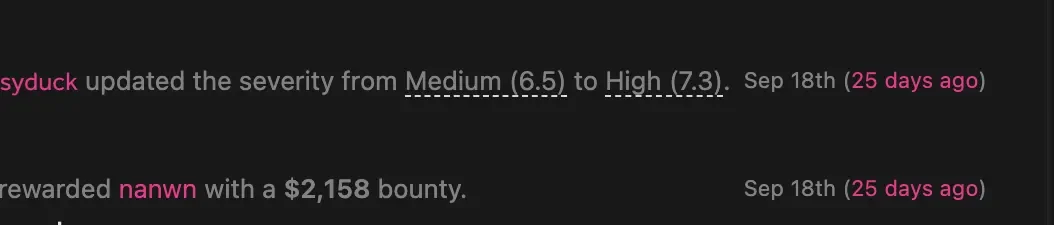
The researcher searched for the CVE associated with the finding and argued for critical impact severity. The program staff classified it as Missing Authentication for Critical Function (CWE-306), but considered the impact minimal because the access only exposed limited access to the router's user rules. Availability was set to low, and the researcher accepted that rating.
The report was then closed:
Redacted closed the report and changed the status to Resolved.
Thanks @nanwn for double checking. We have closed down the port and it should not let anyone connect anymore. Marking it as resolved.
Root cause
The service on port 7500 accepted Telnet connections and presented an interactive command prompt without asking for any credentials. In design terms, authentication was missing from a function that should have been protected, which is why the program mapped it to CWE-306. The report does not describe the device configuration or explain why the authentication check was absent, The report does not describe the device configuration or explain why the authentication check was absent.
Impact
An unauthenticated party who could reach port 7500 could obtain an interactive prompt on the router's vty-authd service and run the commands it exposes (send, set and show). According to the program, the practical impact was limited: the access only provided limited access to the router's user rules, and availability impact was rated low. The researcher had argued for critical severity, but the program's assessment prevailed.
Fix
The program closed the port. Their closing message states that the port has been shut down and should no longer accept connections. No code change is described.
Variants to test
The researcher published the dorks used, which can be reused against other programs:
-
Shodan dork:
"vty-authd#" -
Hunterhow dork:
protocol.banner="vty-authd#"The researcher notes there are numerous IP addresses to explore and invites anyone who finds a target within the program to credit the name.
Happy Hunting
Nan Winata
What happened, in plain words
A security researcher was browsing a public search engine for internet-connected devices. He noticed a strange banner (a short text greeting that a device sends when you connect to it) on an unusual port. He connected to it with a simple terminal tool, and the device let him in without asking for a username or password. He reported it, the company fixed it by closing the port, and he received a bounty. The weakness is classified as Missing Authentication.
This article explains every step for someone who has never done security work before. You only need to know how to use a browser and a computer.
Background: what are Shodan, hunter.how and Censys?
Most search engines index web pages. Shodan, hunter.how and Censys are different: they scan the whole internet and index devices and services that are reachable online, such as routers, cameras and servers. For each device they record the IP address (the numeric address of a machine on the internet, like a postal address) and the port (a numbered door on that machine; for example, web traffic usually goes to port 80 or 443). They also record the banner: the text the service sends back when someone connects. Think of a banner as the sign above a shop door: it tells you what is inside before you walk in.
Researchers use these services to find devices that should not be exposed to the public internet. The researcher in this case was doing exactly that: looking at search results for ports and IP addresses, and reading the banners.
The search
The researcher started with ordinary searches on Shodan, using filters for an organisation name and for a TLS certificate (the certificate that proves a website's identity). The report shows the query like this:
org: "redacted inc"orssl:redacted.com
In plain words: show me devices that belong to this organisation, or devices whose certificate mentions this domain. The report does not give the real organisation name or domain; they are redacted.
After running the search, the researcher looked up the IP address result on screen and examined the banner output. The banner contained the text vty-authd# on port 7500. That was interesting for two reasons. First, the text looked like a command prompt (the # at the end is a common sign of a prompt waiting for commands). Second, port 7500 is not a standard web port, so it suggested a management service rather than a normal website.
Why Telnet?
The researcher recognised the product as a Cisco router. Routers are the devices that direct traffic between networks, and Cisco is a major manufacturer. The banner and product pointed to Cisco Telnetd or a router, and only the port felt different. Telnet is an old protocol for opening a text session on a remote machine: you type commands and see the output in your terminal. It is not encrypted, which is why it is rarely used for anything sensitive today, but it is a quick way to check whether a service is reachable and what it says. Because the banner looked like a command prompt, the researcher decided to try Telnet first.
Step 1: Connect over Telnet
The researcher connected to the IP on port 7500 with this command:
NAN:~/ $ telnet <redactedip> 7500 [14:41:32]Trying redactedip...Connected to redactedip.Escape character is '^]'.vty-authd# show ?show <carriage return> Completes command <number> verbosityvty-authd# show vty-authd# vty-authd# ? send send message set set authd debug settings show show information about AUTHD
Line by line, in plain words:
NAN:~/ $ telnet <redactedip> 7500is the command typed in a terminal.telnetis the program,<redactedip>is the address of the device (redacted in the report), and7500is the port. The$is just the shell prompt showing that the user is ready to type.Trying redactedip...Connected to redactedip.means the connection was established. There was no request for a username or password.Escape character is '^]'.is a standard Telnet message telling you which key combination closes the session.vty-authd#is the prompt returned by the device. The name suggests a service calledvty-authd, and the#shows it is waiting for a command.show ?was typed to ask the device what theshowcommand accepts. The?is a help character.- The lines under it describe the arguments:
<carriage return>completes the command, and<number>sets verbosity (how much detail is printed). vty-authd# showwas typed, and the device returned another prompt without complaining.vty-authd# ?was typed to list the top-level commands. The device listedsend(send a message),set(set authd debug settings) andshow(show information about AUTHD).
The important point is that the connection succeeded without any credential prompt. The prompt vty-authd# was returned directly, and the help output listed the available commands. In other words, the door was open and the device was answering questions about what it could do.
Step 2: Report and triage
The researcher wrote up the reports and sent them to the program. Triage is the first stage of a bug bounty programme: the programme's staff read the report, check that it is valid, and decide how serious it is. The staff assessed and triaged the finding, and the same day the bounty was paid.
Step 3: Severity discussion
Severity is a rating of how much damage a vulnerability could cause. The researcher searched for the CVE associated with the finding. A CVE (Common Vulnerabilities and Exposures) is a public identifier for a known security flaw, like a catalogue number. He argued for critical impact severity, the highest level.
The programme staff classified it as Missing Authentication for Critical Function (CWE-306). CWE is a catalogue of weakness types, and CWE-306 means a function that should require a login does not require one. However, they considered the impact minimal because the access only provided limited access to the router's user rules. Availability was set to low. Availability is one of the three standard impact measures (confidentiality, integrity, availability); low availability impact means the flaw is unlikely to take the service down. The researcher accepted that rating.
The report was then closed:
Redacted closed the report and changed the status to Resolved.
Thanks @nanwn for double checking. We have closed down the port and it should not let anyone connect anymore. Marking it as resolved.
The first block is the programme's status message: the report was closed and marked Resolved. The second block is the programme's closing comment: they shut down the port so that nobody can connect to it anymore, and marked the report resolved.
Root cause
The service on port 7500 accepted Telnet connections and presented an interactive command prompt without asking for any credentials. In design terms, authentication was missing from a function that should have been protected, which is why the programme mapped it to CWE-306. The report does not describe the device configuration or explain why the authentication check was absent, The report does not describe the device configuration or explain why the authentication check was absent.
Impact
An unauthenticated party who could reach port 7500 could obtain an interactive prompt on the router's vty-authd service and run the commands it exposes (send, set and show). According to the programme, the practical impact was limited: the access only provided limited access to the router's user rules, and availability impact was rated low. The researcher had argued for critical severity, but the programme's assessment prevailed.
Fix
The programme closed the port. Their closing message states that the port has been shut down and should no longer accept connections. No code change is described.
Variants to test
The researcher published the dorks used. A dork is simply a search query that is designed to find something specific. These can be reused against other programmes:
-
Shodan dork:
"vty-authd#" -
Hunterhow dork:
protocol.banner="vty-authd#"The researcher notes there are numerous IP addresses to explore and invites anyone who finds a target within the programme to credit the name.
Happy Hunting
Nan Winata
Glossary
- Authentication: the process of proving who you are, usually with a username and password, before a system lets you do anything.
- Availability: one of the three standard impact measures; it describes whether a flaw can stop a service from working.
- Banner: the short text a service sends when someone connects, often revealing the software name and version.
- Bounty: a reward, usually money, paid by a company to a researcher who reports a valid security flaw.
- Censys: a search engine that indexes devices and services reachable on the public internet.
- Cisco: a major manufacturer of networking equipment such as routers.
- CVE (Common Vulnerabilities and Exposures): a public catalogue number for a known security flaw.
- CWE (Common Weakness Enumeration): a catalogue of weakness types, such as CWE-306 for missing authentication.
- CWE-306: Missing Authentication for Critical Function; a function that should require a login does not require one.
- Dork: a search query crafted to find specific results, often used on Shodan or Google.
- Hunter.how: a search engine that indexes internet-connected devices and their banners.
- IP address: the numeric address of a machine on the internet, like a postal address.
- Port: a numbered door on a machine; services listen on specific ports, such as 80 for web traffic.
- Router: a device that directs traffic between networks.
- Severity: a rating of how much damage a vulnerability could cause.
- Shodan: a search engine that indexes internet-connected devices and their banners.
- TLS certificate: a digital document that proves a website's identity and enables encrypted connections.
- Telnet: an old, unencrypted protocol for opening a text session on a remote machine.
- Triage: the first stage of a bug bounty programme, where staff check a report and decide how serious it is.
- vty-authd: the name of the service on port 7500 that the researcher found; it presented a command prompt.
- Vulnerability: a weakness in a system that can be exploited to cause harm.




