Abusing ‘Report Abuse’
The 'report abuse' feature on a forum allowed an attacker to view the contents of posts that were still pending moderation. By iterating over incremental post IDs, an attacker could read unapproved posts that might contain sensitive financial information.
 Published on aseemshrey.in
One fine day, I was invited to another private program, this being a foreign financial institution kind of company. I don't always invest time in foreign fintech companies because in most of the cases the setup itself requires a verified account and for that you need to submit some verification document and which I…
The full write-up lives on its author's site
It belongs to its author, so we link to it rather than copy it. The other two tabs are our own rewrites, checked against it.
Context
A private bug bounty program run by a foreign financial institution gave the researcher access to a product that included a discussion forum. The forum was moderated: every post went through a moderation queue before it appeared publicly. Each post on the forum carried a 'report abuse' feature, which lets a user flag a post for the moderators.
The researcher notes that he does not usually spend time on foreign fintech companies, because their setups typically require a verified account backed by a verification document for that country, which he did not have. This time he joined anyway, after a couple of months without bug hunting.
Setup
- A private program invitation for a foreign financial institution.
- A forum account on the target, with the ability to create posts and to report posts for abuse.
- A second account, created later, to verify the finding from a different user's perspective.
- No special tooling is described: the work was manual fiddling with the forum features.
Finding it
The researcher spent a couple of hours without finding anything, then came back to it later. He checked the forum for XSS and other common issues and found none. What he did observe was that posts went through a moderation queue, so a newly created post was not yet visible on the forum.
He then started experimenting with the forum's features. One of them was a 'report abuse' action attached to every post.
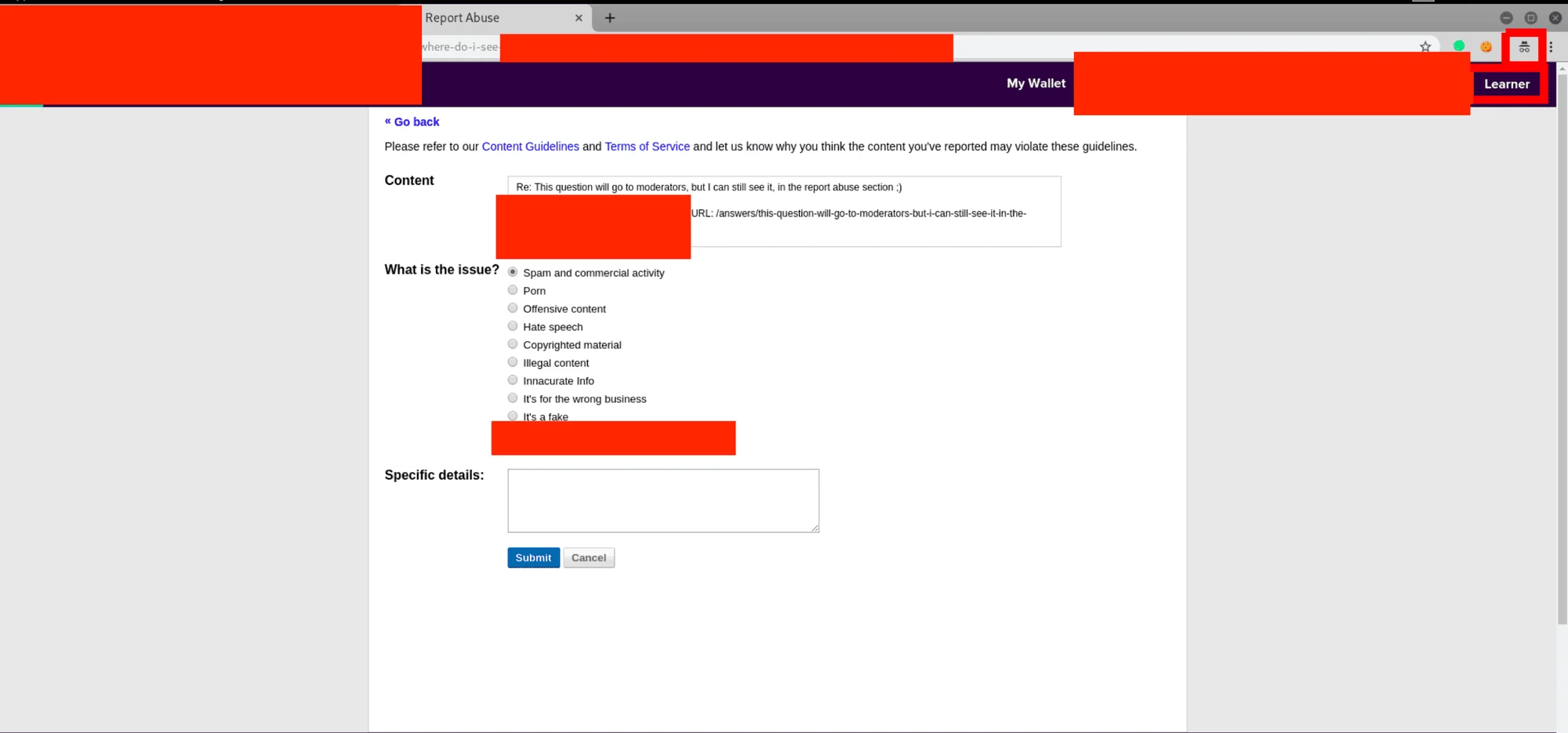
The screenshot shows a post he had created and then reported for abuse. The post was not yet available on the forum, but its contents could still be seen through the 'report abuse' path. That mismatch between the moderation queue and the report feature is what made the behaviour look wrong: a post that moderators had not approved should not be readable by anyone outside the moderation flow.
Exploitation
Step 1: create a post that sits in the moderation queue
The researcher created a post on the forum. Because of the moderation queue, the post was not published to the forum yet.
Step 2: report the post for abuse
He then used the 'report abuse' functionality on that post. Through the 'report abuse' path he could see the contents of the post, even though it had not been approved and was not visible on the forum.
Step 3: verify from a second account
To confirm this was not an artefact of his own session, he created another account. Using the report id, he sent a 'report abuse' request from that second account and could see the post that had not yet been posted. The report does not include the raw request or response, only this description of the verification.
Step 4: iterate over post ids
The post id was incremental. That made enumeration trivial: by iterating over the post id in the report abuse request, the researcher could read posts that had not yet been posted to the forum.
Root cause
The report abuse feature exposed the content of a post that had not passed moderation, and a second account could see it. The post was not visible on the forum, yet its contents could be seen through the report abuse path. Because post ids were incremental, iterating over them let him see posts that were not yet posted. The report describes the behaviour and the enumeration but does not show the underlying code or explain the implementation mistake.
Impact
An attacker with a forum account could read posts that moderators had not approved. On a financial forum this matters: if someone posted something financially important that the moderators rejected because it contained sensitive material that should not appear on the forum, an attacker could still read it. The researcher frames this as the concrete risk, and the enumeration over incremental ids means the exposure is not limited to posts the attacker already knows about.
Fix
The report does not state what was changed. The report does not state what was changed or recommended.
Variants to test
- Report or flag features on any moderated content type (forum posts, comments, classifieds, support tickets). Submit a report against an unapproved item from a second account and see whether the response includes the item body. A positive result is the full content of an item that is not visible on the public view.
- Sequential identifiers in report, preview, draft or notification endpoints. Change the id to neighbouring values and check whether items belonging to other users or to unapproved states come back. A positive result is content you should not be able to see, returned for ids you do not own.
- Draft and preview endpoints. Create a draft, then request it through preview, share or export paths from another account. A positive result is the draft body returned to an account that did not create it.
- Moderation queue leakage through secondary views such as search, RSS, sitemaps or activity feeds. A positive result is an unapproved item appearing in one of those views while absent from the main listing.
- Authorisation consistency between the listing endpoint and the detail endpoint. Compare what each returns for the same id from a low-privileged account. A positive result is the detail endpoint returning an object the listing endpoint hides.
What happened, in plain words
A security researcher was invited to a private bug bounty program. A bug bounty program is an arrangement where a company invites independent testers to look for security problems in its systems and pays them for reporting what they find, instead of those problems being found by criminals. This particular program belonged to a foreign financial institution, meaning a bank or similar money-related company based in another country.
The company ran a discussion forum, a website where users can write posts and reply to each other. The forum was moderated: every new post had to be checked by a moderator (a person who reviews content) before it appeared publicly. Each post also had a 'report abuse' button, which lets any user flag a post so the moderators can look at it.
The researcher found that through the 'report abuse' feature he could see the contents of a post even when that post had not yet been approved by the moderators. In other words, a post that was supposed to be invisible until a moderator said yes could be read through the report button. Because post numbers were handed out in order (1, 2, 3, and so on), he could walk through them one by one and read posts that had not yet been posted.
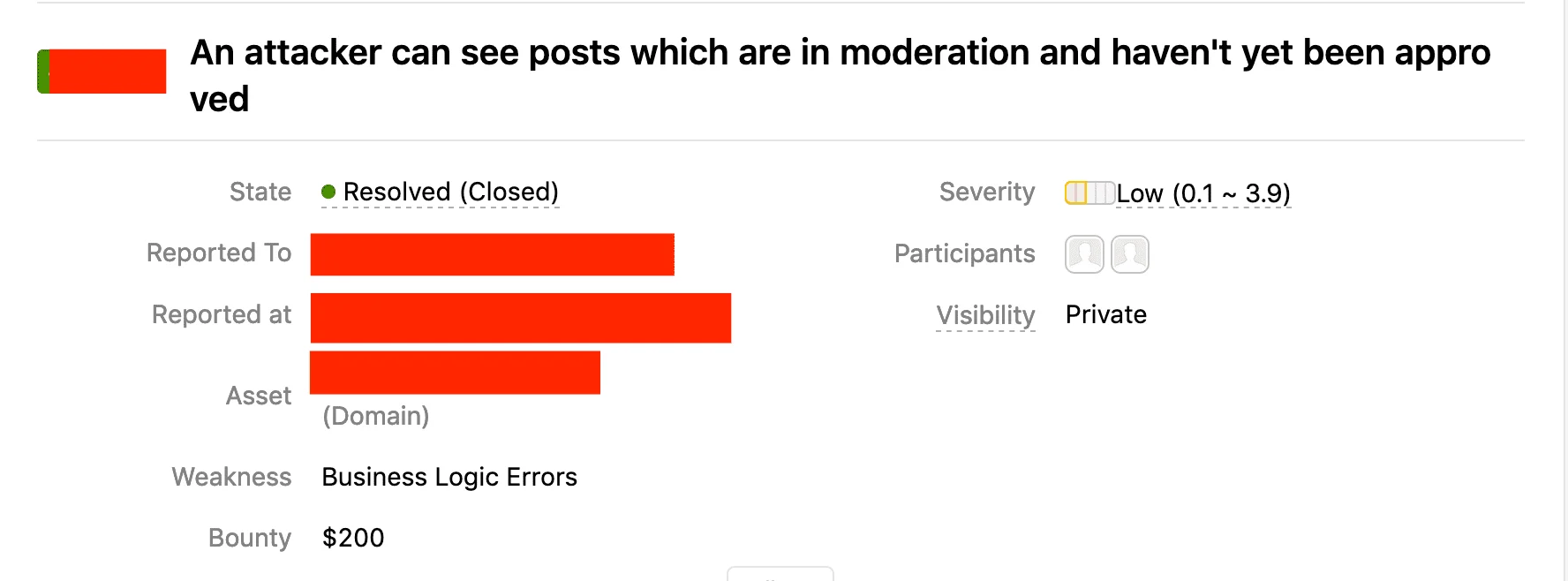
This is a logic flaw combined with broken authorisation. A logic flaw means the software does exactly what it was programmed to do, but the rules it follows are wrong: here, the rule 'only show approved posts' was simply not applied on one particular path. Broken authorisation means the software fails to check whether the person asking is allowed to see something. The researcher was paid 200.00 USD for the report.
The setup
Before the finding, a few things had to be in place:
- An invitation to the private program. Private means not everyone can join; the company picks who gets access.
- An account on the forum, able to create posts and to report posts for abuse.
- A second account, created later, to check the finding from a different user's point of view.
- No special tools. The work was done by hand, clicking around the forum features in a normal browser.
The researcher explains that he does not usually spend time on foreign fintech companies (fintech means financial technology, companies that build money-related software). The reason is practical: their setups typically require a verified account, and verification means uploading a document proving who you are for that country, which he did not have. This time he joined anyway, after a couple of months without doing any bug hunting.
Finding it
He spent a couple of hours without finding anything, then came back to the forum later. He checked for XSS and some other common issues and found none.
XSS, short for cross-site scripting, is a classic web bug where an attacker manages to get their own code (usually JavaScript, the language browsers run) to execute inside another user's browser, for example by typing it into a comment box that the site later displays without cleaning it. Finding none of that, he noticed something else: posts went through a moderation queue. A moderation queue is a holding area, like a tray next to a newspaper editor's desk, where submitted items wait until someone approves or rejects them. A newly created post was therefore not yet visible on the forum.
He then started experimenting with the forum's features. One of them was a 'report abuse' action attached to every post. The idea of the button is simple: a user sees something they think breaks the rules and clicks it, and the moderators get notified.
The screenshot shows a post he had created and then reported for abuse. The post was not yet available on the forum, but its contents could still be seen through the 'report abuse' path. That mismatch is what made the behaviour look wrong: a post the moderators had not approved should not be readable by anyone outside the moderation flow. Think of it as a letter held in the editor's tray: nobody outside the office should be able to read it, yet the report button acted like a window into the tray.
Exploitation, step by step
Step 1: create a post that sits in the moderation queue
The researcher created a post on the forum. Because of the moderation queue, the post was not published to the forum yet. This step exists to produce a test object: something that is definitely unapproved, so that any later appearance of it is clearly a bug.
Step 2: report the post for abuse
He then used the 'report abuse' functionality on that post. Through it he could see the contents of the post, even though it had not been approved and was not visible on the forum.
Why does this matter technically? When you click a button on a website, your browser sends a request to the server, the computer that holds the site's data. The server replies, often with data in a format the page can display. A request is just a message: 'please do this thing'. A response is the server's answer. Here, the report feature exposed the body of a post that the moderators had not approved.
Step 3: verify from a second account
To confirm this was not an artefact of his own session, he created another account. A session is the period during which a site remembers who you are, usually by giving your browser a cookie, a small piece of data the browser stores and sends back with every request. If you are logged in, the cookie is how the server knows it is you and not a stranger. Testing from a second account rules out the possibility that the site was simply showing him his own content because it recognised his session.
Using the report id, he sent a 'report abuse' request from that second account and could see the post that had not yet been posted. A report id is the number the site assigns to each abuse report; it identifies which report you are talking about. The report does not include the raw request or response, only this description of the verification.
Step 4: iterate over post ids
The post id was incremental. That made enumeration trivial: by iterating over the post id in the report abuse request, the researcher could read posts that had not yet been posted to the forum.
Enumeration means trying a series of values one after another to see what comes back, like dialling every number in a street to find out who lives where. Because ids were sequential (1, 2, 3, ...), there was no guessing involved: change the number, send the request, read the next unapproved post.
Why it worked
The report abuse feature exposed the content of a post that had not passed moderation, and a second account could see it. The post was not visible on the forum, yet its contents could be seen through the report abuse path.
An endpoint is a specific address on a server that does a specific job, like a counter in a large office building: one counter handles passports, another handles driving licences. The forum's normal view did not show the post, but the report path did. Because post ids were sequential, iterating over them let him see posts that were not yet posted.
The report describes the behaviour and the enumeration but does not show the underlying code or explain the implementation mistake.
Impact
An attacker with a forum account could read posts that moderators had not approved. On a financial forum this matters: if someone posted something financially important that the moderators rejected because it contained sensitive material that should not appear on the forum, an attacker could still read it. The researcher frames this as the concrete risk, and the enumeration over incremental ids means the exposure is not limited to posts the attacker already knows about.
In everyday terms: the moderation queue exists precisely to stop certain things from being seen. A feature that leaks the queue defeats the purpose of having one.
Fix
The report does not state what was changed. The report does not state what was changed or recommended.
Variants to test
If you want to look for similar problems yourself, these are the patterns worth trying. Each one is a variation on the same idea: a feature that shows you an object through a side door while the front door is locked.
- Report or flag features on any moderated content type (forum posts, comments, classifieds, support tickets). Submit a report against an unapproved item from a second account and see whether the response includes the item body. A positive result is the full content of an item that is not visible on the public view.
- Sequential identifiers in report, preview, draft or notification endpoints. Change the id to neighbouring values and check whether items belonging to other users or to unapproved states come back. A positive result is content you should not be able to see, returned for ids you do not own.
- Draft and preview endpoints. Create a draft, then request it through preview, share or export paths from another account. A positive result is the draft body returned to an account that did not create it.
- Moderation queue leakage through secondary views such as search, RSS, sitemaps or activity feeds. A positive result is an unapproved item appearing in one of those views while absent from the main listing.
- Authorisation consistency between the listing endpoint and the detail endpoint. Compare what each returns for the same id from a low-privileged account. A positive result is the detail endpoint returning an object the listing endpoint hides.
Glossary
- Bug bounty program: an arrangement where a company pays independent testers for reporting security problems to it.
- Private program: a bug bounty program that only invited researchers can join.
- Fintech: financial technology; companies that build software for money-related services.
- Forum: a website where users publish posts and reply to each other.
- Moderator: a person who reviews user content and decides whether it may appear.
- Moderation queue: a holding area where submitted content waits until a moderator approves or rejects it.
- Report abuse: a button or feature that lets a user flag content for the moderators to review.
- XSS (cross-site scripting): a bug where an attacker gets their own code to run inside another user's browser.
- JavaScript: the programming language that browsers run to make web pages interactive.
- Request: a message your browser sends to a server asking it to do something.
- Response: the server's answer to a request, often containing data.
- Server: the computer that stores a website's data and answers requests.
- Endpoint: a specific address on a server that performs a specific job.
- Session: the period during which a site remembers who you are.
- Cookie: a small piece of data stored by your browser and sent back to the site so it can recognise you.
- Report id: the number a site assigns to each abuse report to identify it.
- Post id: the number a site assigns to each post to identify it.
- Incremental / sequential id: identifiers handed out in order (1, 2, 3, ...), so the next one is easy to guess.
- Enumeration: trying a series of values one after another to see what comes back.
- Logic flaw: a bug where the software follows its programmed rules correctly, but the rules themselves are wrong.
- Broken authorisation: a bug where the software fails to check whether the person asking is allowed to see or do something.
- Authorisation check: the part of the software that decides whether a given user may access a given thing.
- Handler: the piece of code that processes a particular request.
- Draft: content saved but not yet published.
- RSS: a format that lets people subscribe to updates from a site.
- Sitemap: a file listing a site's pages, usually for search engines.
- Activity feed: a stream showing recent actions on a site.
- Low-privileged account: an account with only ordinary user rights, no special access.

