Access Control Violation – Wiki Page Creation
Anonymous users could register accounts without authorisation and then create wiki pages, which the organisation did not intend. An attacker could add unauthorised content to the site.
 Published on web.archive.org
Since I am starting this a bit behind the curve, I have a back log of 5-6 write ups at this point I will be catching up on. Below is the first vulnerability of the 2022 year submitted on 1/14/22.
The full write-up lives on its author's site
It belongs to its author, so we link to it rather than copy it. The other two tabs are our own rewrites, checked against it.
Context
The target ran MediaWiki, the open-source wiki software used by Wikipedia. The organisation behind the site appears to have intended it as a repository for its own data, not as a public, crowd-sourced wiki. That distinction matters for everything that follows: on a wiki whose whole purpose is open contribution, anonymous registration and page creation are features; on a private data repository with a reputation to protect, they are an access control problem.
The feature at the centre of the report is MediaWiki's handling of a page title that does not exist. When a user lands on such a title, the software offers to create the page. The researcher classified the resulting issue as an Access Control Violation, because content creation on an organisation's website should sit behind some form of authorisation.
Setup
No special tooling is described. The researcher's stated process on well-known technology stacks is to skim the CVE list for the product, in this case MediaWiki, at https://cve.mitre.org/cve/. He notes that a large number of MediaWiki vulnerabilities are listed but that few public proofs of concept exist for them.
The precondition that made the finding possible was that anonymous users on the internet could register accounts on the target site without any additional authorisation. The researcher acknowledges this is the spirit of MediaWiki, crowd-sourcing a knowledge base, but argues it was almost certainly not the organisation's intention.
Finding it
While reviewing the MediaWiki CVEs, the researcher picked one related to an arbitrary file read through the application's API. He attempted that exploit and instead landed on a page that was not found. The error page carried a message that stood out:
There is currently no text in this page. You can search for this page title in other pages, search the related logs, or create this page.
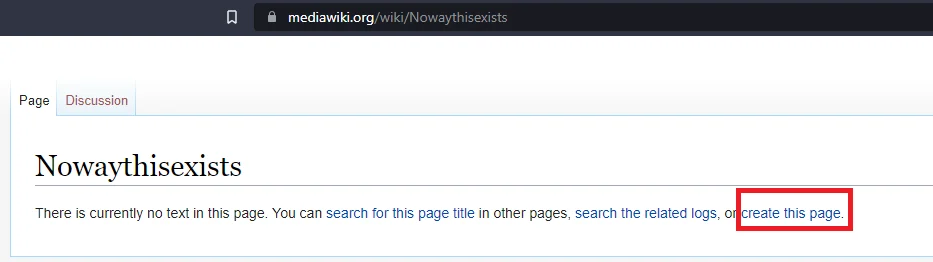
The screenshot shows that error page together with the "create this page" option, as rendered on MediaWiki's own site. The subtlety is the point: it would be easy to see a not-found page, conclude the exploit failed and move on, without registering that the page was offering a route to create content. The researcher describes this as the lesson of the engagement, to pay attention to small differences in error messages.
Exploitation
Step 1: Register an account
Anonymous visitors could register accounts on the site with no additional authorisation step. This gave the researcher an authenticated session on the wiki without any approval from the organisation.
Step 2: Attempt the known API file read
The researcher tried the arbitrary file read through the API that he had found in the CVE list. The attempt did not succeed and returned a page-not-found response instead.
Step 3: Read the error page rather than dismissing it
The not-found response contained the "create this page" option. The not-found response contained the "create this page" option, which offers a route to create a new wiki page under the requested title. Because the account from step 1 required no authorisation, that route was open to him.
Root cause
The design of MediaWiki does not provide fine-grained authorisation for users. The researcher explains that there is little in the way of authorisation controls in the product, and that MediaWiki itself states this on its documentation and recommends that organisations needing more fine-grained control use a different content management system. The organisation appears to have deployed MediaWiki as a private data repository while leaving open registration in place, so the software behaved as designed but the organisation had not yet seen open registration as an issue.
Impact
The researcher frames the impact in terms of reputation and content integrity: an organisation with a reputation to uphold was allowing anyone on the internet to create pages on its site. He is explicit that the same behaviour would be far less of a problem for an organisation like MediaWiki or Wikipedia, whose purpose is open contribution, and that the severity comes from the mismatch between the software's defaults and this organisation's intent. The report does not describe any further use of the created page, such as hosting malicious content or phishing, and does not state what the organisation did with the page afterwards.
Fix
The report does not say what the organisation changed. The researcher notes that MediaWiki itself recommends organisations needing more fine-grained control use a different CMS.
Variants to test
- Default wiki deployments behind a private brand. Register an account and try to create a page. A positive result is a successful page creation on a site whose content is clearly meant to be internal.
- Error pages that offer actions. Trigger not-found responses on other applications and look for links or buttons that create, edit or import content. A positive result is an unauthenticated or self-registered user reaching a creation flow.
- Known CVEs without public PoCs. Pick entries from a product's CVE list that lack published exploits and attempt them, watching the responses rather than only the success path. A positive result is any response that reveals an unintended capability, even when the original exploit fails.
- Open registration on self-hosted software. Check whether account creation requires approval or invitation. A positive result is an account that grants content privileges immediately after self-registration.
This was the researcher's first vulnerability of 2022, submitted on 1/14/22, scored 6.5/10, and rewarded with $522.50.
What happened, in plain words
A security researcher found that a website was running MediaWiki, the free software that powers Wikipedia. MediaWiki is a wiki: a website whose pages anyone with an account can write and edit. That is perfect for Wikipedia, whose whole point is that strangers from all over the world build it together. But this particular organisation was not trying to build a public encyclopedia. It was using MediaWiki as a private store for its own data, and it had left the doors open: anyone on the internet could sign up for an account, and anyone with an account could create new pages on the site.
The researcher did not find this by guessing. He was working through a list of known bugs in MediaWiki, called CVEs, and tried one of them out. That attempt failed, but the failure page had a small link on it offering to create the page he had asked for. That link was the real problem. Because signing up needed no approval, a stranger could follow it and reach a route to put content on the organisation's website. He reported it as an access control violation, meaning the site was letting people do something they should have needed permission to do. It was his first finding of 2022, submitted on 1/14/22, scored 6.5 out of 10, and paid $522.50.
The target and why the setting matters
The site ran MediaWiki, the open-source wiki software used by Wikipedia. The organisation behind the site appears to have meant it as a repository for its own data, not as a public, crowd-sourced wiki.
That difference is the heart of the whole story. Think of two noticeboards. One is in a public square with a box of blank cards next to it, and the whole idea is that passers-by pin up notes. The other is in an office corridor and is meant only for staff. If the office noticeboard also has a box of blank cards and no lock on the door, nothing is technically broken, but the wrong people can write on it. On a wiki built for open contribution, anonymous registration and page creation are features. On a private data repository with a reputation to protect, the same behaviour is an access control problem.
The feature at the centre of the report is how MediaWiki handles a page title that does not exist yet. When a user lands on such a title, the software offers to create the page. The researcher classified the resulting issue as an Access Control Violation, because content creation on an organisation's website should sit behind some form of authorisation.
Setup: how the researcher got started
No special tooling is described. The researcher's stated process on well-known technology stacks is to skim the CVE list for the product, in this case MediaWiki, at https://cve.mitre.org/cve/.
A CVE is a public catalogue entry for a known security flaw in a piece of software. Each entry gets an identifier, and the catalogue is a shared reference so that defenders, vendors and researchers all talk about the same bug. Skimming it is like reading the recall notices for a car model you own: it tells you which parts are known to fail, so you know where to look. He notes that a large number of MediaWiki vulnerabilities are listed but that few public proofs of concept exist for them. A proof of concept is a working demonstration, often a short script, that shows the bug actually happening. Few public proofs of concept means the entries describe the flaw but nobody has published a ready-made recipe, so you have to work out the details yourself.
The precondition that made the finding possible was that anonymous users on the internet could register accounts on the target site without any additional authorisation. In plain terms: the sign-up form was open to everyone, and nobody had to approve the new account. The researcher acknowledges this is the spirit of MediaWiki, crowd-sourcing a knowledge base, but argues it was almost certainly not the organisation's intention.
Finding it: the failed exploit that mattered
While reviewing the MediaWiki CVEs, the researcher picked one related to an arbitrary file read through the application's API. Two ideas need unpacking here.
An API is the part of a website that programs talk to, rather than the part humans click on. When you load a page in your browser, the site sends back a finished page with text and pictures. When a program talks to the API, it asks for raw data and gets raw data back. Think of a restaurant: the dining room is the website you see, and the kitchen door where orders are handed in is the API. Both lead to the same kitchen, but the door is meant for staff and delivery drivers.
An arbitrary file read is a bug where the software can be tricked into handing back a file from the server that it was never supposed to show, such as a configuration file or a password file. "Arbitrary" means the attacker chooses which file, rather than being limited to the ones the site intends to serve.
He attempted that exploit and instead landed on a page that was not found. The error page carried a message that stood out:
There is currently no text in this page. You can search for this page title in other pages, search the related logs, or create this page.
The screenshot shows that error page together with the "create this page" option, as rendered on MediaWiki's own site. The subtlety is the point: it would be easy to see a not-found page, conclude the exploit failed and move on, without registering that the page was offering a route to create content. The researcher describes this as the lesson of the engagement, to pay attention to small differences in error messages.
Why does this matter so much? Most people, and plenty of researchers, treat an error page as a dead end. You tried something, it did not work, you go back. But an error page is still the application talking to you, and it can reveal what the application is willing to do next. Here it was saying, in effect, "there is nothing here yet, would you like to make something?" That is an invitation to write, and on a site that was supposed to be read-only for outsiders, an invitation to write is the vulnerability.
Exploitation
Step 1: Register an account
Anonymous visitors could register accounts on the site with no additional authorisation step. This gave the researcher an authenticated session on the wiki without any approval from the organisation.
A session is how a website remembers who you are between page loads. When you log in, the site gives your browser a small piece of data, usually stored in a cookie, and your browser sends it back with every request. The cookie is like the wristband you get at an event: the door staff do not check your ID again at every room, they just look at the band. An authenticated session simply means the site now treats your requests as coming from a logged-in user. The point here is that the researcher obtained that wristband himself, through the open sign-up form, with nobody at the organisation approving it.
Step 2: Attempt the known API file read
The researcher tried the arbitrary file read through the API that he had found in the CVE list. The attempt did not succeed and returned a page-not-found response instead.
This step is worth pausing on, because it is the part beginners skip. He did not stop when the exploit failed. He read what came back. The response was not a blank error or a generic "something went wrong"; it was a page-not-found response with an offer attached.
Step 3: Read the error page rather than dismissing it
The not-found response contained the "create this page" option. Following that option allows a user to create a new wiki page under the requested title. Because the account from step 1 required no authorisation, the researcher could create content on the organisation's site.
So the chain is short and entirely manual: sign up, try the known bug, get a not-found page, notice the create link. No special tools, no scripts. The only unusual skill involved was reading an error message carefully instead of closing the tab.
Root cause: why the software allowed it
The design of MediaWiki does not provide fine-grained authorisation for users. The researcher explains that there is little in the way of authorisation controls in the product, and that MediaWiki itself states this on its documentation and recommends that organisations needing more fine-grained control use a different content management system.
A content management system, or CMS, is software for building and running a website's content without writing it all by hand. "Fine-grained" authorisation means being able to say precisely who may do what: this group may edit, that group may only read, only these people may create new pages. MediaWiki's model is coarse: it is built around the assumption that the crowd contributes.
The organisation appears to have deployed MediaWiki as a private data repository while leaving open registration in place, so the software behaved as designed but the organisation had not yet seen open registration as an issue. Nothing was broken in the code. The mismatch was between what the software does by default and what the organisation assumed it was getting.
Impact
The researcher frames the impact in terms of reputation and content integrity: an organisation with a reputation to uphold was allowing anyone on the internet to create pages on its site. He is explicit that the same behaviour would be far less of a problem for an organisation like MediaWiki or Wikipedia, whose purpose is open contribution, and that the severity comes from the mismatch between the software's defaults and this organisation's intent. The report does not describe any further use of the created page, such as hosting malicious content or phishing, and does not state what the organisation did with the page afterwards.
In everyday terms: a page on an organisation's own domain carries that organisation's name. If a stranger can put words there, the organisation is publishing words it never wrote and never checked. That is why the researcher called it a problem for an organisation with a reputation to uphold, even though no data was stolen and no server was taken over.
Fix
The report does not say what the organisation changed. The researcher notes that MediaWiki itself recommends organisations needing more fine-grained control use a different CMS.
"Gate behind authorisation" means adding a checkpoint: an invitation, an approval by an administrator, or a restriction so that only signed-in staff can create pages. If the software cannot express that rule, the honest option is different software.
Variants to test
- Default wiki deployments behind a private brand. Register an account and try to create a page. A positive result is a successful page creation on a site whose content is clearly meant to be internal. In browser terms: find the sign-up form, make an account, then visit a page title that does not exist and see whether you are offered the chance to create it.
- Error pages that offer actions. Trigger not-found responses on other applications and look for links or buttons that create, edit or import content. A positive result is an unauthenticated or self-registered user reaching a creation flow. In browser terms: type a nonsense address on the site and read the page you get back, word for word.
- Known CVEs without public PoCs. Pick entries from a product's CVE list that lack published exploits and attempt them, watching the responses rather than only the success path. A positive result is any response that reveals an unintended capability, even when the original exploit fails. In browser terms: the failure message itself is the finding.
- Open registration on self-hosted software. Check whether account creation requires approval or invitation. A positive result is an account that grants content privileges immediately after self-registration. In browser terms: sign up and see what you can do straight away, before anyone has approved you.
This was the researcher's first vulnerability of 2022, submitted on 14 January 2022, scored 6.5/10, and rewarded with $522.50.
Glossary
- Access control: the rules that decide who is allowed to do what on a system, such as who may read, edit or create content.
- Access Control Violation: a flaw where someone can perform an action they should have needed permission for.
- Anonymous registration: a sign-up process open to anyone on the internet, with no invitation or approval step.
- API: the part of a website that programs talk to, exchanging raw data rather than finished pages.
- Arbitrary file read: a bug that lets an attacker make the server return a file of the attacker's choosing, including files never meant to be public.
- Authenticated session: the state where a website recognises your requests as coming from a logged-in user.
- Authorisation: the process of checking whether a user is permitted to perform a particular action, as opposed to authentication, which checks who the user is.
- Content management system (CMS): software for building and running a website's content, with its own rules about who may edit what.
- Cookie: a small piece of data a website stores in your browser and your browser sends back with each request, often used to keep you logged in.
- CVE: a public catalogue entry for a known security flaw in a piece of software, identified by a unique number.
- CVSS score: a standard 0 to 10 rating of how severe a vulnerability is.
- Fine-grained authorisation: permission rules precise enough to distinguish between different groups and different actions, rather than a single on or off switch.
- MediaWiki: the open-source wiki software used by Wikipedia, designed around open contribution.
- Page-not-found response: what a website returns when the address you asked for does not correspond to an existing page.
- Proof of concept (PoC): a working demonstration that shows a vulnerability can actually be exploited.
- Session: the period during which a website remembers who you are, usually carried by a cookie.
- Wiki: a website whose pages can be written and edited by its users, often collaboratively.
- Write-up: a public account of a security finding, describing how it was discovered and reported.