Credential stuffing in Bug bounty hunting
The author describes using leaked username and password pairs (credential stuffing) against bug bounty program scopes, finding that employees reused passwords across services. This gave unauthorised access to a development repository, a corporate cloud service, and other corporate resources.
 Published on krevetk0.medium.com
Bug hunting is not always about looking for classic vulnerabilities (XSS, SQLi, SSRF, RCE, etc). Sometimes it is a search for a new problem domain.
The full write-up lives on its author's site
It belongs to its author, so we link to it rather than copy it. The other two tabs are our own rewrites, checked against it.
Context
Bug hunting is not always about classic vulnerabilities such as XSS, SQLi, SSRF or RCE. Sometimes it is a search for a new problem domain. This write-up describes how crossing credential stuffing with bug bounty hunting turned into a stream of critical findings across several programmes, and what happened when the reports reached the platforms.
Credential stuffing, as defined by OWASP, is the search for leaked usernames and passwords and their reuse against popular online services, on the premise that most users reuse the same password everywhere. Black hats usually apply it to social networks and email services for scamming. The idea here was different: apply the same leaked credentials not to popular consumer services, but to the specific services of a company that runs a bug bounty, and to the services commonly used in the development life cycle.
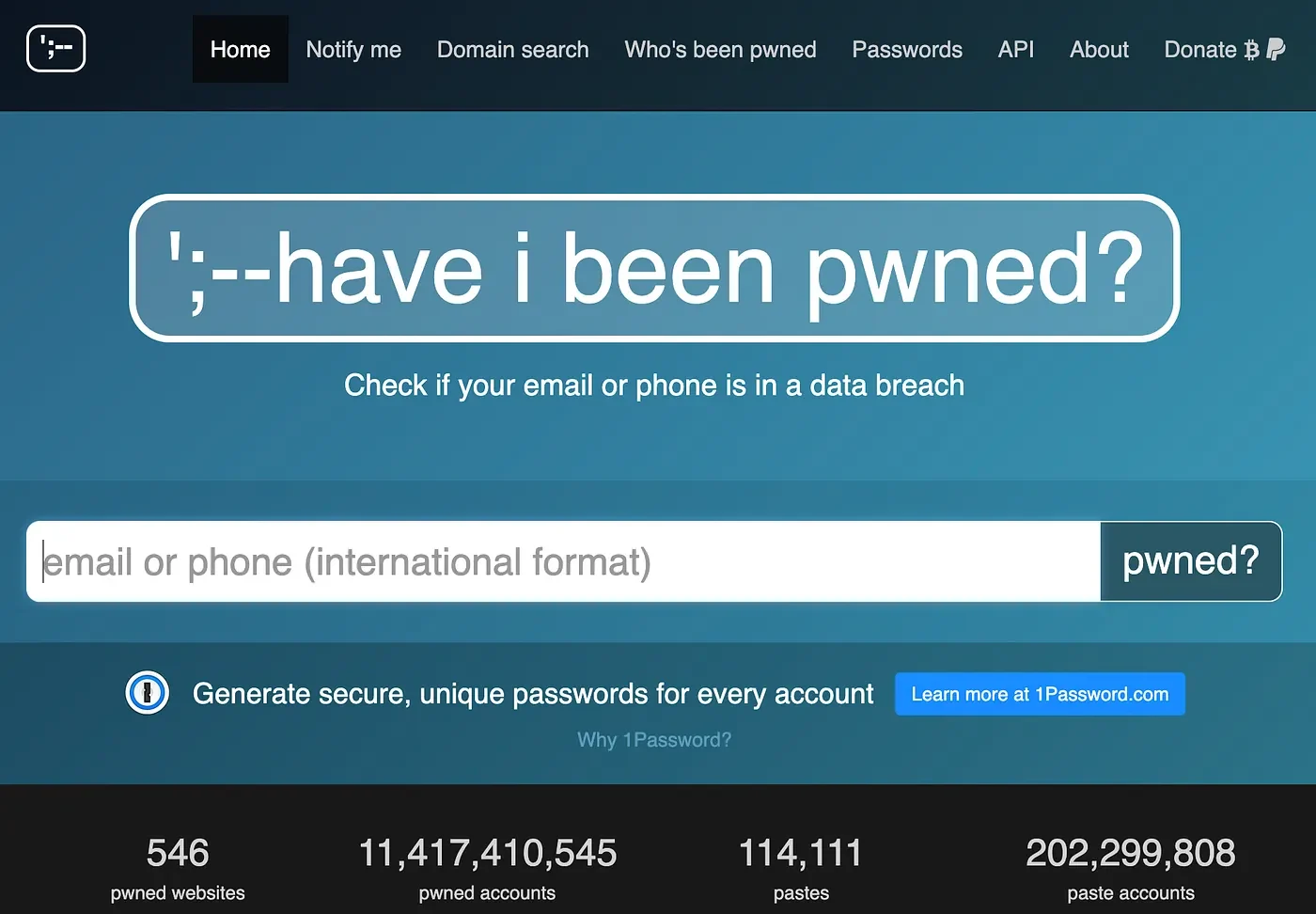
The image shows a popular service where you can check your email address against known data leaks.
Setup
The researcher worked with one friend, and together they found real threats in good bug bounty programmes with nice rewards. There were no special accounts, roles or tooling described: the precondition is simply a set of leaked logins and passwords tied to an organisation's domain, plus knowledge of which services fall inside the programme scope or are used by the company.
Two constraints shaped the work:
- Some bug bounty programmes explicitly forbid the use of leaked credentials in their rules. The stated reason is that if every hunter starts testing leaked data against a real username, accounts on a given service can get locked out. To avoid creating that risk for employees, some companies move this area of testing out of scope.
- The researcher argues this exclusion is odd, because any good pentest assumes this course of events, and if a bug bounty exists to reduce risk, this risk should be considered too. In practice, almost all companies accepted the reports and paid rewards according to their critical vulnerability tables.
On the sources of the leaks, the researcher deliberately does not advertise them, noting that such resources are not exactly ethical since they give access to potentially useful logins and passwords, but that this is a reality and a real risk for the organisation.
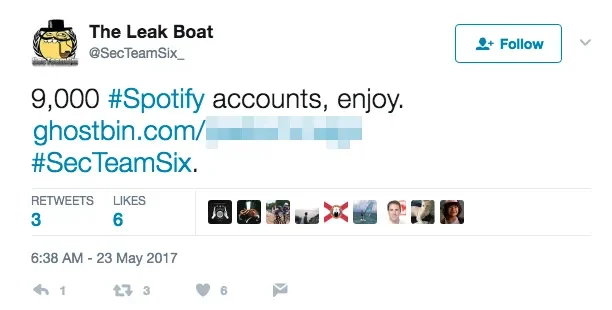
The second image is captioned "Data leaks everywhere" and sits right after that discussion of leak sources.
Finding it
The researcher noticed that, at the time of starting, there was not a single disclosed report about this problem submitted through bug bounty platforms, and suspected nobody was using this approach to infiltration. The suspicion was later reinforced by the reaction of one platform, described below.
The method, stated plainly: take leaked login and password data for the organisation's domain, then check those credentials against the services included in the programme scope, or against services the company can be expected to use. The researcher also points out that a smart pentester always starts with already leaked credentials, so nothing about the technique is new in a full pentest; what was new was applying it inside bug bounty hunting.
Exploitation
The write-up presents three representative findings from this work. No individual HTTP requests or responses are reproduced in the report; what follows is what it states about each case.
Step 1: Admin access to the development repository
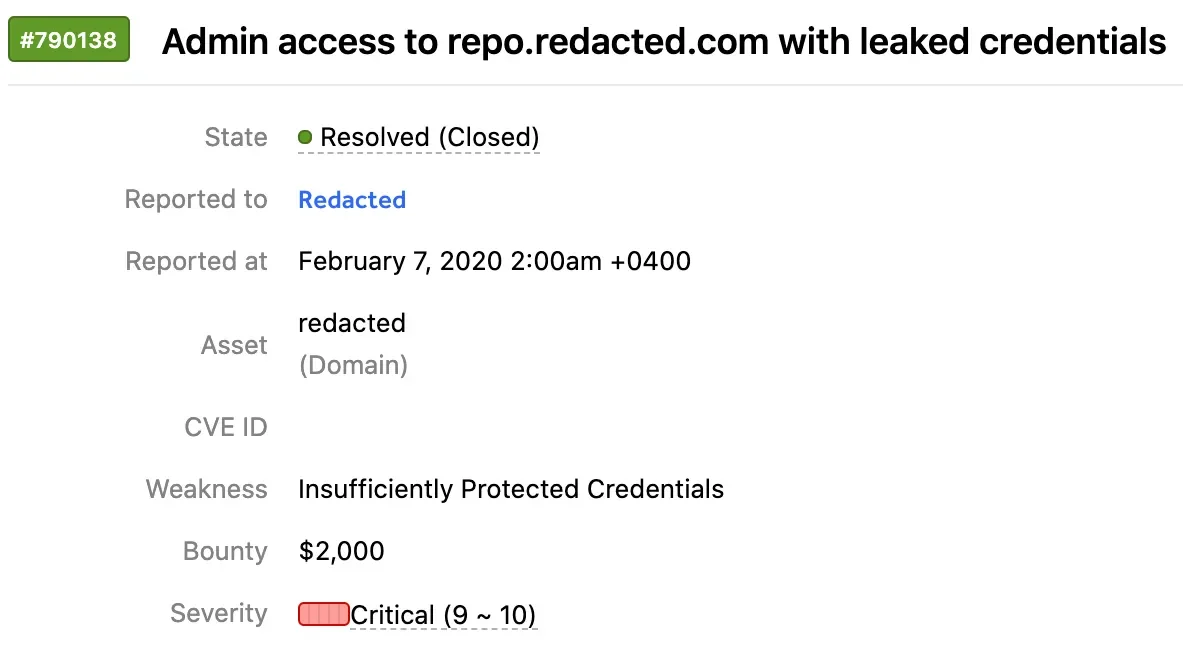
Fully functional access was obtained to the development environment, which ran Mercurial. The leaked data in question dated from 2013. Apparently nobody had considered that those credentials could come with strangers and be reused elsewhere, simply because the user used the same password everywhere. The problem was solved within hours and access to Mercurial was restricted.
Step 2: The CIO's corporate cloud account
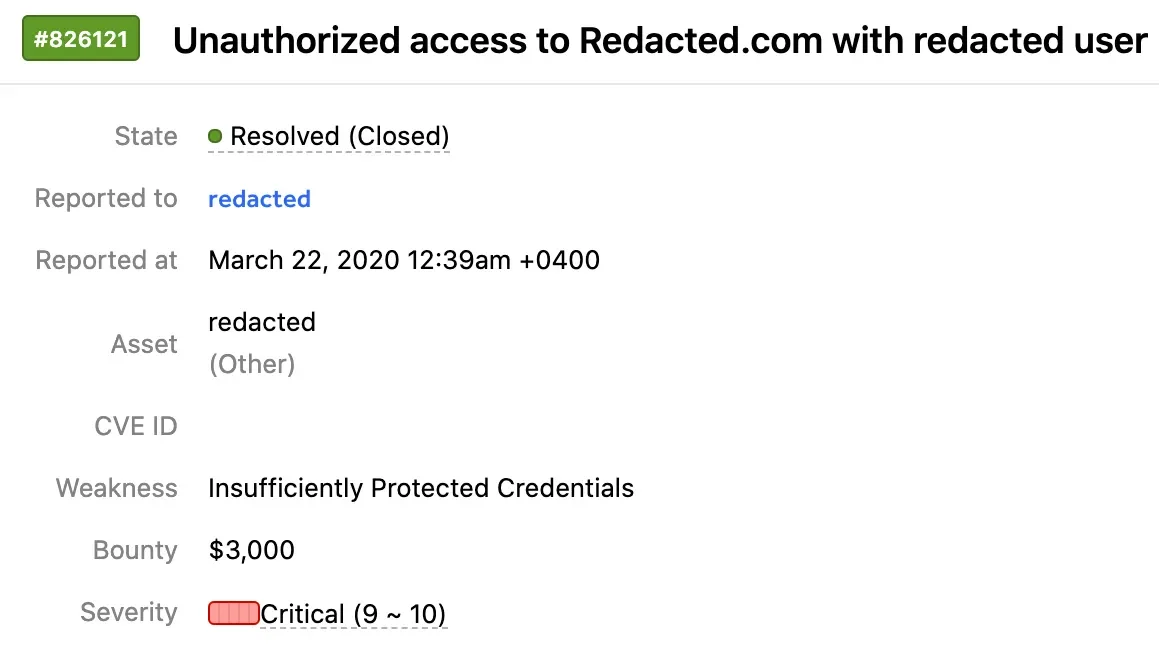
Access was granted to the corporate cloud service using leaked credentials belonging to one of the key people in the company, the Chief Information Officer. The problem was resolved fairly quickly, within a few hours.
Step 3: Several cloud corporate resources
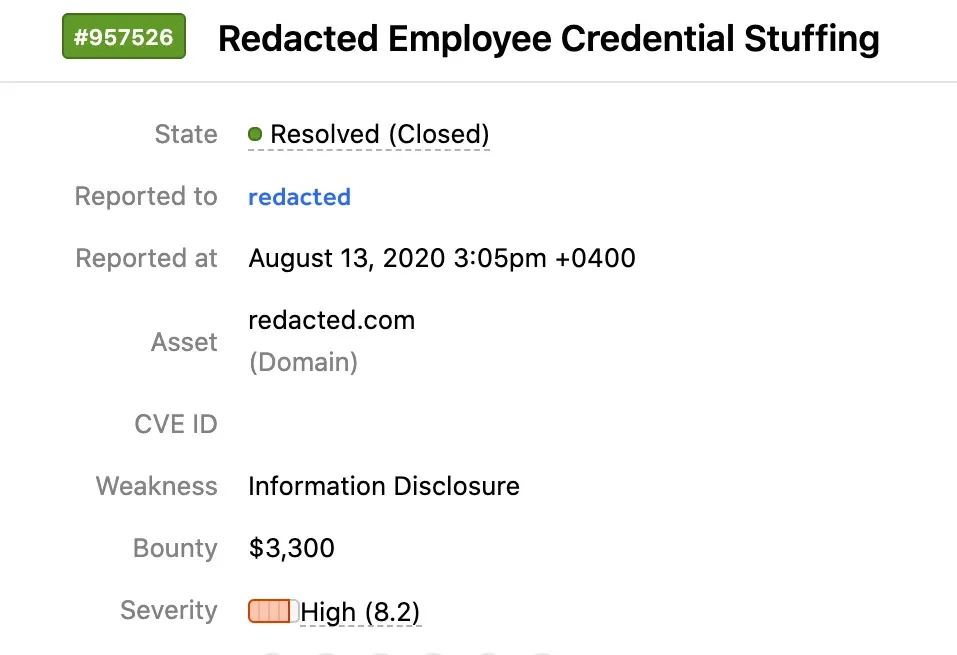
Access was obtained to several cloud corporate resources. This case is notable for the platform reaction rather than the access itself: the managers of HackerOne blocked the account of the friend from whom the reports had been sent, without explaining the reason. It later emerged that the block followed many questions from customers (HackerOne programme owners) about how legal these activities were and whether phishing had been used to obtain working logins and passwords. HackerOne apparently suspended the account in order to get a detailed explanation. There was nothing to add, because all the information had been provided in detail in the reports. The block was lifted the next day, but an unpleasant aftertaste remained.
The platform also asked, politely, that reports be made without checking the credentials themselves, so as not to break the platform's code of conduct. It did not answer the question about the validation process. The researcher's position: reports with potentially usable credentials are like reports with best-practice recommendations, while reports with no validation are the best place to produce tonnes of "Informative" reports.
As a closing observation, HackerOne itself had been the target of credential stuffing. According to a disclosed report, someone appears to have succeeded in logging in to the HackerOne platform with leaked credentials. The researcher finds it strange that the platform did not learn the lesson and did not try to check and prevent such risks on its own side before that happened, and calls it a bit stupid on their part that they did not try to attack HackerOne as a bug bounty programme.
Root cause
The weakness is not a flaw in application code. It is password reuse combined with the availability of leaked credentials: users who reuse the same password everywhere let a leak from one service (in one case, data from 2013) become valid authentication material on a completely different service, including development infrastructure and corporate cloud services. Because the problem cannot be fixed in the code, the researcher notes that it still exists.
The report does not describe any such control being encountered.
Impact
Under the condition that leaked credentials for an organisation's domain exist and that the corresponding users reused their passwords, an attacker can obtain working access to internal and cloud services. The report demonstrates three concrete outcomes: full functional access to a Mercurial development environment, access to the main corporate cloud service through the CIO's account, and access to several cloud corporate resources.
The limits are equally part of the picture. Programmes that forbid leaked-credential testing put this activity out of scope, and testing against real usernames can lock out accounts on the affected service. The platform-side friction described above shows that even a valid finding can be contested on process grounds.
Fix
For the individual findings, the remediation was operational: access to Mercurial was restricted, and the other exposures were resolved within a few hours. The report does not describe code changes.
For the class of problem, the report gives a rough mitigation process:
- Educate employees regularly about internet hygiene and secure passwords.
- Regularly notify them of the need to use 2FA.
- Use a password manager; most can notify users that a password has been compromised and needs changing.
- Regularly ingest leaked data and check it against the list of system users, including password mutations. Users like to change "Password" to "Password1", and such dummy passwords should be tracked.
Variants to test
Concrete directions to try on other targets, each with the signal that makes it worth pursuing:
- Development infrastructure. Take leaked credentials for the target's domain and try them against development environments in scope, as happened with the Mercurial instance. A positive result is any authenticated session on such a service, as happened with the Mercurial instance.
- Key personnel accounts. Identify executives and other key people in the company and test leaked credentials tied to them against corporate cloud services. A positive result is access to a corporate service under a privileged identity, as with the CIO account.
- Cloud resource sprawl. Test the same credential set against the various cloud corporate services a company is likely to use. A positive result is access to several distinct resources.
- Old leaks. Do not discard old breach data: the repository access came from a leak dated 2013. A positive result is a login that still works years after the leak.
Before any of this, read the programme policy: where leaked-credential testing is forbidden, the technique is out of scope, and the report notes the account-lockout risk that motivates such rules.
What happened, in plain words
Bug bounty hunting is usually about finding classic software bugs: cross-site scripting (XSS), SQL injection (SQLi), server-side request forgery (SSRF), remote code execution (RCE). This article is about a different kind of problem: using passwords that have already leaked onto the internet to log in to a company's services. The author calls this "credential stuffing" and shows how it led to critical findings and paid rewards.
The idea is simple. Many people reuse the same password on many websites. When one website is breached, the stolen email and password pairs often end up in public or semi-public collections. An attacker can take those pairs and try them on other websites. Usually this is done against social networks or email providers to scam people. The author tried it against the services of companies that run bug bounty programmes, and against services used in software development.
The article describes three example findings: access to a development repository, access to a corporate cloud service through the account of a Chief Information Officer (CIO), and access to several cloud resources. It also describes how one bug bounty platform, HackerOne, reacted by temporarily blocking the account of the author's friend, and asked them to stop validating credentials in reports. The author argues that this kind of testing is a real risk that companies should address, and gives mitigation advice.
The idea: credential stuffing meets bug bounty
Credential stuffing is defined by OWASP as the search for leaked usernames and passwords and their reuse against popular online services, based on the fact that most users reuse the same password everywhere. In a normal penetration test (pentest), a tester often starts with leaked credentials. But the author had not seen this approach used in bug bounty hunting.
At the time, there was not a single disclosed report about this problem submitted through bug bounty platforms. That absence suggested to the author that nobody was using this approach. The author shared the idea with a friend, and together they found real threats in good bug bounty programmes with nice rewards.
The image shows a popular service where you can check your email address against known data leaks. This is the starting point: you find out whether an email address appears in a breach.
Rules and risks
Some bug bounty programmes explicitly forbid the use of leaked credentials in their rules. The reason is that if every hunter starts testing leaked data against a real username, accounts on a particular service can get locked out. To avoid creating that risk for employees, some companies move this area of testing out of scope.
The author finds this strange: any good pentest assumes this course of events, and if a bug bounty exists to reduce risk, this risk should also be considered. In practice, almost all companies accepted the reports and paid rewards according to their critical vulnerability tables.
The author deliberately does not advertise the sources where leaks can be found. Such resources are not exactly ethical, since they give access to potentially useful logins and passwords, but this is a reality and a real risk for the organisation.
The second image is captioned "Data leaks everywhere" and sits right after that discussion of leak sources.
How the testing was done
The method, stated plainly: take leaked login and password data for the organisation's domain, then check those credentials against the services included in the programme scope, or against services the company can be expected to use. The author also points out that a smart pentester always starts with already leaked credentials, so nothing about the technique is new in a full pentest; what was new was applying it inside bug bounty hunting.
The write-up presents three representative findings from this work. No individual HTTP requests or responses are reproduced in the report; what follows is what it states about each case.
Step 1: Admin access to the development repository
Fully functional access was obtained to the development environment, which ran Mercurial. Mercurial is a version control system, a tool that developers use to store and track changes to source code, similar to Git. The leaked data in question dated from 2013. Apparently nobody had considered that those credentials could come with strangers and be reused elsewhere, simply because the user used the same password everywhere. The problem was solved within hours and access to Mercurial was restricted.
Step 2: The CIO's corporate cloud account
Access was granted to the corporate cloud service using leaked credentials belonging to one of the key people in the company, the Chief Information Officer (CIO). The CIO is a senior executive responsible for the company's information technology and computer systems. The problem was resolved fairly quickly, within a few hours.
Step 3: Several cloud corporate resources
Access was obtained to several cloud corporate resources. This case is notable for the platform reaction rather than the access itself: the managers of HackerOne blocked the account of the friend from whom the reports had been sent, without explaining the reason. It later emerged that the block followed many questions from customers (HackerOne programme owners) about how legal these activities were and whether phishing had been used to obtain working logins and passwords. HackerOne apparently suspended the account in order to get a detailed explanation. There was nothing to add, because all the information had been provided in detail in the reports. The block was lifted the next day, but an unpleasant aftertaste remained.
The platform also asked, politely, that reports be made without checking the credentials themselves, so as not to break the platform's code of conduct. It did not answer the question about the validation process. The author's position: reports with potentially usable credentials are like reports with best-practice recommendations, while reports with no validation are the best place to produce tonnes of "Informative" reports.
As a closing observation, HackerOne itself had been the target of credential stuffing. According to a disclosed report, someone appears to have succeeded in logging in to the HackerOne platform with leaked credentials. The author finds it strange that the platform did not learn the lesson and did not try to check and prevent such risks on its own side before that happened, and calls it a bit stupid on their part that they did not try to attack HackerOne as a bug bounty programme.
Why it works
The weakness is not a flaw in application code. It is password reuse combined with the availability of leaked credentials: users who reuse the same password everywhere let a leak from one service (in one case, data from 2013) become valid authentication material on a completely different service, including development infrastructure and corporate cloud services. Because the problem cannot be fixed in the code, the author notes that it still exists.
The report does not describe any such control being encountered.
Impact
Under the condition that leaked credentials for an organisation's domain exist and that the corresponding users reused their passwords, an attacker can obtain working access to internal and cloud services. The report demonstrates three concrete outcomes: full functional access to a Mercurial development environment, access to the main corporate cloud service through the CIO's account, and access to several cloud corporate resources.
The limits are equally part of the picture. Programmes that forbid leaked-credential testing put this activity out of scope, and testing against real usernames can lock out accounts on the affected service. The platform-side friction described above shows that even a valid finding can be contested on process grounds.
Fix
For the individual findings, the remediation was operational: access to Mercurial was restricted, and the other exposures were resolved within a few hours. The report does not describe code changes.
For the class of problem, the report gives a rough mitigation process:
- Educate employees regularly about internet hygiene and secure passwords.
- Regularly notify them of the need to use 2FA. 2FA (two-factor authentication) is a second proof of identity beyond a password, such as a code from a phone app.
- Use a password manager; most can notify users that a password has been compromised and needs changing. A password manager is a program that stores and generates passwords.
- Regularly ingest leaked data and check it against the list of system users, including password mutations. Users like to change "Password" to "Password1", and such dummy passwords should be tracked.
Variants to test
Concrete directions to try on other targets, each with the signal that makes it worth pursuing:
- Development infrastructure. Take leaked credentials for the target's domain and try them against development environments in scope, as happened with the Mercurial instance. A positive result is any authenticated session on such a service, as happened with the Mercurial instance.
- Key personnel accounts. Identify executives and other key people in the company and test leaked credentials tied to them against corporate cloud services. A positive result is access to a corporate service under a privileged identity, as with the CIO account.
- Cloud resource sprawl. Test the same credential set against the various cloud corporate services a company is likely to use. A positive result is access to several distinct resources.
- Old leaks. Do not discard old breach data: the repository access came from a leak dated 2013. A positive result is a login that still works years after the leak.
Before any of this, read the programme policy: where leaked-credential testing is forbidden, the technique is out of scope, and the report notes the account-lockout risk that motivates such rules.
Glossary
- Bug bounty: A programme where organisations reward people for finding and reporting security problems in their systems.
- Credential stuffing: Trying leaked username and password pairs on other services, hoping that people reused the same password.
- XSS (cross-site scripting): A vulnerability where an attacker can inject malicious scripts into web pages viewed by other users.
- SQLi (SQL injection): A vulnerability where an attacker can insert malicious SQL code into a database query.
- SSRF (server-side request forgery): A vulnerability where an attacker can make a server send requests to unintended locations.
- RCE (remote code execution): A vulnerability that lets an attacker run their own code on a remote system.
- Pentest (penetration test): An authorised simulated attack on a system to find security weaknesses.
- Mercurial: A version control system used by developers to manage source code changes.
- CIO (Chief Information Officer): A senior executive responsible for a company's information technology and computer systems.
- 2FA (two-factor authentication): A security process that requires two different forms of identification to access an account.
- Password manager: A software application that stores and manages passwords, often generating strong ones and alerting to compromised passwords.
- HackerOne: A bug bounty platform where organisations run programmes and researchers submit reports.
- Code of conduct: A set of rules that participants in a platform or programme agree to follow.
- Informative report: A report that is considered useful but not a security vulnerability, often not eligible for a reward.
- OWASP: Open Web Application Security Project, a community that produces resources on web application security.
- Scope: The set of systems and activities that are allowed under a bug bounty programme's rules.
- Leaked credentials: Usernames and passwords that have been exposed in a data breach.
- Password mutation: A slight change to a password, such as adding a number or changing a letter's case.
- Phishing: A technique to trick people into revealing sensitive information by pretending to be a trustworthy entity.





