Hacking Hackers for fun and profit
A researcher placed a blind cross-site scripting payload in a LinkedIn profile field, which later executed inside a third-party recruiter system that imported the profile data, exposing candidate personal information. In a separate case, a blind payload entered into a phishing page's password field executed on the attackers' own panel, revealing victim data that was passed to the bank.
 Published on krevetk0.medium.com
This story will be in several parts. In each of the situations, I had to face unexpected results.
The full write-up lives on its author's site
It belongs to its author, so we link to it rather than copy it. The other two tabs are our own rewrites, checked against it.
This write-up collects three stories about XSS in the wild, each of which ended somewhere other than where I expected. In each of the situations I had to face unexpected results, and in each the interesting part was often who ended up executing the payload. I hope you find something useful in these stories.

Context
The three targets are unrelated: a professional social network (LinkedIn) and one of its systems for recruiters and HR managers, a Telegram bot that messages people with what looks like a scam, and a phishing kit that impersonates a bank's login page. The common thread is the payload: a Blind XSS, so that execution on a system I never see directly still produces evidence.
Setup
The tool named in the first story is XSS Hunter, used as the collector for the Blind XSS payload. No versions, accounts or roles are given. The preconditions differ per story: a profile field I control on LinkedIn, an incoming Telegram message from a suspected bot, and a phishing page reachable from a link in a spoofed bank SMS.
Finding it
Story 1: Self XSS as a critical vulnerability
Most people treat Self XSS as hard to count as a valid vulnerability, and especially hard to get accepted on a bug bounty. Almost nobody believes it can become a critical problem. One day it did.
A few years ago I decided to update my LinkedIn profile and, out of curiosity, put a Blind XSS in the skills area of my profile.
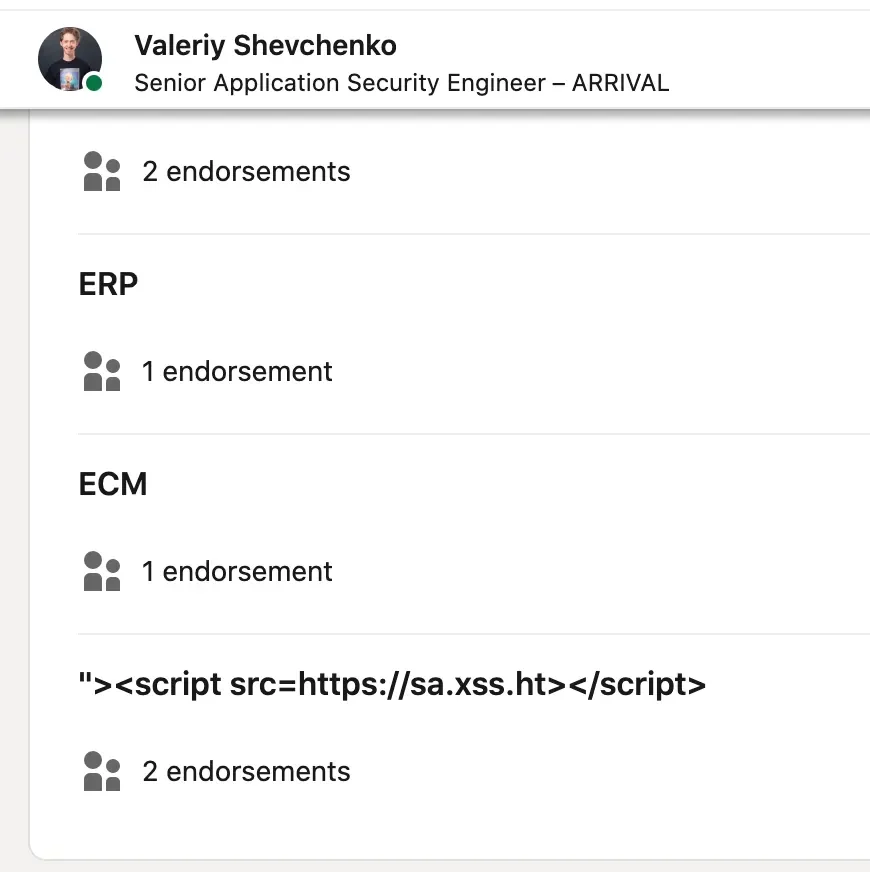
Nothing happened for a year. A year later I got a very interesting result: a huge list of people from the security industry for my region in the XSS Hunter panel, with names, addresses and phone numbers, all of it PII.
The surprising part was where the JavaScript executed. It did not run on LinkedIn's own internal systems. It ran on one of the systems for recruiters and HR managers. Someone had collected candidates from various sources, filtering for people working in the security industry, and then tried to upload all that data into a system that was previously unknown to me. At the loading step, the Self XSS triggered. To me it looked like a Blind Self XSS vulnerability.
Story 2: Breaking the hacker Telegram bot with Blind XSS
Strangers sometimes write to me in personal messages on Telegram or Instagram. Sometimes they are real people asking for advice. Sometimes, from the first message, I get the feeling that a robot is writing: the style of the messages or the speed of sending suggests something is wrong. At such moments I start to fool around and promote a scam, and sometimes I just send a Blind XSS in response.
Once again it happened.

Story 3: Hacking hackers to prevent money theft
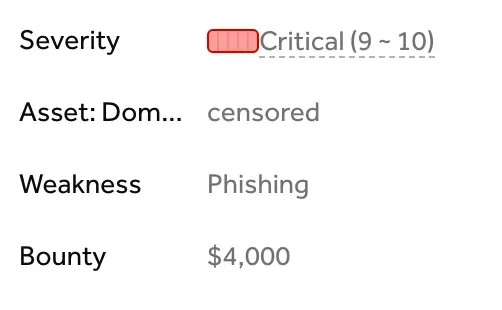
This is the most interesting and the most incredible story, because it led to a valid report on the bug bounty platform and the maximum payout in that program.
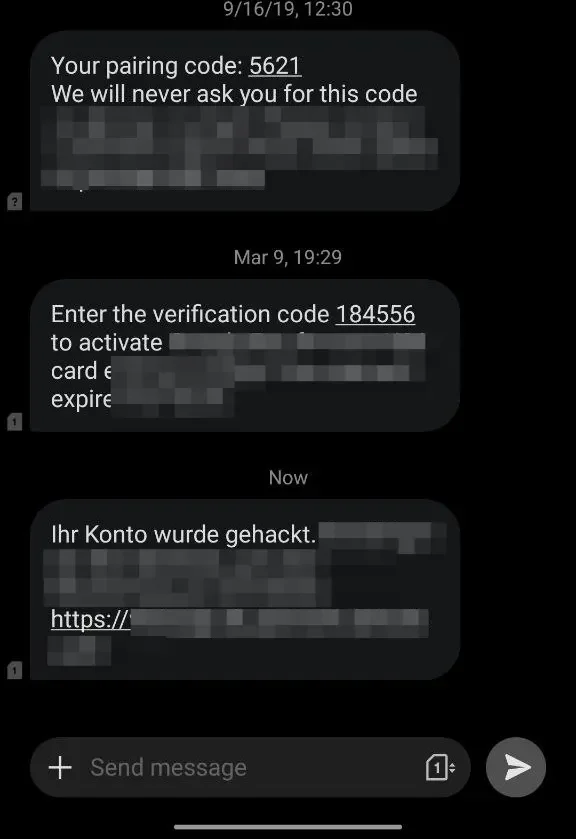
It started when a friend messaged me asking whether I knew anything about having to reconfirm an account for one of the banks. It was all a bit strange. The message was an SMS from the bank where the sender's name was the bank, and it sat in the list of valid messages previously sent by that bank. The only confusing thing was a little strange link, with a domain where you had to confirm your account. Clicking the link led to a fairly plausible form from the bank asking for a login and password.
At that point I weighed the pros and cons of what could be done. Obviously, the sender had been tampered with and the phone had been tricked into placing a false text message from the bank on the list of legitimate texts from the real bank.
A huge risk was created for the bank itself, since most likely the affected people would be able to get their stolen funds back in full, as it would be quite difficult for ordinary users to recognise the attack. It also became clear that the bank might be the party most interested in information about the victims and the attackers, because for the bank such an attack can be a direct loss.
Exploitation
Step 1: Blind XSS in a profile field, executed by a recruiter-side system
I placed a Blind XSS payload in the skills area of my LinkedIn profile. The report does not reproduce the payload. For a year there was nothing. Then the XSS Hunter panel returned a large set of security-industry contacts with names, addresses and phone numbers.
The execution happened on a recruiter and HR system, at the step where the operator uploaded collected candidate data. The payload fired during that load, which is why I describe it as a Blind Self XSS: the injection was mine, but the execution was on a third-party system processing my profile data.
The risks were obvious, so I immediately tried to find the owners of the system. The vulnerability was fixed fairly quickly, and after responsible disclosure I was paid a reward of $1000. Not bad for a Self XSS at first glance.
Step 2: Blind XSS against a Telegram bot
I replied to the suspected bot with a Blind XSS. The results of the JavaScript execution were stunning: I started getting information from the local service about the profiles the bot was trying to communicate with.
I told the story in my Telegram channel straight away, and people picked it up and started flooding the bot with JavaScript payloads. Someone was even able to perform a stop-mailing action. The hackers and spammers clearly did not expect such results, and the message attack was really shut down.
Step 3: Blind XSS in the password field of a phishing kit
I took a closer look at the service that hosted the login and password collection page, and at what I could do with it. At the login and password form I did not expect any data validation, and I immediately managed to send a Blind XSS in the password field.
I did not have to fill those in, because within a second I already had JavaScript execution on the attacker's panel.
As a result I obtained a complete list of affected people. Somewhere the victims had not had time to enter sensitive data; somewhere they had given the attackers all their card data, CVV codes and account balance information. I formatted everything I found into a report and sent it to the bank itself through the bug bounty platform.
Root cause
In the stories described, the payload executed on a system other than the one I injected into. The report does not analyse the server-side code of any of the three targets, so the specific missing output encoding is not shown.
In the third story the phishing kit collected credentials, and the attacker's own control panel executed what was submitted in the password field. The operator's panel is the trusted side of the scam, and it executed whatever the victim side submitted. In the first story the Self XSS triggered at the loading step when candidate data was uploaded.
In the first story the input came from a profile on another platform; in the third it came from phishing victims.
Impact
- Recruiter system: execution on a system used by recruiters and HR managers, returning a large list of security-industry contacts with names, addresses and phone numbers. The report does not state what else the execution context allowed.
- Telegram bot: information from the local service about the profiles the bot was trying to contact, and, for other people who sent payloads, the ability to perform a stop-mailing action. The message attack was shut down.
- Phishing kit: a complete list of affected people, including victims who had submitted card data, CVV codes and account balances, and victims who had not yet entered sensitive data. Because the attack was not a one-time event, I logged into the control panel and transferred all the information to the bank for subsequent blocking of accounts and re-issue of cards.
The bank responded quickly, assessed the risks and took decisive measures of card revocations. It was forced to repeat the notification of all users about hacker attacks and how to recognise them. The attack was massive and affected other banks, which were notified; some anti-fraud departments defined a strategy and knew how to be proactive afterwards. I was able to identify vulnerabilities in the frameworks used for those attacks, and teams at some banks subsequently knew how to get the data of affected users even without Blind XSS. For a number of reasons I cannot give many technical details, but from the last conversation it was clear that the group of attackers left a lot of traces and some of the individuals involved were identified.
Fix
For the recruiter system the report only says the vulnerability was fixed fairly quickly after responsible disclosure. For the phishing kit the response was operational: I logged into the control panel, transferred the information to the bank, and accounts were blocked and cards re-issued. The report does not describe code changes on any target.
Variants to test
- Profile fields consumed by third-party tools. Put a Blind XSS in fields that other organisations import: skills, job titles, summaries, tags. A positive result is an XSS Hunter callback from a host you do not own, ideally with the importing system's data in the report.
- Bulk import and upload steps. Target the fields that a recruiter or CRM tool renders while loading a candidate or contact list. A positive result is execution at the loading step rather than on the platform where the data was entered.
- Chat and messaging bots. Reply to suspected bots with a Blind XSS and watch for callbacks from the bot's backend. A positive result is data about the bot's other targets, or the ability to trigger an action such as stopping the mailing.
- Phishing kit forms. Submit a Blind XSS in every field of a credential or card collection form, including password and transaction fields, and check whether the operator panel executes it. A positive result is execution on the attacker-side panel, which then gives you the victim list.
- Self XSS with a cross-system consumer. Treat Self XSS as worth reporting when the stored value is later rendered by a different system. A positive result is a callback from that other system, which turns a self-inflicted injection into a finding with a real owner.
What happened, in plain words
This article tells three stories about the same kind of bug, found in three very different places. The bug is called XSS, short for Cross-Site Scripting. In plain terms, it means getting a website to run a small piece of code that you supplied, as if the website itself had written it. When that happens, your code runs inside someone else's browser session, and it can read and send back whatever that session can see.
The particular flavour used in all three stories is Blind XSS. "Blind" here means you cannot see the page where your code will eventually run. You plant the code somewhere, and you wait. If it ever runs, it quietly reports back to a server you control, so you learn that it fired and what it could see. The tool used for that reporting is called XSS Hunter: it gives you a payload (a small snippet of code) and a panel (a web page) where the callbacks arrive.
The three stories are:
- A Blind XSS planted in the skills section of a LinkedIn profile. It did nothing for a year, then fired on a separate system used by recruiters and HR managers, and returned a large list of security-industry contacts with names, addresses and phone numbers. It was fixed and paid $1000.
- A Blind XSS sent in reply to a suspected scam bot on Telegram. It returned information from the local service about the profiles the bot was trying to communicate with. Other people then sent their own payloads, and the message attack was shut down.
- A Blind XSS sent through the password field of a fake bank login page (a phishing page). It gave JavaScript execution on the attacker's panel, and I obtained a complete list of affected people, including those who had given card data, CVV codes and account balances. The report went to the bank through a bug bounty platform, and the payout was $4000.
A bug bounty platform, by the way, is a website where organisations publish the rules for reporting security problems to them and pay rewards for valid reports. "Responsible disclosure" means telling the owner privately and giving them time to fix it before saying anything publicly.
The idea that ties the stories together
All three targets are unrelated: a professional social network and one of its recruiter tools, a Telegram bot that messages people with what looks like a scam, and a phishing kit that pretends to be a bank's login page. What they share is the payload: a Blind XSS that reports back to an XSS Hunter panel. That way, code running on a system I never see directly still leaves evidence.
The setup
The only tool described is XSS Hunter, used as the out-of-band collector for Blind XSS payloads. "Out-of-band" means the evidence comes back through a different channel than the one you sent the payload through: you do not watch the victim page, you watch your own panel. No versions, accounts or roles are given.
The starting conditions differ per story:
- a profile field I control on LinkedIn;
- an incoming Telegram message from a suspected bot;
- a phishing page reachable from a link in a spoofed bank SMS.
Finding it
Story 1: Self XSS as a critical vulnerability
Most people treat Self XSS as hard to count as a valid vulnerability, and especially hard to get accepted on a bug bounty. Self XSS means the only person who can trigger the code is you, typing it into your own browser, for example by pasting it into a form. On the face of it that harms nobody, which is why it is usually dismissed. Almost nobody believes it can become a critical problem. One day it did.
A few years ago I decided to update my LinkedIn profile and, out of curiosity, put a Blind XSS in the skills area of my profile. The skills area is just the list of skills shown on a profile. The reason to try it there is that a profile is not only read by the person who wrote it: other systems import it.
Nothing happened for a year. A year later I got a very interesting result: a huge list of people from the security industry for my region in the XSS Hunter panel, with names, addresses and phone numbers, all of it PII. PII stands for Personally Identifiable Information: data that identifies a real person, such as a name, an address or a phone number.
The surprising part was where the JavaScript executed. JavaScript is the programming language that browsers run to make pages interactive; when a page runs JavaScript you supplied, that is the XSS. It did not run on LinkedIn's own internal systems. It ran on one of the systems for recruiters and HR managers. Someone had collected candidates from various sources, filtering for people working in the security industry, and then tried to upload all that data into a system that was previously unknown to me. At the loading step, the Self XSS triggered. To me it looked like a Blind Self XSS vulnerability: the injection was mine, but the execution happened on a third party's system that was processing my profile data.
Story 2: Breaking the hacker Telegram bot with Blind XSS
Strangers sometimes write to me in personal messages on Telegram or Instagram. Sometimes they are real people asking for advice. Sometimes, from the first message, I get the feeling that a robot is writing: the style of the messages or the speed of sending suggests something is wrong. At such moments I start to fool around and promote a scam, and sometimes I just send a Blind XSS in response. The reasoning is simple: if a bot is messaging me, the messages I send back are probably being read and stored by some system on the other side, and that system might display them somewhere.
Once again it happened.
Story 3: Hacking hackers to prevent money theft
This is the most interesting and the most incredible story, because it led to a valid report on the bug bounty platform and the maximum payout in that program.
It started when a friend messaged me asking whether I knew anything about having to reconfirm an account for one of the banks. It was all a bit strange. The message was an SMS from the bank where the sender's name was the bank, and it sat in the list of valid messages previously sent by that bank. The only confusing thing was a little strange link, with a domain where you had to confirm your account. Clicking the link led to a fairly plausible form from the bank asking for a login and password.
At that point I weighed the pros and cons of what could be done. Obviously, the sender had been tampered with and the phone had been tricked into placing a false text message from the bank on the list of legitimate texts from the real bank.
A huge risk was created for the bank itself, since most likely the affected people would be able to get their stolen funds back in full, as it would be quite difficult for ordinary users to recognise the attack. It also became clear that the bank might be the party most interested in information about the victims and the attackers, because for the bank such an attack can be a direct loss.
Exploitation
Step 1: Blind XSS in a profile field, executed by a recruiter-side system
I placed a Blind XSS payload in the skills area of my LinkedIn profile. The report does not reproduce the payload. For a year there was nothing. Then the XSS Hunter panel returned a large set of security-industry contacts with names, addresses and phone numbers.
The execution happened on a recruiter and HR system, at the step where the operator uploaded collected candidate data. The payload fired during that load, which is why I describe it as a Blind Self XSS: the injection was mine, but the execution was on a third-party system processing my profile data.
The risks were obvious, so I immediately tried to find the owners of the system. The vulnerability was fixed fairly quickly, and after responsible disclosure I was paid a reward of $1000. Not bad for a Self XSS at first glance.
Step 2: Blind XSS against a Telegram bot
I replied to the suspected bot with a Blind XSS. The results of the JavaScript execution were stunning: I started getting information from the local service about the profiles the bot was trying to communicate with.
I told the story in my Telegram channel straight away, and people picked it up and started flooding the bot with JavaScript payloads. Someone was even able to perform a stop-mailing action. The hackers and spammers clearly did not expect such results, and the message attack was really shut down.
Step 3: Blind XSS in the password field of a phishing kit
I took a closer look at the service that hosted the login and password collection page, and at what I could do with it. A phishing kit is the package of pages and scripts criminals set up to look like a real login page; whatever a victim types is stored and shown to the criminal running it. At the login and password form I did not expect any data validation, and I immediately managed to send a Blind XSS in the password field.
I did not have to fill those in, because within a second I already had JavaScript execution on the attacker's panel.
As a result I obtained a complete list of affected people. Somewhere the victims had not had time to enter sensitive data; somewhere they had given the attackers all their card data, CVV codes and account balance information. I formatted everything I found into a report and sent it to the bank itself through the bug bounty platform.
Root cause
In the stories described, the payload executed on a system other than the one I injected into. "Stored" means the value was saved somewhere; "rendered" means it was later put back into a web page; "sanitise" means cleaning input so that any code in it is neutralised before display. The report does not analyse the server-side code of any of the three targets, so the specific missing output encoding is not shown. Output encoding is the practice of converting characters like < and > into harmless text so a browser shows them instead of treating them as code.
In the third story the phishing kit collected credentials, and the attacker's own control panel executed what was submitted in the password field. The operator's panel is the trusted side of the scam, and it executed whatever the victim side submitted. In the first story the Self XSS triggered at the loading step when candidate data was uploaded.
In the first story the input came from a profile on another platform; in the third it came from phishing victims.
Impact
- Recruiter system: execution on a system used by recruiters and HR managers, returning a large list of security-industry contacts with names, addresses and phone numbers. The report does not state what else the execution context allowed.
- Telegram bot: information from the local service about the profiles the bot was trying to contact, and, for other people who sent payloads, the ability to perform a stop-mailing action. The message attack was shut down.
- Phishing kit: a complete list of affected people, including victims who had submitted card data, CVV codes and account balances, and victims who had not yet entered sensitive data. Because the attack was not a one-time event, I logged into the control panel and transferred all the information to the bank for subsequent blocking of accounts and re-issue of cards.
The bank responded quickly, assessed the risks and took decisive measures of card revocations. It was forced to repeat the notification of all users about hacker attacks and how to recognise them. The attack was massive and affected other banks, which were notified; some anti-fraud departments defined a strategy and knew how to be proactive afterwards. I was able to identify vulnerabilities in the frameworks used for those attacks, and teams at some banks subsequently knew how to get the data of affected users even without Blind XSS. For a number of reasons I cannot give many technical details, but from the last conversation it was clear that the group of attackers left a lot of traces and some of the individuals involved were identified.
Fix
For the recruiter system the report only says the vulnerability was fixed fairly quickly after responsible disclosure. For the phishing kit the response was operational: I logged into the control panel, transferred the information to the bank, and accounts were blocked and cards re-issued. The report does not describe code changes on any target.
Variants to test
- Profile fields consumed by third-party tools. Put a Blind XSS in fields that other organisations import: skills, job titles, summaries, tags. A positive result is an XSS Hunter callback from a host you do not own, ideally with the importing system's data in the report.
- Bulk import and upload steps. Target the fields that a recruiter or CRM tool renders while loading a candidate or contact list. A positive result is execution at the loading step rather than on the platform where the data was entered.
- Chat and messaging bots. Reply to suspected bots with a Blind XSS and watch for callbacks from the bot's backend. A positive result is data about the bot's other targets, or the ability to trigger an action such as stopping the mailing.
- Phishing kit forms. Submit a Blind XSS in every field of a credential or card collection form, including password and transaction fields, and check whether the operator panel executes it. A positive result is execution on the attacker-side panel, which then gives you the victim list.
- Self XSS with a cross-system consumer. Treat Self XSS as worth reporting when the stored value is later rendered by a different system. A positive result is a callback from that other system, which turns a self-inflicted injection into a finding with a real owner.
Glossary
- XSS (Cross-Site Scripting): a bug where a website runs code you supplied as if it had written it itself, inside someone else's browser session.
- Self XSS: an XSS where the only person who can trigger the code is you, entering it into your own browser.
- Blind XSS: an XSS where you cannot see the page that will run your code; you plant the payload and wait for it to report back.
- Payload: the small piece of code you inject, designed to do something specific when it runs.
- XSS Hunter: a service that gives you a Blind XSS payload and a panel where reports arrive when the payload executes.
- Panel: a web page where you view collected results.
- Callback: the report your payload sends back to your own server when it runs.
- Out-of-band: evidence that arrives through a different channel than the one you used to send the payload.
- JavaScript: the programming language browsers run to make pages interactive.
- PII (Personally Identifiable Information): data that identifies a real person, such as a name, address or phone number.
- Recruiter/HR system: software used by recruiters and HR managers to collect and manage candidate data.
- Bug bounty platform: a website where organisations publish reporting rules and pay rewards for valid security reports.
- Responsible disclosure: telling the owner of a system privately about a bug and giving them time to fix it before saying anything publicly.
- Phishing kit: a package of pages and scripts criminals set up to look like a real login page and collect what victims type.
- Spoofed sender: an SMS whose sender name has been tampered with so it appears to come from a real organisation.
- CVV code: the short security number printed on a payment card.
- Stored: saved somewhere, to be used later.
- Rendered: put back into a web page for display.
- Sanitise: clean input so any code in it is neutralised before display.
- Output encoding: converting characters like
<and>into harmless text so a browser shows them instead of treating them as code. - Injection point: the place where your input goes in.
- Execution point: the place where your input is later run as code.
- CRM: software for managing contacts and customer relationships.
- Anti-fraud department: the team at a bank or company that detects and responds to fraud.





