**🚨 Critical Vulnerability Alert: CVE-2026–77806 — SPIP Unauthenticated RCE Explained**
SPIP's template rendering engine trusted a client-supplied HTTP header and inserted it into generated PHP code without sanitisation or an allowlist. An unauthenticated attacker could therefore run arbitrary system commands on the server.

Cve 2026 77806
The full write-up lives on its author's site
It belongs to its author, so we link to it rather than copy it. The other two tabs are our own rewrites, checked against it.
Context
SPIP is a publishing system (CMS) used to build and run websites. Like most CMSs, it compiles skeleton templates into PHP code at render time, and during that compilation it allows dynamic filter functions to sanitise or format data before it is placed into the generated code.
The flaw described here, tracked as CVE-2026-77806 with a CVSS score of 9.8, sits in that template rendering engine, specifically in the analyse_resultat_skel function. It affects all SPIP versions prior to 4.4.21 and allows a remote, unauthenticated attacker to execute arbitrary system commands on the server with no administrative privileges at all.
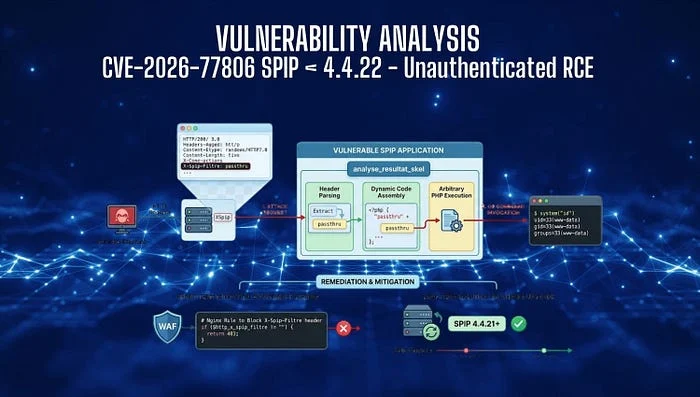
The header image that ran with the write-up.
Setup
The write-up does not describe a lab, a test instance, tooling or any account setup. The only precondition it states is the target version: any SPIP installation below 4.4.21. No authentication is needed, which is the point of the finding.
Finding it
The flaw sits in the template compilation path. During normal skeleton template compilation, SPIP permits dynamic filter functions to sanitise or format data, and the engine takes the filter to apply from client-supplied HTTP request headers, most notably X-Spip-Filtre. Trusting a request header to select a function that ends up inside generated PHP code is the anomaly: the value crosses from user-controlled input into executable code without an allowlist.
Exploitation
Step 1: reach a template-rendering endpoint
The attacker sends an unauthenticated HTTP request to any endpoint that renders a template, such as a public forum page or a comment preview page. No login or privileged session is required.
Step 2: supply the filter through the header
The request carries an X-Spip-Filtre header. SPIP extracts the untrusted header string and appends it directly into the generated dynamic PHP code array. Because there is no input sanitisation and no strict function allowlist, standard command execution primitives such as passthru, system or exec are accepted as the filter and run under the security context of the web server daemon (www-data).
The write-up does not reproduce the exact header value, the request line or the server response; it only names the header and the primitives. The full payloads are said to be in the linked blog post rather than in this article.
Step 3: commands run as the web user
Once the generated code is compiled and executed, the chosen primitive runs the attacker's command as www-data. The result is remote code execution without authentication.
Root cause
The mistake is in analyse_resultat_skel: the template engine treats a client-supplied HTTP header as a trusted source for the name of a dynamic filter function and writes it straight into the generated PHP code array. Two controls are missing: sanitisation of the header value, and a strict allowlist restricting which functions may be used as filters.
SPIP's built-in écran de sécurité does not stop this out of the box, because the payload travels in an HTTP header rather than in conventional GET or POST parameters, which is what that protection is built to inspect.
Impact
An unauthenticated remote attacker can execute arbitrary system commands on any SPIP server below 4.4.21, with the privileges of the web server user (www-data). No administrative access is needed. The write-up does not go further into what an attacker could reach from that position, such as data, files or lateral movement.
Fix
The remediation given is to upgrade to SPIP 4.4.21 or later, which patches the underlying template compilation logic. Alongside the upgrade, the article recommends two defensive measures:
- Deploy WAF or reverse proxy rules on Nginx or Apache to drop incoming requests that contain the
X-Spip-Filtreheader. - Audit access logs for anomalous header strings targeting dynamic template endpoints.
- Other header-driven filter paths. Send unusual values in headers that a template engine might use to select filters or formatting functions. A positive result is a value appearing in generated code or changing rendered output in a way the application did not intend.
- Other template-rendering endpoints. Try public forum pages, comment previews and any other page that compiles a skeleton. A positive result is the same header being honoured on an endpoint that requires no session.
- Command primitives as filter names. Where a filter name is accepted from input, try
passthru,systemandexec. A positive result is command output in the response or a side effect on the host. - WAF bypass check. If a rule blocks
X-Spip-Filtre, test header name casing and equivalent header spellings to see whether the rule is bypassed while the application still honours the header. A positive result is the payload reaching the template engine despite the rule.
What happened, in plain words
A piece of software called SPIP, which people use to build and run websites, had a serious security hole. Someone gave it the identifier CVE-2026-77806 and a severity score of 9.8 out of 10. The hole let anyone on the internet, without any account or password, make the website's server run commands of their choosing. That is called remote code execution, and it is about as bad as a web flaw gets.
To understand why, you need one idea first: a website is not just pages of text. Behind the pages sits a computer (the server) running programs. Normally those programs only do what the site's owner built them to do. A remote code execution flaw means a stranger can slip extra instructions in and the server obeys them too.
The flaw affected every SPIP version before 4.4.21. The write-up was published on 31 August 2026 by a researcher writing as Synthex.
Some background before the details
What a CMS is
SPIP is a CMS, short for Content Management System. Think of it as a ready-made kit for building a website: instead of writing every page by hand, you write your articles in an editor and the CMS assembles the pages for visitors. WordPress is the best-known example; SPIP is another, widely used publishing system.
What templates and compilation mean
A CMS does not store finished web pages. It stores templates: files that describe the shape of a page, with blanks to fill in. When a visitor asks for a page, the CMS fills in the blanks and produces the final page.
SPIP does this in two stages. First it turns its own template language (called skeletons) into PHP code, the programming language the server actually runs. That translation step is called compilation, and it happens each time a page is rendered. Then the PHP runs and the page goes out.
A useful comparison: a template is like a recipe card with gaps ("add ___ grams of flour"). Compilation is the cook reading the card and writing out a full shopping list in a language the kitchen staff understand. If someone can scribble on the recipe card before the cook reads it, they can change what the kitchen does.
What a filter is
During compilation SPIP lets templates use filter functions: small helpers that clean up or reformat data before it goes into the page. One filter might strip dangerous characters from text; another might turn a date into a nicer format. The engine needs to know which filter to apply, and that is where things went wrong.
What an HTTP header is
When your browser asks a web server for a page, it sends a request made of several parts. There is the address (the URL), and there are headers: small labelled lines of extra information. You have probably seen the effect of headers without knowing it, for example the line that tells a site which language you prefer.
Headers are just text, and anyone can write any header they like. A server should therefore treat every header as untrusted, the way a bouncer treats whatever a stranger says at the door.
What the vulnerability class means
This flaw is a remote code execution (RCE) issue. "Remote" means the attacker does not need to be at the machine; the internet is enough. "Code execution" means the attacker's instructions run on the server. The specific mistake underneath is that the program takes a value supplied by the visitor and uses it as if it were a trusted instruction, without checking it. Security people call that injection: untrusted input crossing into a place where it is treated as code.
Setup
The write-up does not describe a lab, a test instance, any tooling or any account setup. The only precondition it states is the target version: any SPIP installation below 4.4.21. No authentication is needed, which is the whole point of the finding.
Finding it
The flaw sits in the template compilation path. During normal skeleton template compilation, SPIP permits dynamic filter functions to sanitise or format data, and the engine takes the filter to apply from client-supplied HTTP request headers, most notably X-Spip-Filtre.
In plain words: the engine asks the incoming request "which filter should I use?", and it believes whatever the request says. Trusting a request header to select a function that ends up inside generated PHP code is the anomaly. The value crosses from user-controlled input into executable code without an allowlist.
An allowlist is a list of things that are permitted, with everything else refused. A nightclub guest list works this way: if your name is not on it, you do not get in. The opposite, a blocklist, names what is forbidden and lets everything else through, which is much easier to slip past.
Exploitation
Step 1: reach a template-rendering endpoint
The attacker sends an unauthenticated HTTP request to any endpoint that renders a template, such as a public forum page or a comment preview page. No login or privileged session is required.
An endpoint is simply a particular address on a website that does something when you ask for it, for example the page that shows a forum thread or the page that previews a comment before you post it. "Unauthenticated" means the request carries no proof of identity: no login, no session, nothing.
Why this step matters: the attacker needs a page where SPIP compiles a template, because that is the moment the vulnerable code runs. Public pages are ideal precisely because they are open to everyone.
Step 2: supply the filter through the header
The request carries an X-Spip-Filtre header. SPIP extracts the untrusted header string and appends it directly into the generated dynamic PHP code array. Because there is no input sanitisation and no strict function allowlist, standard command execution primitives such as passthru, system or exec are accepted as the filter and run under the security context of the web server daemon (www-data).
Let us unpack that sentence by sentence.
- The request carries an
X-Spip-Filtreheader. The attacker adds a line to their request with that name. Header names beginning withX-are conventionally used for custom, application-specific information, so this one is SPIP's own invention. - SPIP extracts the untrusted header string. The server reads the value the attacker wrote and treats it as data to work with.
- and appends it directly into the generated dynamic PHP code array. This is the heart of the bug. The value does not stay as harmless text; it is pasted into the PHP program that is being built, so it becomes part of the program.
- Because there is no input sanitisation and no strict function allowlist. Sanitisation means cleaning input before using it, for example removing characters that have special meaning. An allowlist, as above, means only named functions are accepted. Neither control was present.
- standard command execution primitives such as
passthru,systemorexecare accepted as the filter. These are ordinary PHP functions whose job is to run an operating system command.systemruns a command and prints the output;execruns a command and hands back its output;passthruruns a command and passes the raw output straight through. They are legitimate tools for a programmer, and dangerous when a stranger can choose them. - and run under the security context of the web server daemon (
www-data). A daemon is a program that runs in the background without a person watching it. The web server daemon is the program serving pages, and on many Linux systems it runs under a low-privilege user account namedwww-data. Whatever commands run, they run with that account's permissions, not the administrator's.
The write-up does not reproduce the exact header value, the request line or the server response; it only names the header and the primitives. The full payloads are said to be in the linked blog post rather than in this article.
Why this step matters: this is the moment the attacker's text stops being data and becomes an instruction. Choosing a command-running function as the "filter" is what turns a formatting feature into a way to run anything.
Step 3: commands run as the web user
Once the generated code is compiled and executed, the chosen primitive runs the attacker's command as www-data. The result is remote code execution without authentication.
Why this step matters: the page request that the attacker sent has now caused the server to do something the site owner never intended. Because it happens under the web server's own account, the attacker inherits whatever that account is allowed to touch.
Root cause
The mistake is in analyse_resultat_skel: the template engine treats a client-supplied HTTP header as a trusted source for the name of a dynamic filter function and writes it straight into the generated PHP code array. Two controls are missing: sanitisation of the header value, and a strict allowlist restricting which functions may be used as filters.
A comparison: imagine a form at an office reception that says "which department should handle this?" and the receptionist forwards your envelope to whatever you wrote, including "the safe". The fix is not to trust the form; it is to check the answer against the list of real departments.
SPIP's built-in écran de sécurité does not stop this out of the box, because the payload travels in an HTTP header rather than in conventional GET or POST parameters, which is what that protection is built to inspect.
The écran de sécurité (French for "security screen") is a protective layer SPIP ships with. GET and POST parameters are the usual ways a browser sends data to a site: GET parameters sit in the address bar after a question mark, POST parameters travel in the body of the request. The security screen was built to look at those, so a value hidden in a header slipped past it. It is like a guard checking bags at the front door while someone walks in through the loading bay.
Impact
An unauthenticated remote attacker can execute arbitrary system commands on any SPIP server below 4.4.21, with the privileges of the web server user (www-data). No administrative access is needed. The write-up does not go further into what an attacker could reach from that position, such as data, files or lateral movement.
Privileges are the permissions an account has. Running as www-data is not the same as running as the machine's administrator, but it is still enough to run commands on the server, which is why the score is so high.
Fix
The remediation given is to upgrade to SPIP 4.4.21 or later, which patches the underlying template compilation logic. Upgrading is the real fix: it removes the mistake rather than hiding it.
Alongside the upgrade, the article recommends two defensive measures:
- Deploy WAF or reverse proxy rules on Nginx or Apache to drop incoming requests that contain the
X-Spip-Filtreheader. - Audit access logs for anomalous header strings targeting dynamic template endpoints.
What those mean:
- A WAF (Web Application Firewall) sits in front of a website and inspects incoming requests, blocking ones that look malicious. A reverse proxy is a server that receives visitors' requests first and passes them on to the real site; Nginx and Apache are two widely used web server programs that can act this way. A rule that drops any request containing the
X-Spip-Filtreheader stops this particular attack at the door. - Access logs are the records a web server keeps of every request it receives. Auditing them means reading through those records looking for signs of attack, here unusual header strings aimed at pages that compile templates. This helps you find out whether anyone tried, or succeeded, before you patched.
Variants to test
- Other header-driven filter paths. Send unusual values in headers that a template engine might use to select filters or formatting functions. A positive result is a value appearing in generated code or changing rendered output in a way the application did not intend.
- Other template-rendering endpoints. Try public forum pages, comment previews and any other page that compiles a skeleton. A positive result is the same header being honoured on an endpoint that requires no session.
- Command primitives as filter names. Where a filter name is accepted from input, try
passthru,systemandexec. A positive result is command output in the response or a side effect on the host. - WAF bypass check. If a rule blocks
X-Spip-Filtre, test header name casing and equivalent header spellings to see whether the rule is bypassed while the application still honours the header. A positive result is the payload reaching the template engine despite the rule.
A word on the last one: HTTP header names are not case-sensitive, so X-Spip-Filtre, x-spip-filtre and X-SPIP-FILTRE all mean the same thing to the server. A WAF rule that matches only one spelling can be walked around by using another, while the application still understands it. That is why the advice is to test casing and equivalent spellings.
Glossary
- Allowlist: a list of permitted items, with everything else refused.
- Audit: to review records systematically, here web server logs, looking for signs of attack.
- Authentication: proving who you are, usually with a login and password. "Unauthenticated" means no proof of identity was given.
- CMS (Content Management System): software for building and running a website without writing every page by hand.
- Compilation: translating a template into the programming language the server runs, here PHP.
- CVE: a public identifier for a known security vulnerability, so people can refer to it unambiguously.
- CVSS: a scoring system for the severity of a vulnerability, from 0 to 10.
- Daemon: a program that runs in the background without a person operating it, such as a web server.
- Endpoint: a particular address on a website that performs an action when requested.
- Filter function: a small helper that cleans or reformats data before it is placed into a page.
- GET / POST parameters: the two common ways a browser sends data to a site, in the URL or in the request body.
- Header: a labelled line of extra information sent with an HTTP request or response.
- HTTP: the protocol browsers and web servers use to exchange requests and pages.
- Injection: a flaw where untrusted input is treated as code or instructions.
- Nginx / Apache: widely used web server programs, which can also act as reverse proxies.
- PHP: the programming language most commonly used to build dynamic websites.
- Privileges: the permissions an account has on a system.
- Remote code execution (RCE): a flaw that lets an attacker run their own commands on a server over a network.
- Reverse proxy: a server that receives visitors' requests first and forwards them to the real site.
- Sanitisation: cleaning input before use, for example removing characters with special meaning.
- Skeleton: SPIP's own template format.
- SPIP: a content management system used to build and run websites.
- Template: a file describing the shape of a page, with blanks to fill in.
- WAF (Web Application Firewall): a protective layer in front of a website that inspects and blocks suspicious requests.
www-data: the low-privilege user account under which the web server daemon commonly runs on Linux.



