**🚨 CVE-2026–55224: Deep-Dive into MineAdmin Plugin Path Traversal to RCE**
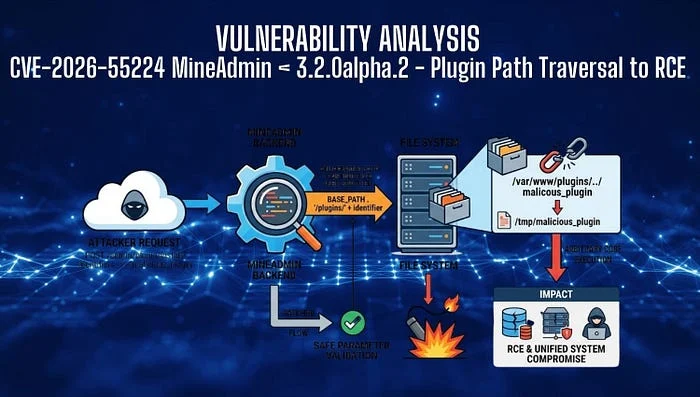
MineAdmin versions before 3.2.0-alpha.2 concatenated an unvalidated plugin identifier into a filesystem path, allowing an authenticated attacker to use directory traversal to reach arbitrary locations. Combined with the plugin loading logic, this could lead to remote code execution.

Cve 2026 55224
The full write-up lives on its author's site
It belongs to its author, so we link to it rather than copy it. The other two tabs are our own rewrites, checked against it.
Context
MineAdmin is a modular administrative panel built on the Hyperf PHP framework and Vue 3, aimed at backend management deployments. One of its features is an App-Store style plugin management service: an administrator can install and uninstall plugins from the backend, and the backend resolves each plugin by an identifier parameter supplied with the request.
The vulnerability described here is tracked as CVE-2026-55224, with a CVSS v3.1 score of 7.5 (High), and affects MineAdmin versions prior to 3.2.0-alpha.2. It lets an authenticated attacker perform a path traversal through the plugin management service and escalate to full remote code execution.
Setup
The write-up does not describe a lab build, test accounts, tooling or a captured request. The only precondition it states is authentication: the attacker must already be able to reach the plugin management functionality as an authenticated user, and the flaw is exercised when an administrator manages a plugin.
Finding it
The researcher focused on how the backend processes plugin installation and uninstallation routines. When a plugin is managed, the backend expects an identifier parameter, and that user-supplied value is concatenated directly into a local file system path. There is no input validation or sanitisation on the value before it is used to build the path, which is what makes the parameter interesting: any path syntax the attacker puts in identifier ends up in the resolved plugin location.
Exploitation
Step 1: Control the plugin path
The vulnerable construction is shown as:
$pluginPath = BASE_PATH . '/plugins/' . $identifier;
BASE_PATH is the application root, and the plugin is expected to live under /plugins/. Because $identifier is appended without checks, the resulting path is entirely determined by the request parameter.
Step 2: Traverse out of the plugins directory
By supplying dot-dot-slash (../) sequences in identifier, an attacker can escape the restricted /plugins/ directory and reference arbitrary locations on the server. The report does not include a concrete request or payload string beyond the ../ sequence itself.
Step 3: Reach code execution
Escaping the directory is not the end of the chain. Combined with MineAdmin's internal plugin loading logic, the crafted path can coerce the system into triggering composer operations or autoloading arbitrary PHP classes. That is the step that turns the traversal into remote code execution.
Root cause
The mistake is the direct concatenation of the user-controlled identifier into a filesystem path with no validation and no sanitisation, so ../ sequences are honoured and the path leaves /plugins/. The report does not describe any defence that was present and failed; the input handling is simply absent, and the plugin loading logic then acts on whatever path was produced.
Impact
An authenticated attacker can traverse outside the plugins directory and reference arbitrary server locations, and, through the plugin loading logic, cause composer operations or autoloading of arbitrary PHP classes, ending in remote code execution on the host. The report frames this as a severe threat to enterprise deployments of affected versions.
Fix
The remediation given is to upgrade to MineAdmin 3.2.0-alpha.2 or higher. In addition, the report recommends:
- Enforce strict regex whitelisting on input parameters:
/^[a-zA-Z0-9_-]+$/. - Use
basename()andrealpath()verification to ensure target paths remain locked within the intended directory boundaries.
Variants to test
- Other plugin-style identifiers. A positive result is a path that resolves outside the intended directory when the value contains
../. - Install versus uninstall paths. The report says the flaw lies in the plugin installation and uninstallation routines.
- Post-traversal loading. A positive result is execution of attacker-supplied PHP through the plugin loading logic.
- Whitelist bypass attempts. A positive result is any value that changes the resolved path without violating the pattern.
What happened, in plain words
MineAdmin is a piece of software that lets an organisation run the administrative side of a website or application: the screens where staff log in, manage content, and configure how the system behaves. It is built on two other pieces of software, Hyperf (a framework for the PHP programming language, which runs on the server) and Vue 3 (a framework for building the pages you see in the browser).
One of MineAdmin's features works like an app store on a phone. An administrator can browse plugins (add-on packages that extend the software) and install or uninstall them from the admin screens. To know which plugin is meant, the server expects a value called identifier to be sent along with the request.
A security researcher, Synthex, published an analysis of a flaw in that feature. The flaw is tracked as CVE-2026-55224. A CVE is a public catalogue number given to a known security bug so that everyone can refer to the same thing. The flaw has a CVSS v3.1 score of 7.5, rated High. CVSS is a standard way of scoring how serious a vulnerability is, on a scale from 0 to 10. It affects MineAdmin versions before 3.2.0-alpha.2.
In plain terms: someone who is already logged in can send a crafted identifier value that makes the server look for a plugin in a folder it should never look in. Because of how MineAdmin then loads plugins, that wrong folder can be used to run the attacker's own code on the server. Running your own code on someone else's server is called remote code execution, usually shortened to RCE, and it is about as bad as it gets: the attacker is no longer limited to what the admin screens offer.
The pieces you need to know first
Before the details make sense, a few everyday ideas.
- Server and browser. The browser is the program on your computer showing the page. The server is the computer somewhere else that stores the data and does the real work. When you click something, your browser sends a request to the server and the server sends back an answer.
- API. An API is the set of doors a program offers to other programs. Think of a restaurant: the menu is the API, the kitchen is the server, and you never walk into the kitchen yourself, you order through the menu. MineAdmin's plugin management is one of those doors.
- Parameter. A parameter is a named piece of information sent with a request, like the "To" field on an envelope. Here the parameter is called
identifier, and its job is to say which plugin is meant. - Authentication. Being authenticated means the server knows who you are, usually because you logged in. This flaw needs the attacker to be logged in already; it is not something a random visitor can do.
- Path. A path is the address of a file or folder on the server's disk, for example
/plugins/. Folders are nested inside each other, and a path describes the route from the top down to the file you want. - Path traversal. This is the vulnerability class in the title. It means tricking a program into leaving the folder it intended to use and walking into another one. The trick is the two-dot sequence
../, which in every operating system means "go up one folder". If a program glues your input onto a folder name without checking it, you can supply../and climb out. The everyday comparison: a hotel clerk told to fetch something from "room 12" who blindly follows a note saying "room 12, then up the stairs, then the manager's office" instead of stopping at room 12. - Composer. Composer is the standard tool in the PHP world for fetching and installing packages of code. If an attacker can make the server run Composer on a folder the attacker controls, Composer will happily install and load the attacker's code.
- Autoloading. PHP loads code files on demand rather than all at once. The mechanism that decides which file to load for a given class is called the autoloader. If the path handed to the autoloader can be influenced, the attacker can make PHP load a file of their choosing.
The setup the researcher used
The write-up does not describe a lab build, test accounts, tooling or a captured request. The only precondition it states is authentication: the attacker must already be able to reach the plugin management functionality as a logged-in user, and the flaw is exercised when an administrator manages a plugin.
How the researcher found it
The researcher focused on how the backend processes plugin installation and uninstallation routines. When a plugin is managed, the backend expects an identifier parameter, and that user-supplied value is concatenated directly into a local file system path. There is no input validation or sanitisation on the value before it is used to build the path, which is what makes the parameter interesting: any path syntax the attacker puts in identifier ends up in the resolved plugin location.
Two words in that paragraph deserve unpacking. Validation means checking that input is allowed at all, for example that it contains only letters and digits. Sanitisation means cleaning input up so that dangerous parts are removed or neutralised. Neither happens here, so whatever the attacker sends is used as-is.
Exploitation, step by step
Step 1: Control the plugin path
The vulnerable construction is shown as:
$pluginPath = BASE_PATH . '/plugins/' . $identifier;
Line by line, in plain words:
$pluginPathis the name of a variable, a labelled box in the program that will hold the final path.BASE_PATHis the application root, the top folder where MineAdmin lives on the server.'/plugins/'is the folder where plugins are supposed to live, appended to the root.$identifieris the value that came in with the request, appended at the end with no checks whatsoever.- The dot between the pieces is PHP's way of gluing text together, so the result is one long string: root, then
/plugins/, then whatever the user sent.
Because $identifier is appended without checks, the resulting path is entirely determined by the request parameter. If the attacker sends a normal plugin name, everything is fine. If the attacker sends something containing ../, the glued-together path contains ../ too, and the server will follow it.
Step 2: Traverse out of the plugins directory
By supplying dot-dot-slash (../) sequences in identifier, an attacker can escape the restricted /plugins/ directory and reference arbitrary locations on the server. The report does not include a concrete request or payload string beyond the ../ sequence itself.
Why this step matters: the /plugins/ folder is the boundary the developer intended. Everything inside it is code the administrator chose to install. Everything outside it is the rest of the server, including configuration files, other applications, and temporary folders. Once the path leaves /plugins/, the attacker is pointing the plugin machinery at files it was never meant to touch.
Step 3: Reach code execution
Escaping the directory is not the end of the chain. Combined with MineAdmin's internal plugin loading logic, the crafted path can coerce the system into triggering composer operations or autoloading arbitrary PHP classes. That is the step that turns the traversal into remote code execution.
In everyday terms: step 2 gets you into the wrong room. Step 3 is the part where the room's occupant, the plugin loader, does what it is told and runs whatever code it finds there. The attacker does not need a separate bug for this; the normal behaviour of the plugin loader is enough once the path is wrong.
Root cause
The mistake is the direct concatenation of the user-controlled identifier into a filesystem path with no validation and no sanitisation, so ../ sequences are honoured and the path leaves /plugins/. The report does not describe any defence that was present and failed; the input handling is simply absent, and the plugin loading logic then acts on whatever path was produced.
A useful way to remember it: the program trusted a value that came from outside. Any value that arrives in a request is under the sender's control, and must be treated as untrusted until proven otherwise.
Impact
An authenticated attacker can traverse outside the plugins directory and reference arbitrary server locations, and, through the plugin loading logic, cause composer operations or autoloading of arbitrary PHP classes, ending in remote code execution on the host. The report frames this as a severe threat to enterprise deployments of affected versions.
Why "authenticated" still matters: it narrows who can attack, but it does not make the bug harmless.
Fix
The remediation given is to upgrade to MineAdmin 3.2.0-alpha.2 or higher. In addition, the report recommends:
- Enforce strict regex whitelisting on input parameters:
/^[a-zA-Z0-9_-]+$/. - Use
basename()andrealpath()verification to ensure target paths remain locked within the intended directory boundaries.
What those two recommendations mean:
- A regex (regular expression) is a pattern used to describe what text is allowed. The pattern
/^[a-zA-Z0-9_-]+$/says: from the start of the value to the end, only letters (upper and lower case), digits, underscore and hyphen are permitted, and at least one character must be present. A dot is not in the list, so../cannot pass. This is a whitelist: only known-good characters are allowed, rather than trying to list every bad one. basename()is a PHP function that returns just the final name of a path, stripping any folder parts.realpath()resolves a path to its true, final location on disk, following any..and symbolic links. Checking the result against the intended directory means that even if something slips through, the program refuses to act on a path that ended up outside/plugins/.
Variants to test
- Other plugin-style identifiers. Look for parameters that name a package, theme, module or extension and are joined onto a base directory. A positive result is a path that resolves outside the intended directory when the value contains
../. - Install versus uninstall paths. The report says the flaw lies in the plugin installation and uninstallation routines.
- Post-traversal loading. Where a traversed path is later handed to a package manager or autoloader, check whether a file placed at the referenced location is loaded. A positive result is execution of attacker-supplied PHP through the plugin loading logic.
- Whitelist bypass attempts. A positive result is any value that changes the resolved path without violating the pattern.
Glossary
- API: the set of defined ways one program can ask another program to do something, like a menu you order from.
- Authentication: proving to a server who you are, usually by logging in.
- Autoloader: the part of PHP that decides which code file to load when a class is needed.
basename(): a PHP function that returns only the final name of a path, dropping any folder parts.- Composer: the standard package manager for PHP, used to fetch and install code packages.
- Concatenation: gluing two pieces of text together into one.
- CVE: a public catalogue number assigned to a known security vulnerability.
- CVSS: a standard scoring system for the severity of a vulnerability, from 0 to 10.
- Hyperf: a PHP framework used to build server applications.
- Identifier: here, the request parameter naming which plugin is meant.
- MineAdmin: a modular administrative panel built on Hyperf and Vue 3.
- Parameter: a named piece of information sent with a request.
- Path: the address of a file or folder on a disk.
- Path traversal: tricking a program into leaving its intended folder by using
../sequences. - PHP: a programming language commonly used for server-side web software.
- Plugin: an add-on package that extends a piece of software.
realpath(): a PHP function that resolves a path to its true location on disk, following..and links.- Regex (regular expression): a pattern describing which text is allowed or should be matched.
- Remote code execution (RCE): making a server run code the attacker supplied.
- Sanitisation: cleaning input so dangerous parts are removed or neutralised.
- Server: the remote computer that stores data and does the work behind a website.
- Validation: checking that input is allowed at all before using it.
- Vue 3: a framework for building the pages you see in the browser.
- Whitelist: a list of what is allowed, as opposed to a list of what is forbidden.



