**Critical Security Alert: Unauthenticated LFI to RCE in Visual Composer (CVE-2026–12227)**
The Visual Composer WordPress plugin up to version 45.16.0 handles the vcv-template parameter without proper validation, allowing unauthenticated local file inclusion. An attacker could read sensitive files such as wp-config.php and, by uploading a malicious image, escalate to remote code execution.

Cve 2026 12227
The full write-up lives on its author's site
It belongs to its author, so we link to it rather than copy it. The other two tabs are our own rewrites, checked against it.
Context
Visual Composer Website Builder is a WordPress plugin, and the vulnerability described here affects versions up to and including 45.16.0. The flaw is tracked as CVE-2026-12227 and is an unauthenticated Local File Inclusion (LFI) in the handling of the vcv-template parameter. The CVSS v3.1 base score given is 9.8, classified as critical.
Local File Inclusion is the class of bug where an application builds a path to a local file from user-supplied input and includes it without strict validation or sanitisation. In this case the vulnerable endpoint requires no authentication at all, so any anonymous user on the internet can reach it.
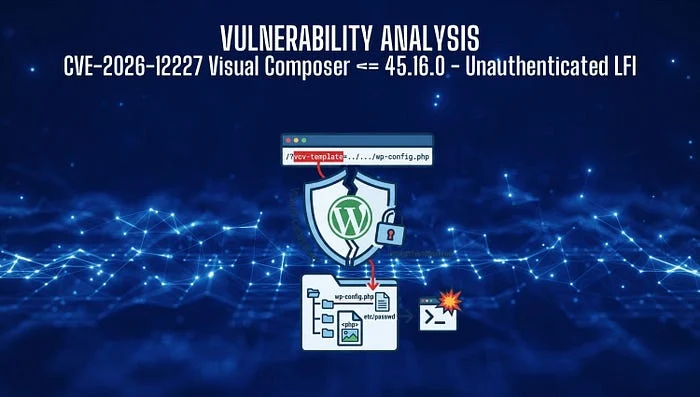
The image is the article header, showing the title "Critical Security Alert: Unauthenticated LFI to RCE in Visual Composer (CVE-2026-12227)" with the author Synthex and the publication date of 29 September 2026.
Setup
The report does not describe a lab, a specific WordPress version, a hosting stack or any tooling. The only precondition it states is the plugin version: Visual Composer up to and including 45.16.0. No account, role or credential is needed, because the vulnerable endpoint is reachable without authentication.
Finding it
The report frames the issue as insecure handling of the vcv-template parameter. The parameter is used to decide which local file the application includes, and the input is not validated or sanitised strictly enough. Because the endpoint performs no authentication check, the parameter can be driven by an anonymous request.
The report does not describe how the parameter was originally discovered, nor does it show the plugin source that handles it.
Exploitation
The report describes the exploitation at the level of technique rather than reproducing a full HTTP transcript. It does not print a complete request, a URL, a response body or a status code, so the exact wire format is not available here.
Step 1: Traverse out of the intended directory
The attacker sends a specially crafted HTTP request to the vulnerable endpoint, using basic directory traversal sequences such as ../ in the vcv-template parameter. The traversal moves the include path outside the directory the plugin intended to read from.
Step 2: Read sensitive local files
By pointing the traversal at sensitive local system files, the attacker forces the server to expose them. The report names wp-config.php as an example. That file leaks critical database credentials.
Step 3: Upload a disguised payload
The attacker uploads a file through standard WordPress media uploads. The file looks like a benign image but contains a hidden malicious PHP payload.
Step 4: Include and execute the uploaded file
The attacker then uses the same LFI vulnerability to include the uploaded file, which causes the hidden PHP payload to execute. The report describes this as the step that turns the file disclosure into Remote Code Execution.
Step 5: Full server compromise
The result of the chain is total server compromise, giving the attacker complete operational control without ever needing a valid username or password.
Root cause
The mistake is that the application dynamically includes local server files based on user-supplied input, here the vcv-template parameter, without enforcing strict validation or sanitisation. The endpoint also performs no authentication check, so the include can be driven anonymously.
The escalation to RCE depends on the attacker also being able to upload a file through standard WordPress media uploads; the report presents that as part of the chain but does not detail any upload restrictions that would have to be bypassed.
Impact
The direct impact is a breach of confidentiality: an anonymous attacker can read sensitive local files, including wp-config.php, and thereby obtain critical database credentials. The report describes this alone as a massive breach of confidentiality.
The larger impact is escalation. Combined with standard WordPress media uploads, the LFI allows an attacker to execute a hidden PHP payload and achieve full Remote Code Execution, resulting in total server compromise and complete operational control, with no valid username or password required.
Fix
It points to a separate vulnerability analysis and remediation guide published on the author's blog, titled "Vulnerability Analysis CVE-2026-12227: Visual Composer <= 45.16.0, Unauthenticated LFI", for the complete exploitation flow and step-by-step mitigation strategies. The concrete remediation steps are not reproduced in this article.
Variants to test
The report gives no additional payloads or endpoints.
What happened, in plain words
A security researcher who writes under the name Synthex published a short alert on 29 September 2026 about a serious flaw in a piece of software called Visual Composer Website Builder. Visual Composer is a plugin: an add-on that people install on a WordPress website to get extra features. In this case the feature is a page builder, a tool that lets you assemble web pages visually, by dragging blocks around, instead of writing code.
The flaw has an official tracking number, CVE-2026-12227. A CVE is a public catalogue entry: when someone finds a security bug, it gets a number so that everyone, vendors, defenders and other researchers, can talk about the same thing. The flaw affects Visual Composer versions up to and including 45.16.0.
The bug class is Local File Inclusion, usually shortened to LFI. To understand it, imagine a hotel receptionist who is told "fetch the guest file from room 12" and simply walks to whatever room number is written on the slip, without checking that the room is one a guest is allowed to see. If someone writes "room 12, then the manager's office", the receptionist obediently fetches the manager's paperwork too. A web application does the same thing when it builds a path to a file on its own disk from something a visitor typed, and includes that file without checking the path carefully. "Local" means the file is on the server itself, not somewhere else on the internet.
The report gives the flaw a CVSS v3.1 base score of 9.8. CVSS is a standard scoring system for the severity of a security bug; scores run from 0 to 10, and 9.8 is at the top end, which is why the report calls it critical. The reason for that score is that no login is needed: any anonymous person on the internet can reach the vulnerable part of the site.
The image is the header of the article, showing the title "Critical Security Alert: Unauthenticated LFI to RCE in Visual Composer (CVE-2026-12227)", the author Synthex and the date 29 September 2026.
Setup
The report does not describe a test lab, a particular WordPress version, a hosting setup or any tools. The only precondition it states is the plugin version: Visual Composer up to and including 45.16.0. No account, user role or password is needed, because the vulnerable endpoint can be reached without logging in.
An endpoint, in web terms, is simply a particular address on a website that accepts a request and does something with it, like a service counter in a shop. "Unauthenticated" means the counter serves anyone who walks up, with no membership card required.
Finding it
The report frames the problem as insecure handling of a parameter called vcv-template. A parameter is a named value attached to a request, the way a form field is filled in before you press submit. This parameter is used to decide which local file the application includes, and the input is not validated or sanitised strictly enough. Validating means checking that the value is of the expected shape; sanitising means cleaning it so that dangerous parts cannot take effect. Neither happens here.
Because the endpoint performs no authentication check, the parameter can be driven by an anonymous request. The report does not describe how the parameter was originally discovered, and it does not show the plugin source code that handles it.
Exploitation
The report describes the exploitation at the level of technique rather than reproducing a full HTTP transcript. It does not print a complete request, a URL, a response body or a status code, so the exact wire format is not available here. HTTP is the language browsers and web servers use to exchange requests and responses; a transcript would be a literal copy of that conversation.
Step 1: Traverse out of the intended directory
The attacker sends a specially crafted HTTP request to the vulnerable endpoint, using basic directory traversal sequences such as ../ in the vcv-template parameter. The traversal moves the include path outside the directory the plugin intended to read from.
Directory traversal is worth explaining from zero. Files on a server are arranged in folders, also called directories, like folders in a filing cabinet. The notation ../ means "go up one folder". If a program expects to read files from a folder called templates and you tell it to read ../wp-config.php, you are asking it to step up out of templates and then open a file next door. The program should refuse to leave its own folder, but here it does not.
Step 2: Read sensitive local files
By pointing the traversal at sensitive local system files, the attacker forces the server to expose them. The report names wp-config.php as an example. That file leaks critical database credentials.
wp-config.php is the WordPress configuration file. It holds the settings a WordPress site needs to talk to its database, including the username and password for that database. A credential here means exactly what it sounds like: the login details that unlock the database. If an outsider can read that file, they can read those details too.
Step 3: Upload a disguised payload
The attacker uploads a file through standard WordPress media uploads. The file looks like a benign image but contains a hidden malicious PHP payload.
WordPress has a built-in media library where site owners upload pictures and other files for their pages. PHP is the programming language WordPress is written in, and a PHP payload is a small piece of PHP code written to do something the attacker wants. The trick is disguise: the file is presented as an image, but inside it sits code that the server will run if it is ever treated as a program rather than a picture.
Step 4: Include and execute the uploaded file
The attacker then uses the same LFI vulnerability to include the uploaded file, which causes the hidden PHP payload to execute. The report describes this as the step that turns the file disclosure into Remote Code Execution.
Remote Code Execution, or RCE, means an attacker can make the server run code of their choosing from a distance. "Include" is the key word: the LFI feature does not merely read a file, it pulls the file into the running application, and if that file contains PHP, the server runs it.
Step 5: Full server compromise
The result of the chain is total server compromise, giving the attacker complete operational control without ever needing a valid username or password. A chain, in security writing, means several small weaknesses used one after another, where each step makes the next possible.
Root cause
The mistake is that the application dynamically includes local server files based on user-supplied input, here the vcv-template parameter, without enforcing strict validation or sanitisation. The endpoint also performs no authentication check, so the include can be driven anonymously.
The escalation to RCE depends on the attacker also being able to upload a file through standard WordPress media uploads; the report presents that as part of the chain but does not detail any upload restrictions that would have to be bypassed.
Impact
The direct impact is a breach of confidentiality: an anonymous attacker can read sensitive local files, including wp-config.php, and thereby obtain critical database credentials. The report describes this alone as a massive breach of confidentiality. Confidentiality here is the security property that says information stays with the people allowed to see it.
The larger impact is escalation. Combined with standard WordPress media uploads, the LFI allows an attacker to execute a hidden PHP payload and achieve full Remote Code Execution, resulting in total server compromise and complete operational control, with no valid username or password required.
Default configurations are the settings a product ships with, before anyone tunes them.
Fix
It points to a separate vulnerability analysis and remediation guide published on the author's blog, titled "Vulnerability Analysis CVE-2026-12227: Visual Composer <= 45.16.0, Unauthenticated LFI", for the complete exploitation flow and step-by-step mitigation strategies. The concrete remediation steps are not reproduced in this article.
Variants to test
The report gives no additional payloads or endpoints.
Glossary
- CVE: a public catalogue number for a specific security vulnerability, so people can refer to the same bug unambiguously.
- CVSS: a standard scoring system that rates the severity of a vulnerability from 0 to 10.
- Plugin: an add-on installed on a website platform to add features.
- WordPress: a widely used system for building and running websites.
- Visual Composer Website Builder: a WordPress plugin that lets people build pages visually.
- Endpoint: a particular address on a website that accepts requests and performs an action.
- Parameter: a named value sent with a request, like a filled-in form field.
- Authentication: proving who you are, usually by logging in.
- Unauthenticated: reachable without logging in, by anyone.
- LFI (Local File Inclusion): a bug where an application loads a file from its own server based on input a visitor controls, without checking the path properly.
- Directory traversal: using sequences such as
../to move up out of the folder a program intended to stay in. - Validation: checking that input has the expected shape.
- Sanitisation: cleaning input so dangerous parts cannot take effect.
wp-config.php: the WordPress configuration file, which contains database credentials.- Credentials: login details such as a username and password.
- Database: the system that stores a website's content and settings.
- Payload: the piece of code an attacker wants the target to run.
- PHP: the programming language WordPress is written in.
- RCE (Remote Code Execution): making a server run code of your choosing from a distance.
- Exploit chain: several weaknesses used in sequence, each enabling the next.
- Confidentiality: the property that information is only seen by those allowed to see it.
- HTTP: the protocol browsers and web servers use to exchange requests and responses.
- Session cookie: a small piece of data stored in a browser that tells a site you are logged in.
- Default configuration: the settings a product ships with before anyone changes them.
- Patch: a software update that fixes a flaw.



