CVE-2026–34486 Analysis — Apache Tomcat EncryptInterceptor Bypass
A regression in Apache Tomcat's EncryptInterceptor caused decryption failures to be logged but not stop message processing, so unencrypted cluster messages were forwarded to deserialisation. An attacker able to reach the cluster port could send crafted bytes that reach the deserialisation stage, potentially leading to remote code execution if a gadget chain is available.
 Published on medium.com
Cve
The full write-up lives on its author's site
It belongs to its author, so we link to it rather than copy it. The other two tabs are our own rewrites, checked against it.
Context
Apache Tomcat's clustering layer, Apache Tribes, lets cluster nodes exchange messages with each other. When cluster traffic has to stay confidential, Tomcat provides the EncryptInterceptor, a channel interceptor that encrypts messages between nodes and decrypts them on receipt. The class involved here is org.apache.catalina.tribes.group.interceptors.EncryptInterceptor, and the method at the centre of the analysis is messageReceived().
CVE-2026-34486 is a bypass of that component: under certain conditions the interceptor can be fully circumvented, so plaintext, or otherwise unverified, messages pass through even when encryption is configured. The write-up rates it CVSS 3.1 7.5 (High), maps it to CWE-311 and CWE-807, and gives a disclosure date of 2026-04-09. The article itself was published on 8 August 2026.

The vulnerability is a regression introduced by the fix for an earlier issue, CVE-2026-29146.
Setup
The write-up is a source-code analysis rather than a live engagement, and it does not describe a lab, accounts, roles or tooling. The precondition it does state is deployment shape: the flaw only matters in clustered deployments, meaning a <Cluster> configuration with EncryptInterceptor applied. Single-instance deployments without clustering are not affected.
Finding it
The starting point is CVE-2026-29146, a padding oracle in the decryption logic of EncryptInterceptor. An attacker could observe decryption failure signals, such as error responses or timing differences, and use them to decrypt ciphertext gradually, a classic side-channel issue.
To close that oracle, the Tomcat team changed the code so that decryption exceptions were caught, which stopped the signal from leaking externally. In doing so, the accompanying control-flow rule, "if decryption failed, processing of this message must stop here", was dropped. The exception was caught and logged, but execution was allowed to continue to the next processing stage anyway. The write-up calls this a textbook case of a patch for one vulnerability introducing a more severe bypass.

Figure 1. How the CVE-2026-29146 patch led to the CVE-2026-34486 regression
Exploitation
Step 1: read the patched messageReceived()
The flawed structure after the CVE-2026-29146 patch, as simplified in the write-up:
public void messageReceived(ChannelMessage msg) { try { byte[] data = msg.getMessage().getBytes(); data = encryptionManager.decrypt(data); XByteBuffer xbb = msg.getMessage(); xbb.clear(); xbb.append(data, 0, data.length); } catch (GeneralSecurityException gse) { log.error("Unable to decrypt cluster message", gse); } super.messageReceived(msg); }
The decisive detail is that super.messageReceived(msg) sits outside the try-catch block. That produces two behaviours:
- If decryption succeeds,
xbbis replaced with the decrypted plaintext and passed to the next interceptor, which is the intended behaviour. - If decryption fails, the exception is caught and
xbbis never replaced, but the original message bytes, which may be unencrypted, are still forwarded unmodified tosuper.messageReceived(msg).
Step 2: send an unencrypted message
In practice, sending an unencrypted message makes decrypt() throw. The exception is silently logged, and the message is still passed on to the next processing stage, including deserialisation, with no validation. EncryptInterceptor effectively becomes a no-op.
Step 3: reach deserialisation
The bypass matters because Apache Tribes deserializes incoming messages into objects. Once EncryptInterceptor is bypassed, a path opens for attacker-controlled bytes to reach that deserialisation stage unchecked.
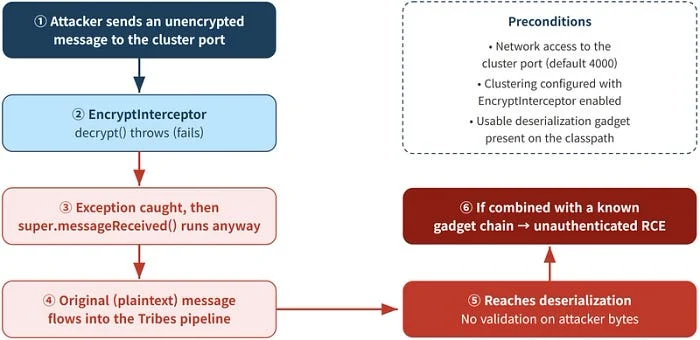
Figure 2. Attack chain from EncryptInterceptor bypass to potential RCE (conceptual)
The write-up deliberately covers only the structural root cause and the conceptual attack flow. It omits actual gadget chain payloads and exploit reproduction steps, on the grounds that weaponised reproduction steps are not something to publish even for a patched CVE. For environment testing it points to official vendor guidance and internal security procedures.
Root cause
The mistake is a control-flow error introduced while fixing a side channel. Catching GeneralSecurityException suppressed the oracle signal, but nothing stopped execution after the catch, so the failure path fell through to super.messageReceived(msg) with the original, unvalidated bytes. The encryption check was therefore reduced to a logging step. The write-up frames the lesson for code review directly: catching an exception is not the same as handling it safely.
Impact
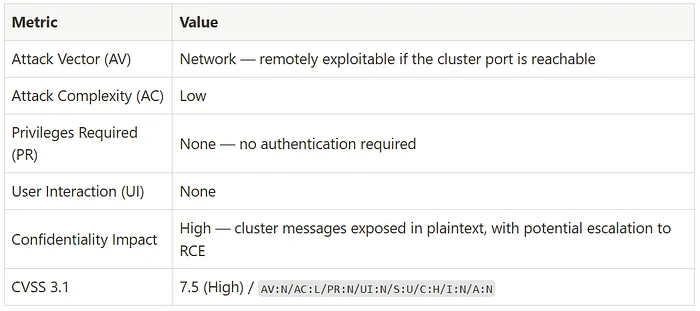
The official CVSS vector scores only confidentiality impact as High. The write-up argues that because cluster messages get deserialised, there is a realistic path to chained integrity and availability impact, and that prioritising purely by the raw CVSS score risks underrating the issue. Combined with a known gadget chain, the bypass could escalate to unauthenticated remote code execution, a risk the author says arguably exceeds what the raw score suggests. These escalations are presented as potential and conditional, not as a demonstrated exploit.
Affected versions
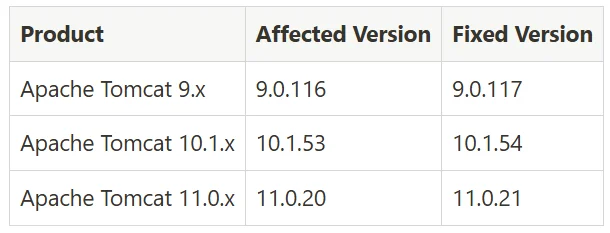
The write-up lists the fixed releases as 9.0.117, 10.1.54 and 11.0.21. It states that the flaw only matters in clustered deployments with EncryptInterceptor applied; single-instance deployments without clustering are not affected.
Fix
The corrected structure adds an explicit return on decryption failure, so unvalidated messages never propagate further:
public void messageReceived(ChannelMessage msg) { try { byte[] data = msg.getMessage().getBytes(); data = encryptionManager.decrypt(data); XByteBuffer xbb = msg.getMessage(); xbb.clear(); xbb.append(data, 0, data.length); } catch (GeneralSecurityException gse) { log.error("Unable to decrypt cluster message, dropping message", gse); return; } super.messageReceived(msg); }
The write-up's mitigation list:
- Patch immediately: upgrade to 9.0.117 / 10.1.54 / 11.0.21 or later.
- Until patched, restrict the cluster port (default 4000) to trusted nodes only, and consider network-level encryption such as IPsec or a VPN tunnel.
- After patching, independently confirm that inter-node communication is actually encrypted.
- Add detection rules for unusual scanning or connection attempts against the cluster port.
- For unsupported legacy versions, evaluate commercial extended support options (the write-up names HeroDevs NES).
What happened, in plain words
Apache Tomcat is a piece of software that runs Java web applications on a server. Many websites and internal business tools are built on it. When a Tomcat installation is set up as a cluster, several Tomcat servers work together as a team, sharing information so that the application keeps working even if one machine fails or gets busy. To share that information, Tomcat uses a component called Apache Tribes, which is the messaging layer that carries messages between the machines in the cluster.
Because those messages travel over a network, someone might be able to listen in on them. To prevent that, Tomcat offers a component called EncryptInterceptor. An interceptor is a piece of code that sits in the path of every message and can inspect or modify it before it moves on. The EncryptInterceptor's job is simple: before a message leaves one node, scramble it (encrypt it) so nobody on the network can read it; when a message arrives at another node, unscramble it (decrypt it) so the application can use it.
CVE-2026-34486 is a bug in that EncryptInterceptor. Under certain conditions the interceptor can be completely bypassed, meaning messages that were never encrypted at all still get accepted and processed as if they had been. The write-up rates it CVSS 3.1 7.5 (High), maps it to CWE-311 and CWE-807, and gives a disclosure date of 2026-04-09. The article itself was published on 8 August 2026.
The bug is a regression, which means it was introduced by a fix for an earlier bug. The earlier bug was CVE-2026-29146, and the fix for it accidentally created this new, more serious problem.
Background: the earlier bug and its fix
To understand CVE-2026-34486 you first need to understand CVE-2026-29146. That earlier issue was a padding oracle in the decryption logic of EncryptInterceptor. A padding oracle is a subtle information leak: when the software tries to decrypt something and the decryption fails, it gives a slightly different response (an error message, or it takes a slightly different amount of time) than when decryption succeeds. An attacker who can send many messages and watch those differences can use them like a slow, noisy yes/no signal to gradually work out what the encrypted data contains, without ever having the key. It is a classic side-channel issue: the secret is not stolen directly, it leaks through a side effect.
To close that leak, the Tomcat team changed the code so that decryption exceptions were caught. In programming, an exception is an error signal that a function throws when something goes wrong. Catching it means the surrounding code takes over instead of letting the error crash the program. By catching the exception, the team stopped the error signal from reaching the attacker, which closed the oracle.
But in doing so, they also dropped an important rule that used to be in the code: "if decryption failed, processing of this message must stop here." The exception was caught and logged (written to a log file), but execution was allowed to continue to the next processing stage anyway. The write-up calls this a textbook case of a patch for one vulnerability introducing a more severe bypass.
Figure 1. How the CVE-2026-29146 patch led to the CVE-2026-34486 regression
Root cause: reading the flawed code
The problem lives in a method called messageReceived() inside the class org.apache.catalina.tribes.group.interceptors.EncryptInterceptor. A method is a named block of code that does one job; messageReceived() is the method that runs every time a message arrives at a node. The write-up shows a simplified version of the flawed code, as it looked after the CVE-2026-29146 patch:
public void messageReceived(ChannelMessage msg) { try { byte[] data = msg.getMessage().getBytes(); data = encryptionManager.decrypt(data); XByteBuffer xbb = msg.getMessage(); xbb.clear(); xbb.append(data, 0, data.length); } catch (GeneralSecurityException gse) { log.error("Unable to decrypt cluster message", gse); } super.messageReceived(msg); }
Line by line, in plain words:
public void messageReceived(ChannelMessage msg) {declares the method. It takes one input,msg, which is the incoming message.try {starts a block of code that might fail. If anything inside throws an exception, the program jumps to the matchingcatchblock instead of crashing.byte[] data = msg.getMessage().getBytes();pulls the raw bytes out of the message. A byte array is just a sequence of numbers, the raw form of any data on a computer.data = encryptionManager.decrypt(data);asks the encryption manager to decrypt those bytes. If the bytes are not valid ciphertext (for example, because they were never encrypted), this call throws an exception.XByteBuffer xbb = msg.getMessage();grabs a handle to the message's internal buffer, the place where its bytes are stored.xbb.clear();empties that buffer.xbb.append(data, 0, data.length);puts the decrypted bytes back into the buffer. So on success, the message now holds plaintext, ready for the next stage.} catch (GeneralSecurityException gse) {catches any security-related exception thrown inside thetryblock.log.error("Unable to decrypt cluster message", gse);writes an error to the log. This is the only thing the failure path does.}closes the catch block.super.messageReceived(msg);passes the message on to the parent class, which forwards it to the next interceptor in the chain. This is the line that actually moves the message forward.}closes the method.
The decisive detail is that super.messageReceived(msg) sits outside the try-catch block. That produces two behaviours:
- If decryption succeeds,
xbbis replaced with the decrypted plaintext and passed to the next interceptor, which is the intended behaviour. - If decryption fails, the exception is caught and
xbbis never replaced, but the original message bytes, which may be unencrypted, are still forwarded unmodified tosuper.messageReceived(msg).
In everyday terms: imagine a mailroom clerk whose job is to open every parcel, check it, and reseal it before passing it on. If a parcel cannot be opened, the clerk is supposed to stop and return it. In this buggy version, the clerk writes "could not open" in a notebook and then passes the unopened parcel straight through anyway. The check happened, but it changed nothing.
Attack flow: how the bypass becomes dangerous
In practice, sending an unencrypted message makes decrypt() throw. The exception is silently logged, and the message is still passed on to the next processing stage, including deserialisation, with no validation. EncryptInterceptor effectively becomes a no-op, meaning it does nothing at all.
Deserialisation is the process of turning a stream of bytes back into a live object inside the program. It is how the receiving node reconstructs the message. It is also a well-known dangerous operation, because if an attacker controls the bytes, they may be able to shape the resulting object in ways the programmer never intended. The bypass matters because Apache Tribes deserializes incoming messages into objects. Once EncryptInterceptor is bypassed, a path opens for attacker-controlled bytes to reach that deserialisation stage unchecked.
Figure 2. Attack chain from EncryptInterceptor bypass to potential RCE (conceptual)
The write-up deliberately covers only the structural root cause and the conceptual attack flow. It omits actual gadget chain payloads and exploit reproduction steps, on the grounds that weaponised reproduction steps are not something to publish even for a patched CVE. A gadget chain is a sequence of existing pieces of code in the application that, chained together, do something the attacker wants. For environment testing the write-up points to official vendor guidance and internal security procedures.
Root cause, restated
The mistake is a control-flow error introduced while fixing a side channel. Control flow is the order in which a program executes its lines. Catching GeneralSecurityException suppressed the oracle signal, but nothing stopped execution after the catch, so the failure path fell through to super.messageReceived(msg) with the original, unvalidated bytes. The encryption check was therefore reduced to a logging step. The write-up frames the lesson for code review directly: catching an exception is not the same as handling it safely.
Impact and severity
The official CVSS vector scores only confidentiality impact as High. CVSS is a scoring system that rates how serious a vulnerability is; it breaks impact into three parts: confidentiality (can secrets be read), integrity (can data be changed), and availability (can the service be knocked offline). The write-up argues that because cluster messages get deserialised, there is a realistic path to chained integrity and availability impact, and that prioritising purely by the raw CVSS score risks underrating the issue. Combined with a known gadget chain, the bypass could escalate to unauthenticated remote code execution (RCE), a risk the author says arguably exceeds what the raw score suggests. These escalations are presented as potential and conditional, not as a demonstrated exploit.
Affected versions
The write-up lists the fixed releases as 9.0.117, 10.1.54 and 11.0.21. The write-up states that the flaw only matters in clustered deployments with EncryptInterceptor applied. The precondition the write-up states is deployment shape: the flaw only matters in clustered deployments, meaning a <Cluster> configuration with EncryptInterceptor applied. Single-instance deployments without clustering are not affected.
The fix
The corrected structure adds an explicit return on decryption failure, so unvalidated messages never propagate further:
public void messageReceived(ChannelMessage msg) { try { byte[] data = msg.getMessage().getBytes(); data = encryptionManager.decrypt(data); XByteBuffer xbb = msg.getMessage(); xbb.clear(); xbb.append(data, 0, data.length); } catch (GeneralSecurityException gse) { log.error("Unable to decrypt cluster message, dropping message", gse); return; } super.messageReceived(msg); }
What changed, line by line:
- The
tryblock and the decryption logic are the same as before. - The
catchblock still logs the error, but the message now says "dropping message" to make the intent clear. - The new line
return;exits the method immediately. Because of it, the linesuper.messageReceived(msg);is never reached when decryption fails. The message is dropped, not forwarded. - On success, the flow is unchanged: the decrypted bytes are placed back in the buffer and the message is passed on.
In the mailroom comparison: the clerk now actually returns the unopened parcel to the sender instead of passing it through.
Mitigation list from the write-up
- Patch immediately: upgrade to 9.0.117 / 10.1.54 / 11.0.21 or later.
- Until patched, restrict the cluster port (default 4000) to trusted nodes only, and consider network-level encryption such as IPsec or a VPN tunnel. A port is a numbered channel on a server that a particular service listens on; the cluster port is the one Tribes uses to talk to other nodes.
- After patching, independently confirm that inter-node communication is actually encrypted.
- Add detection rules for unusual scanning or connection attempts against the cluster port.
- For unsupported legacy versions, evaluate commercial extended support options (the write-up names HeroDevs NES).
Conclusion
CVE-2026-34486 is a textbook example of a security patch introducing a new vulnerability. In fixing a padding-oracle side channel by catching an exception, the accompanying control-flow question, "should processing continue after this failure?", was overlooked, effectively neutralising the encryption component it was meant to protect.
Glossary
- Apache Tomcat: a Java application server that runs web applications.
- Cluster: several Tomcat servers working together as a team, sharing messages so the application stays available.
- Apache Tribes: Tomcat's messaging layer that carries messages between cluster nodes.
- Interceptor: a piece of code that sits in the path of every message and can inspect or modify it before it moves on.
- EncryptInterceptor: the Tomcat interceptor that encrypts outgoing cluster messages and decrypts incoming ones.
- Encryption: scrambling data so that only someone with the right key can read it.
- Decryption: unscrambling encrypted data back into readable form.
- CVE: a public identifier for a known security vulnerability.
- CVSS: a scoring system that rates the severity of a vulnerability, broken into confidentiality, integrity and availability impact.
- CWE-311: the weakness category for missing encryption of sensitive data.
- CWE-807: the weakness category for relying on untrusted inputs in a security decision.
- Regression: a new bug introduced by a change that was meant to fix something else.
- Padding oracle: a side-channel leak where differences in error responses or timing reveal information about encrypted data.
- Side channel: information that leaks indirectly through a side effect (timing, error messages) rather than through the protected data itself.
- Exception: an error signal a function throws when something goes wrong.
- Catch: code that takes over when an exception is thrown, instead of letting the program crash.
- Control flow: the order in which a program executes its lines.
- Method: a named block of code that performs one job.
- Byte array: a sequence of raw bytes, the basic form of data on a computer.
- Deserialisation: turning a stream of bytes back into a live object inside the program.
- Gadget chain: a sequence of existing code pieces that, chained together, do something the attacker wants.
- RCE (remote code execution): an attacker can run their own code on the target machine.
- Unauthenticated: without needing any login or credentials.
- No-op: a piece of code that does nothing.
- Port: a numbered channel on a server that a particular service listens on.
- IPsec: a set of protocols that encrypt network traffic between machines.
- VPN tunnel: an encrypted connection between two networks over an untrusted network.
- HeroDevs NES: a commercial extended support offering named in the write-up for unsupported legacy versions.



