“Hey Siri, follow that car!” - How traffic cameras expose your location through parking apps.
Parking apps that use automatic license plate recognition (ANPR) allow anyone to register another person's license plate without verification, so when the plate is detected, the attacker receives a live notification with the parking location. A second method exploits error messages from free-parking sessions to infer whether a vehicle is parked in a zone, enabling location tracking without cameras.
 Published on notmyplate.com
Automated license plate recognition systems have been used for over a decade by law enforcement to monitor and identify traffic offenders. More recently, the technology has found its way to customer-facing applications, despite criticism by privacy advocates.
The full write-up lives on its author's site
It belongs to its author, so we link to it rather than copy it. The other two tabs are our own rewrites, checked against it.
Context
Automated licence plate recognition (ANPR) has moved from law enforcement into customer-facing parking and toll applications. In these products a driver enters a licence plate number once, and from then on a camera at the entrance of a car park (or on a toll road) detects the plate, starts a session, and the fee is debited automatically. The convenience is real: no ticket, no barrier interaction, no app at the gate.
The feature that makes this work is also the feature that breaks it: the applications let any user type in any plate number. As the research puts it, "none of the apps verified whether the licence plate was owned or affiliated to the person who entered it." Once a plate is registered to an attacker's account, every ANPR detection of that plate produces a session on the attacker's account, and with it a push notification naming the car park where the vehicle was seen.
The research covered three techniques in total: session hijacking through ANPR cameras, an oracle attack against free limited-time on-street parking, and receipt or unpaid-session lookups that only need a plate (and in one case a phone number). The affected surface was mapped across 10 countries in Western Europe, with more than 3,850 affected areas identified.
Setup
No special tooling was needed for the primary technique. The preconditions were:
- A normal account in a parking app that supports ANPR-based payment (the study used the apps of Q-Park and Indigo Neo, formerly OPnGO).
- A payment method attached to that account, because a successful hit means the attacker pays for the victim's parking.
- The victim's licence plate number, which is public by design.
For the participant study, a call was launched on Twitter and Instagram on 31 May 2022. Eligibility required the person to be a named driver of the car; there were no requirements on how much the car was used. 120 participants eventually had their plates entered into the two selected operators' apps. None of them were briefed about the methodologies, so their driving behaviour would not change.
Interparking, the third big Belgian operator, was excluded from the large-scale experiment because its application only allows a user to link one licence plate at a time, which is less convenient at scale.
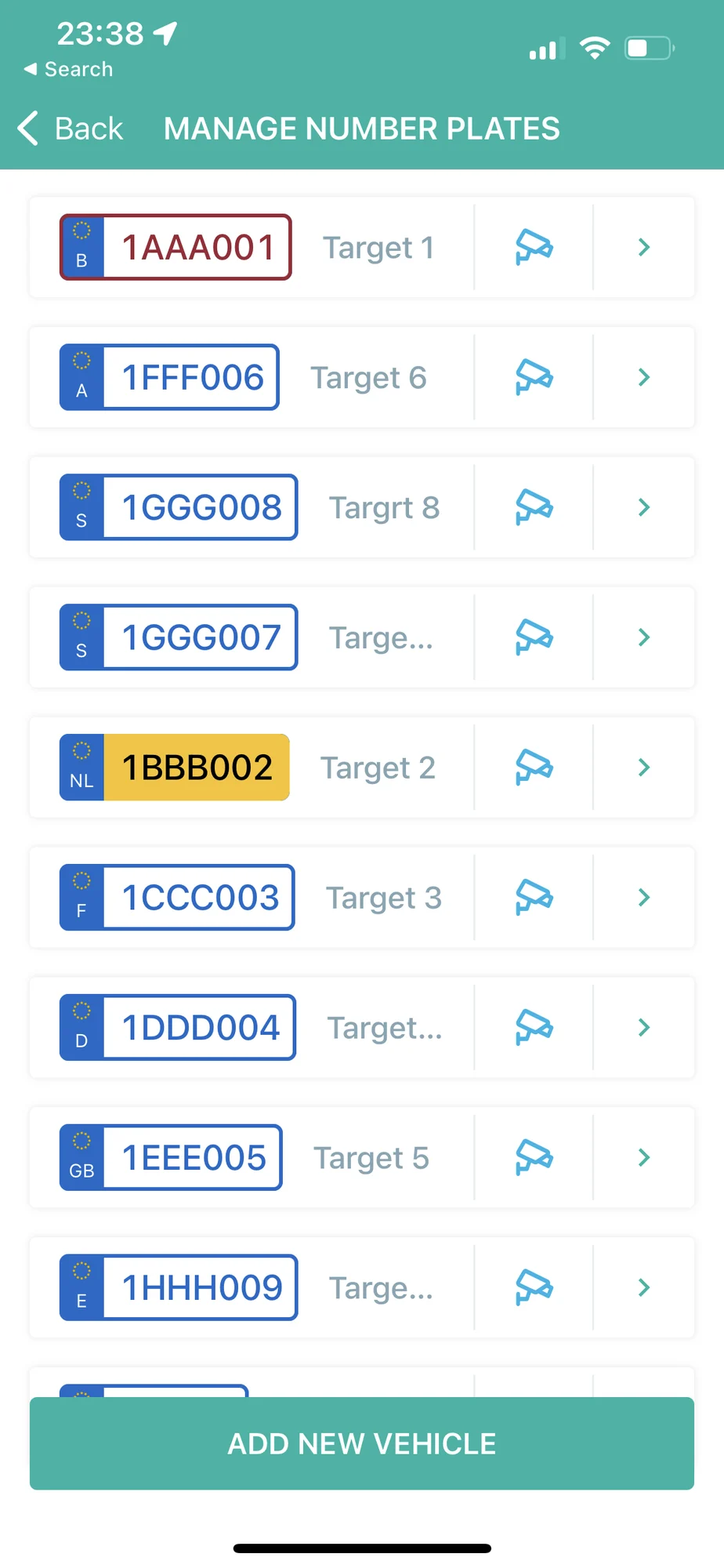
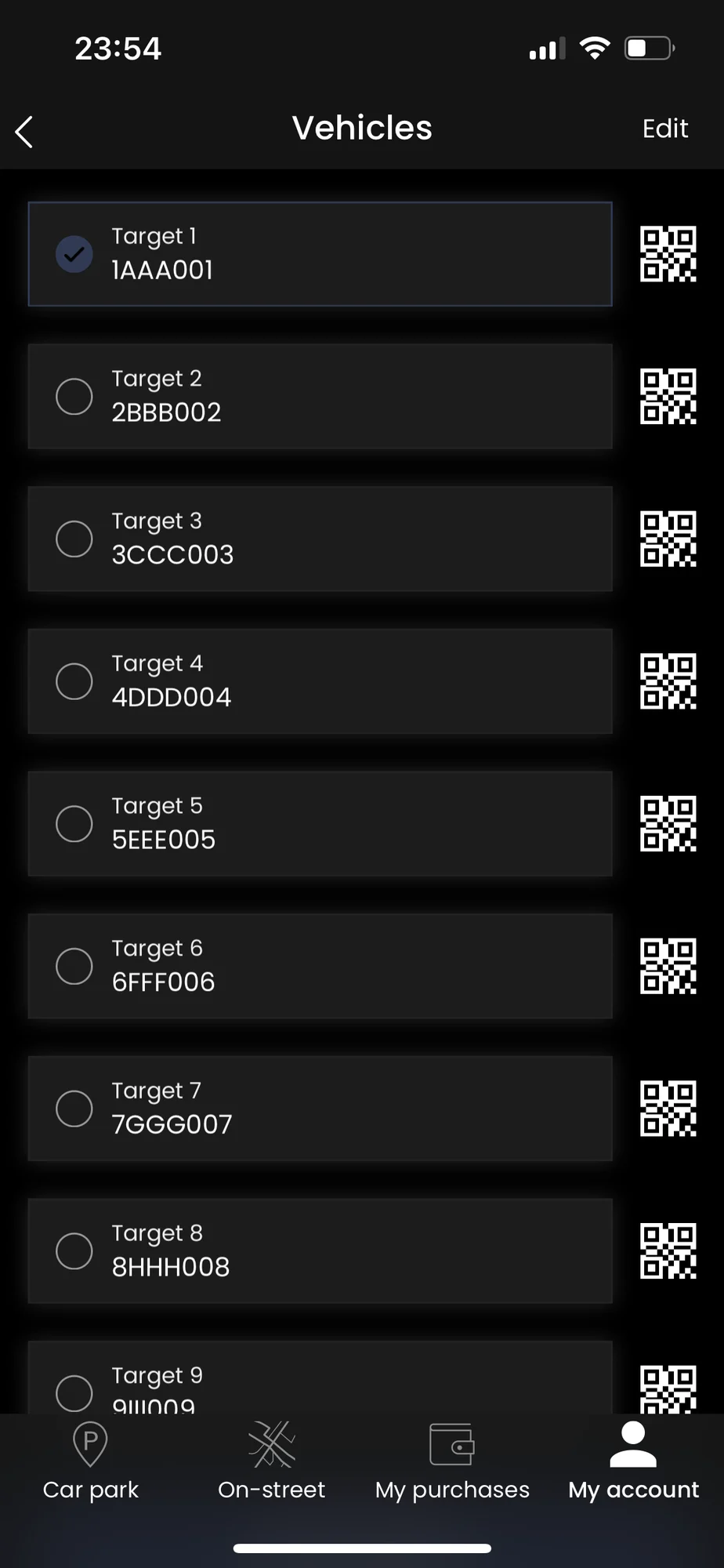
The screenshots show hundreds of plates being entered in 4411 (Q-Park) and Indigo Neo (OPnGO), with real plates replaced by fake ones for the screenshots.
For the second technique, a proof-of-concept stalkerware application was written for the 4411.io app, active in Belgium and The Netherlands. It simulated a normal Android application and created parking sessions programmatically.
Finding it
The observation is simple once stated: the plate is the only identifier the ANPR system uses, and the apps accept it without proof. There is no ownership check, no confirmation sent to an existing owner, and in most apps no block on re-registering a plate that is already listed. In most apps, registering someone else's plate silently disables it on the victim's account and redirects future charges and notifications to the attacker.
A second observation came from on-street parking. Cities offer free parking for a limited time (for example 30 minutes near a shopping district) and implement a cooldown so the free slot cannot be renewed indefinitely, usually once per day per plate. When a plate has already used its free slot, the app returns an error instead of creating a session. That error is an oracle: it tells the attacker whether the vehicle is parked in that zone right now.
A third observation is that some operators expose session data through lookups: VAT receipts by plate and phone number, or unpaid sessions from the last 48 hours by plate alone.
Exploitation
Step 1: register the target's plate for ANPR payment
The steps differ per app but the shape is the same. For Q-Park:
- Install Q-Park's mobile application on your device
- In Profile > Payment methods, click Add payment method and enter your details
- In Profile > Number plates, enter the target's licence plate. Make sure to select the correct country
- In Products > Pay as you Go Parking (alternatively named mobile parking), link the target's licence plate.
- All set! You are now able to intercept (and pay for) your victim's parking sessions in real-time, disclosing their location
For EasyPark (CameraPark):
- Install the EasyPark app and create an account
- Click the menu icon (☰), tap payment and add a payment method
- Click the menu icon (☰), tap vehicles and add your target's licence plate
- Click the menu icon (☰), tap CameraPark and select your target's vehicle to enable tracking
- All set!
For Indigo Neo:
- Install the Indigo Neo application on your device
- Go to My account > Cards and add your credit card
- Go to My account > Vehicles and add your target's licence plate
- Go to My account > On demand access and press enable
- All set!
For Interparking (Belgium), a PCard+ is ordered first, then the plate is added through the web application at https://www.parkingmadeeasy.be:
- First, order a PCard+ from your local Interparking website
- Navigate to https://www.parkingmadeeasy.be (Belgium) and login with your PCard+ details
- Click Add new licence plate, and add the licence plate number of your victim
- All set!
For APCOA Flow the steps are to install the app, create an account, add the vehicle licence and set up a payment method. For APCOA Connect (UK/IE) the flow is web-based:
- Go to apcoaconnect.com
- Log in or create an account
- Under payment details, fill in your credit card details
- Go to Auto pay > Vehicle details and scroll down to "Add new vehicle"
- Enter the target's vehicle details (pick anything for make and colour)
- Go to Auto pay > Autopay details > Register for autopay and sign up the vehicle for all contracts
- All set!
For Autopay.io:
- Go to autopay.io
- Go to the vehicles section
- Click add vehicle and add your target's licence plate
- Go to Payment cards and add a payment card
- All set!
For TWINT+ / ParkingPay (Switzerland, untested because it is only available to Swiss citizens):
- Open the TWINT app and tap on TWINT+
- Choose "parking" and tap on the car symbol on the right
- Add your target's licence plate
- Click on Licence Plate Recognition and activate it
- All set!
For AENA Parking (Spain):
- Register for AENA Club here
- Add the target's licence plate here
- Add a payment method here
- Activate number plate payment for all locations here
- All set!
For NCP (UK), through the ParkPass app:
- Download & install the 'ParkPass' app on your mobile device
- In settings, go to payment details and add a card
- In settings, go to vehicles and add your target's VRN
- Toggle the 'Enable AutoPay' switch
- All set!
Step 2: wait for a detection
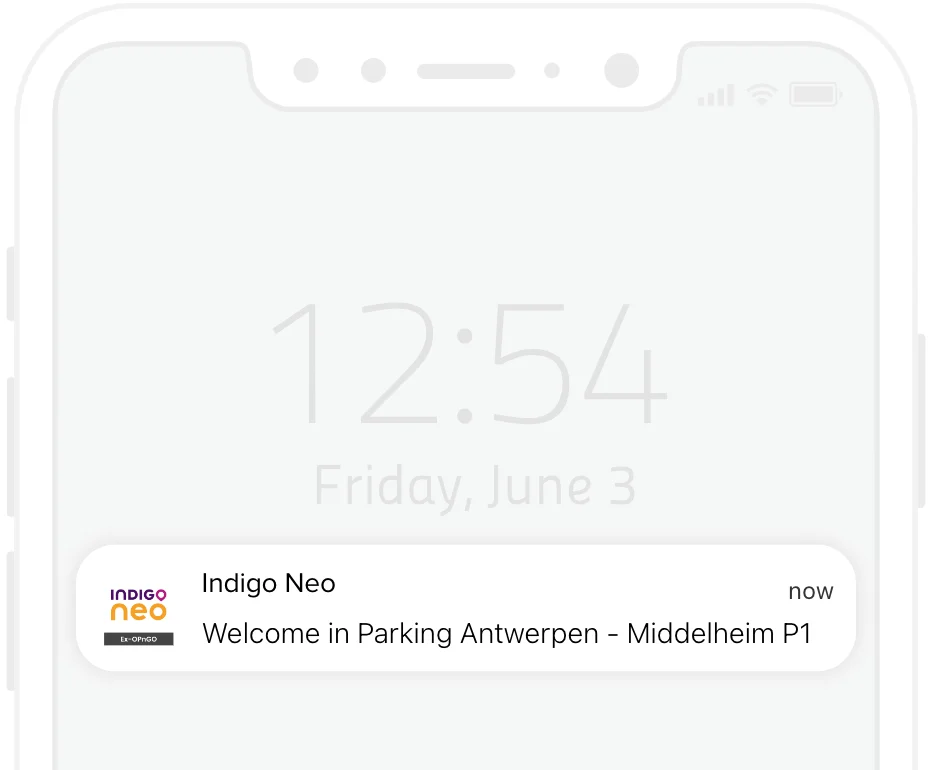
Once the plate is linked, the next ANPR detection starts a session on the attacker's account and produces a push notification naming the car park. Within the first days of the experiment the first hits arrived: one in a Q-Park location near a hospital in Antwerp, and one in an Indigo location in Malines.
Over the 100-day window the list of located vehicles grew linearly. After 100 days, 26.5% of all vehicles had been successfully located with this methodology alone. After every successful match the plate was deactivated or removed from the system to avoid suspicion.
The matched locations reveal activity: hospitals, shopping malls, casinos, swimming pools, concert venues, public transport hubs and offices all appear in the data. Given enough data points, the report notes it could be possible to deanonymise individuals from their activity history.
Step 3: understand the cost
Because the attacker creates sessions on the victim's behalf, a successful hit means paying the parking fee. During the investigation €273.85 was spent on parking tickets ranging from €1,60 to €36,00. Some sessions were not charged because the driver left immediately or a technical error occurred. The average cost to successfully track a vehicle was €7,82.
In a real attack the cost can be reduced: cutting the session short through customer service, using stolen credit cards, or simply relying on the victim grabbing a ticket and paying it themselves, which brings the cost down to zero.
Step 4: use the free-parking error as an oracle
Where there are no cameras, the free-slot cooldown still leaks. The 4411 app returns an error when a plate has already consumed its free slot:
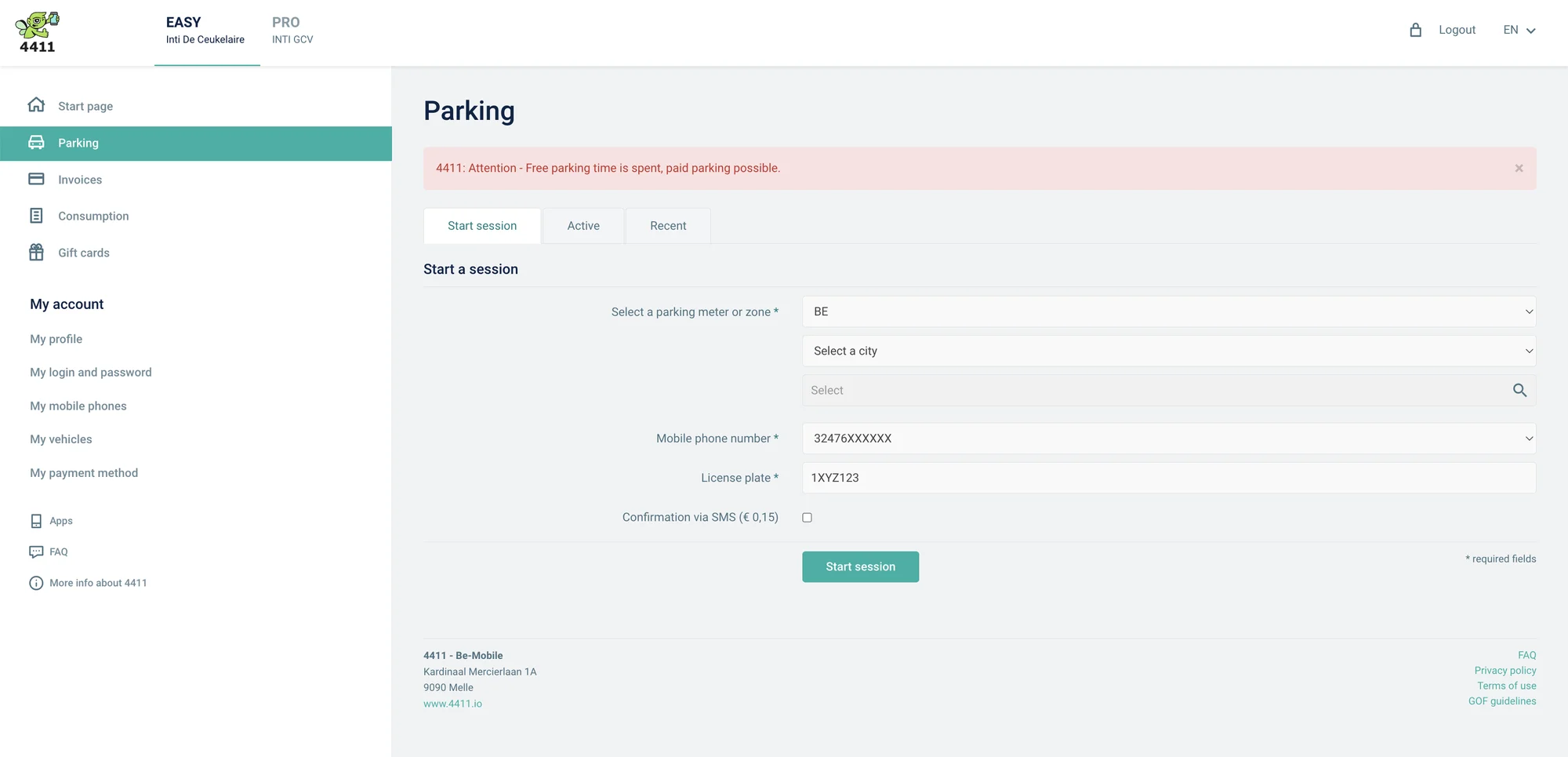
The PlateScan proof of concept simulated a normal Android application and created 1-second parking sessions for selected plates on a daily basis. When the free session could not be created because the user had already parked there, the system caught this error:
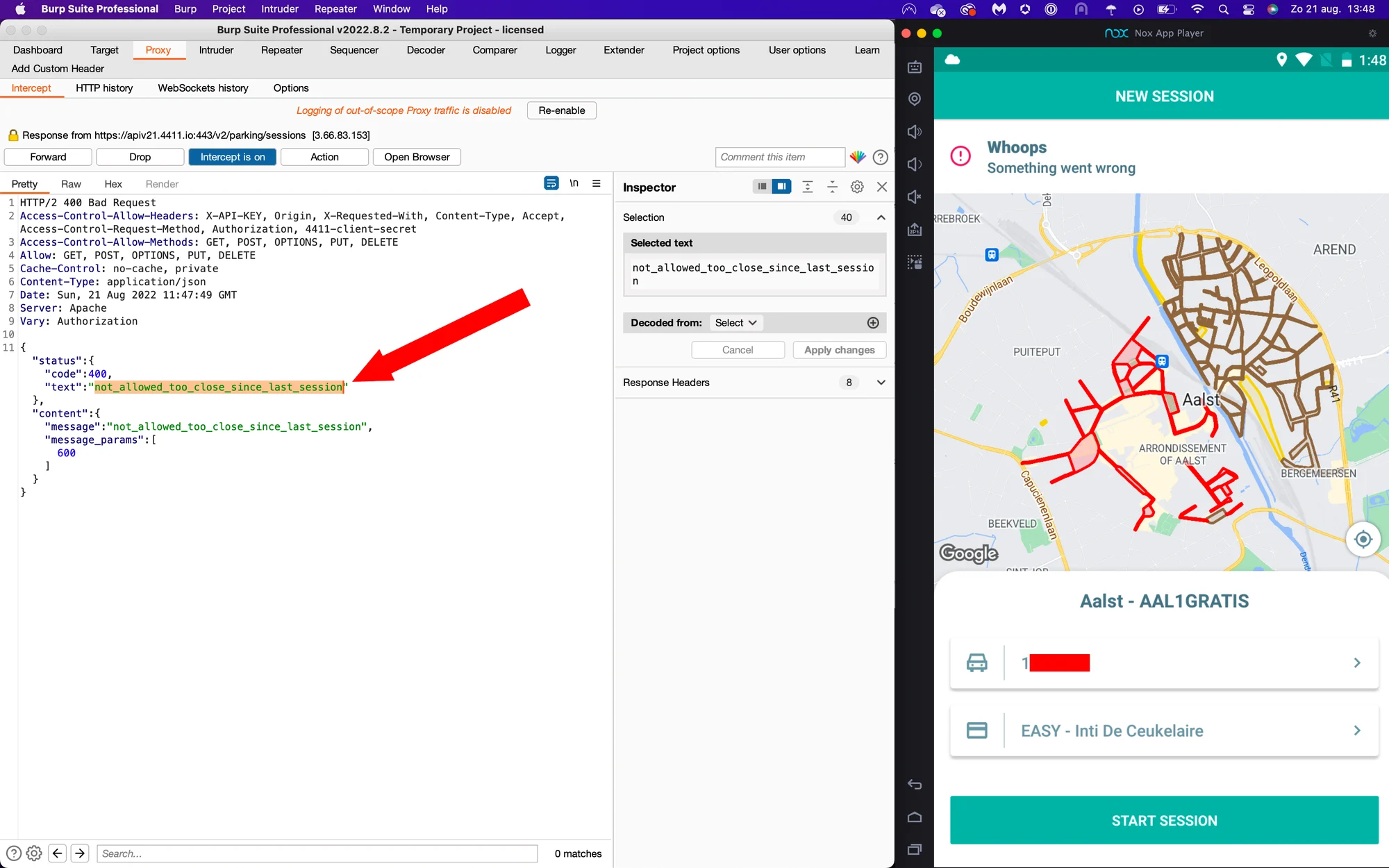
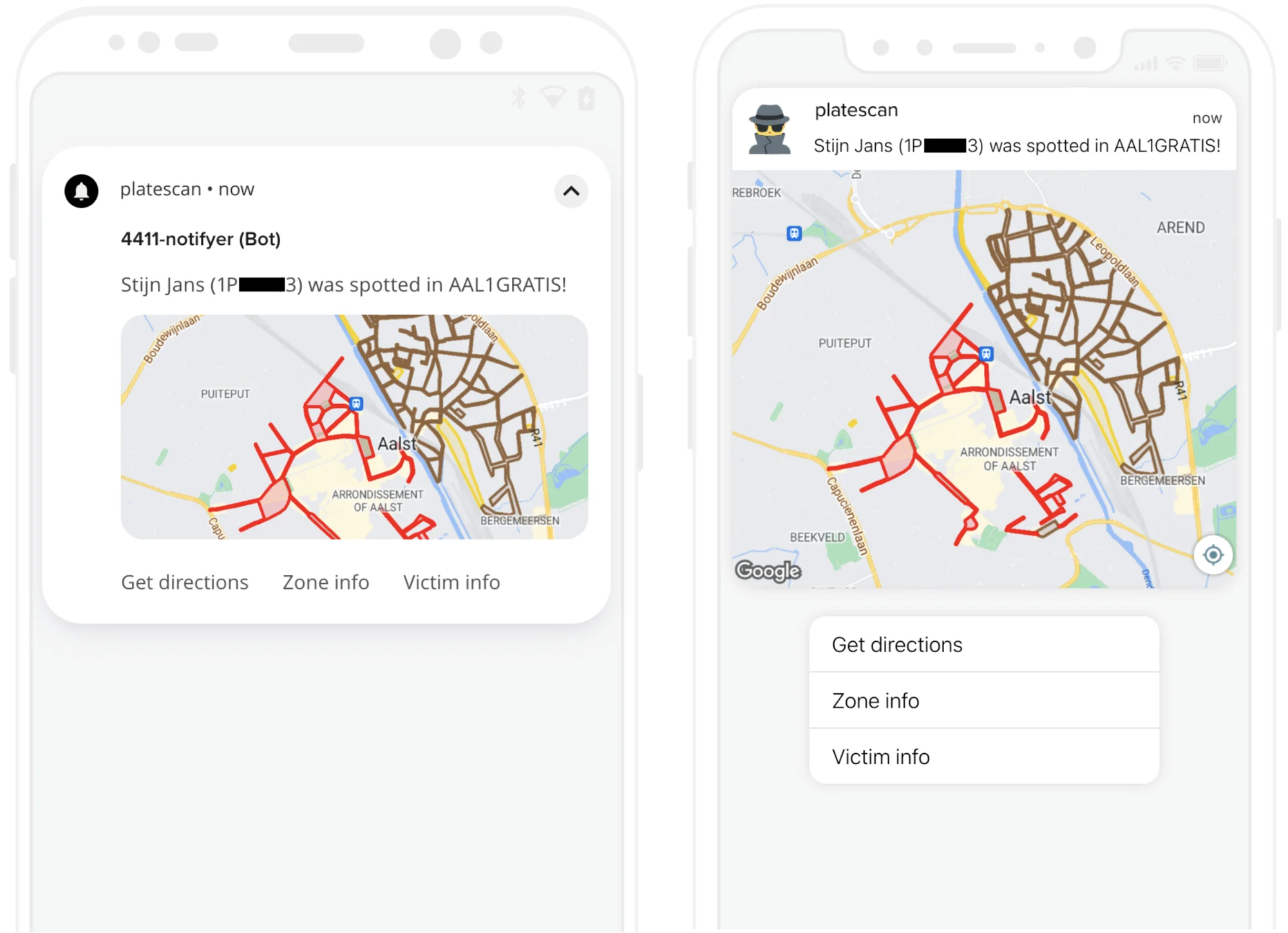
The error shown is NOT_ALLOWED_TOO_CLOSE_SINCE_LAST_SESSION. To avoid suspicion, sessions were created just before the free slots reset, so the target would never arrive at a spot to find a session had been created on their behalf. On a captured error, a push notification informed the attacker of a hit:
Platescan demo:
The video shows PlateScan detecting that the researcher has used a free parking slot today by attempting to create another free session at the end of the day; when the plate has already used its free time, a notification is sent to the phone. The plate in the video is fake.
This technique is less suited to mass surveillance because it requires many sessions per target, increasing the chance of detection by the operator. In the limited proof of concept, 19 participants from a selected city were tracked over 100 days. Three inhabitants were detected in the monitored zones, all of them multiple times. The system created more than 5,000 parking sessions in a clearly automated pattern and was never blocked by the operators.
Step 5: query sessions by plate alone
APCOA Connect lets anyone download VAT receipts containing the exact time and location of parking sessions by supplying a plate and a phone number. The researcher created a demonstration session:
| Field | Value |
|---|---|
| Phone number | [redacted] |
| Licence plate | T3ST1337 |
Anyone navigating to https://www.apcoaconnect.com/receipts can enter those details and query the location info. A system polling this periodically gets a real-time overview of sessions:
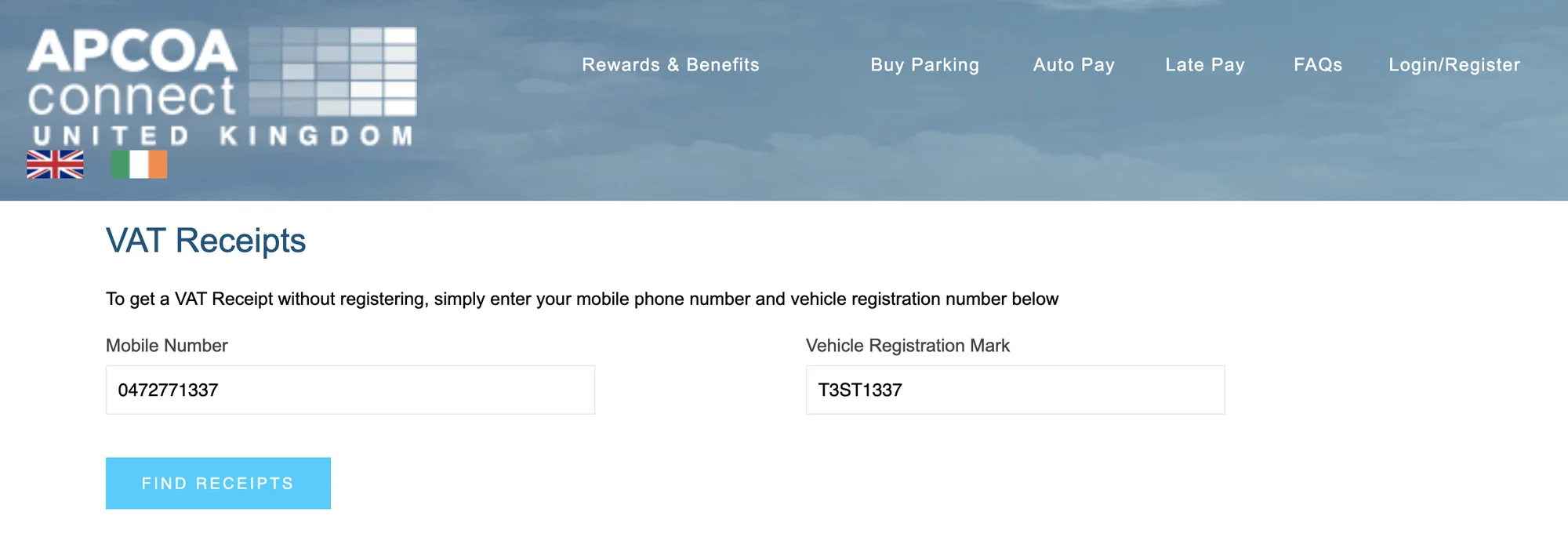
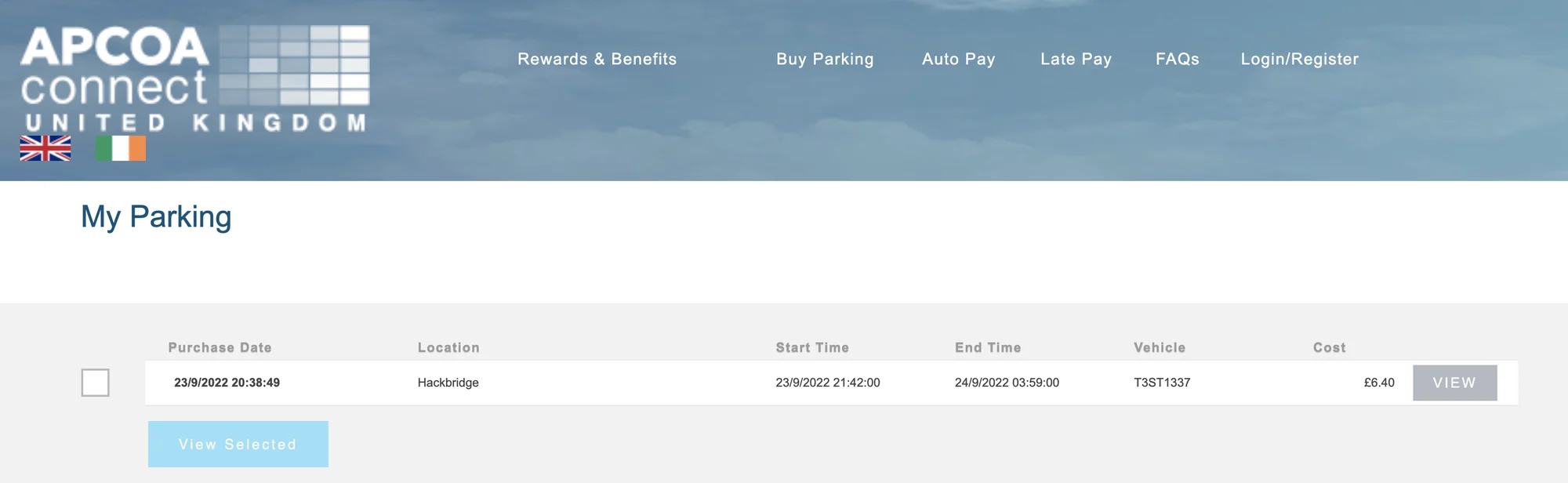
The screenshots show that everyone can see the session started at Hackbrigdge at 23/09/2022 21:42 local time. The phone number needed alongside the plate can be obtained from public data sources, such as the Facebook data breach, to build a location overview for a victim.
Autopay.io, active in Norway, Sweden, Denmark, Finland and Germany, uses ANPR to debit parking costs automatically:
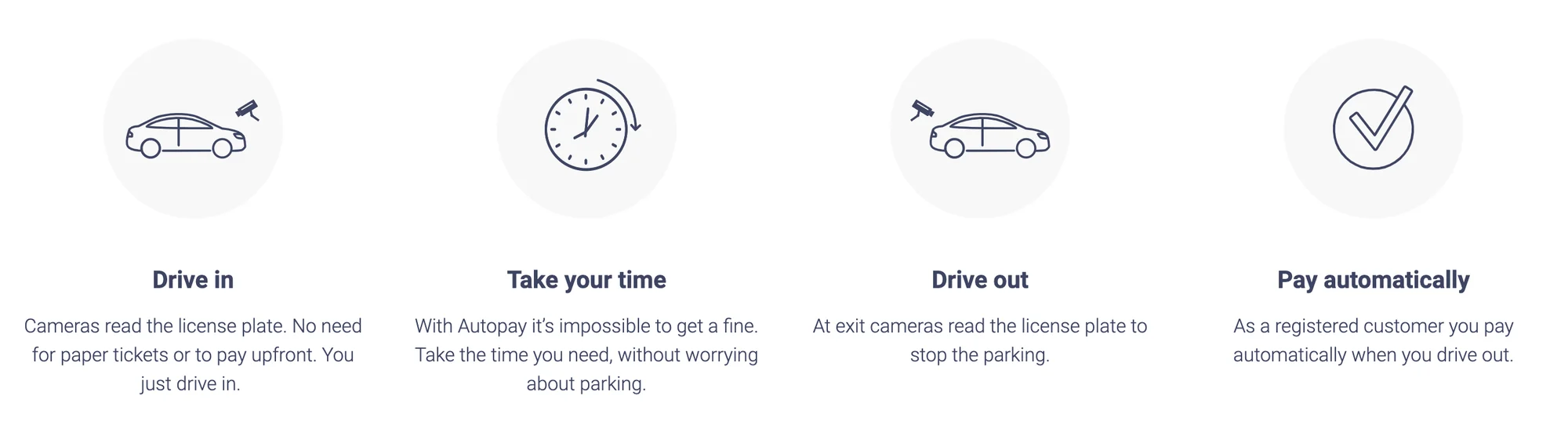
Its website has a form that lets users query unpaid parking sessions for the past 48 hours and pay for them:
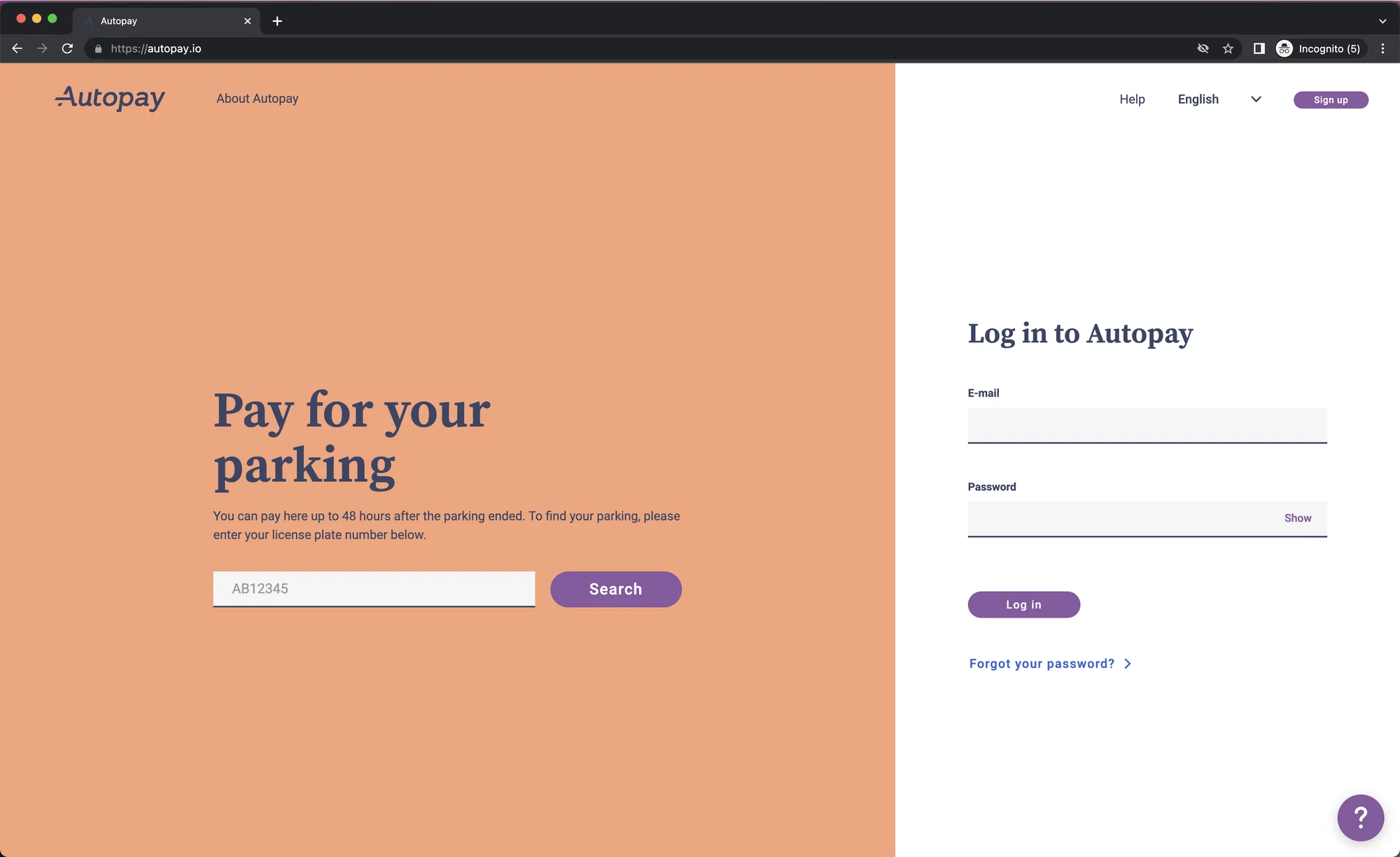
At first glance the absence of (re)captcha technologies means a script could run this every 48 hours to monitor a plate continuously.
Root cause
The design treats the licence plate as both identifier and credential. The apps accept a plate as proof that the person entering it is entitled to manage payments for that vehicle, and most of them allow re-registration of a plate that is already listed, without notification or confirmation to the existing owner. When that happens the plate is disabled on the victim's account and future charges and notifications go to the attacker.
Existing defences do not help. A barrier that opens automatically is unremarkable at a car park, so the victim notices nothing. Some applications do prevent re-use of a plate inside their own app, but customer service could still re-assign it when contacted. The free-parking oracle exists because the cooldown error distinguishes "already parked" from "session created". The receipt and unpaid-session lookups exist because the operators expose session data to those who know a plate, and in one case a phone number.
Impact
An attacker who knows a plate can learn, in near real time, when and where the vehicle is parked, for as long as the plate stays linked, though the researcher removed plates after each match to avoid suspicion. The study located slightly over 29% of 120 monitored vehicles during a 100-day window: 26.5% through session hijacking and an additional 2.5% through the free-parking oracle, which was tested on a smaller scale. One target was located parking more than 1,100km from home, near the Spanish border.
All traffic participants can be affected, whether or not they use parking apps. The affected surface spans nearly 4,000 locations in 10 Western European countries, with more than a million trackable parking spots. Toll roads extend the reach: Epass24 in Sweden and Norway, Ireland's M50 and England's M6 already charge tolls to accounts tied to a user-supplied plate.
The limits are cost and coverage. Session hijacking requires the attacker to pay each fee unless they cut the session short, use stolen cards, or the victim pays. The oracle technique needs many sessions per target and is therefore less suited to mass surveillance. The researcher could only test and validate ANPR functionality in Belgium, and some operators may not have rolled out number plate recognition in all territories yet.
Fix
The report frames the mitigations as trade-offs, since the technique attacks the fundamentals of plate-based parking and cannot be fully removed without losing convenience. The options it lists:
- Proof of plate ownership. Uploading a registration certificate hurts the user experience, gives operators more sensitive data than they are permitted to process, and is easy to forge.
- Block re-registration (plate hijacking). Most apps allow a plate to be re-registered even when already listed. Preventing this, and requiring confirmation, would stop the silent takeover.
- Limit plates per user. Some apps allowed an unlimited number of plates on one ANPR payment list. A cap makes scale attacks less convenient but does not remediate the issue, and fleets already use these apps to manage many vehicles.
- Opt-out list. A centralised blacklist, like a Robinson list, for people who do not want their plate processed. It does not protect people unaware of the risk, needs an authorised and trusted body to maintain it, and only works if every app implements it.
- ANPR only for pre-booked slots. This does not stop an attacker verifying whether a vehicle was somewhere in a period, but makes wide-scale operation costly and less feasible.
- Show and confirm ANPR payment details on entry. The attack raised little or no suspicion because an automatically opening barrier is normal. Screens at the entrance showing the ANPR session and payment information that does not match the driver would have made it noticeable.
- Secondary authentication with an RFID tag. Toll systems such as France's Bip & Go télépéage require a physical tag in the car. Linking payments to a secure tag ID rather than a plate may still allow seamless entry and prevent others from accessing or registering the account.
Other than avoiding all affected areas, the only way for drivers to temporarily mitigate the risk is to invoke the GDPR right to restrict processing with the data processors. A web application at NOTMYPLATE.COM was built to help users send a proper GDPR request for their plate, with an up-to-date list of affected apps. The report also reminds drivers that a plate is personal identifiable information and should not be exposed online, for example on social media.
Variants to test
- Re-registration of an already-linked plate. Create two accounts, link the same plate in both, and observe whether the second registration succeeds silently, whether the first account loses the plate, and where notifications and charges go. A positive result is a silent takeover with no confirmation to the first account.
- Cooldown error as an oracle. In any app offering free limited parking, create a free session for a plate, then attempt a second one in the same zone. A distinct error (the 4411 app returned
NOT_ALLOWED_TOO_CLOSE_SINCE_LAST_SESSION) that differs from a successful creation confirms the oracle. Check whether the error is rate limited or whether automated patterns are blocked. - Receipt lookup by plate. On operators offering VAT receipts, try a plate plus a phone number and see whether time and location are returned without authentication. A positive result is a receipt showing the exact session time and car park.
- Unpaid-session lookup. Where a form lists unpaid sessions for the past 48 hours, submit a plate and check for session details. Absence of captcha or rate limiting makes continuous polling feasible.
- Plate limits per account. Add plates one by one and find the cap, if any. An unlimited list means the operator is exposed to surveillance at scale.
- Entry-screen disclosure. At an ANPR car park, check whether the entry screen shows the session and payment details. If it shows nothing, a victim has no way to notice a session created by someone else.
- Integrators. Apps that integrate another operator's ANPR (the report lists 4411, ParkMobile, ParkNow and KBC as Q-Park integrations) may inherit the same weakness even when they are not listed as data processors. Test the same plate registration flow through the integrator.
What happened, in plain words
A researcher spent June to mid-September 2022 finding out whether the cameras that read car number plates at car parks and toll roads could be turned into a tracking tool. They can. The trick is not a break-in in the usual sense. It is that the parking apps behind those cameras let anyone type in any number plate, and the apps never check whether the person typing it actually owns that car.
Here is the everyday comparison. Imagine a cloakroom where you hand in a coat and get a ticket with a number on it. Now imagine the cloakroom also lets anyone walk in, write down any ticket number, and from then on that person gets a text message every time the coat is handed in, saying which cloakroom it was at. That is roughly what these parking apps do with number plates. The plate is the only thing the camera recognises, and the app treats "I typed this plate" as "this is my car".
Once a plate is linked to an attacker's account, every time a camera sees that car, a parking session starts on the attacker's account and the attacker gets a push notification naming the car park. The attacker learns where the car is, in near real time. The attacker does have to pay the parking fee, because the session is on their account; the average cost to successfully track a vehicle was €7,82.
The research covered three techniques in total:
- Session hijacking through number plate cameras. Link someone else's plate to your account and wait for the notifications.
- A trial-and-error trick against free on-street parking. Many towns give you, say, 30 free minutes, once a day per plate. If you try to start a second free session for a plate that has already used its free time, the app returns an error. That error tells an attacker whether the car is parked in that zone right now.
- Looking up parking sessions with nothing but a plate. Some operators let anyone download a receipt, or list unpaid sessions, just by entering a plate (and in one case a phone number).
The affected surface was mapped across 10 countries in Western Europe, with more than 3,850 affected areas identified.
A few terms before we go further, because they come up constantly:
- ANPR stands for Automated Number Plate Recognition. It is software that reads a number plate from a camera image, the same way a supermarket self-checkout reads a barcode. Police have used it for years; parking companies now use it to open barriers and bill drivers.
- A parking session is simply a record that says "this plate was in this car park from this time to that time, and this is what it costs". Normally you start and stop it yourself in an app. With ANPR, the cameras start and stop it for you.
- An account in a parking app is your personal login, tied to a payment card. Anything charged through that account goes on your card.
- A push notification is the little message that pops up on a phone's lock screen, the same kind you get from a messaging app.
Setup
No special tools were needed for the main technique. This is worth pausing on, because it is the point of the whole report: you did not need to be a hacker with custom software. You needed a phone and a normal app account. The preconditions were:
- A normal account in a parking app that supports ANPR-based payment. The study used the apps of Q-Park and Indigo Neo, formerly called OPnGO.
- A payment method attached to that account, because a successful hit means the attacker pays for the victim's parking.
- The victim's number plate, which is public by design. It is printed on the back of the car and visible to anyone standing behind it.
For the participant study, a call was launched on Twitter and Instagram on 31 May 2022. To take part, a person had to be a named driver of the car; there were no requirements on how much the car was used. In the end 120 participants had their plates entered into the two selected operators' apps. None of them were told what the researchers were doing, so their driving behaviour would not change. That last detail matters: if people know they are being tracked, they drive differently, and the results would be skewed.
Interparking, the third big Belgian operator, was left out of the large-scale experiment because its application only allows a user to link one number plate at a time, which is less convenient when you want to enter hundreds of plates.
The screenshots show hundreds of plates being entered in 4411 (Q-Park) and Indigo Neo (OPnGO), with real plates replaced by fake ones for the screenshots.
For the second technique, a proof-of-concept stalkerware application was written for the 4411.io app, which is active in Belgium and The Netherlands. "Proof of concept" means a working demonstration built to show that an idea is possible, not a polished product. "Stalkerware" here means software built to follow a person's movements. It simulated a normal Android application and created parking sessions programmatically, meaning the software did the tapping instead of a human.
Finding it
The observation is simple once stated: the plate is the only identifier the ANPR system uses, and the apps accept it without proof. There is no ownership check, no confirmation sent to an existing owner, and in most apps no block on re-registering a plate that is already listed. In most apps, registering someone else's plate silently disables it on the victim's account and redirects future charges and notifications to the attacker.
Think of it like a shared family calendar where anyone can add any event, and if two people add the same event, the second one quietly replaces the first. The original owner gets no warning that their entry has been taken over.
A second observation came from on-street parking. Cities offer free parking for a limited time (for example 30 minutes near a shopping district) and implement a cooldown so the free slot cannot be renewed indefinitely, usually once per day per plate. When a plate has already used its free slot, the app returns an error instead of creating a session. That error is an oracle. In security, an oracle is any signal that answers a question you were not supposed to be able to ask. Here the question is "is this car parked in this zone right now?", and the error message answers it.
A third observation is that some operators expose session data through lookups. "Unauthenticated" means you do not need to log in; anyone with a browser can do it. The lookups were VAT receipts by plate and phone number, or unpaid sessions from the last 48 hours by plate alone.
Exploitation
Step 1: register the target's plate for ANPR payment
The steps differ per app but the shape is the same. In every case you install the app, add a payment card, add the victim's plate, and switch on the automatic plate recognition feature. The reason each step is needed: the card is there so the session can be paid for, the plate is the thing the camera will recognise, and the switch is what tells the app to start sessions automatically instead of waiting for you to press a button.
For Q-Park:
- Install Q-Park's mobile application on your device
- In Profile > Payment methods, click Add payment method and enter your details
- In Profile > Number plates, enter the target's licence plate. Make sure to select the correct country
- In Products > Pay as you Go Parking (alternatively named mobile parking), link the target's licence plate.
- All set! You are now able to intercept (and pay for) your victim's parking sessions in real-time, disclosing their location
For EasyPark (CameraPark):
- Install the EasyPark app and create an account
- Click the menu icon (☰), tap payment and add a payment method
- Click the menu icon (☰), tap vehicles and add your target's licence plate
- Click the menu icon (☰), tap CameraPark and select your target's vehicle to enable tracking
- All set!
For Indigo Neo:
- Install the Indigo Neo application on your device
- Go to My account > Cards and add your credit card
- Go to My account > Vehicles and add your target's licence plate
- Go to My account > On demand access and press enable
- All set!
For Interparking (Belgium), a PCard+ is ordered first, then the plate is added through the web application at https://www.parkingmadeeasy.be:
- First, order a PCard+ from your local Interparking website
- Navigate to https://www.parkingmadeeasy.be (Belgium) and login with your PCard+ details
- Click Add new licence plate, and add the licence plate number of your victim
- All set!
For APCOA Flow the steps are to install the app, create an account, add the vehicle licence and set up a payment method. For APCOA Connect (UK/IE) the flow is web-based:
- Go to apcoaconnect.com
- Log in or create an account
- Under payment details, fill in your credit card details
- Go to Auto pay > Vehicle details and scroll down to "Add new vehicle"
- Enter the target's vehicle details (pick anything for make and colour)
- Go to Auto pay > Autopay details > Register for autopay and sign up the vehicle for all contracts
- All set!
For Autopay.io:
- Go to autopay.io
- Go to the vehicles section
- Click add vehicle and add your target's licence plate
- Go to Payment cards and add a payment card
- All set!
For TWINT+ / ParkingPay (Switzerland, untested because it is only available to Swiss citizens):
- Open the TWINT app and tap on TWINT+
- Choose "parking" and tap on the car symbol on the right
- Add your target's licence plate
- Click on Licence Plate Recognition and activate it
- All set!
For AENA Parking (Spain):
- Register for AENA Club here
- Add the target's licence plate here
- Add a payment method here
- Activate number plate payment for all locations here
- All set!
For NCP (UK), through the ParkPass app:
- Download & install the 'ParkPass' app on your mobile device
- In settings, go to payment details and add a card
- In settings, go to vehicles and add your target's VRN
- Toggle the 'Enable AutoPay' switch
- All set!
Step 2: wait for a detection
Once the plate is linked, the next ANPR detection starts a session on the attacker's account and produces a push notification naming the car park. There is nothing else to do. The attacker does not follow the car, does not install anything on it, and does not need to be anywhere near it. The cameras do the watching.
Within the first days of the experiment the first hits arrived: one in a Q-Park location near a hospital in Antwerp, and one in an Indigo location in Malines.
Over the 100-day window the list of located vehicles grew linearly, meaning at a steady rate rather than in bursts. After 100 days, 26.5% of all vehicles had been successfully located with this methodology alone. After every successful match the plate was deactivated or removed from the system to avoid suspicion. That is a careful touch: if a plate stays linked, the victim might eventually notice charges or notifications, or the operator might spot the pattern.
The matched locations reveal activity: hospitals, shopping malls, casinos, swimming pools, concert venues, public transport hubs and offices all appear in the data. Given enough data points, the report notes it could be possible to deanonymise individuals from their activity history. "Deanonymise" means working out who an anonymous record belongs to. If a plate is seen at a dialysis clinic twice a week and at a school every weekday afternoon, you can guess a lot about the driver without ever learning their name.
Step 3: understand the cost
Because the attacker creates sessions on the victim's behalf, a successful hit means paying the parking fee. During the investigation €273.85 was spent on parking tickets ranging from €1,60 to €36,00. Some sessions were not charged because the driver left immediately or a technical error occurred. The average cost to successfully track a vehicle was €7,82.
In a real attack the cost can be reduced: cutting the session short through customer service, using stolen credit cards, or simply relying on the victim grabbing a ticket and paying it themselves, which brings the cost down to zero. The last one is the neatest: if the driver pays at the machine out of habit, the attacker's session is settled by the victim and the attacker pays nothing.
Step 4: use the free-parking error as an oracle
Where there are no cameras, the free-slot cooldown still leaks. The 4411 app returns an error when a plate has already consumed its free slot:
The PlateScan proof of concept simulated a normal Android application and created 1-second parking sessions for selected plates on a daily basis. A 1-second session is short enough that it costs nothing and ends almost immediately, but it is still a real session as far as the app is concerned. When the free session could not be created because the user had already parked there, the system caught this error:
The error shown is NOT_ALLOWED_TOO_CLOSE_SINCE_LAST_SESSION. Read it as a sentence: "not allowed, too close since last session". In plain words, the app is saying "this plate already had a session recently, so I will not start another one". For a normal user that is a mild annoyance. For an attacker it is a yes/no answer to "is this car here today?".
To avoid suspicion, sessions were created just before the free slots reset, so the target would never arrive at a spot to find a session had been created on their behalf. On a captured error, a push notification informed the attacker of a hit:
Platescan demo:
The video shows PlateScan detecting that the researcher has used a free parking slot today by attempting to create another free session at the end of the day; when the plate has already used its free time, a notification is sent to the phone. The plate in the video is fake.
This technique is less suited to mass surveillance because it requires many sessions per target, increasing the chance of detection by the operator. In the limited proof of concept, 19 participants from a selected city were tracked over 100 days. Three inhabitants were detected in the monitored zones, all of them multiple times. The system created more than 5,000 parking sessions in a clearly automated pattern and was never blocked by the operators. That last point is the uncomfortable one: 5,000 sessions in an obvious machine rhythm, and nobody stopped it.
Step 5: query sessions by plate alone
APCOA Connect lets anyone download VAT receipts containing the exact time and location of parking sessions by supplying a plate and a phone number. A VAT receipt is the paperwork a business needs for tax purposes; here it doubles as a location record. The researcher created a demonstration session:
| Field | Value |
|---|---|
| Phone number | [redacted] |
| Licence plate | T3ST1337 |
Anyone navigating to https://www.apcoaconnect.com/receipts can enter those details and query the location info. A system polling this periodically gets a real-time overview of sessions. "Polling" means asking the same question on a timer, like checking your letterbox every hour.
The screenshots show that everyone can see the session started at Hackbrigdge at 23/09/2022 21:42 local time. The phone number needed alongside the plate can be obtained from public data sources, such as the Facebook data breach, to build a location overview for a victim. A data breach is when a company loses or leaks a database of its users' information; once that data is public, phone numbers stop being secret.
Autopay.io, active in Norway, Sweden, Denmark, Finland and Germany, uses ANPR to debit parking costs automatically:
Its website has a form that lets users query unpaid parking sessions for the past 48 hours and pay for them:
At first glance the absence of (re)captcha technologies means a script could run this every 48 hours to monitor a plate continuously. A captcha is the little puzzle that asks you to tick a box or pick out traffic lights, designed to tell humans from software. No captcha means software can fill in the form as often as it likes.
Root cause
The design treats the licence plate as both identifier and credential. An identifier is a name or label that points at something, like a username. A credential is proof that you are allowed to act on it, like a password. Using the same thing for both is like a bank that lets anyone withdraw money from an account as long as they can say the account number out loud.
The apps accept a plate as proof that the person entering it is entitled to manage payments for that vehicle, and most of them allow re-registration of a plate that is already listed, without notification or confirmation to the existing owner. When that happens the plate is disabled on the victim's account and future charges and notifications go to the attacker.
Existing defences do not help. A barrier that opens automatically is unremarkable at a car park, so the victim notices nothing. Some applications do prevent re-use of a plate inside their own app, but customer service could still re-assign it when contacted. The free-parking oracle exists because the cooldown error distinguishes "already parked" from "session created". The receipt and unpaid-session lookups exist because the operators expose session data to those who know a plate, and in one case a phone number.
Impact
An attacker who knows a plate can learn, in near real time, when and where the vehicle is parked, for as long as the plate stays linked, though the researcher removed plates after each match to avoid suspicion. The study located slightly over 29% of 120 monitored vehicles during a 100-day window: 26.5% through session hijacking and an additional 2.5% through the free-parking oracle, which was tested on a smaller scale. One target was located parking more than 1,100km from home, near the Spanish border.
All traffic participants can be affected, whether or not they use parking apps. The affected surface spans nearly 4,000 locations in 10 Western European countries, with more than a million trackable parking spots. Toll roads extend the reach: Epass24 in Sweden and Norway, Ireland's M50 and England's M6 already charge tolls to accounts tied to a user-supplied plate.
The limits are cost and coverage. Session hijacking requires the attacker to pay each fee unless they cut the session short, use stolen cards, or the victim pays. The oracle technique needs many sessions per target and is therefore less suited to mass surveillance. The researcher could only test and validate ANPR functionality in Belgium, and some operators may not have rolled out number plate recognition in all territories yet.
Fix
The report frames the mitigations as trade-offs, since the technique attacks the fundamentals of plate-based parking and cannot be fully removed without losing convenience. The options it lists:
- Proof of plate ownership. Uploading a registration certificate hurts the user experience, gives operators more sensitive data than they are permitted to process, and is easy to forge.
- Block re-registration (plate hijacking). Most apps allow a plate to be re-registered even when already listed. Preventing this, and requiring confirmation, would stop the silent takeover.
- Limit plates per user. Some apps allowed an unlimited number of plates on one ANPR payment list. A cap makes scale attacks less convenient but does not remediate the issue, and fleets already use these apps to manage many vehicles.
- Opt-out list. A centralised blacklist, like a Robinson list, for people who do not want their plate processed. It does not protect people unaware of the risk, needs an authorised and trusted body to maintain it, and only works if every app implements it.
- ANPR only for pre-booked slots. This does not stop an attacker verifying whether a vehicle was somewhere in a period, but makes wide-scale operation costly and less feasible.
- Show and confirm ANPR payment details on entry. The attack raised little or no suspicion because an automatically opening barrier is normal. Screens at the entrance showing the ANPR session and payment information that does not match the driver would have made it noticeable.
- Secondary authentication with an RFID tag. Toll systems such as France's Bip & Go télépéage require a physical tag in the car. Linking payments to a secure tag ID rather than a plate may still allow seamless entry and prevent others from accessing or registering the account. RFID means radio-frequency identification: a small chip that talks to a reader at close range, like the tag on a shop door alarm.
Other than avoiding all affected areas, the only way for drivers to temporarily mitigate the risk is to invoke the GDPR right to restrict processing with the data processors. GDPR is the European data protection law, and the right to restrict processing lets you ask a company to stop using your data for a particular purpose. A web application at NOTMYPLATE.COM was built to help users send a proper GDPR request for their plate, with an up-to-date list of affected apps. The report also reminds drivers that a plate is personal identifiable information and should not be exposed online, for example on social media.
Variants to test
These are the checks a security tester would repeat to see whether a given app has the same weakness. Each one is written as a small experiment with a clear pass or fail.
- Re-registration of an already-linked plate. Create two accounts, link the same plate in both, and observe whether the second registration succeeds silently, whether the first account loses the plate, and where notifications and charges go. A positive result is a silent takeover with no confirmation to the first account.
- Cooldown error as an oracle. In any app offering free limited parking, create a free session for a plate, then attempt a second one in the same zone. A distinct error (the 4411 app returned
NOT_ALLOWED_TOO_CLOSE_SINCE_LAST_SESSION) that differs from a successful creation confirms the oracle. Check whether the error is rate limited or whether automated patterns are blocked. Rate limiting means the server refuses to answer if you ask too often. - Receipt lookup by plate. On operators offering VAT receipts, try a plate plus a phone number and see whether time and location are returned without authentication. A positive result is a receipt showing the exact session time and car park.
- Unpaid-session lookup. Where a form lists unpaid sessions for the past 48 hours, submit a plate and check for session details. Absence of captcha or rate limiting makes continuous polling feasible.
- Plate limits per account. Add plates one by one and find the cap, if any. An unlimited list means the operator is exposed to surveillance at scale.
- Entry-screen disclosure. At an ANPR car park, check whether the entry screen shows the session and payment details. If it shows nothing, a victim has no way to notice a session created by someone else.
- Integrators. Apps that integrate another operator's ANPR (the report lists 4411, ParkMobile, ParkNow and KBC as Q-Park integrations) may inherit the same weakness even when they are not listed as data processors. Test the same plate registration flow through the integrator.
Glossary
- ANPR (Automated Number Plate Recognition): software that reads a number plate from a camera image, used to open barriers and start parking or toll sessions automatically.
- Account: your personal login in an app, tied to a payment card, through which charges are made.
- Captcha: a small puzzle used to tell humans from software, so that forms cannot be filled in automatically at scale.
- Cooldown: a waiting period during which a free parking slot cannot be used again for the same plate, usually once per day.
- Credential: proof that you are allowed to act on an identifier, such as a password or a physical key.
- Data breach: an incident where a company's database of user information is lost or leaked.
- Deanonymise: to work out who an anonymous record belongs to, for example by combining location patterns.
- GDPR: the European data protection law that gives people rights over their personal data.
- Identifier: a name or label that points at something, such as a username or a number plate.
- Integrator: an app that connects to another operator's system and inherits its features, and possibly its weaknesses.
- Oracle: any signal from a system that answers a question you were not supposed to be able to ask, such as an error message revealing whether a car is parked.
- Plate hijacking: silently re-registering a plate that already belongs to someone else's account, so that charges and notifications go to the new owner.
- Polling: asking the same question on a timer, repeatedly, to keep information up to date.
- Proof of concept: a working demonstration built to show that an idea is possible, not a finished product.
- Push notification: a message that appears on a phone's screen without the app being open.
- Rate limiting: a server refusing to answer requests that come too often, used to block automation.
- RFID (Radio-Frequency Identification): a small chip that communicates with a reader at close range, used for tags and toll badges.
- Right to restrict processing: a GDPR right that lets you ask a company to stop using your data for a particular purpose.
- Session (parking): a record of a vehicle being parked in a place between two times, with a cost attached.
- Session hijacking: taking over someone else's parking session by registering their plate on your own account.
- Stalkerware: software built to follow a person's movements or activity without their knowledge.
- Unauthenticated: reachable without logging in, by anyone with a browser.
- VAT receipt: tax paperwork for a payment, which here also records the time and place of a parking session.
- VRN (Vehicle Registration Number): the official term for a number plate.




