UnrealIRCd CVE-2026–114713 Exploited: Patch by November 16
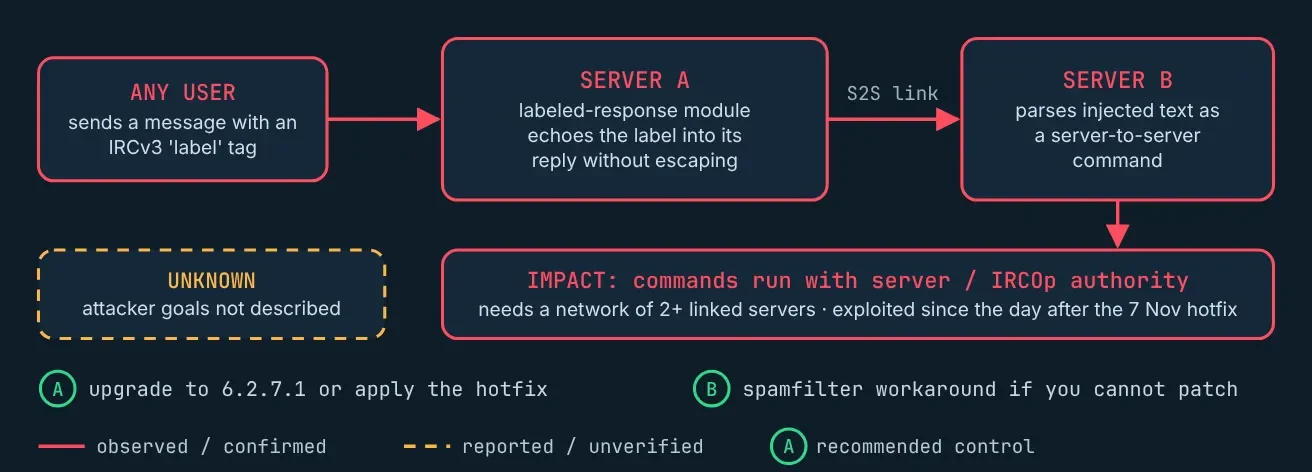
UnrealIRCd fails to escape IRCv3 label tags in the labeled-response module, allowing any connected user to inject server commands that cross the server-to-server link and execute with server or IRC-operator authority. Attackers are exploiting this on internet-facing linked networks.
 Published on medium.com
CVE-2026–114713 (CVSS 8.6) is an improper neutralisation of delimiters in UnrealIRCd, the widely used open-source IRC server. The maintainer, Bram Matthys (Syzop), said attackers were exploiting it on the internet; exploitation attempts reportedly began the day after the 7 November hotfix.
The full write-up lives on its author's site
It belongs to its author, so we link to it rather than copy it. The other two tabs are our own rewrites, checked against it.
Context
UnrealIRCd is a widely used open-source IRC server. The vulnerability in question, CVE-2026-114713, is an improper neutralisation of delimiters, rated CVSS 8.6. It matters most on networks built from two or more linked servers, where servers pass traffic to each other over a server-to-server link.
The feature at the centre of the flaw is IRCv3 message tags, specifically the label tag used by the labeled-response module. A client attaches a label to a message so it can match the server's reply to its request. The module echoes that label back in its reply. The bug is that the echo is not escaped, so text a user controls crosses the server-to-server link and is parsed there as a server command.
The maintainer is Bram Matthys (Syzop). CISA added the CVE to its Known Exploited Vulnerabilities catalogue on 13 November with a due date of 16 November for US federal civilian agencies, and the maintainer says attackers are exploiting it. Exploitation attempts reportedly began the day after the 7 November hotfix.
Setup
No test lab, accounts or tooling are described. The conditions that matter are product and network ones:
- Affected versions: UnrealIRCd 6.0.0 up to, but not including, 6.2.7.1.
- Affected deployments: networks with two or more linked servers.
- Required privileges: none beyond a normal connection. Any connected user can trigger the flaw; no IRC operator rights are needed.
Finding it
What it gives is the maintainer's description of the mechanism, as reported by The Hacker News, and the operational signals that follow from it.
Exploitation
Step 1: send a message with a label tag
A user sends a message carrying an IRCv3 label message tag. The report does not include the literal message or tag syntax used.
Step 2: the label is echoed unescaped
The labeled-response module echoes the label into its reply without escaping it. The user's text is now inside a server-generated message.
Step 3: the text crosses the server-to-server link
The unescaped text crosses the server-to-server link, where it is parsed as a server command. This is the point where a client-side label becomes server-side syntax.
Step 4: the command runs with elevated authority
The injected command runs with server or IRC-operator authority.
What attackers have done with that access is not described: the reports do not cover their activity or goals.
Root cause
The mistake is a missing escape when the labeled-response module copies a user-supplied label into its reply. Because the reply travels over the server-to-server link, and that link's parser treats its input as trusted server commands, the unescaped label is reinterpreted as protocol commands rather than as data. The labeled-response module echoes the label without escaping it, so the text is parsed as a server command on the link.
The absence of escaping at the echo point is the failure described in the reports.
Impact
Any connected user, with no operator rights, can inject commands that run with server authority across a linked IRC network. Because the command executes at server or IRC-operator level, the blast radius is the linked network rather than a single client session. The report does not state what the attackers behind the observed exploitation did with the access they obtained.
CISA added the CVE to the catalogue on 13 November with a 16 November due date for US federal civilian agencies.
Detection
Defenders should look for:
- Unexpected IRC operator actions, new server links, K-lines or G-lines that were not set by an administrator.
- Configuration changes or rehashes since 7 November that no administrator made.
- Unusual messages carrying
labeltags in server logs.
Fix
- Upgrade every linked server to UnrealIRCd [redacted], or apply the maintainer's hotfix. The spamfilter workaround is only a temporary measure.
- From an IRC client, run
/VERSIONagainst each server and confirm it reports [redacted] or later. - Review operator actions, links, bans and configuration changes since 7 November.
- If you find unexplained changes, rotate operator and link passwords and rebuild the affected server's configuration from a known-good copy.
Because linked-server designs mean one unpatched node exposes the whole network, every linked server should sit on the same patch level. Subscribing to the project's security announcements helps catch the next one early.
The other KEV deadline: Check Point
CISA added CVE-2026-114713 to the catalogue on 13 November alongside Check Point CVE-2026-123039, the DynamicCLI root flaw, and both are due on 16 November. CVE-2026-123039 lets attackers who already have low-privilege code execution on a Check Point Gaia gateway or management server run commands as root through the DynamicCLI control socket. Check Point says it is exploited against a couple of dozen customers. Install the fixed Jumbo Hotfix take for your release and run the sk1000362 log hunt.
Variants to test
- A positive result is a reply in which your tag content appears verbatim and is then reinterpreted on the linked server.
- A positive result is a server command executing from data you supplied as a client.
- A positive result is a reply that parses as more than one command on the receiving server.

Sources
- The Hacker News, "Attackers exploit UnrealIRCd flaw that enables server-level command injection", 14 Nov 2026.
- CISA, "CISA adds two known exploited vulnerabilities to catalogue", 13 Nov 2026.
- Security Affairs, "U.S. CISA adds Check Point and UnrealIRCd flaws to its KEV catalogue", 14 Nov 2026.
- MAG212 CYBER, "Check Point CVE-2026-123039: Root Through the Gateway, and How to Hunt dynamicCli.log", 14 Nov 2026.
What happened, in plain words
A piece of software called UnrealIRCd has a serious security bug. UnrealIRCd is an IRC server: IRC is one of the oldest ways people chat online in groups, and an IRC server is the computer program that runs a chat network, letting people connect, join channels and send messages to each other. UnrealIRCd is open source, which means its code is public and anyone can run it, and it is widely used.
The bug has an official identifier, CVE-2026-114713. A CVE is a public catalogue number given to a known security flaw so that everyone can refer to the same thing. This one is rated CVSS 8.6. CVSS is a scoring system from 0 to 10 that tries to express how serious a flaw is; 8.6 is high.
The flaw lets any ordinary person who is connected to a chat network send hidden commands that the servers themselves will run, with the servers' own authority. It only works on networks made of two or more linked servers, where several servers pass chat traffic between each other so that users on different machines appear to be on one network. The person who maintains UnrealIRCd, Bram Matthys (known as Syzop), says attackers are already using the bug on the internet. CISA, the US government's cybersecurity agency, added it to a list of flaws known to be exploited in the real world, and gave US federal civilian agencies until 16 November to fix it.
This article walks through what the flaw is, who is affected, how the attack works, what to look for and how to fix it, in the same order as the technical report, but explained from scratch.
Background: the pieces involved
Before the details, four ideas need explaining.
IRC server. Think of an IRC server as a large public noticeboard building. People connect to it with a chat program (the client), walk into rooms called channels, and read and write messages. The server decides who sees what and enforces the rules.
Linked servers. Big IRC networks are not one machine but several servers joined together. Each server knows about the others and forwards messages across a private connection between them, called the server-to-server link. To users it looks like one network; behind the scenes the servers talk to each other in their own language, which includes commands that only servers are supposed to send. That private link is the equivalent of staff-only corridors in the building: messages travelling there are treated as coming from trusted staff, not from visitors.
IRCv3 message tags. IRC has been extended over the years by a set of improvements called IRCv3. One of them lets a chat client attach small labels, called tags, to a message. A tag is extra data attached to a message, a bit like writing a reference number on the back of an envelope. The server can read it and act on it.
The label tag and the labeled-response module. One specific tag, label, exists so that a client can mark a request and then recognise which reply belongs to it. The part of the server that handles this is called the labeled-response module. When a client sends a message with a label, the module copies that label into its reply so the client can match them up. This is the same idea as quoting a ticket number in a reply email so the recipient knows which request you mean.
The vulnerability class here is called improper neutralisation of delimiters. A delimiter is a character that separates one piece of data from another, like the comma in a shopping list or the line break between paragraphs. When software copies text from an untrusted source into a place where delimiters have meaning, it must neutralise (escape) any delimiter characters in that text, so they are treated as ordinary letters rather than as separators. If it does not, the untrusted text can break out of its intended slot and be read as extra instructions. The everyday comparison: if a form asks for your name and you type Smith, approve my expenses, and the system pastes that straight into a comma-separated list of approvers, the comma turns your name into two entries. Escaping would have kept the comma as part of the name.
Who is affected
The conditions are about the software version and the network layout, not about any particular account or tool:
- Versions: UnrealIRCd 6.0.0 up to, but not including, 6.2.7.1. In other words, every release from 6.0.0 onwards is affected until [redacted], which contains the fix.
- Deployments: networks with two or more linked servers. The report describes networks with two or more linked servers as affected.
- Privileges needed: none beyond a normal connection. Any connected user can trigger the flaw; you do not need to be an IRC operator (the IRC equivalent of a moderator or administrator).
That last point is what makes it serious: the attacker does not need any special access. Being an ordinary user in a chat room is enough.
How the attack works
The maintainer's description, as reported by The Hacker News, breaks the attack into four steps.
Step 1: send a message with a label tag
A user sends a message carrying an IRCv3 label message tag. The report does not include the literal message or tag syntax used, so there is no code to show here. The idea is simply that the attacker includes a label in their message, and the label's content is under the attacker's control.
It is the delivery mechanism for the malicious text.
Step 2: the label is echoed unescaped
The labeled-response module echoes the label into its reply without escaping it. Escaping, as explained above, means turning special characters into harmless ones. Here the server takes the attacker's label text and pastes it into a reply message exactly as received. The user's text is now inside a server-generated message.
Why this matters: the reply is now a trusted server message that contains untrusted content.
Step 3: the text crosses the server-to-server link
The unescaped text crosses the server-to-server link, where it is parsed as a server command. Parsed means read and interpreted according to the rules of a language. On the private link between servers, the language is the server command language, and the receiving server assumes everything arriving there is a legitimate instruction from a peer server. So the attacker's label, which was meant to be data, is read as an instruction.
This is the point where a client-side label becomes server-side syntax. The trust boundary, the line between what visitors may say and what staff may command, has been crossed.
Step 4: the command runs with elevated authority
The injected command runs with server or IRC-operator authority. In plain terms, the attacker's text is now executed as if a server administrator had typed it.
What attackers have actually done with that access is not described: the reports do not cover their activity or goals.
Why this matters
The flaw lets any connected user inject commands that run with server authority across a linked IRC network, and the maintainer says it is being exploited. CISA gave US federal agencies only three days to fix it, counting from the 13 November addition to its list to the 16 November deadline. CISA gave US federal agencies only three days to fix it.
Root cause
Because the reply travels over the server-to-server link, and that link's parser treats its input as trusted server commands, the unescaped label is reinterpreted as protocol commands rather than as data. The trust boundary between client-supplied tag content and server-to-server syntax is not enforced.
The absence of escaping at the echo point is the failure the maintainer describes.
A useful comparison: a receptionist who takes a visitor's note and forwards it to the staff room on staff letterhead, without checking whether the note contains instructions addressed to staff. The receptionist meant well; the problem is that the note was never treated as a visitor's note once it left the front desk.
Detection
If you run an affected network, these are the signs to look for. Detection means watching for evidence that someone has already used the flaw, because patching stops future attacks but does not undo past ones.
- Unexpected IRC operator actions, new server links, K-lines or G-lines that were not set by an administrator. An IRC operator action is anything a moderator does: kicking, banning, changing settings. A new server link is another server being connected to the network, which an attacker might add to keep access. K-lines and G-lines are ban rules: a K-line blocks a user from one server, a G-line blocks a user from the whole network. If you did not create them, someone else did.
- Configuration changes or rehashes since 7 November that no administrator made. A rehash is the server reloading its configuration file, the settings that define how it behaves. An unexplained rehash or edit suggests someone with server authority has been active.
- Unusual messages carrying
labeltags in server logs. Server logs are the records the server keeps of what happened. Since the attack depends on a label tag, odd label traffic in the logs is a clue.
How to fix and verify
- Upgrade every linked server to UnrealIRCd [redacted], or apply the maintainer's hotfix. A hotfix is a small, targeted patch issued quickly, as opposed to a full new release. The spamfilter workaround, a temporary filter rule that blocks suspicious messages, is only a temporary measure and not a substitute for the upgrade.
- From an IRC client, run
/VERSIONagainst each server and confirm it reports [redacted] or later./VERSIONis a standard IRC command that asks a server which version it is running. You type it in your chat client, and the server answers. Doing this on every server in the network confirms none was missed. - Review operator actions, links, bans and configuration changes since 7 November. The report refers to the 7 November hotfix, so anything after it is worth checking. You are looking for activity you cannot explain.
- If you find unexplained changes, rotate operator and link passwords and rebuild the affected server's configuration from a known-good copy. Rotating a password means replacing it with a new one, so that anyone who learned the old one loses access. A known-good copy is a backup you trust, taken before the compromise.
Because linked-server designs mean one unpatched node exposes the whole network, every linked server should sit on the same patch level. Subscribing to the project's security announcements helps catch the next one early.
The other KEV deadline: Check Point
CISA added CVE-2026-114713 to the catalogue on 13 November alongside Check Point CVE-2026-123039, the DynamicCLI root flaw, and both are due on 16 November.
Check Point is a security vendor, and Gaia is its operating system for security gateways and management servers. CVE-2026-123039 lets attackers who already have low-privilege code execution on a Check Point Gaia gateway or management server run commands as root through the DynamicCLI control socket. Low-privilege code execution means the attacker can already run some limited code on the machine; root is the highest level of authority on a Linux system, able to do anything. A control socket is a local communication channel that programs use to send commands to each other on the same machine. Check Point says it is exploited against a couple of dozen customers. The fix is the Jumbo Hotfix take for your release, followed by the sk1000362 log hunt; the companion Check Point article has the details.
Variants to test
Only do this on systems you are authorised to test.
- ** A positive result is a reply in which your tag content appears verbatim and is then reinterpreted on the linked server. In plain words: does the server copy your text back out unchanged, and does the next server act on it?
- ** A positive result is a server command executing from data you supplied as a client. In plain words: is there another place where your words end up in the staff corridor?
- ** A positive result is a reply that parses as more than one command on the receiving server. In plain words: can you smuggle an extra instruction in by using the separator characters?
- ** In plain words: is any machine in the network still on an old, vulnerable release?
Prevention and awareness
Community infrastructure such as IRC networks often runs on volunteer time, but linked-server designs mean one unpatched node exposes the whole network. Subscribe to the project's security announcements and keep every linked server on the same patch level.
Sources
- The Hacker News, "Attackers exploit UnrealIRCd flaw that enables server-level command injection", 14 Nov 2026.
- CISA, "CISA adds two known exploited vulnerabilities to catalogue", 13 Nov 2026.
- Security Affairs, "U.S. CISA adds Check Point and UnrealIRCd flaws to its KEV catalogue", 14 Nov 2026.
- MAG212 CYBER, "Check Point CVE-2026-123039: Root Through the Gateway, and How to Hunt dynamicCli.log", 14 Nov 2026.
Glossary
- CVE: a public catalogue number given to a known security flaw so everyone can refer to the same issue.
- CVSS: a scoring system from 0 to 10 that expresses how serious a flaw is; 8.6 is high.
- CISA: the US Cybersecurity and Infrastructure Security Agency, a government body that tracks and warns about exploited flaws.
- KEV catalogue: CISA's Known Exploited Vulnerabilities list, a catalogue of flaws known to be used in real attacks.
- UnrealIRCd: a widely used open-source IRC server.
- IRC: Internet Relay Chat, an old and still-used protocol for group chat online.
- IRC server: the program that runs a chat network, letting clients connect, join channels and exchange messages.
- IRC client: the chat program a person uses to connect to an IRC server.
- Channel: a named room on an IRC network where people chat.
- Linked servers: several IRC servers joined so they pass traffic to each other and appear as one network.
- Server-to-server link: the private connection between linked servers, carrying traffic in the servers' own command language.
- IRCv3: a set of extensions that modernise the IRC protocol.
- Message tag: extra data attached to an IRC message, like a reference number on an envelope.
labeltag: a specific IRCv3 tag a client attaches so it can match the server's reply to its request.- Labeled-response module: the part of the server that handles
labeltags and echoes the label back in its reply. - Improper neutralisation of delimiters: a flaw class where software copies untrusted text without escaping the characters that separate fields, so the text is read as extra instructions.
- Delimiter: a character that separates one piece of data from another.
- Escaping: turning special characters into harmless ones so they are treated as ordinary text.
- Parsing: reading text and interpreting it according to the rules of a language.
- Trust boundary: the line between data that is trusted and data that is not.
- Command injection: making a system run instructions that were smuggled in as data.
- IRC operator: an IRC moderator or administrator with special rights on the network.
- Server authority: the level of power a server itself has, above that of an ordinary user.
- Root: the highest level of authority on a Linux system, able to do anything.
- Hotfix: a small, targeted patch issued quickly to fix a specific problem.
- Spamfilter workaround: a temporary filter rule that blocks suspicious messages, used only until a proper fix is applied.
- K-line: a ban rule blocking a user from one server.
- G-line: a ban rule blocking a user from the whole network.
- Rehash: a server reloading its configuration file.
- Server logs: the records a server keeps of what happened.
/VERSION: a standard IRC command that asks a server which version it is running.- Rotate a password: replace a password with a new one so anyone who learned the old one loses access.
- Known-good copy: a backup of a configuration you trust, taken before any compromise.
- Check Point: a security vendor whose Gaia operating system runs its gateways and management servers.
- Gaia: Check Point's operating system for security gateways and management servers.
- DynamicCLI control socket: a local communication channel on a Check Point system used to send commands to it.
- Low-privilege code execution: the ability to run some limited code on a machine, without full authority.
- Jumbo Hotfix: Check Point's bundled fix package for a given release.
- Patch level: the exact version of software a machine is running; keeping every server on the same patch level means none is left behind.


