Xen Orchestra Auth Bypass (VSA-2026–062) Is Exploited: An Empty-Object Cookie Hands Over XCP-ng
A crafted login cookie is parsed into an empty object that the token check accepts, letting an attacker become a Xen Orchestra administrator. From there they can run code across pools and gain root on the hosts.
 Published on medium.com
Xen Orchestra, the web console many MSPs, hosting providers and schools use to run XCP-ng virtualisation, has a critical authentication bypass that is already being exploited. Vates’ advisory VSA-2026–062 explains that a crafted login cookie is parsed into an empty object that the token check accepts.
The full write-up lives on its author's site
It belongs to its author, so we link to it rather than copy it. The other two tabs are our own rewrites, checked against it.
Context
Xen Orchestra (XO) is the web console that many managed service providers, hosting providers and schools use to operate XCP-ng virtualisation. It is the control plane: from the browser you manage pools, hosts and virtual machines. Vates, the vendor behind XCP-ng and Xen Orchestra, published advisory VSA-2026-062, "Empty-object login token", rated Critical, and states that the flaw is being actively exploited. There is no CVE yet.
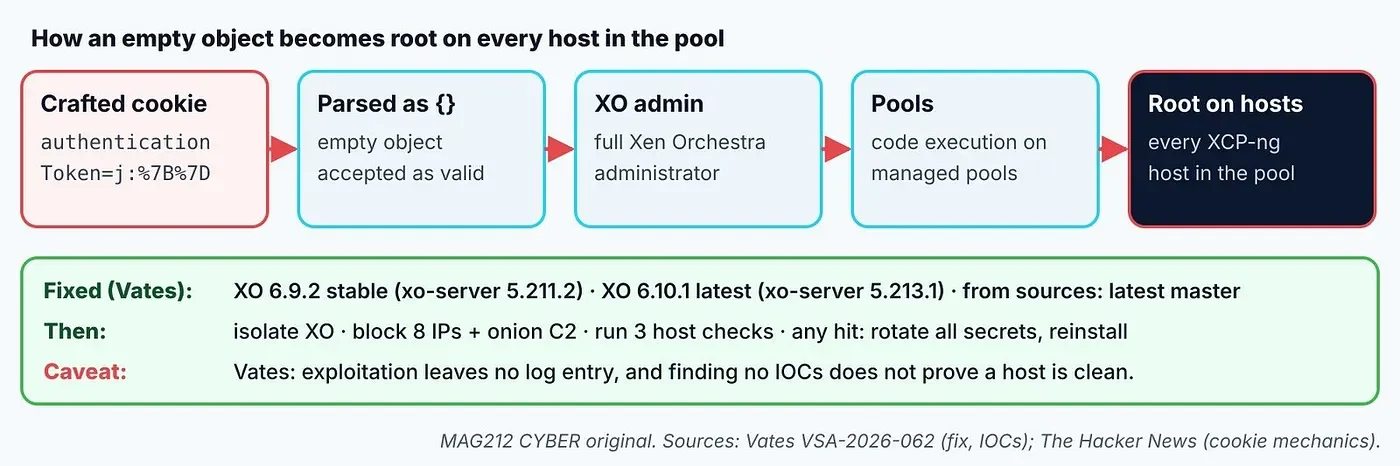
The defect sits in the login token handling. A crafted cookie is parsed into an empty object, and the token provider accepts that empty object as a valid identity. The result is an authentication bypass: the attacker becomes a Xen Orchestra administrator without credentials. From that position the advisory describes code execution across pools and, ultimately, root on the hosts.
Vates warns that successful exploitation leaves no log entry, so a clean log review proves nothing.
Setup
There are no accounts, roles or lab tools to describe here: the report does not present a researcher's test environment. What it does give is the affected and fixed versions, and the exploitation is a single crafted cookie, so the precondition is simply network reachability of a vulnerable Xen Orchestra instance.
Affected and fixed versions, per Vates:
| Affected | Fixed |
|---|---|
| XO 6.9.1 | XO 6.9.2 (xo-server 5.211.2) |
| XO 6.10.0 | XO 6.10.1 (xo-server 5.213.1) |
Builds installed from sources should be updated to the latest master. The report notes a conflict: The Hacker News gives 6.9.1 / 6.10.0 with the same xo-server versions, and the vendor's figures are the ones used here.
Finding it
The report does not describe how the flaw was discovered. It credits the finding to Filip Magic and Christoffer Olsen (TDC NET Security). The technical essence, as stated in the advisory, is that a crafted login cookie is parsed into an empty object that the token check accepts. That is the whole of the bypass: no password, no session fixation, no second step.
Exploitation
Step 1: send the crafted cookie
The payload is a single cookie value:
authenticationToken=j:%7B%7D
The report gives the cookie value but does not explain how it is parsed. The token provider parses that into an empty object and accepts it as valid, so the request is treated as coming from an authenticated Xen Orchestra administrator.
Step 2: act as XO administrator
With the bypass in place the attacker holds the Xen Orchestra administrator role. The report does not show the requests made at this stage; it states the outcome, which is administrative control of the console.
Step 3: code execution on pools, root on hosts
From the administrator position the attacker can run code across pools and ends up as root on the hosts.
Who is behind it
Vates says the flaw is being actively exploited by an actor operating initially from [redacted]:8001 and an onion address. The Hacker News adds that VirusTotal flags that IP as a RedLine Stealer command-and-control server. The start date of the exploitation and the number of victims are not established.
Root cause
A crafted login cookie is parsed into an empty object that the token provider accepts as a valid token. An empty object satisfies the check and the request is authorised as an administrator.
Why the existing defences did not stop it: the report does not analyse the code path further. The most consequential property is stated plainly by the vendor: successful exploitation leaves no log entry, so detection through logging is not available after the fact.
Impact
A virtualisation control plane is a master key. Whoever holds it can snapshot, copy, modify or destroy every virtual machine it manages. In this case the attacker reaches Xen Orchestra administrator, executes code across pools and obtains root on the hosts.
Because exploitation is silent, a clean log review proves nothing, and the report does not establish how many victims there are or when exploitation began.
Fix
Vates' remediation, in the order the advisory gives it:
- Take XO off the internet onto a dedicated management network, and block the IPs and onion address.
- Upgrade to XO 6.9.2 or 6.10.1 (xo-server 5.211.2 / 5.213.1); from-sources builds to latest master.
- Optionally add an interim WAF or reverse-proxy rule for the token patterns; Vates warns that regex rules can be bypassed.
- Run the host checks below on every host.
- If compromised, rotate all secrets (proxy, backup remotes, root, pool secret, users, OTP, mail) and fully reinstall.
Host checks
The following commands are copied from the Vates advisory and were not tested by MAG212 CYBER. They are intended for XCP-ng dom0, in bash, as root, and are read-only.
# VMs whose platform settings include a file-backed serial port (IOC: hvm_serial: file)
xe vm-list params=name-label,platform | grep -B1 'hvm_serial: file'

# Search current and rotated xensource logs for file-backed serial configuration
zgrep -- '-serial file:' /var/log/xensource.log*

# Preload hijack and the published persistence files
ls -la /etc/ld.so.preload /.ustar* /etc/cron.d/zz-ustar*
Run them on every XCP-ng host: any output naming those indicators is a hit, and "No such file" for the last command is the expected clean result.
Verify recovery
Confirm the XO version, confirm the interface is unreachable from untrusted networks, re-run the checks, and confirm the rotated secrets are in use. With no logs, reinstalling is the only high-confidence recovery for a host with any hit.
Variants to test
These are general directions suggested by the shape of this bug, not items from the report.
- Other
j:-prefixed cookie values. Try{}and near-empty structures such as[],nullor objects with only unknown keys on other applications that deserialise prefixed cookie values. A positive result is a request that reaches an authenticated page or API without a real session. - Empty-object acceptance in token providers. Wherever a token is parsed into an object and then checked for truthiness rather than for required claims, send the empty form. A positive result is authorisation succeeding with no identity fields present.
- URL-encoded and double-encoded forms. Send
%7B%7D,%257B%257Dand literal{}to see which decoding layer the parser sits behind. A positive result is any encoding that still yields an accepted empty object. - Privilege level of the accepted identity. When the bypass works, check which role the empty object maps to. A positive result is administrative access rather than a low-privilege or anonymous context.
- Logging after exploitation. Perform the bypass and then review application and access logs. A positive result for an attacker is no entry; for a defender it is the confirmation that log-based detection will not help.
- Post-authentication reach. From the bypassed session, enumerate what the console can do to managed hosts. A positive result is any path from console administration to command execution on the underlying hosts.
What happened, in plain words
Xen Orchestra is a web console. Think of it as the remote control for a whole room full of computers: you open it in a browser, log in, and from that one page you can start, stop, copy, delete and inspect virtual machines. A virtual machine (VM) is a computer that exists only as software, running inside a bigger physical computer. Xen Orchestra is used by managed service providers (companies that look after IT for other businesses), hosting providers and schools to run many VMs at once on a platform called XCP-ng.
XCP-ng is the software that sits directly on the physical hardware and hands out slices of it to those VMs. The physical machine running XCP-ng is called a host. A group of hosts working together is called a pool. Xen Orchestra, usually shortened to XO, is the control plane: the single place from which a person manages pools, hosts and VMs.
Vates is the company that makes both XCP-ng and Xen Orchestra. Vates published a security advisory numbered VSA-2026-062, titled "Empty-object login token", and rated it Critical, which is the most serious level in the usual severity scale. An advisory is the vendor's official notice telling customers what is wrong and what to do about it. Vates states that this flaw is being actively exploited, meaning real attackers are already using it against real systems. There is no CVE yet. A CVE is a public catalogue number given to a known vulnerability so everyone can refer to the same thing; not having one yet just means the paperwork is not finished, not that the problem is small.
The flaw is in how XO handles the login token. A token is a small piece of data the server gives your browser after you log in, and the browser sends it back with every later request so the server knows who you are. In a browser this is usually stored in a cookie, which is a small labelled note that a website asks your browser to keep and to show again on each visit. A crafted cookie value is accepted instead of one the server issued. XO reads that value, turns it into an empty object, and accepts the empty object as a valid identity. An object here means a bundle of labelled fields, like a form with boxes; an empty object is that form with every box blank. Accepting a blank form as proof of identity is the whole bug. The attacker becomes a Xen Orchestra administrator without knowing any password. From there, the advisory describes running code across pools and ending up as root on the hosts. Root is the all-powerful account on a Linux system; code execution means making the machine run commands of your choosing.
Vates warns that successful exploitation leaves no log entry. Logs are the automatic diaries that systems keep of what happened; if the break-in writes nothing into them, then looking at the logs afterwards and finding nothing suspicious proves nothing at all.
Setup
There are no accounts, roles or lab tools to describe here: the report does not present a researcher's test environment. What it does give is the affected and fixed versions, and the exploitation is a single crafted cookie, so the precondition is simply network reachability of a vulnerable Xen Orchestra instance. The report gives the affected and fixed versions but does not describe the conditions for exploitation.
Affected and fixed versions, per Vates:
| Affected | Fixed |
|---|---|
| XO 6.9.1 | XO 6.9.2 (xo-server 5.211.2) |
| XO 6.10.0 | XO 6.10.1 (xo-server 5.213.1) |
A version number is like the edition of a book: 6.9.1 and 6.10.0 are the editions with the mistake, and 6.9.2 and 6.10.1 are the corrected editions. The numbers in brackets, xo-server 5.211.2 and 5.213.1, refer to the internal component that does the server-side work; the table pairs each XO release with the matching component version so administrators can check exactly what they are running.
Builds installed from sources should be updated to the latest master. "From sources" means the software was assembled by the administrator from the project's raw code rather than downloaded as a ready-made package; for those installations there is no numbered release to point at, so the guidance is simply to take the newest code from the project's main development line, called master.
The report notes a conflict: The Hacker News gives 6.9.1 / 6.10.0 with the same xo-server versions, and the vendor's figures are the ones used here. When two sources disagree, the maker of the software is treated as the authority.
Finding it
The report does not describe how the flaw was discovered. It credits the finding to Filip Magic and Christoffer Olsen (TDC NET Security). The technical essence, as stated in the advisory, is that a crafted login cookie is parsed into an empty object that the token check accepts. That is the whole of the bypass: no password, no session fixation, no second step. Parsing means taking a piece of text and turning it into a structured value the program can work with, the way a person reads "3 apples" and understands a quantity and a fruit. The token check is the piece of code that is supposed to decide whether the parsed value represents a real, logged-in user. Here it said yes to a value that contains nothing at all.
Exploitation
Step 1: send the crafted cookie
The payload is a single cookie value:
authenticationToken=j:%7B%7D
Line by line, in plain words:
authenticationTokenis the name of the cookie. It is the label the server looks for when deciding who is making the request. The name is not secret; what matters is the value after the equals sign.=separates the cookie's name from its value, exactly as a label on a jar is separated from what is inside.j:is a prefix at the start of the value; the report does not explain its meaning. JSON is a common text format for structured data, built from curly braces, names, colons and values; it is how programs exchange bundles of labelled fields as text.%7Bstands for the opening curly brace{and%7Dstands for the closing curly brace}. So%7B%7Dis simply{}in disguise.- The report states only that the crafted cookie is parsed into an empty object.
The token provider parses that into an empty object and accepts it as valid, so the request is treated as coming from an authenticated Xen Orchestra administrator. The crafted cookie is accepted as a valid identity.
Step 2: act as XO administrator
With the bypass in place the attacker holds the Xen Orchestra administrator role. A role is a set of permissions, and administrator is the top one: it can see and change everything the console controls. In everyday terms, the attacker has walked past the front desk and is now sitting at the manager's desk with the manager's keys.
Step 3: code execution on pools, root on hosts
From the administrator position the attacker can run code across pools and ends up as root on the hosts. The important idea for a newcomer is the chain: the console is not the valuable thing in itself, it is the doorway to the machines underneath. Whoever controls the console can ask the hosts to do things, and the hosts are the physical computers that hold every VM.
Who is behind it
Vates says the flaw is being actively exploited by an actor operating initially from [redacted]:8001 and an onion address. An IP address is the numeric label of a computer on the internet, the equivalent of a street address; the :8001 part is a port, a numbered door on that computer. An onion address is a web address on the Tor network, a system designed to make the origin of traffic hard to trace. The Hacker News adds that VirusTotal flags that IP as a RedLine Stealer command-and-control server. VirusTotal is a service that checks files and addresses against many security vendors' findings, and command-and-control means the server an attacker uses to give instructions to malicious software planted on victims' machines. The start date of the exploitation and the number of victims are not established.
Root cause
The mistake is in how the login token is parsed and accepted. A crafted login cookie is parsed into an empty object that the token provider accepts. An empty object satisfies the check and the request is authorised as an administrator.
The bug is the same: the code confirms that something object-shaped arrived, but never confirms that it contains the details a genuine session would have, such as who the user is and when the session was issued.
Why the existing defences did not stop it: the report does not analyse the code path further. The most consequential property is stated plainly by the vendor: successful exploitation leaves no log entry, so detection through logging is not available after the fact. For a defender this is the hardest part. Most incident response starts with reading the logs to see what happened and when; here that starting point is missing.
Impact
A virtualisation control plane is a master key. Whoever holds it can snapshot, copy, modify or destroy every virtual machine it manages. A snapshot is a saved copy of a VM's state at a moment in time, useful for backups and equally useful to someone who wants to take data away quietly. In this case the attacker reaches Xen Orchestra administrator, executes code across pools and obtains root on the hosts.
"Publish the console" means making it reachable from the open internet so staff can log in from anywhere, which is convenient and also means anyone else on the internet can reach the login page. Because exploitation is silent, a clean log review proves nothing, and the report does not establish how many victims there are or when exploitation began.
Fix
Vates' remediation, in the order the advisory gives it:
- Take XO off the internet onto a dedicated management network, and block the IPs and onion address. A management network is a separate, private network used only for administration, so the console is reachable by the people who run it and not by the public. Blocking the addresses means telling your firewall, the device that decides which traffic may pass, to drop anything coming from or going to those known attacker locations.
- Upgrade to XO 6.9.2 or 6.10.1 (xo-server 5.211.2 / 5.213.1); from-sources builds to latest master. Upgrading installs the corrected code, which is the actual cure; the other steps reduce risk while you get there.
- Optionally add an interim WAF or reverse-proxy rule for the token patterns; Vates warns that regex rules can be bypassed. A WAF, web application firewall, inspects incoming web traffic and blocks requests that look malicious. A reverse proxy is a server that sits in front of the real application and forwards requests to it, so it is a natural place to filter. A regex, regular expression, is a pattern-matching rule for text. The warning matters: an attacker can often rewrite the same value in a slightly different form that the pattern no longer matches, so filtering is a stopgap, not a fix.
- Run the host checks below on every host. These look for traces that an attacker already got through, because the logs will not tell you.
- If compromised, rotate all secrets (proxy, backup remotes, root, pool secret, users, OTP, mail) and fully reinstall. Rotating a secret means replacing it with a new one, so anything the attacker copied stops working. OTP means one-time password, the second code used in two-factor login. A full reinstall is recommended because an attacker with root may have left hidden changes that no check can reliably find.
Host checks
The following commands are copied from the Vates advisory and were not tested by MAG212 CYBER. They are intended for XCP-ng dom0, in bash, as root, and are read-only. Dom0 is the special control VM on an XCP-ng host from which the host itself is administered. Bash is the standard Linux command interpreter, the program that reads typed commands and runs them. Read-only means these commands only look; they do not change anything.
# VMs whose platform settings include a file-backed serial port (IOC: hvm_serial: file)
xe vm-list params=name-label,platform | grep -B1 'hvm_serial: file'

# Search current and rotated xensource logs for file-backed serial configuration
zgrep -- '-serial file:' /var/log/xensource.log*

# Preload hijack and the published persistence files
ls -la /etc/ld.so.preload /.ustar* /etc/cron.d/zz-ustar*
Line by line, in plain words:
- The first line, starting with
#, is a comment. The computer ignores it; it is there to tell the human reader what the next command is for. IOC stands for indicator of compromise, a clue that suggests an intrusion has happened.hvm_serial: fileis the specific clue being hunted. xe vm-list params=name-label,platformasks the XCP-ng tool calledxeto list virtual machines, showing only two fields for each: the VM's name and its platform settings.|is a pipe, which takes the output of the command on its left and feeds it to the command on its right, like passing a printed list to a colleague.grep -B1 'hvm_serial: file'searches that list for the texthvm_serial: fileand prints the matching line plus one line before it (-B1), so you can see which VM the setting belongs to.- The second comment explains the next command.
zgrepis a version ofgrepthat can also read compressed log files, which is why it is used on logs that may have been rotated, meaning closed off and compressed to save space.-- '-serial file:'is the text being searched for, with--telling the command that everything after it is the search term and not an option./var/log/xensource.log*is the set of log files whose names begin withxensource.log; the*is a wildcard standing for any ending, so it covers both the current log and the older compressed ones. - The third comment names what the last command looks for: a preload hijack and the published persistence files. Persistence files are files an attacker leaves behind so their access survives a reboot.
ls -lalists files with full detail (-l) including hidden ones (-a). The paths are/etc/ld.so.preload, the file that drives the preload feature;/.ustar*, files at the root of the filesystem whose names start with.ustar; and/etc/cron.d/zz-ustar*, scheduled-task files with that name. Cron is the Linux scheduler that runs tasks at set times, so a file there can restart an attacker's program automatically.
Run them on every XCP-ng host: any output naming those indicators is a hit, and "No such file" for the last command is the expected clean result. In other words, if the last command reports that those files do not exist, that is good news, not an error.
Verify recovery
Confirm the XO version, confirm the interface is unreachable from untrusted networks, re-run the checks, and confirm the rotated secrets are in use. With no logs, reinstalling is the only high-confidence recovery for a host with any hit. Each of these is a separate question with a separate answer: is the fixed software actually installed, can the outside world still reach the console, do the checks still come back clean, and are the old passwords and keys genuinely gone from use.
Variants to test
These are general directions suggested by the shape of this bug, not items from the report.
- Other
j:-prefixed cookie values. Try{}and near-empty structures such as[],nullor objects with only unknown keys on other applications that deserialise prefixed cookie values. A positive result is a request that reaches an authenticated page or API without a real session. An API is the machine-facing side of a web application: instead of drawing a page for a person, it answers requests from other software with data.[]is an empty list andnullmeans "nothing at all", so the idea is to see whether other programs also accept a value that carries no identity. - Empty-object acceptance in token providers. Wherever a token is parsed into an object and then checked for truthiness rather than for required claims, send the empty form. A positive result is authorisation succeeding with no identity fields present. Checking for truthiness means asking only "is this something rather than nothing?", which an empty object passes; checking required claims means asking "does this contain the specific fields a real session must have?", which it fails.
- URL-encoded and double-encoded forms. Send
%7B%7D,%257B%257Dand literal{}to see which decoding layer the parser sits behind. A positive result is any encoding that still yields an accepted empty object. Double encoding means encoding the percent sign itself, so%7Bbecomes%257B; the point is that different layers of software may decode once or twice, and the test finds out which. - Privilege level of the accepted identity. When the bypass works, check which role the empty object maps to. A positive result is administrative access rather than a low-privilege or anonymous context. This matters because a bug that logs you in as a nobody is far less dangerous than one that logs you in as the manager.
- Logging after exploitation. Perform the bypass and then review application and access logs. A positive result for an attacker is no entry; for a defender it is the confirmation that log-based detection will not help. This is the test that tells you whether you can rely on your monitoring at all.
- Post-authentication reach. From the bypassed session, enumerate what the console can do to managed hosts. A positive result is any path from console administration to command execution on the underlying hosts. Enumerating means listing capabilities one by one; the question is how far the console's power extends downwards into the physical machines.
Glossary
- Advisory: an official notice from a software vendor describing a security problem, its severity and what customers should do.
- API: the machine-facing interface of a web application, which answers requests from other software with data rather than drawing pages for people.
- Authentication bypass: getting past a login check without valid credentials, so the system treats you as a logged-in user you are not.
- Bash: the standard Linux command interpreter that reads typed commands and runs them.
- Command-and-control (C2): the server an attacker uses to send instructions to malicious software running on victims' machines.
- Control plane: the management layer from which an infrastructure is operated, as opposed to the machines doing the actual work.
- Cookie: a small labelled note a website asks your browser to store and send back with later requests, commonly used to carry a login token.
- Cron: the Linux scheduler that runs tasks at set times, configured by files in
/etc/cron.d. - CVE: a public catalogue number assigned to a known vulnerability so everyone can refer to the same issue.
- Deserialise: turn text back into a structured value that a program can work with.
- Dom0: the special control virtual machine on an XCP-ng host, used to administer the host itself.
- Firewall: the device or software that decides which network traffic is allowed to pass.
- Host: a physical computer running the virtualisation software that holds virtual machines.
- Indicator of compromise (IOC): a clue, such as a file, setting or address, that suggests an intrusion has occurred.
- IP address: the numeric label of a computer on a network, like a street address; a port after a colon is a numbered door on that computer.
- JSON: a common text format for structured data, built from curly braces, names, colons and values.
- Log: the automatic diary a system keeps of what happened, used afterwards to investigate.
- Management network: a separate private network used only for administration, not reachable from the public internet.
- Master: the main development line of a software project, holding its newest code.
- Object: a bundle of labelled fields, like a form with boxes; an empty object has every box blank.
- Onion address: a web address on the Tor network, designed to make the origin of traffic hard to trace.
- OTP (one-time password): the second, single-use code used in two-factor login.
- Parse: read a piece of text and turn it into a structured value the program can use.
- Payload: the piece of data an attacker sends to trigger a flaw.
- Persistence: changes an attacker leaves behind so their access survives a reboot.
- Pipe (
|): a shell symbol that feeds the output of one command into another. - Pool: a group of XCP-ng hosts managed together as one unit.
- Port: a numbered door on a computer through which a particular service is reached.
- Preload hijack: abuse of a Linux feature that loads extra libraries into every starting program, letting an attacker run code inside trusted programs.
- Privilege: the set of things an account is allowed to do.
- Regex (regular expression): a pattern-matching rule for text, used by filters to spot suspicious strings.
- Reverse proxy: a server placed in front of an application that forwards requests to it, often used to filter traffic.
- Role: a named set of permissions, such as administrator, that decides what an account can do.
- Root: the all-powerful administrator account on a Linux system.
- Rotate (a secret): replace a password or key with a new one so the old value stops working.
- Snapshot: a saved copy of a virtual machine's state at a particular moment.
- Token: a piece of data issued after login and sent back with later requests so the server knows who you are.
- Tor: a network designed to make the origin of traffic hard to trace.
- URL encoding: writing awkward characters as a percent sign plus two hexadecimal digits, such as
%7Bfor{. - Vendor: the company that makes a piece of software.
- Virtual machine (VM): a computer that exists only as software, running inside a larger physical computer.
- VirusTotal: a service that checks files and addresses against many security vendors' findings.
- Vulnerability: a mistake in software that lets someone make it behave in a way its maker did not intend.
- WAF (web application firewall): a filter that inspects incoming web traffic and blocks requests that look malicious.
- XCP-ng: the virtualisation platform that runs directly on physical hardware and hosts virtual machines.
- Xen Orchestra (XO): the web console used to manage XCP-ng pools, hosts and virtual machines.
- xo-server: the server-side component of Xen Orchestra that does the actual work behind the console.