DLL Hijacking when sending feedback and crash report leading to Privilege Escalation
The feedback and crash-report helper binary of Acronis True Image 2021 loads several DLLs by name without a safe search path, so a normal user can plant a malicious DLL in a user-writable folder that is searched. When the helper runs elevated, the DLL executes with Administrator rights, which the author then escalated to SYSTEM via a scheduled task.

- Triaged in 1 hour
- Fixed in 4 months
- Paid in 6 days
- Disclosed after 3.9 years
Summary
Acronis True Image 2021 has a feature to send user feedback or application crash report to Acronis Support staff. report_sender.exe is the binary which manages such functionalities. The application is vulnerable to DLL hijacking attack because it searches for non-existing DLL files in locations which can be controlled by the attacker or normal user thus placing a malicious DLL in one of the folder will result it getting loaded by report_sender.exe with Administrator privileges which can be escalated to SYSTEM privileges thus resulting in a Privilege Escalation.
report_sender.exe looks for the following DLL files and name of any file can be used to exploit the vulnerability.
- CSUNSAPI.dll
- swift.dll
- nfhwcrhk.exe
- SureWareHook.dll
- aep.dll
- atasi.dll
- nusonsll.dll
- ubsec.dll
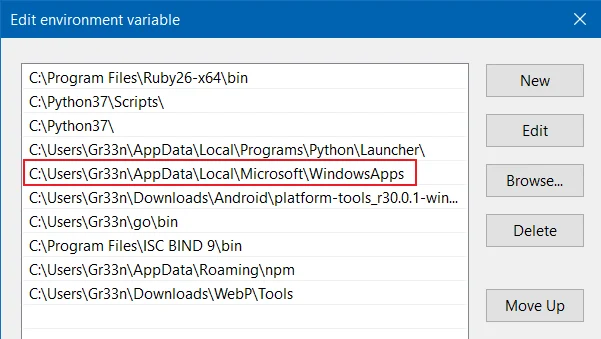
Every Windows system contains %USERPROFILE%\AppData\Local\Microsoft\WindowsApps folder as a value in the User PATH environment variable where report_sender.exe will search for the DLL if not found in the preceding Search order folders. The malicious DLL file can be placed in this folder as normal user has Full control over this folder.
Even if %USERPROFILE%\AppData\Local\Microsoft\WindowsApps folder is not in User PATH environment variable, attacker can add any folder of his choice to the User PATH environment variable as this does not require Administrative permissions.
Steps To Reproduce
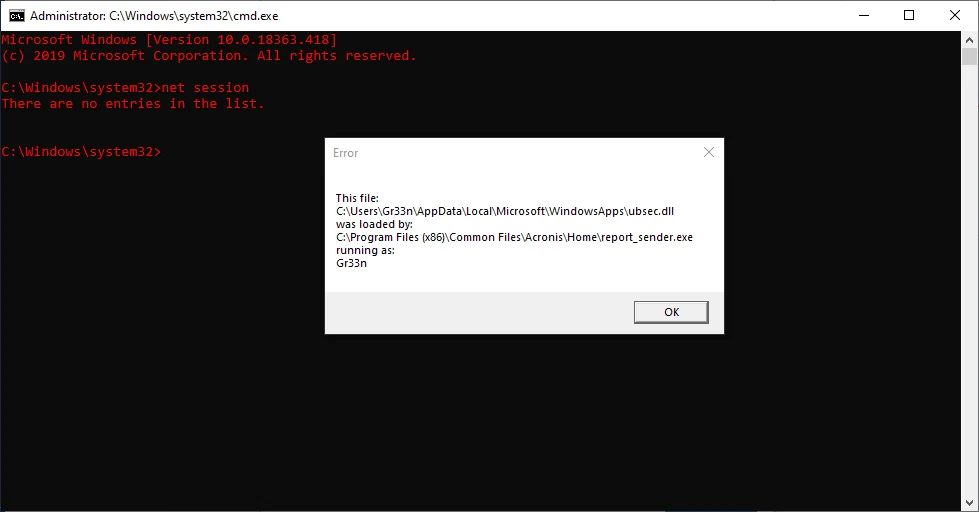
I created a DLL file which when loaded spawns cmd.exe while giving information as to which application loaded the DLL, path from where the file was loaded, and user privilege. I have attached the DLL file as well as the C++ code to build the DLL below if any necessary changes are to be made.
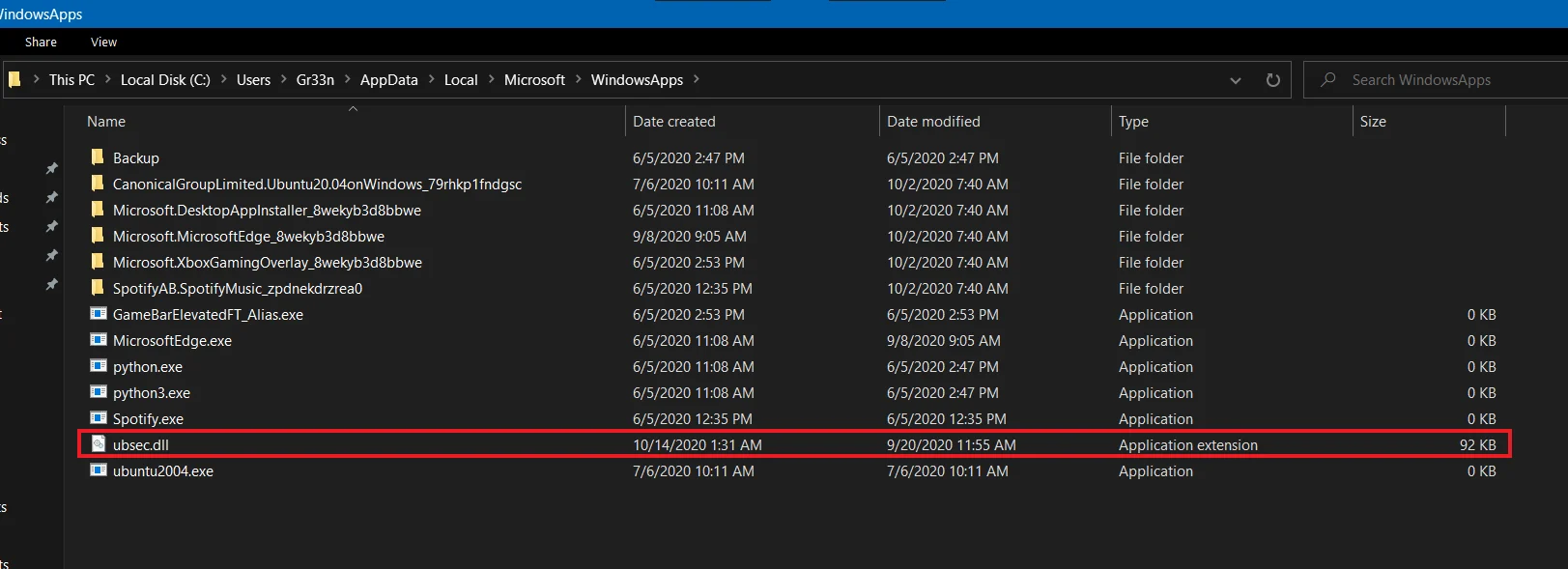
[ 1 ] - Copy or write the DLL file with any name from the above specified DLL file names in %USERPROFILE%\AppData\Local\Microsoft\WindowsApps folder. I chose ubsec.dll in this example.
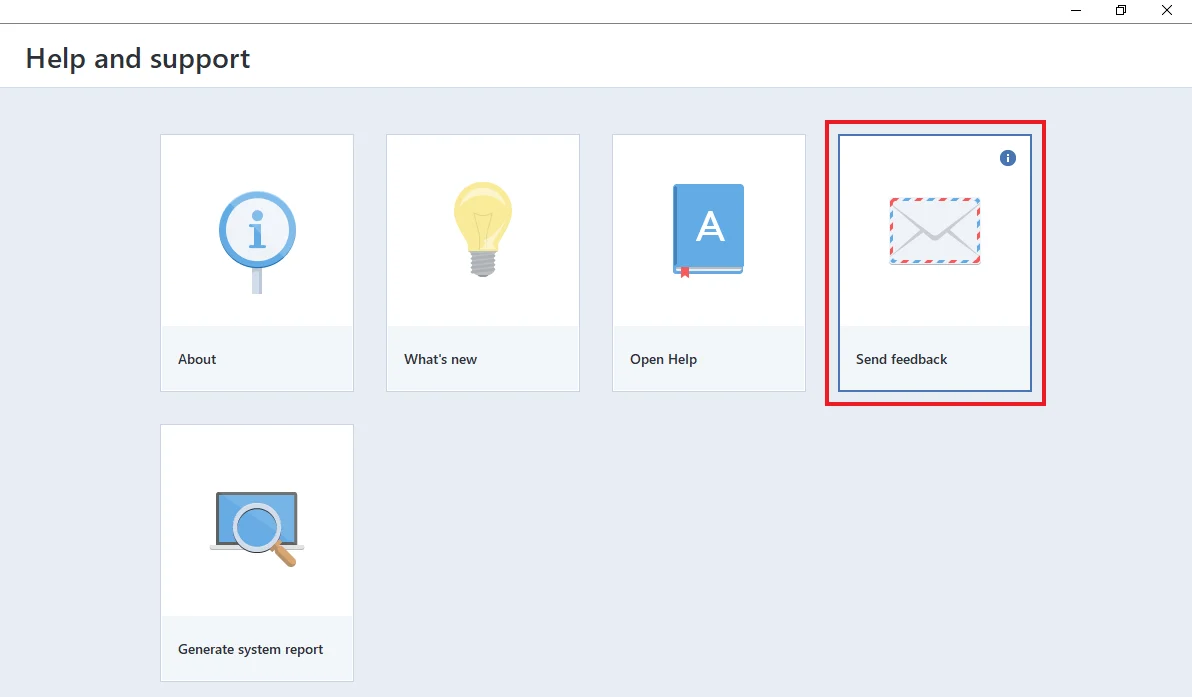
[ 2 ] - Go to the Help tab in Acronis True Image and click on Send feedback.
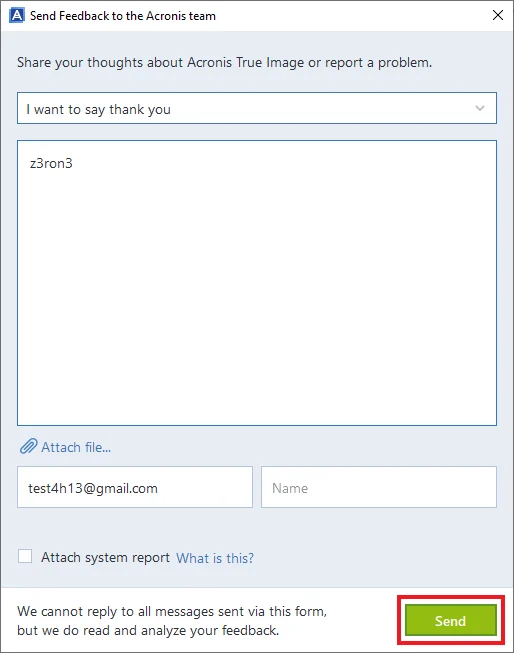
[ 3 ] - Fill in the details of the feedback and click on Send.
A cmd.exe window will open when report_sender.exe loads the DLL file.
We can see in the title of the cmd.exe window that it was started with Administrator privileges. To confirm, I ran net session command which gives There are no entries in this list output if executed with Administrator privileges and Access denied if executed as a normal user.
Escalating from Administrator privileges to NT AUTHORITY\SYSTEM.
[ 1 ] - From the Command Prompt that was executed after the DLL was loaded, create a scheduled task by using the Windows built-in schtasks.exe utility.
schtasks /create /SC WEEKLY /RU "NT AUTHORITY\SYSTEM" /TN EOP /TR C:\Windows\System32\winver.exe /IT /RL HIGHEST

[ 2 ] - Run the task created in above step from the elevated Command Prompt.
schtasks /run /I /TN EOP
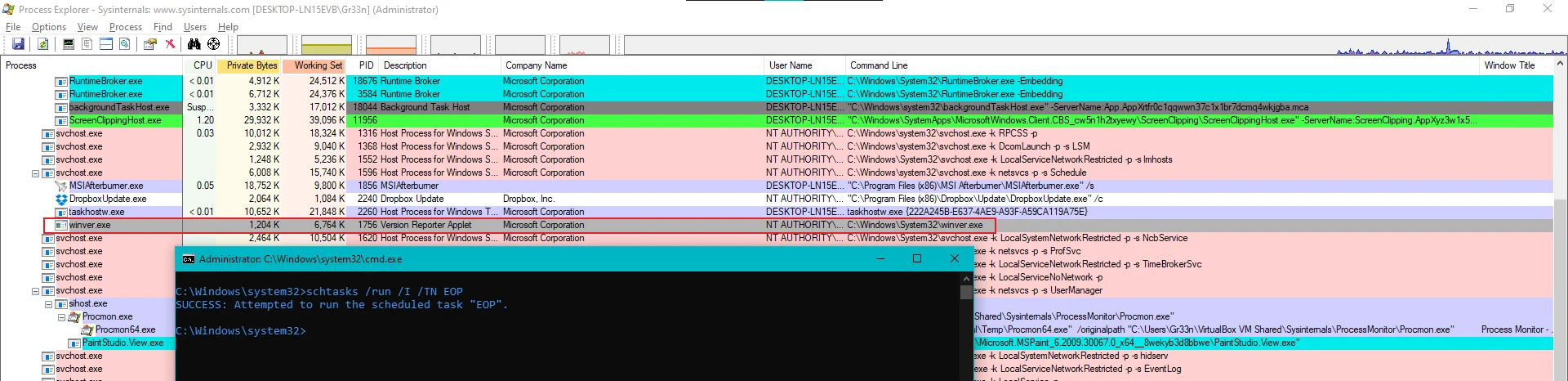
winver.exe can be seen executed as NT AUTHORITY\SYSTEM resulting in SYSTEM privileged code execution.
Impact
Attackers gaining privilege to execute commands as Administrator or NT AUTHORITY\SYSTEM.
This attack can also work without any user interaction when report_sender.exe automatically sends crash report.
Attachments
Not written yet. The AI write-up for this report has not been written yet. The Original tab links to the source.
How it worked
Root cause
Likely the helper binary loads DLLs by bare name without a fully qualified path, so the Windows search order reaches user-writable directories such as the per-user WindowsApps folder or a folder the user adds to their PATH.
Impact
An attacker could run code as Administrator or NT AUTHORITY\SYSTEM, and the text claims this may also happen without user interaction when a crash report is sent automatically.
What the attacker needed
Local access to the machine; ability to write to a user-writable folder; feedback or crash report is sent
How it was found
- Place a DLL named after one of the listed names in the per-user WindowsApps folder.
- Open the Help tab in Acronis True Image and choose Send feedback.
- Fill in the feedback details and send it.
- The helper loads the DLL and a command prompt opens with Administrator rights.
- Create a scheduled task that runs as SYSTEM from that prompt.
- Run the task to execute code as SYSTEM.
Explained by bugbounty.wiki with AI from the original and checked against quotes from it; it can still be wrong. Read the original before relying on a detail.
Not written yet. The AI write-up for this report has not been written yet. The Original tab links to the source.
Windows programs often load extra code from DLL files by name, and Windows looks in several folders in a set order. If a program does not say exactly which folder to use, it may pick up a file an ordinary user placed in a folder they can write to. Here the helper program ran with high rights, so the planted file ran with those same high rights.
What is RCE?
Running the attacker's code on the target's servers: through command or code injection, unsafe deserialisation or template injection.



