Abusing tag names in GitLab
GitLab allowed a tag to have the same name as the default branch, and when viewing the repository, the tag's content was shown instead of the branch's. An attacker could create a repository where the displayed code appears safe but cloning and running it executes malicious code.

GitLab
Originally disclosed on GitLab
- Fixed in 2 months
- Disclosed after 2 months
HackerOne report #1831543 by inspector-ambitious on 2023-01-11, assigned to @fvpotvin:
Report | Attachments | How To Reproduce
Report
Summary
Introduction
I was curious to know what would happen on a GitLab repository if I was creating tags that match branch names. After a few experiments, I believe I found one vulnerability that would allow an attacker to lure users into thinking a repository content is safe.
A quick recap about symbolic ref names
The following is extracted from this documentation.
A symbolic ref name. E.g.
mastertypically means the commit object referenced byrefs/heads/master. If you happen to have bothheads/masterandtags/master, you can explicitly say heads/master to tell Git which one you mean. When ambiguous, a<refname>is disambiguated by taking the first match in the following rules:If $GIT_DIR/
<refname>exists, that is what you mean (this is usually useful only for HEAD, FETCH_HEAD, ORIG_HEAD, MERGE_HEAD and CHERRY_PICK_HEAD);
otherwise, refs/
<refname>if it exists;otherwise, refs/tags/
<refname>if it exists;otherwise, refs/heads/
<refname>if it exists;otherwise, refs/remotes/
<refname>if it exists;otherwise, refs/remotes/
<refname>/HEAD if it exists.
In the following exploitation scenarios, we're going to abuse the fact that the following symbolic reference name
main, can resolve to either refs/tags/main or refs/heads/main.
Steps to reproduce
This scenario was tested on a local instance of GitLab 15.6.2-ee at the URL http://gitlab.ubuntu/. But I quickly checked and it also impacts gitlab.com
Step 1: The malicious main branch
A user named inspector-ambitious creates an empty new repo named repo1 (without a README).
inspector-ambitious will then create a branch named main containing a malicious script named ./script.sh. That branch will become the default branch since the repo was empty.
From the command line, it would look like this
git clone [email protected]:inspector-ambitious/repo1.git
cd repo1
echo "echo 'execute malicious code'" >> script.sh
chmod +x script.sh
git add script.sh
git commit -m "malicious script"
git branch -M hack
git push origin hack:refs/heads/main
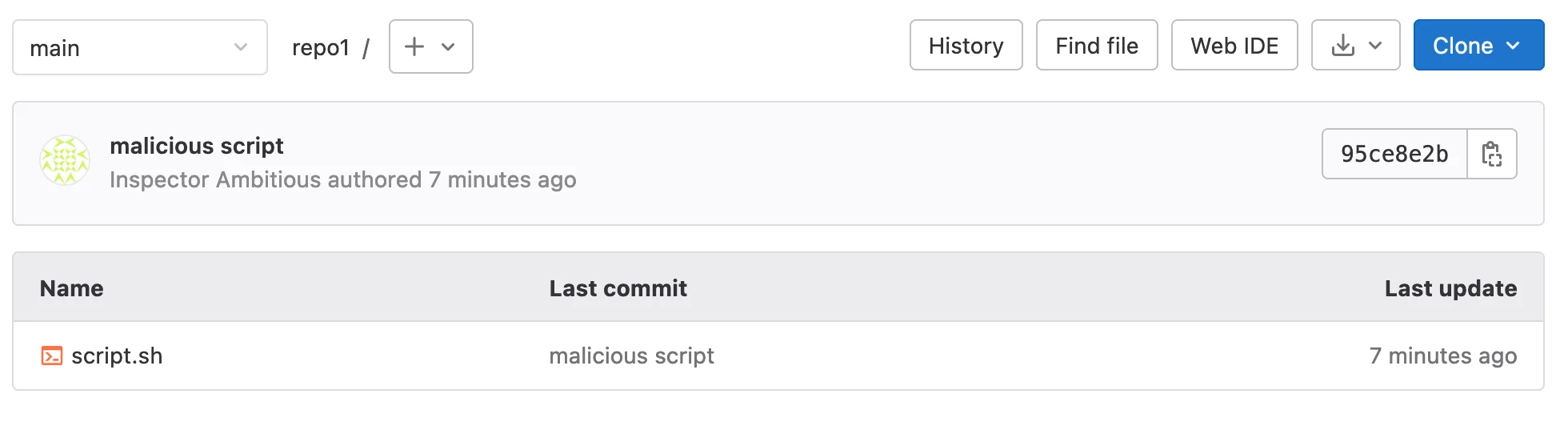
Note in the screenshot above that the default branch is main and the commit name is malicious commit.
Step 2: The genuine main tag
Then inspector-ambitious creates a genuine branch in the repository containing as well a ./script.sh but this time the content of ./script.sh is genuine and safe to execute.
From the command line, it would look like this
mkdir repo1_genuine
cd repo1_genuine
echo "echo 'this is genuine'" >> script.sh
chmod +x script.sh
git init
git add script.sh
git commit -m "genuine script"
git branch -M genuine
git remote add origin [email protected]:inspector-ambitious/repo1.git
git push origin genuine
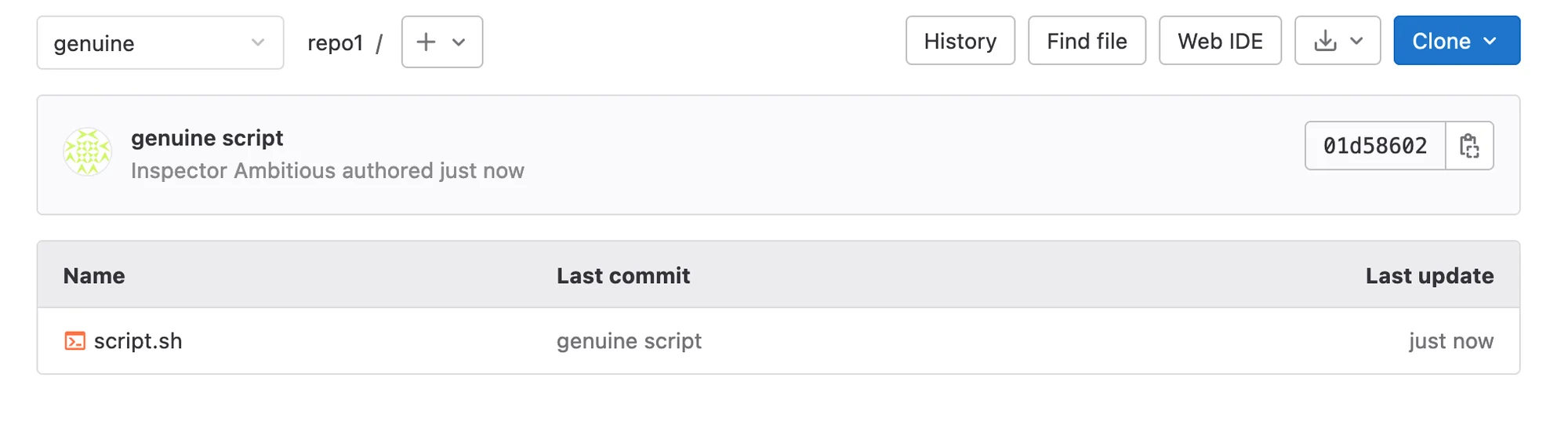
The next step for inspector-ambitious is to push a tag called main, but this will fail if tried directly as you can see below.
inspector-ambitious@ubuntu:~/dev/report4/repo1/repo1_genuine$ git push origin genuine:refs/tags/main
Total 0 (delta 0), reused 0 (delta 0), pack-reused 0
remote: GitLab: You cannot use default branch name to create a tag
To gitlab.ubuntu:inspector-ambitious/repo1.git
 ! [remote rejected] genuine -> main (pre-receive hook declined)
error: failed to push some refs to 'gitlab.ubuntu:inspector-ambitious/repo1.git'
However, this can be easily bypassed by doing the following.
From the UI, inspector-ambitious sets genuine as the default branch.
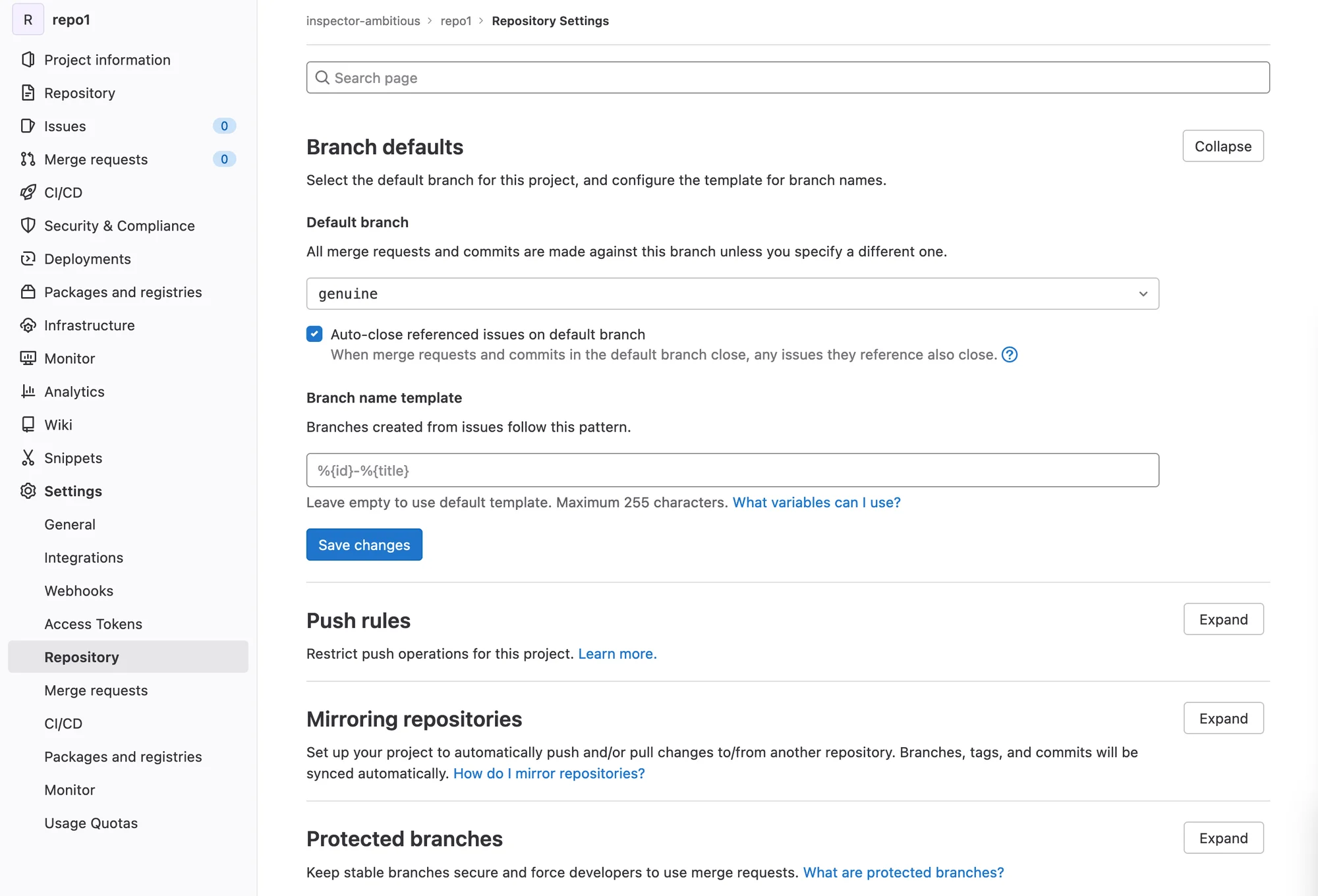
From the command line inspector-ambitious can now push the tag main.
git push origin genuine:refs/tags/main
And this time, no errors the tag is created.
Finally from the UI again, inspector-ambitious sets main as the default branch and delete the genuine branch.
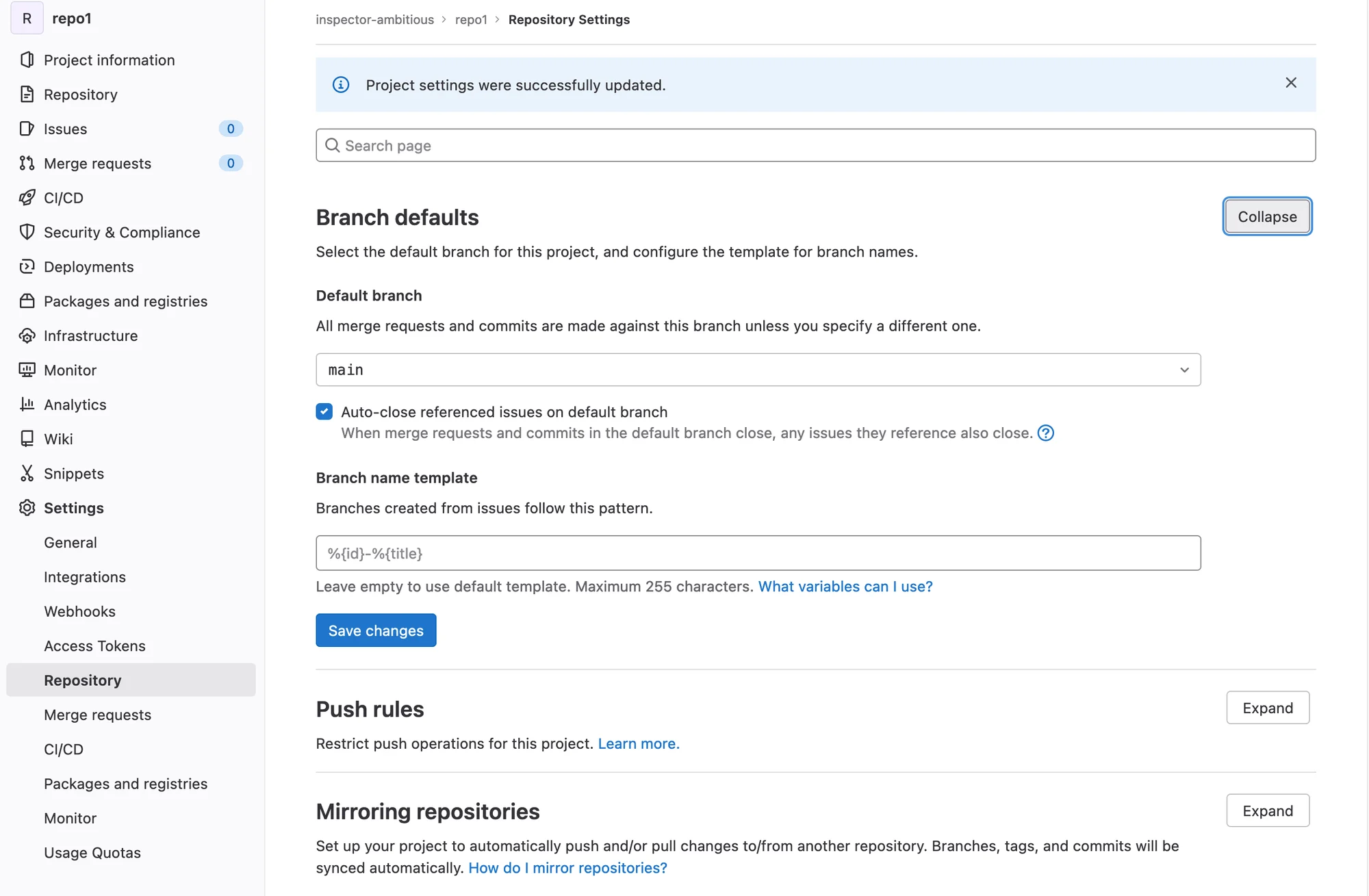
Step 3: The victim
Now let's say the user victim goes to the repository http://gitlab.ubuntu/inspector-ambitious/repo1/, victim will see the following.
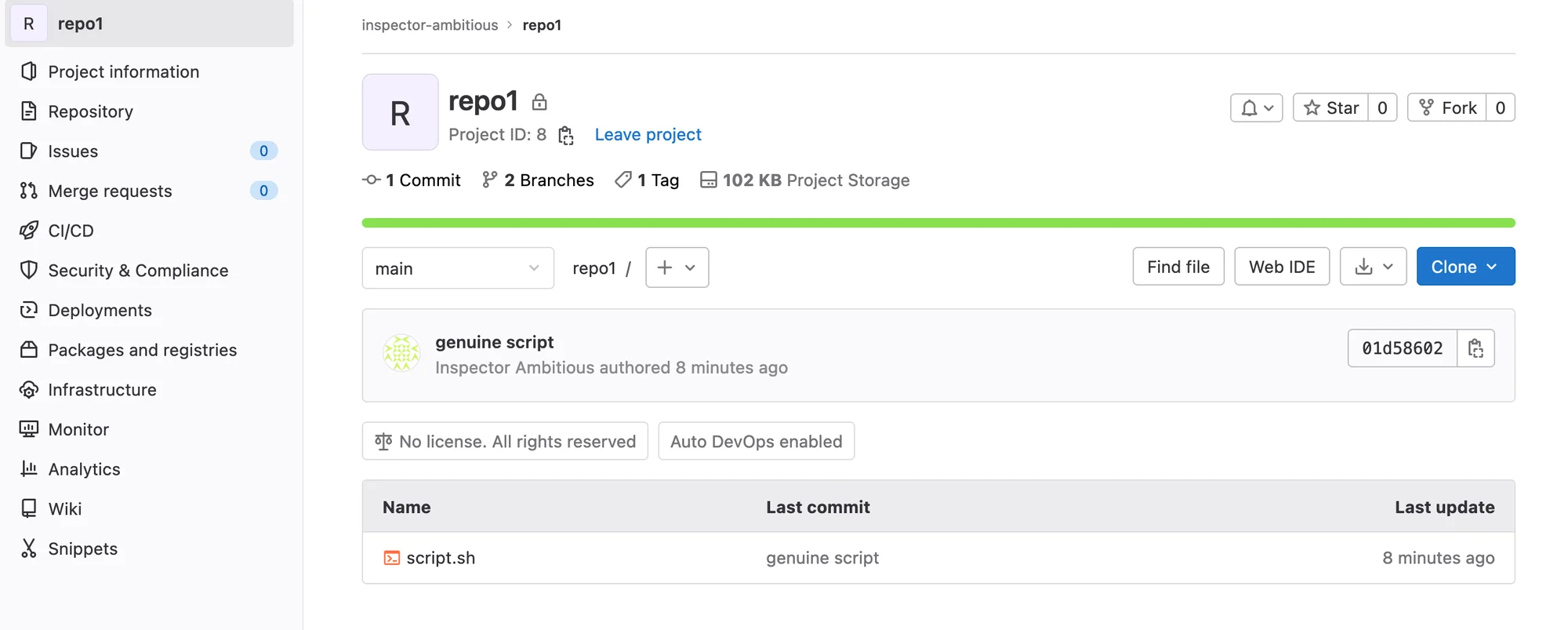
While the default branch is main, victim will see the content of main tag instead (note the commit name genuine script). And if victim was cloning the repository and executing script.sh, it will be the malicious code that would be executed instead.
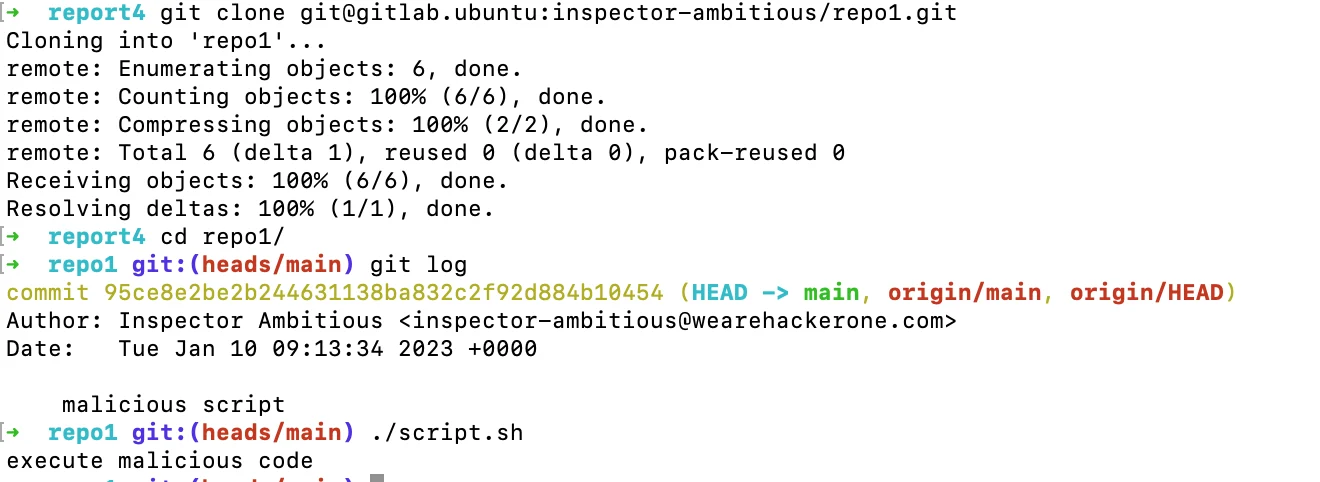
I also tested the download of the zip file and it is not vulnerable, the victim would download the main tag instead of the main branch.
Impact
Malicious repositories could be created to lure users into executing what they think is safe code, resulting in the takeover of the victim system.
Output of checks
This bug happens on GitLab.com and but i did most of my testing on a local instance of GitLab 15.6.2-ee.
Impact
Malicious repositories could be created to lure users into executing what they think is safe code, resulting in the takeover of the victim system.
Attachments
Warning: Attachments received through HackerOne, please exercise caution!
- issue1_screenshot1.png
- issue1_screenshot2.png
- issue1_screenshot3.png
- issue1_screenshot4.png
- issue1_screenshot5.png
- issue1_screenshot6.png
How To Reproduce
Please add reproducibility information to this section:
Not written yet. The AI write-up for this report has not been written yet. The Original tab links to the source.
How it worked
Root cause
Likely, GitLab's web interface resolves ambiguous references (same name for branch and tag) by preferring the tag, while the clone operation uses the branch, and the restriction on creating such tags can be bypassed by temporarily changing the default branch.
Impact
Malicious repositories could be created to lure users into executing what they think is safe code, resulting in the takeover of the victim system.
What the attacker needed
Attacker can create a repository; victim clones and runs code from the repository
How it was found
- Create an empty repository and push a malicious script to a branch named main, making it the default branch.
- Create a genuine branch with a safe script and push it to the repository.
- Set the genuine branch as the default branch to bypass the restriction on creating a tag named main.
- Push a tag named main pointing to the genuine branch.
- Set main back as the default branch and delete the genuine branch.
- A victim visiting the repository sees the safe script from the tag, but cloning and running it executes the malicious script from the branch.
Explained by bugbounty.wiki with AI from the original and checked against quotes from it; it can still be wrong. Read the original before relying on a detail.
Not written yet. The AI write-up for this report has not been written yet. The Original tab links to the source.
In Git, a tag is a label for a specific commit, and a branch is a moving line of development. GitLab has a rule that you cannot create a tag with the same name as the default branch, but the researcher found a way around it. When someone views the repository, GitLab shows the tag's content instead of the branch's, so the code looks safe but is actually malicious.
What is Business logic?
The application works as coded but not as intended: a negative price, a skipped payment step, a limit that can be crossed.




