Ambiguous branch name exploitation
A GitLab repository could have a default branch named 'heads/main' that contains malicious code, while the web interface displays the content of a different branch named 'main'. An attacker could trick a user into cloning the repository and executing the malicious script, leading to system compromise.

GitLab
Originally disclosed on GitLab
- Fixed in 54 days
- Disclosed after 54 days
⚠️ Please read the process on how to fix security issues before starting to work on the issue. Vulnerabilities must be fixed in a security mirror.
HackerOne report #1940441 by inspector-ambitious on 2023-04-10, assigned to @fvpotvin:
Report | Attachments | How To Reproduce
Report
Summary
Introduction
I previously reported #1831547 and #1831543, they have been closed and fixed. However I wanted to retest them carefully over the weekend and I managed to replicate the issue again but this time using a branch called heads/main !
A quick recap about symbolic ref names
The following is extracted from this documentation.
A symbolic ref name. E.g.
mastertypically means the commit object referenced byrefs/heads/master. If you happen to have bothheads/masterandtags/master, you can explicitly say heads/master to tell Git which one you mean. When ambiguous, a<refname>is disambiguated by taking the first match in the following rules:If $GIT_DIR/
<refname>exists, that is what you mean (this is usually useful only for HEAD, FETCH_HEAD, ORIG_HEAD, MERGE_HEAD and CHERRY_PICK_HEAD);
otherwise, refs/
<refname>if it exists;otherwise, refs/tags/
<refname>if it exists;otherwise, refs/heads/
<refname>if it exists;otherwise, refs/remotes/
<refname>if it exists;otherwise, refs/remotes/
<refname>/HEAD if it exists.
In the following exploitation scenario, we're going to abuse the fact that the following symbolic reference name
heads/foo, can resolve to two distinct branches either refs/heads/foo or refs/heads/heads/foo.
Steps to reproduce
This scenario was tested on gitlab.com.
Step 1: The malicious heads/main default branch
A user named victim01 creates an empty new repository named ambiguity (without a README).
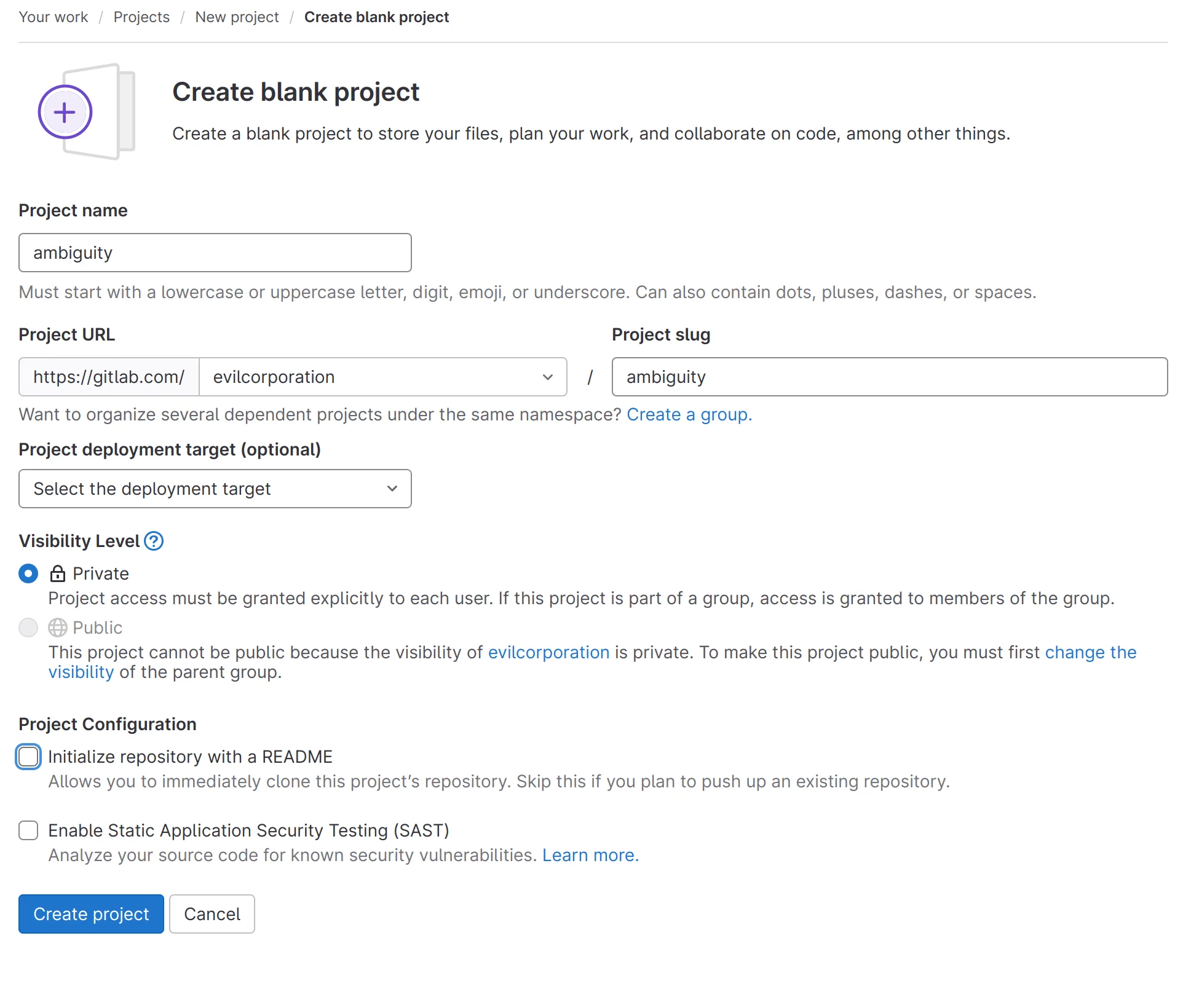
victim01 will then create a branch named heads/main containing a malicious script named ./script.sh. That branch will become the default branch since the repository was empty.
From the command line, it would look like this
git clone [email protected]:evilcorporation/ambiguity.git
cd ambiguity
echo "echo 'execute malicious code'" >> script.sh
chmod +x script.sh
git add script.sh
git commit -m "malicious script"
git branch -M hack
git push origin hack:refs/heads/heads/main
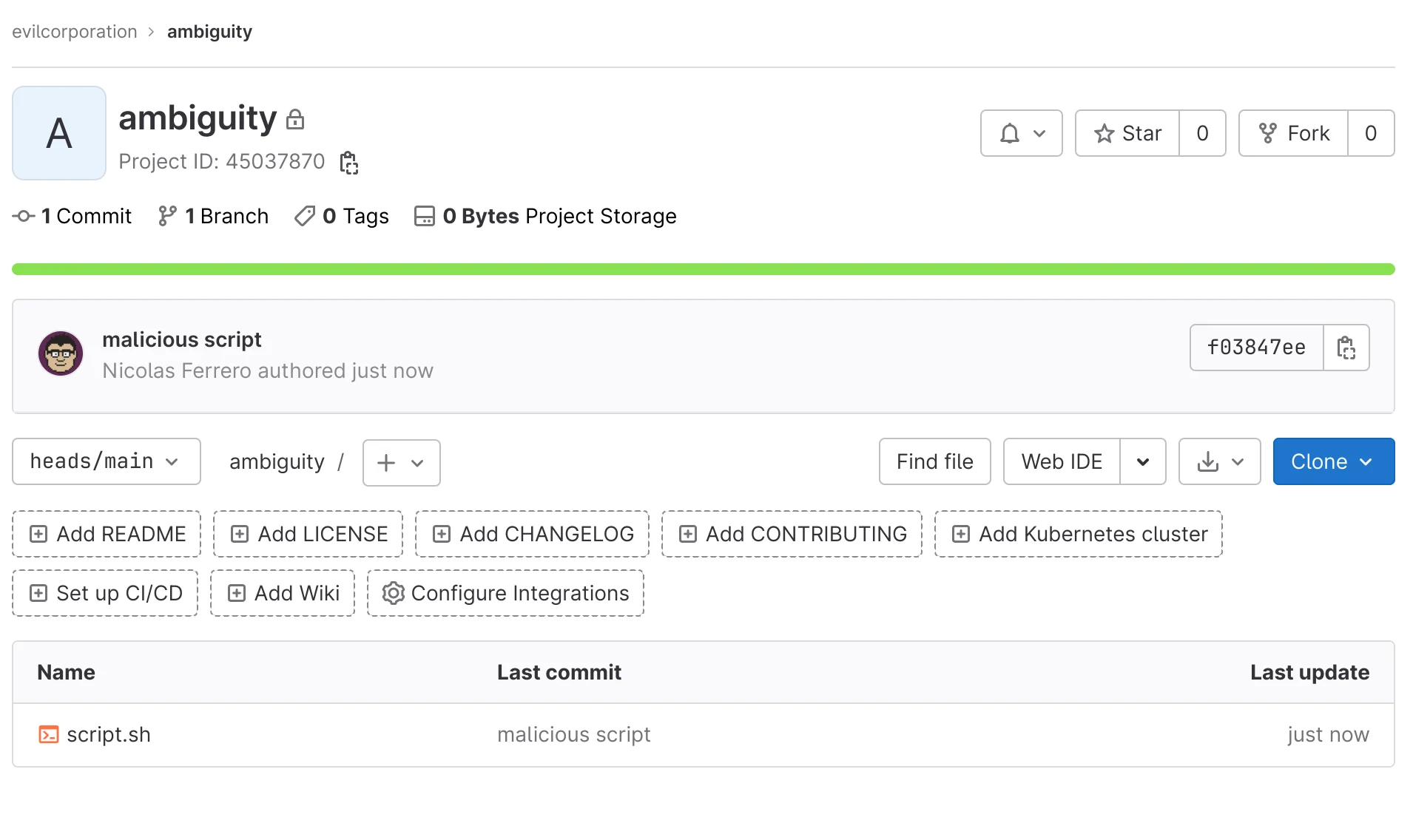
Note in the screenshot above that the default branch is heads/main and the commit name is malicious script.
Step 2: The genuine main branch
Then victim01 creates a main branch in the repository containing as well a ./script.sh but this time the content of ./script.sh is genuine and safe to execute.
From the command line, it would look like this
mkdir ambiguity_genuine
cdambiguity_genuine
echo "echo 'this is genuine'" >> script.sh
chmod +x script.sh
git init
git add script.sh
git commit -m "genuine script"
git branch -M genuine
git remote add origin  [email protected]:evilcorporation/ambiguity.git
git push origin genuine:refs/heads/main
Step 3: The victim clone the repo and execute the script
Now let's say the user user1 goes to the repository https://gitlab.com/evilcorporation/ambiguity.git/, user1 will see the following.
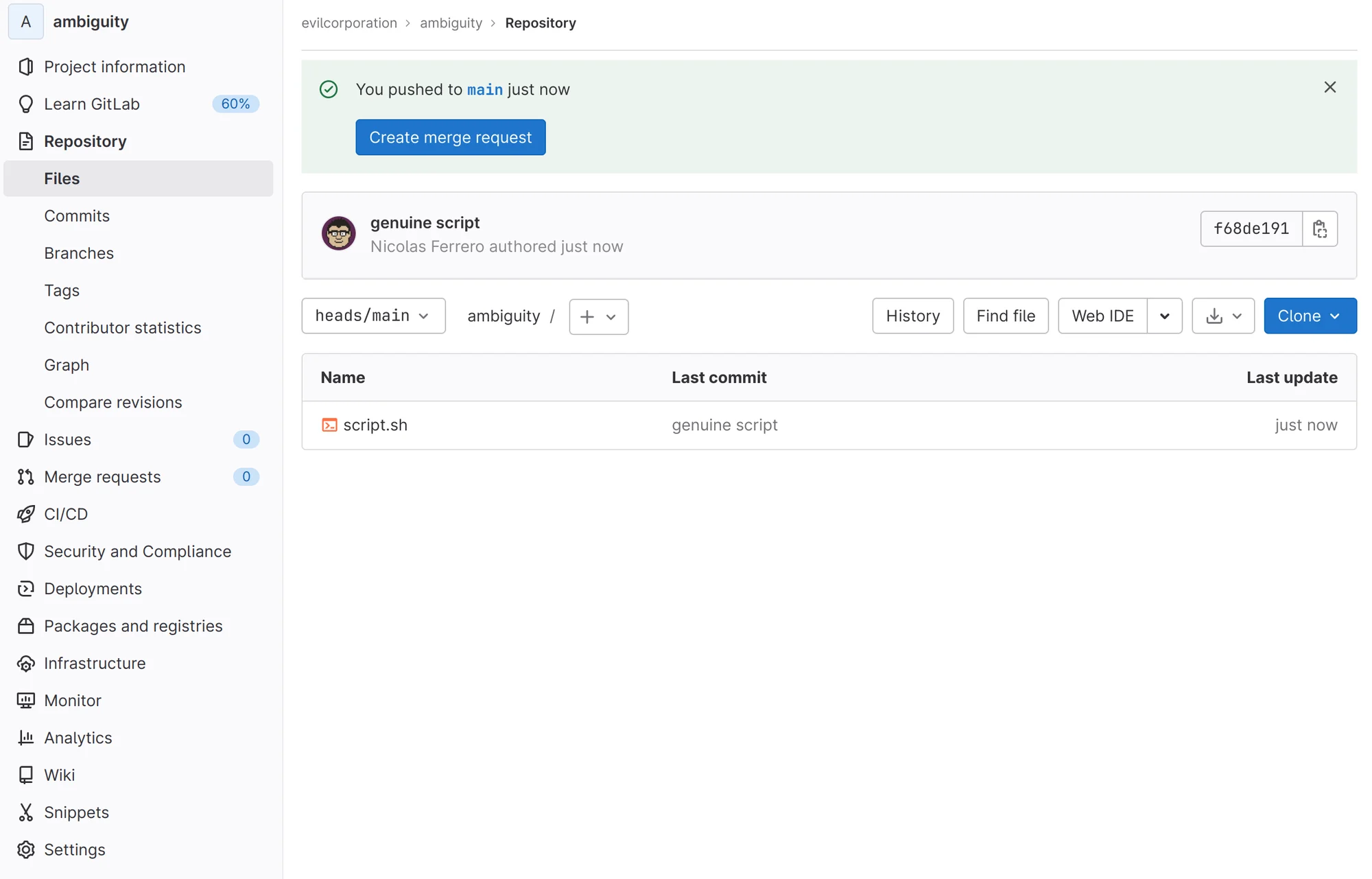
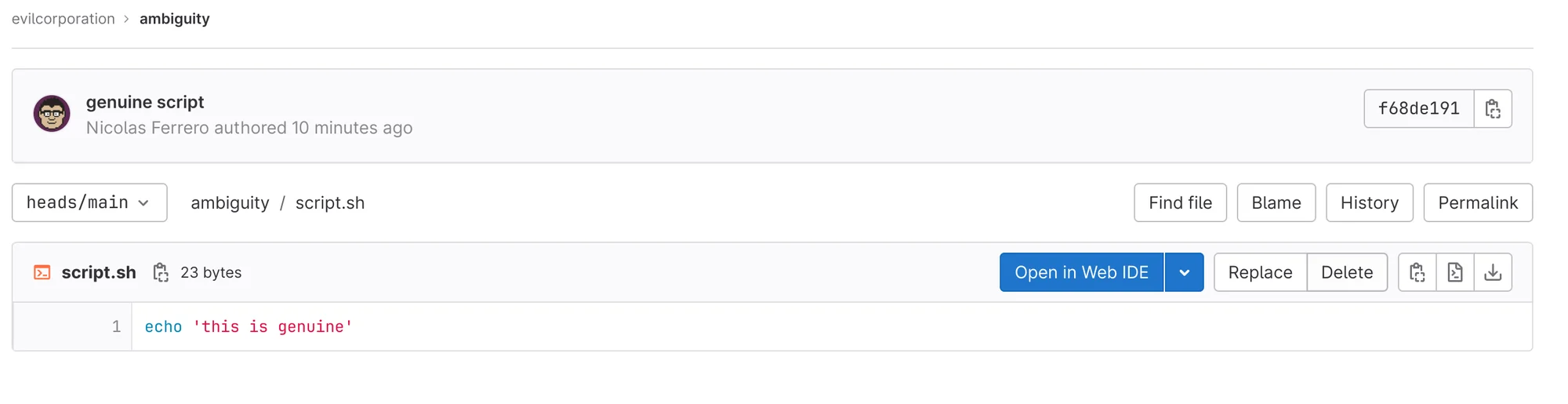
While the default branch is heads/main, user1 will see the content of main branch instead, note the commit name genuine script. And if user1 was cloning the repository and executing script.sh, it will be the malicious code that would be executed instead.
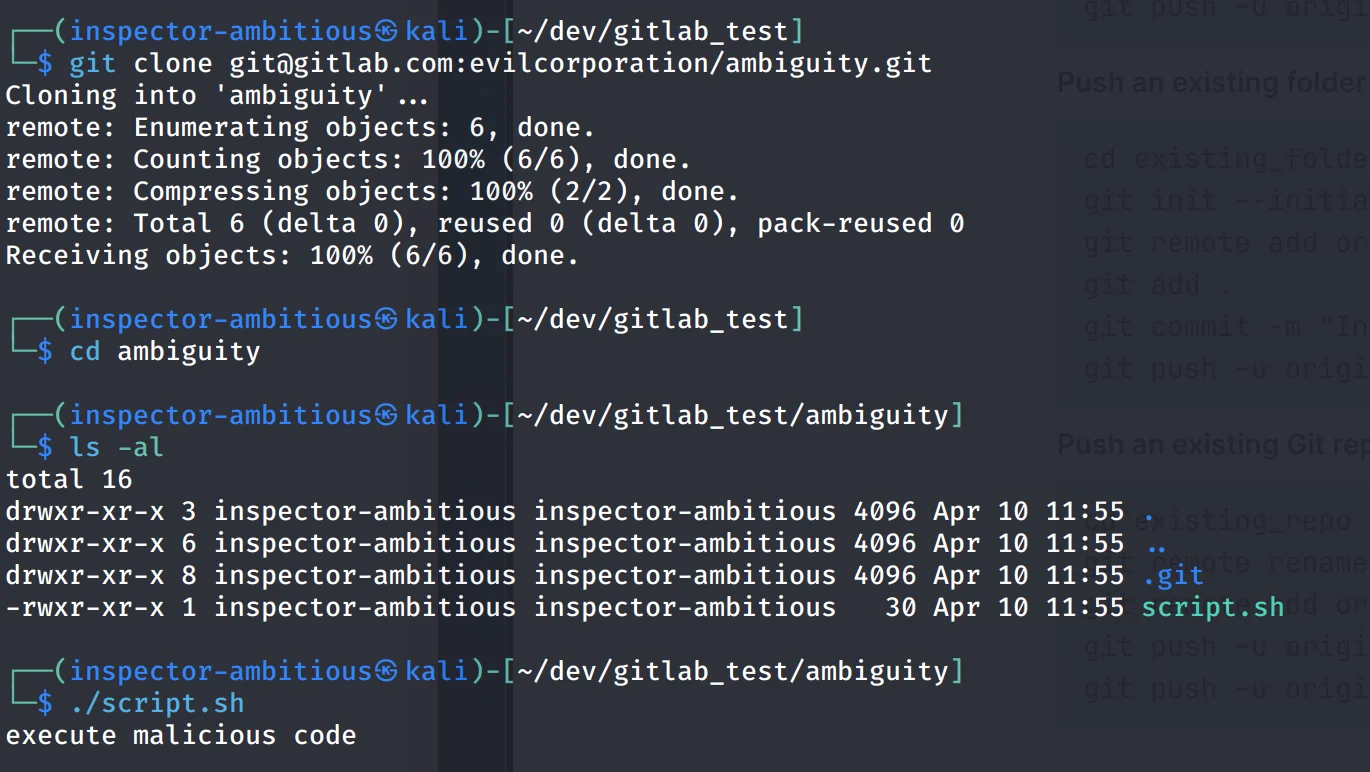
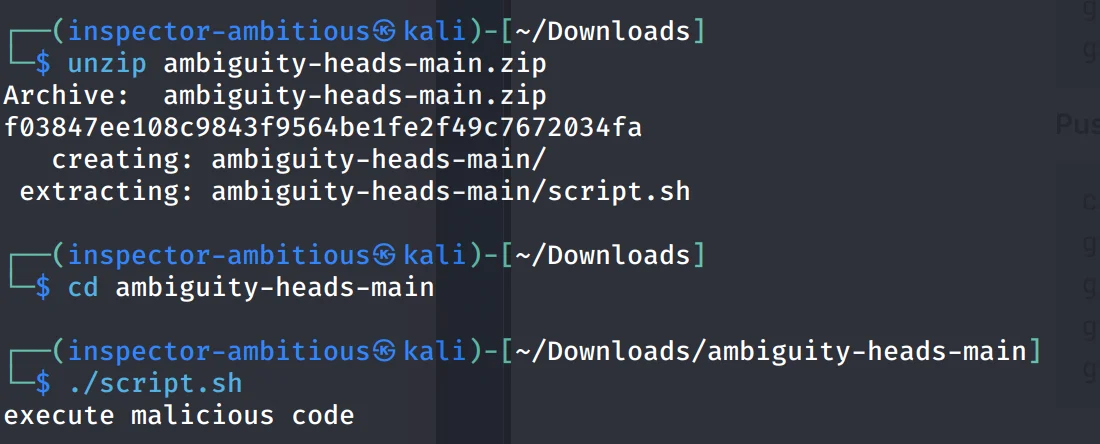
I also tested the download of the zip file and it is vulnerable this time ! (contrary to previous report), the victim would download the content heads/main branch, see below the extraction of the zip and the output of script.sh
Output of checks
This bug happens on GitLab.com
Impact
Malicious repositories could be created to lure users into executing what they think is safe code, resulting in the takeover of the victim system.
Attachments
Warning: Attachments received through HackerOne, please exercise caution!
How To Reproduce
Please add reproducibility information to this section:
Not written yet. The AI write-up for this report has not been written yet. The Original tab links to the source.
How it worked
Root cause
Likely, GitLab's web interface and Git's ref resolution logic handle ambiguous branch names like 'heads/main' inconsistently, causing the displayed branch to differ from the one actually cloned.
Impact
Malicious repositories could be created to lure users into executing what they think is safe code, resulting in the takeover of the victim system.
What the attacker needed
Attacker can create a repository; victim clones and runs a script
How it was found
- Create an empty repository without a README.
- Create a branch named 'heads/main' containing a malicious script; this becomes the default branch.
- Create a 'main' branch with a benign script.
- Visit the repository page; the web interface shows the content of the 'main' branch.
- Clone the repository and execute the script; the malicious script from 'heads/main' runs.
Explained by bugbounty.wiki with AI from the original and checked against quotes from it; it can still be wrong. Read the original before relying on a detail.
Not written yet. The AI write-up for this report has not been written yet. The Original tab links to the source.
Git allows branch names that look like paths, such as 'heads/main'. GitLab's web interface and Git's command-line tool resolve such ambiguous names differently: the web shows one branch, but cloning gives another. An attacker can exploit this to show safe code on the website while delivering malicious code when the repository is cloned.
What is Business logic?
The application works as coded but not as intended: a negative price, a skipped payment step, a limit that can be crossed.




