Arbitrary GFM references rendered in Jira issue description leak private/confidential resources
Jira issue descriptions rendered in GitLab were not redacted, so an attacker could include a GFM reference to a private or confidential issue and see its title. This allowed scanning issue numbers to leak titles of private resources.

GitLab
Originally disclosed on GitLab
- Fixed in 3 months
- Disclosed after 3 months
HackerOne report #1653149 by yvvdwf on 2022-07-28, assigned to @ngeorge1:
Report | Attachments | How To Reproduce
Report
Hi,
Gitlab allows integrating Jira issues whose descriptions are rendered using GFM. However the descriptions are not redacted. Consequently the priviate/confidential information are leaked to unauthorized users.
This report is basically the same as the previous report. They are the same model of exploitation but their root causes are different. Indeed the Jira descriptions are managed by JiraGfmPipeline pipeline.
Steps to reproduce:
Requirements:
- access to a premium subscription (no problem on GitLab.com as there are free trials, they work great for the attack)
- a Jira server. I used a cloud Jira instance on atlassian.com
As a normal user (victim):
- create a private project, let's call
victim/project-a, then create a confidential issue inside. It's GFM reference is nowvictim/project-a#1
As an attacker which has a premium subscription (e.g., via free trials):
- In an existing project or create a new one
- Go to
Settings/Integrationsand selectJira. Follow the guide to fill the form to enable viewing Jira issues in the project. - Login Jira, create an issue on the dashboard by fillting
victim/project-a#1into theDescriptiontextbox. - Go back to Gitlab web to view the issue you've created, .e.g., in
Issues/Jira issuesthen select the issue - Right click on the link of
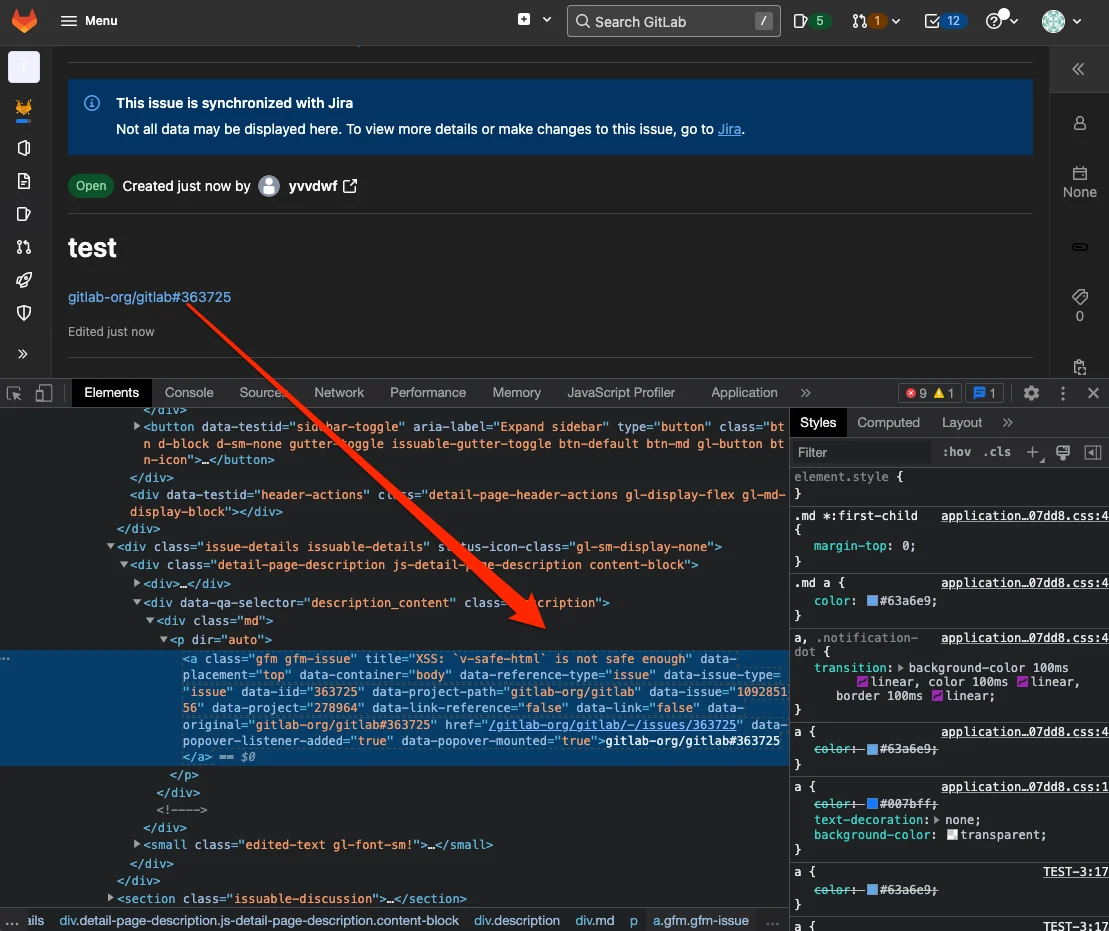
victim/project-a#1to view its source code. You should see the title of the issue created by the victim. - Below is an example when I used
gitlab-org/gitlab#363725as payload which is used to track one of my H1 reports.
Impact
This vulnerability allows to renders all GFM references, such as, merged requests, issues, etc, even if they are private or confidential.
For example, attackers can simply scan through all issue numbers (starting from 1) of the gitlab-org/gitlab project, and thus leaking their titles.
Best regards,
yvvdwf
Impact
This vulnerability allows attacker to access to all private or confidential GFM references, such as, merged requests, issues, etc.
For example, attackers can simply scan through all issue numbers (starting from 1) of the gitlab-org/gitlab project, and thus leaking their titles.
Impact
This vulnerability allows attacker to access to all private or confidential GFM references, such as, merged requests, issues, etc.
For example, attackers can simply scan through all issue numbers (starting from 1) of the gitlab-org/gitlab project, and thus leaking their titles.
Attachments
Warning: Attachments received through HackerOne, please exercise caution!
How To Reproduce
Please add reproducibility information to this section:
Not written yet. The AI write-up for this report has not been written yet. The Original tab links to the source.
How it worked
Root cause
Likely the Jira GFM pipeline rendered references without checking the viewer's permission to see the referenced resource.
Impact
An attacker could leak the titles of all private or confidential GFM references, such as issues and merge requests, by scanning issue numbers.
What the attacker needed
Premium subscription (free trial works); a Jira server or cloud instance; victim has a private project with issues
How it was found
- As a victim, create a private project and a confidential issue in it.
- As an attacker with a premium subscription, enable the Jira integration in a project.
- In Jira, create an issue whose description contains the victim's issue reference.
- In GitLab, view the Jira issue and inspect the link to see the victim's issue title.
Explained by bugbounty.wiki with AI from the original and checked against quotes from it; it can still be wrong. Read the original before relying on a detail.
Not written yet. The AI write-up for this report has not been written yet. The Original tab links to the source.
GitLab can show Jira issues inside its interface. When it does, it turns special references like 'project#1' into links with the issue title. The problem was that it did this even for private issues the viewer should not see, so an attacker could learn the title of a private issue by putting its reference in a Jira description.
What is Info disclosure?
Data the application should keep private (personal data, internal details, other users' records) reaches someone it should not.




