Discloses private groups in service desk emails while transfering the (public) projects.
When a public project was transferred to a private group, replies to service desk emails disclosed the private group's name. An attacker who had previously exchanged service desk emails with the project could learn the private group name.

GitLab
Originally disclosed on GitLab
- Fixed in 3 months
- Disclosed after 3 months
HackerOne report #602515 by uzsunny on 2019-06-06, assigned to jmatos_bgtvf:
Summary
While transferring the public projects the private groups will be disclosed in service desk emails.
Steps to reproduce
Go to gitlab.com create public project in your own profile
my user name is hack2hackgitab i created the project at https://gitlab.com/hack2hackgitab/test-project-hackerone-gitlab/
Encourage users to submit service desk emails.
In service desk emails reply from victim side to the attacker. and save the email for future attack.
Next victim tries to transfer his project to any private group and in real scenario the public project becomes private when you transfer the public project to private group.
Now victim transfers his public project to private group https://gitlab.com/private-test-group-hackerone/test-project-hackerone-gitlab
after transferring when you reply to the attackers service desk emails the private group is getting disclosed.
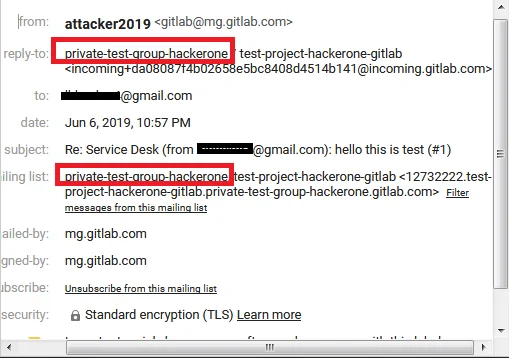
By this attacker can view the private group names in service desk emails after transferring the public project to private groups.
And from next time if the user transfers his project from one private group another group. The private groups also disclosed.
Impact
The attacker will able to disclose the private group names in service desk emails when the public project is transferred to private group.
Attachments
Warning: Attachments received through HackerOne, please exercise caution!
Not written yet. The AI write-up for this report has not been written yet. The Original tab links to the source.
How it worked
Root cause
Likely the service desk email reply template included the project's new namespace (the private group) without checking whether the recipient should see it.
Impact
An attacker could disclose private group names in service desk emails when a public project is transferred to a private group.
What the attacker needed
Victim has a public project; attacker has exchanged service desk emails; victim transfers project to a private group
How it was found
- Create a public project in your own profile.
- Encourage users to submit service desk emails and reply from the victim side, saving the email.
- The victim transfers the public project to a private group.
- After transferring, reply to the attacker's service desk emails and the private group is disclosed.
Explained by bugbounty.wiki with AI from the original and checked against quotes from it; it can still be wrong. Read the original before relying on a detail.
Not written yet. The AI write-up for this report has not been written yet. The Original tab links to the source.
A service desk email is an email address that creates issues in a GitLab project. When a project is moved into a private group, the group's name should stay secret. But the email replies still showed the private group's name, so someone who had emailed the project before could find it out.
What is Info disclosure?
Data the application should keep private (personal data, internal details, other users' records) reaches someone it should not.




