Read any repo file (incl. private ones) via postMessage on both gitlab.com/self-hosted instance (bypass #1417680)
A cross-site scripting flaw in GitLab's Live Preview sandbox allowed an attacker to bypass a previous postMessage source check and read files from a victim's private repository. The attacker could steal source code and sensitive files such as .gitlab-ci.yml containing API keys or SSH keys.

GitLab
Originally disclosed on GitLab
- Fixed in 4 months
- Disclosed after 4 months
HackerOne report #1699831 by niraeth on 2022-09-14, assigned to GitLab Team:
Report | Attachments | How To Reproduce
Report
Summary
An attacker can use a specially crafted webpage to read the content of a victim's repo via postMessage when the victim uses the Live Preview feature.
The attack vector and impact is the same as report #1417680 or CVE-2022-2907 . Although it was fixed in the previous report, I have found a workaround/bypass for it.
Steps to reproduce
The reproduction below will be done on gitlab.com, but it works (and I have tested) for self-hosted instances as well. For self-hosted instances, you will need to manually enable the Live Preview feature for the exploit to work. You can follow the guide here to enable the feature.
Reproduce for gitlab.com:
- Login to https://gitlab.com using the credentials: email
[email protected]and password89J6\U^_tV?/yY7X - Go to the poc page at https://exploits.niraeth.com/sites/gitlab/postMessage%20readFile%202/readFile%203499E693D443B4E6ED4CE8D0F815F991.html
- Follow instructions on the poc page.
Reproduce for your own instance:
- Download the HTML file :
- Modify the URL shown below

- Follow the instructions above (
Reproduce for gitlab.com)
Vulnerable Code / Bypass Details
First, take a look at the fix implemented from the previous report. You can see below that it checks for the message's source, to check that it comes from this.frameWindow. this.frameWindow is an iframe that points to https://sandbox-prod.gitlab-static.net/. $id is now also checked against this.channelId (a random int from 100000-999999)
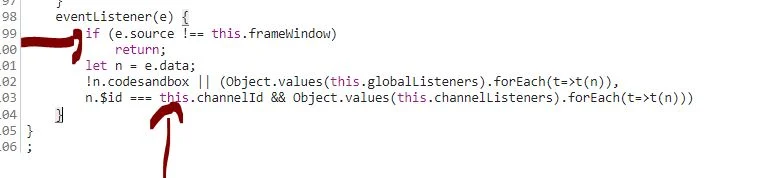
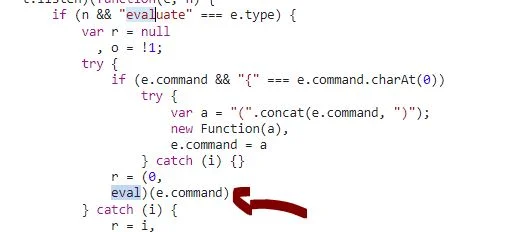
However, because there is a XSS vulnerability at https://sandbox-prod.gitlab-static.net/, an attacker can use this XSS to call postMessage and bypass the source check. The said XSS can be triggered via postMessage due to vulnerable code shown below
- This is the
messageevent listener

- Eventually, the code below gets executed. The XSS is executed by the line
eval(e.command)
Impact
- Read files of private repo - steal source code etc
- Read sensitive files such as .gitlab-ci.yml which is almost guaranteed to contain things like api keys, ssh keys that are necessary for the pipeline to work. This would then enable an attacker to further their attack, e.g gaining remote access to a server.
Examples
The repo used for this PoC is available at https://gitlab.com/nicgene/vue-todo . However, any other project/repo that is properly configured for the Live Preview feature would work too.
Note that the above repo is not controlled by me.
What is the current bug behavior?
Attacker is able to read repo files
What is the expected correct behavior?
The attacker should not be able to communicate with the message event listener.
Relevant logs and/or screenshots
Nil. Refer to the section Vulnerable Code / Bypass Details for screenshots of the affected code
Output of checks
This bug happens on GitLab.com and Self Hosted GitLab
Results of GitLab environment info
System information
System:         Ubuntu 20.04
Current User:   git
Using RVM:      no
Ruby Version:   2.7.5p203
Gem Version:    3.1.6
Bundler Version:2.3.15
Rake Version:   13.0.6
Redis Version:  6.2.7
Sidekiq Version:6.4.0
Go Version:     unknown

GitLab information
Version:        15.3.3
Revision:       c629a47f87f
Directory:      /opt/gitlab/embedded/service/gitlab-rails
DB Adapter:     PostgreSQL
DB Version:     13.6
URL:            http://ec2-13-228-76-134.ap-southeast-1.compute.amazonaws.com
HTTP Clone URL: http://ec2-13-228-76-134.ap-southeast-1.compute.amazonaws.com/some-group/some-project.git
SSH Clone URL:  [email protected]:some-group/some-project.git
Using LDAP:     no
Using Omniauth: yes
Omniauth Providers:

GitLab Shell
Version:        14.10.0
Repository storage paths:
- default:      /var/opt/gitlab/git-data/repositories
GitLab Shell path:              /opt/gitlab/embedded/service/gitlab-shell
Impact
Mentioned in the report.
Attachments
Warning: Attachments received through HackerOne, please exercise caution!
- fix_from_prev_report.JPG
- cframe_-_2-_eval.JPG
- cframe_-1-_message_listener.JPG
- URL_to_be_modified.JPG
- readFile_3499E693D443B4E6ED4CE8D0F815F991.html
How To Reproduce
Please add reproducibility information to this section:
Not written yet. The AI write-up for this report has not been written yet. The Original tab links to the source.
How it worked
Root cause
Likely the sandbox page at sandbox-prod.gitlab-static.net used eval on a command received via postMessage without proper validation, allowing an attacker to execute JavaScript in the sandbox origin and bypass the source check in the parent page.
Impact
An attacker could read files from a victim's private repository, including sensitive files like .gitlab-ci.yml that may contain API keys or SSH keys, potentially leading to further compromise.
What the attacker needed
Victim uses Live Preview feature; victim visits attacker's webpage; self-hosted: Live Preview manually enabled
How it was found
- Log in to gitlab.com with the provided credentials.
- Visit the attacker's proof-of-concept page.
- Follow the instructions on the page to trigger the attack.
Explained by bugbounty.wiki with AI from the original and checked against quotes from it; it can still be wrong. Read the original before relying on a detail.
Not written yet. The AI write-up for this report has not been written yet. The Original tab links to the source.
When you use GitLab's Live Preview, your browser talks to a separate sandbox website to show your code. The report found that this sandbox website had a bug that let an attacker run their own code inside it. That let the attacker pretend to be the sandbox and ask GitLab for your private files, which they could then steal.
What is XSS?
Script an attacker supplies runs in another user's browser, on the target's origin, with that user's session.


