CVE-2022-42710: A journey through XXE to Stored-XSS
The application parses an uploaded XML file with simplexml_load_file and echoes the content of a background tag without sanitisation, allowing stored cross-site scripting. An attacker could upload a crafted XML file and then load it via a path traversal in the tpl parameter to execute script in a victim's browser.
 Published on omar0x01.medium.com
The Linear eMerge E3 Series is one of the industry leading products in building management systems as it is one of the most widely used products in the industry which is used for control
The full write-up lives on its author's site
It belongs to its author, so we link to it rather than copy it. The other two tabs are our own rewrites, checked against it.
Context
The target of this research is the Linear eMerge E3 Series, a building management system. The write-up describes it as one of the industry leading products in that market and lists the kinds of sites where it is deployed: school districts and campuses (K12 and higher education), corporate campuses, state and local government buildings such as civic centres, city halls, police stations and jails, public utilities, transportation sites such as airports, subway and bus depots, places of worship, and medical facilities including hospitals, pharma and bio labs.
The feature under review is the badge template printing script, badge_template_print.php, which lives under the badging directory. It takes a template name from the user, loads the corresponding file as XML and renders parts of it. The vulnerability that came out of this review is CVE-2022-42710, found through static analysis of the PHP source.
Setup
The work was done as a source code review of the application's PHP scripts, with the code running locally: every URL in the write-up points at [redacted]. No accounts, roles or special tooling are described beyond reading the source and requesting the scripts. The relevant configuration detail is that TPL_DIR in the configuration file is set to tpl/, so template files are expected to live in a tpl subdirectory relative to the badging scripts.
Finding it
The template loader
While reviewing the source, the researcher came across this script:
http://[redacted]/badging/badge_template_print.php
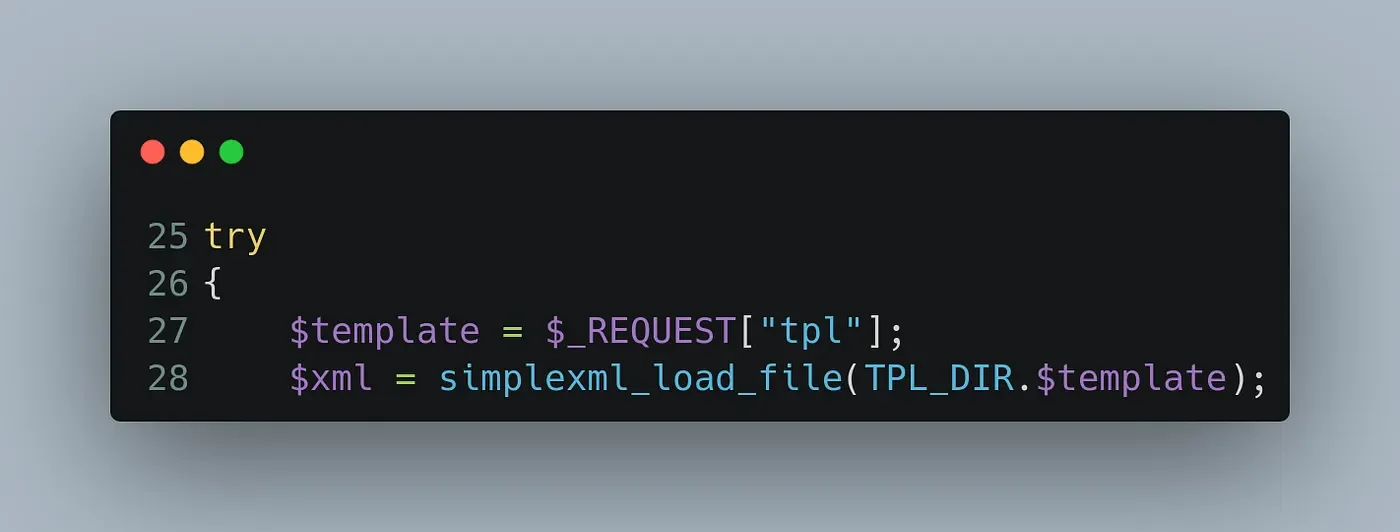
The script takes the tpl parameter from the user and passes it to simplexml_load_file, so the user's input is parsed by the XML parser. At first glance this does not look like XXE, because XXE through external entity substitution requires the LIBXML_NOENT flag, which is what substitutes external entities. The write-up gives this as an example of code that would be vulnerable:
try{ $template = $_REQUEST["tpl"]; $xml = simplexml_load_file(TPL_DIR.$template, 'SimpleXMLElement', LIBXML_NOENT);
That is not the scenario here, so on that basis the product was not vulnerable to XXE at this point.
Chasing the parser version
The researcher then gathered more information about the XML parser library in use.
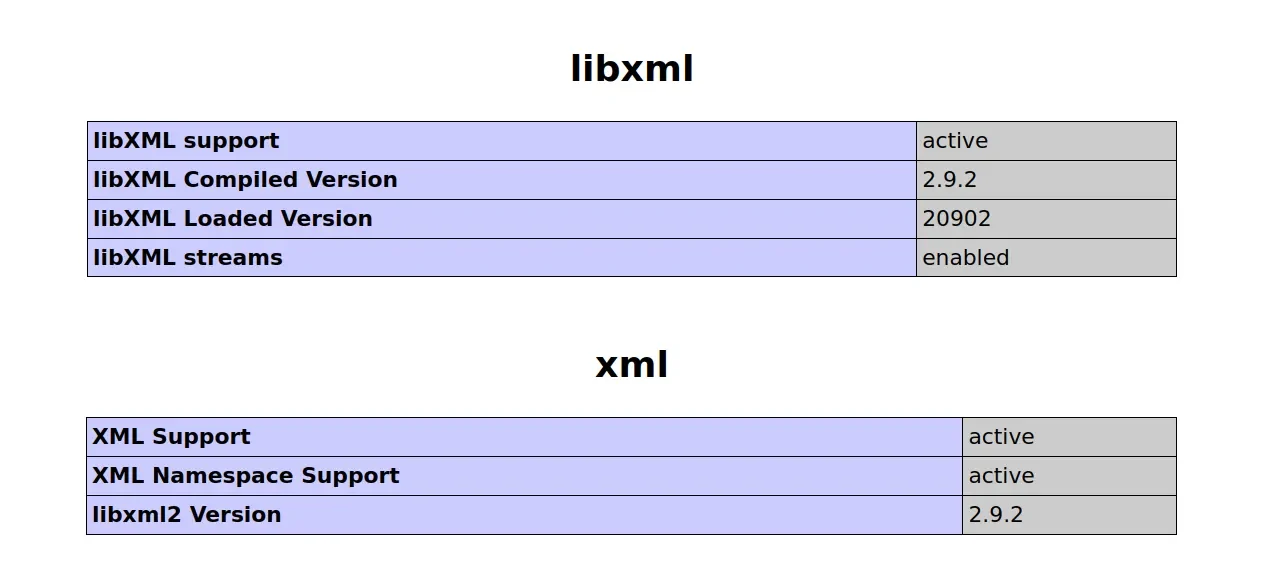
The libxml version in the application is not vulnerable to XXE by external entity substitution by default in its latest releases, but the version in use looked somewhat old, so the next step was to search for it on CVE Details to see whether there was an exploitation path or some way to abuse the function. Some exploits were found, but they did not match the configuration of the application and did not lead to any vulnerability. The write-up notes that this step matters in static code analysis because it sometimes leads to critical findings, and cites a comparable case: a researcher reviewing a Java application found that the developers used an XML parser library that allows external entity substitution by default, which led to XXE (CVE-2017-1000190).
For this specific version nothing was found, and the only way to get external entity substitution is to add the LIBXML_NOENT flag to simplexml_load_file. The product is therefore not vulnerable to XXE.
What the parser output is used for
Returning to the template script, the underlined code shows how the XML data is parsed.
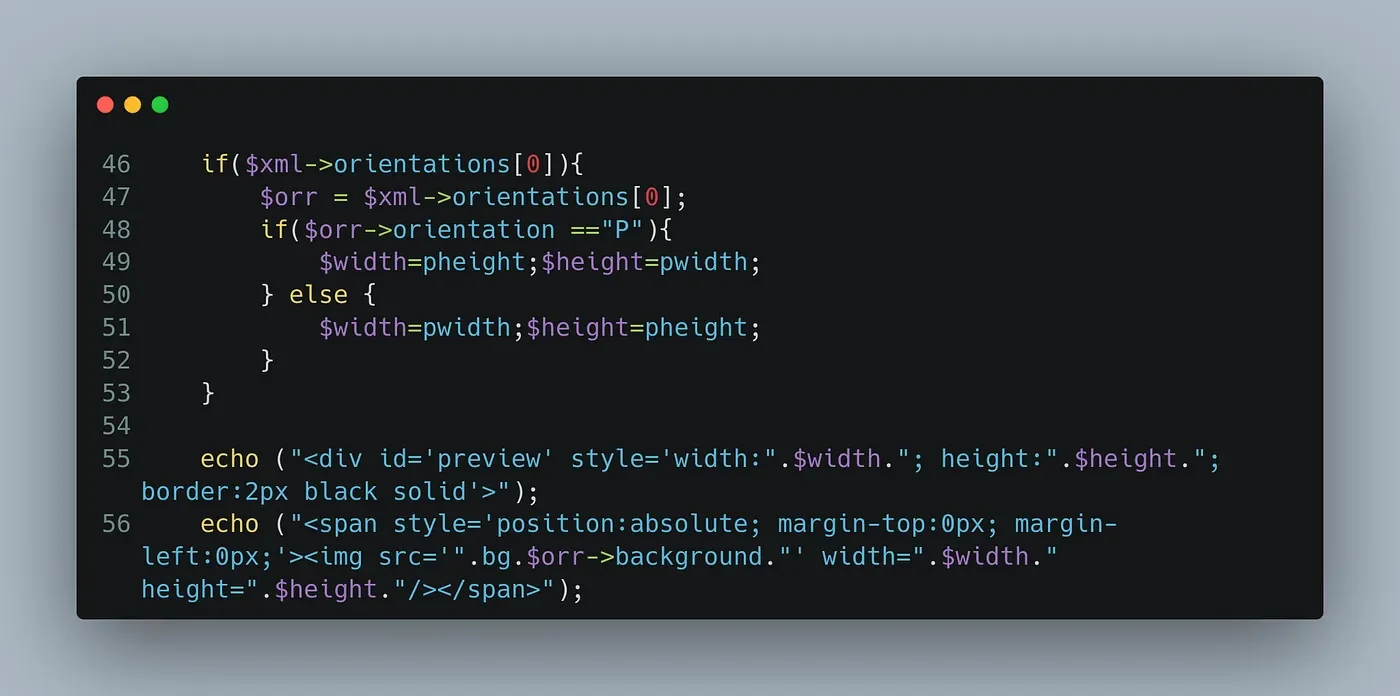
The application takes a file as input, parses it with the XML parser and saves the result in the $xml variable. The input file must contain an orientations tag, and inside it two tags, orientation and background. At line 56, whatever is inside the background tag is printed. That print is the sink: whatever is inside the background tag is printed.
Exploitation
Step 1: build the XML payload
To get XSS, the file must first declare the <xml> tag so the parser knows it is parsing an XML file, then define <orientations> as the PHP code expects, and inside it the two tags: <orientation> and <background>. The background tag carries the XSS payload, which is printed through the echo function. The final payload looks like this:
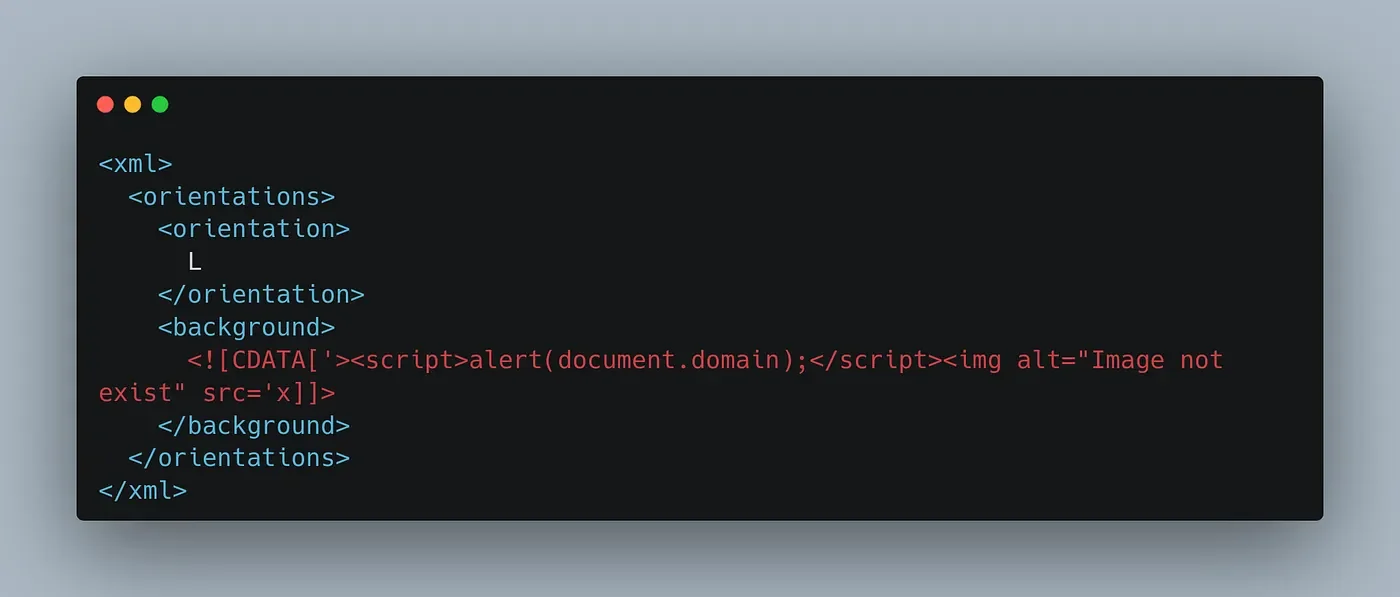
exploit
CDATA is used to tell the parser that that section of the document contains no markup and should be treated as regular text rather than parsed as XML. The reason for wrapping the payload this way is to make the parser treat the <script> tag as text inside the background tag, which is later printed by the application.
Step 2: find a way to upload the file
The next question is how to get the XML file containing the exploit onto the server. Researching the application turned up another PHP script:
http://[redacted]/badging/person_funct.php
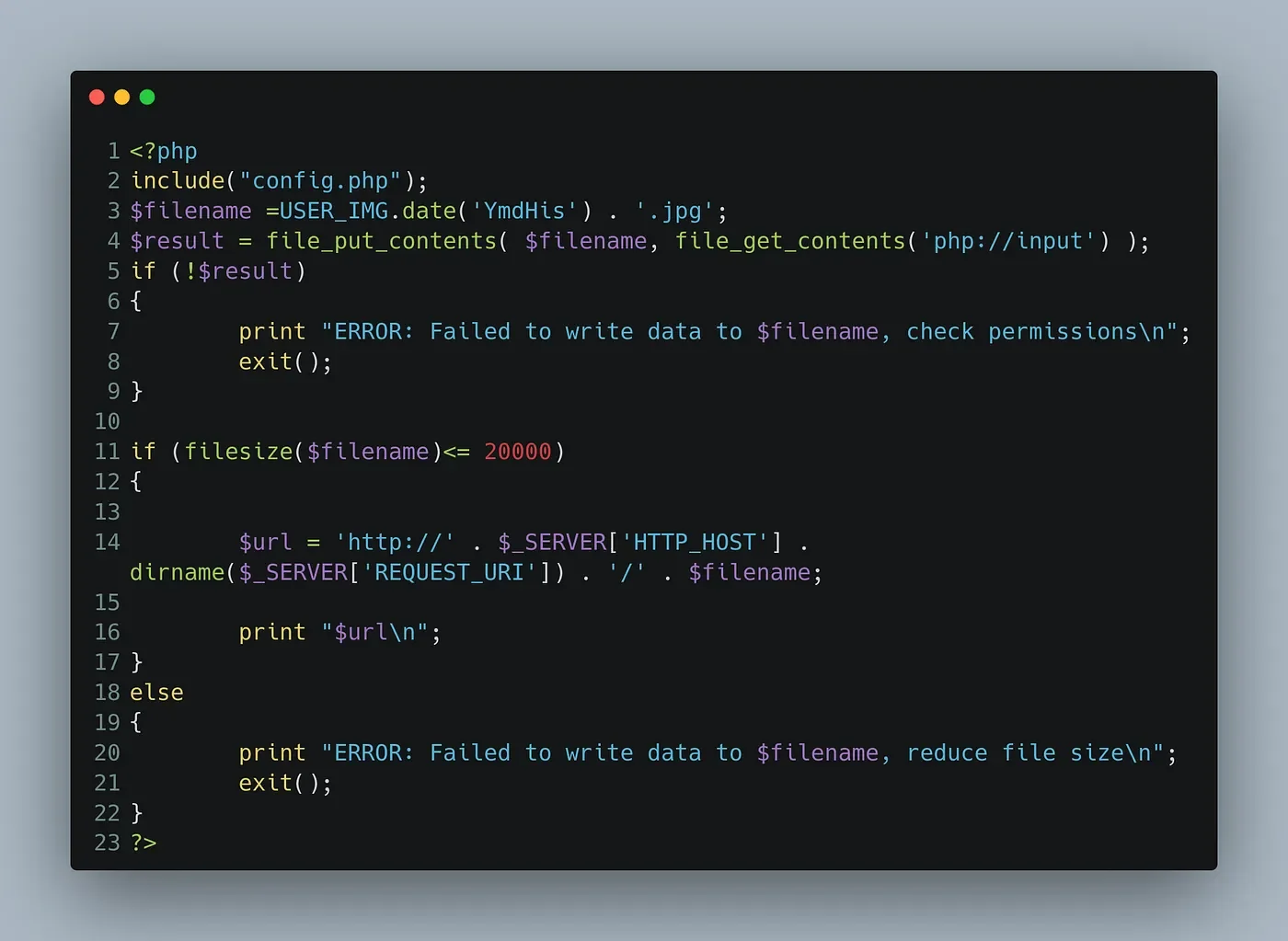
This is a file upload function. It validates the size to prevent a denial of service attack, names the file with the time of upload to prevent XSS in the filename, and forces a .jpg extension to prevent uploading a malicious extension. The write-up notes there are some best practices in this script but moves on to more important things.
Step 3: upload the exploit despite the extension check
The exploit file is exploit.xml, but the application forces a .jpg extension. This does not matter, because the XML parser used by simplexml_load_file() does not care about the file extension; all it cares about is the file syntax. The exploit is therefore uploaded through the person_funct.php script.
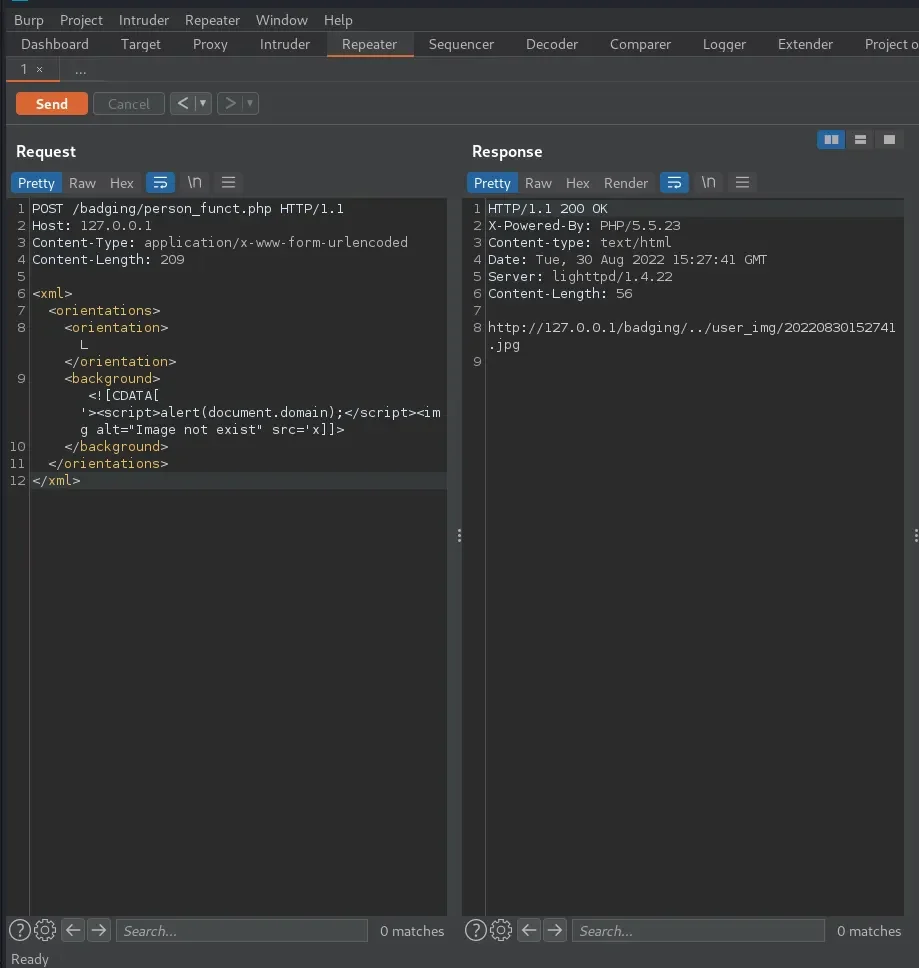
Upload our expolit request
The uploaded exploit ends up at:
http://[redacted]/user_img/20220830152741.jpg
Step 4: reach the uploaded file from the template loader
The uploaded file is now requested through the tpl parameter of badge_template_print.php. The obstacle is that the exploit sits in the user_img directory, while the vulnerable function loads files from the /badging/tpl/ directory. Directory traversal solves this: ../../user_img moves out of http://[redacted]/badging/tpl/ and into http://[redacted]/user_img, where the exploit is located.
http://[redacted]/badging/badge_template_print.php?idt=1&tpl=../../user_img/20220830152741.jpg
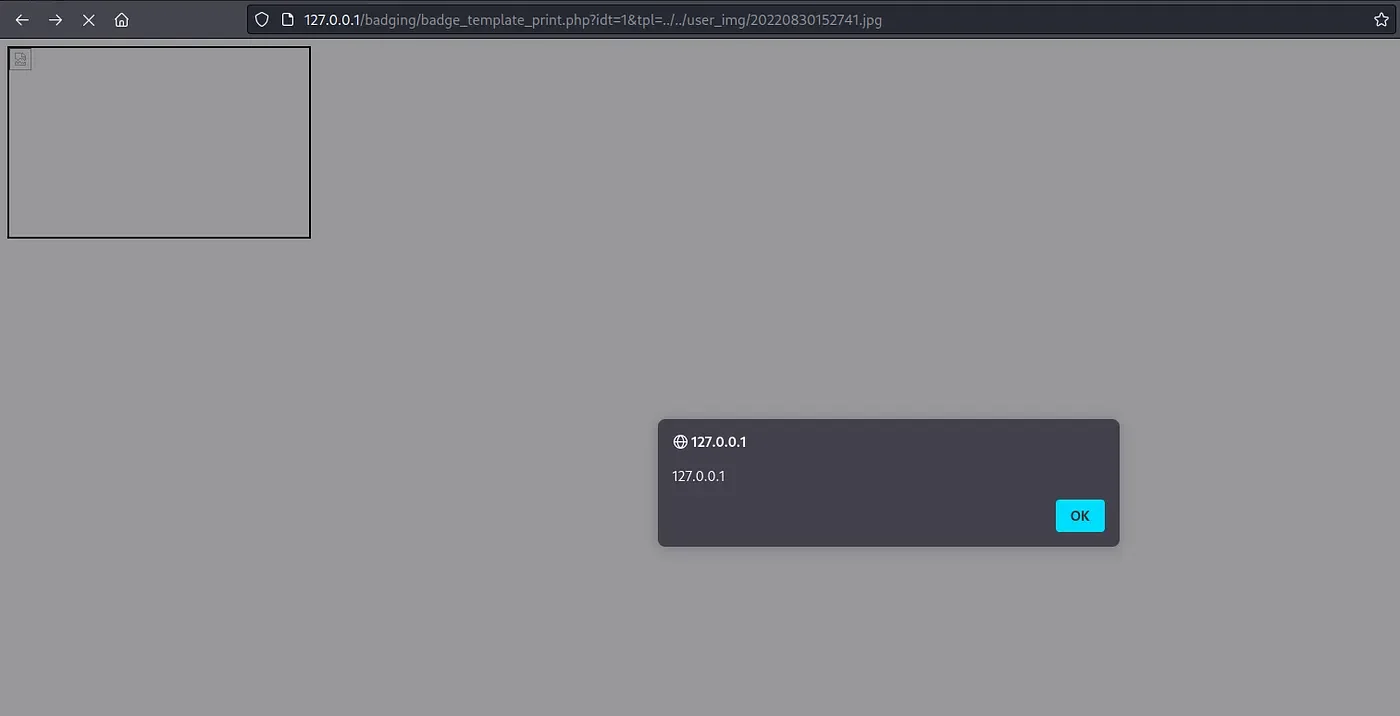
The result is stored XSS.
Automated exploit
The write-up points to an automated exploit script published at https://github.com/omarhashem123/Security-Research/tree/main/CVE-2022-42710.
Root cause
The template loader concatenates the user-controlled tpl parameter onto TPL_DIR and hands the result to simplexml_load_file, then echoes the contents of the background element without encoding. Two separate weaknesses combine:
- Path traversal in the template path. The
tplvalue is not constrained to thetpl/directory, so../../user_img/...escapes it and loads a file the attacker controls. - Unescaped output of parsed XML. Whatever sits inside
backgroundis printed directly, so markup in the XML becomes markup in the page.
The upload script's defences do not stop the chain. The size check addresses denial of service, the timestamped filename addresses XSS through the filename, and the forced .jpg extension addresses malicious extensions. None of them addresses the content of the file, and the XML parser only looks at syntax, not at the extension. The XXE angle was investigated and ruled out: without LIBXML_NOENT, external entity substitution does not happen, and no usable exploit for the parser version in use was found.
Impact
The write-up's demonstrated result is stored XSS: a file uploaded through the upload function is later loaded as an XML template and its background content is echoed into the page. The write-up does not go further into which users or roles view that page, nor into what the script could do once it runs.
Fix
The write-up does not describe a fix or a patch. Based on the two weaknesses above, the changes that would address them are: constrain the tpl parameter so it cannot escape TPL_DIR (for example by resolving the path and rejecting anything outside the template directory, or by accepting only known template names), and HTML-encode the value taken from the background element before echoing it, so that markup in the XML is rendered as text.
Variants to test
- Template loaders that concatenate a directory with a user parameter. Try values containing
../sequences and absolute paths. A positive result is the application loading a file from outside the intended template directory. - XML parsed from user-supplied files whose elements are echoed. Submit XML with markup inside the elements that get printed. A positive result is the markup appearing unencoded in the response.
- Upload functions that enforce an extension but not content. Upload a syntactically valid XML file with a
.jpgname and then feed it to any parser that reads it by path. A positive result is the parser accepting the file and processing its XML structure. simplexml_load_filecall sites withoutLIBXML_NOENT. Check whether the parser version in use has a documented external entity issue that applies to the configuration. A positive result is a working external entity reference in the parsed output; the write-up found none for this version.- Filename-based XSS defences. Where uploads are renamed with a timestamp, check whether the original filename is reflected anywhere else in the application. A positive result is the original name appearing unencoded in a response.
What happened, in plain words
A security researcher read the source code of a building management product called Linear eMerge E3 Series and found a stored XSS bug, tracked as CVE-2022-42710. The bug is tracked as CVE-2022-42710. The researcher found it by reading the code, not by poking at a live website, and this article walks through the same steps at a beginner's pace.
Before the details, a few ideas you will need.
- Source code is the set of instructions that make up a program, written by developers in a language such as PHP. Reading it is called source code review or static analysis: you study the code without running it, looking for places where it trusts input it should not trust.
- A web server is the computer that stores a website and answers requests from browsers. When you type an address, your browser sends a request and the server sends back a page.
- PHP is a programming language commonly used to build the server side of websites. A PHP script is a file the server runs when a browser asks for it.
- A parameter is a piece of information a browser sends along with a request, usually visible in the address after a question mark, for example
?name=value. The server-side script reads it and acts on it. If the script does not check that value carefully, an attacker can put something unexpected there. - XML is a text format for structured data, built from tags in angle brackets, much like HTML. A file can describe a list of items, a configuration, or a template.
- An XML parser is the piece of software that reads an XML file and turns its tags into something the program can use. Think of it as a translator: you hand it a document, it hands back a structured object.
- XSS (Cross-Site Scripting) is a vulnerability where an attacker gets their own script into a page that other people view. The victim's browser cannot tell that the script did not come from the site, so it runs it with the site's permissions. A stored XSS is the worse kind: the malicious content is saved on the server (stored) and served to every visitor, rather than being crafted into a single link.
- XXE (XML External Entity) is a vulnerability of XML parsers. XML has a feature called entities, which are named placeholders that the parser can expand into other content, including the contents of files on the server. If a parser expands such an entity when it should not, an attacker can make the server read files or make network requests. XXE is a close cousin of what this article is about, and the researcher checks for it along the way.
- CVE is a public catalogue number for a known vulnerability, so that everyone can refer to the same bug unambiguously.
The product
The Linear eMerge E3 Series is a building management system: software used to control access to buildings. The write-up calls it one of the industry leading products in that market and lists where it is deployed:
- school districts and campuses (K12 and higher education)
- corporate campuses
- state and local government buildings such as civic centres, city halls, police stations and jails
- public utilities
- transportation sites such as airports, subway and bus depots
- places of worship
- medical facilities including hospitals, pharma and bio labs
That list matters because it tells you the stakes.
The feature under review is the badge template printing script, badge_template_print.php, which sits in the badging directory. A badge template is the layout used to print an ID badge: where the photo goes, what the background looks like, and so on. The script takes a template name from the user, loads the matching file as XML, and renders parts of it. The vulnerability that came out of the review is CVE-2022-42710, found by reading the PHP source.
Setting up
The work was a source code review of the application's PHP scripts, with the code running locally. Every address in the write-up points at [redacted], which is the special address a computer uses to talk to itself (often called localhost). In other words, the researcher ran a copy of the application on their own machine and read its files. No accounts, roles or special tools are described beyond reading the source and requesting the scripts.
One configuration detail matters. In the configuration file, TPL_DIR is set to tpl/. TPL_DIR is simply a setting that says where template files live: in a tpl subdirectory next to the badging scripts. Keep that in mind, because the whole exploit depends on where that directory sits relative to other directories.
Finding it
The template loader
While reviewing the source, the researcher came across this script:
http://[redacted]/badging/badge_template_print.php
The script takes the tpl parameter from the user and passes it to simplexml_load_file, so the user's input is parsed by the XML parser. In plain terms: the browser says "use this template", the script glues that name onto the template directory, and the XML parser opens the resulting file.
At first glance this does not look like XXE, because XXE through external entity substitution requires the LIBXML_NOENT flag. A flag here is an option passed to a function to change its behaviour. LIBXML_NOENT is the option that tells the parser to substitute external entities, that is, to replace a named placeholder with content from outside the document. Without that option, the parser leaves such placeholders alone, and the XXE trick does not work. The write-up gives this as an example of code that would be vulnerable:
try{ $template = $_REQUEST["tpl"]; $xml = simplexml_load_file(TPL_DIR.$template, 'SimpleXMLElement', LIBXML_NOENT);
Line by line:
try{starts a block in which errors can be caught rather than crashing the script.$template = $_REQUEST["tpl"];reads the value the user sent astpland stores it in a variable called$template.$_REQUESTis PHP's way of collecting values sent by the browser.$xml = simplexml_load_file(TPL_DIR.$template, 'SimpleXMLElement', LIBXML_NOENT);builds a path by gluingTPL_DIRand the user's value together, loads that file as XML, and stores the parsed result in$xml. The third argument,LIBXML_NOENT, is the dangerous option.
That is not the scenario here, so on that basis the product was not vulnerable to XXE at this point. The researcher did not stop there, though.
Chasing the parser version
The researcher then gathered more information about the XML parser library in use.
A library is a bundle of ready-made code that a program uses instead of writing everything itself. The XML parser here is a library called libxml. The libxml version in the application is not vulnerable to XXE by external entity substitution by default in its latest releases, but the version in use looked somewhat old. Old software is a classic source of trouble: bugs fixed in newer versions may still be present in the old one.
So the next step was to search for that version on CVE Details, a public website that lists known vulnerabilities, to see whether there was an exploitation path or some way to abuse the function. Some exploits were found, but they did not match the configuration of the application and did not lead to any vulnerability. In other words, the published tricks assumed settings or conditions this application did not have.
The write-up notes that this step matters in static code analysis because it sometimes leads to critical findings, and cites a comparable case: a researcher reviewing a Java application found that the developers used an XML parser library that allows external entity substitution by default, which led to XXE (CVE-2017-1000190). The lesson is that the same function call can be safe or dangerous depending on the library and its defaults.
For this specific version nothing was found, and the only way to get external entity substitution is to add the LIBXML_NOENT flag to simplexml_load_file. The product is therefore not vulnerable to XXE. That door is closed, but the researcher keeps looking at what the parsed file is used for.
What the parser output is used for
Returning to the template script, the underlined code shows how the XML data is parsed.
The application takes a file as input, parses it with the XML parser and saves the result in the $xml variable. The input file must contain an orientations tag, and inside it two tags, orientation and background. At line 56, whatever is inside the background tag is printed. That print is the sink: the place where data ends up in the page. If the data is printed without being treated as plain text, any markup inside it becomes live markup in the browser.
Think of it like a noticeboard. If the person pinning notices treats every sheet as a picture and hangs it up, fine. If they instead copy whatever is written on the sheet onto the board as instructions, then a sheet saying "ignore the previous notice and do this instead" gets followed. The echo at line 56 copies the content of background into the page as instructions, not as a picture.
Exploitation
Step 1: build the XML payload
A payload is the piece of content an attacker crafts to trigger the bug. To get XSS, the file must first declare the <xml> tag so the parser knows it is parsing an XML file, then define <orientations> as the PHP code expects, and inside it the two tags: <orientation> and <background>. The background tag carries the XSS payload, which is printed through the echo function. The final payload looks like this:
exploit
CDATA is used to tell the parser that that section of the document contains no markup and should be treated as regular text rather than parsed as XML. The reason for wrapping the payload this way is to make the parser treat the <script> tag as text inside the background tag, which is later printed by the application.
Why does that matter? If you put a <script> tag straight into an XML file, the XML parser sees a tag it does not recognise and may reject the file or mangle it. CDATA is a wrapper that says "everything inside here is characters, not structure". The parser therefore hands the script through untouched, and the PHP echo later writes it into the HTML page, where the browser does treat it as a script. The same text is inert to one program and active to another, and that mismatch is the whole trick.
Step 2: find a way to upload the file
The next question is practical: how do you get the XML file containing the exploit onto the server? An attacker cannot usually drop files into arbitrary directories. Researching the application turned up another PHP script:
http://[redacted]/badging/person_funct.php
This is a file upload function. It validates the size to prevent a denial of service attack, names the file with the time of upload to prevent XSS in the filename, and forces a .jpg extension to prevent uploading a malicious extension. The write-up notes there are some best practices in this script but moves on to more important things.
Unpack those three defences, because each one is a sensible idea that turns out not to cover the actual problem:
- Size validation. A denial of service attack is one where an attacker does not steal anything but makes the service unusable, for example by filling the disk with huge uploads. Limiting size blocks that.
- Timestamped filename. If the server keeps the name the user supplied, an attacker can name a file something like
<script>..., and any page that later shows the name could run it. Renaming the file to the time of upload removes that risk. - Forced
.jpgextension. An extension is the part of a filename after the dot, such as.jpgor.php. Servers often decide how to handle a file by its extension, so forcing.jpgstops someone uploading a.phpfile that the server would then execute.
All three are about the file's size, name and extension. None of them is about the file's content.
Step 3: upload the exploit despite the extension check
The exploit file is exploit.xml, but the application forces a .jpg extension. This does not matter, because the XML parser used by simplexml_load_file() does not care about the file extension; all it cares about is the file syntax. The exploit is therefore uploaded through the person_funct.php script.
Upload our expolit request
This is the key insight of the whole chain. The upload script is guarding one door (what the file is called) while the template script opens the file through another door (what the file contains). A file named something.jpg that contains valid XML is still valid XML to the parser. The extension is a label, not a guarantee.
The uploaded exploit ends up at:
http://[redacted]/user_img/20220830152741.jpg
The name is the timestamp the upload script assigned, with the forced .jpg extension, and it sits in the user_img directory.
Step 4: reach the uploaded file from the template loader
The uploaded file is now requested through the tpl parameter of badge_template_print.php. The obstacle is that the exploit sits in the user_img directory, while the vulnerable function loads files from the /badging/tpl/ directory. Directory traversal solves this.
Directory traversal (also called path traversal) means putting ../ sequences into a path. In a file path, .. means "the directory above this one". So ../../user_img moves out of http://[redacted]/badging/tpl/ and into http://[redacted]/user_img, where the exploit is located. It is like being told to fetch a document from the filing cabinet in room 3, and instead walking two rooms down the corridor to a cabinet you control.
http://[redacted]/badging/badge_template_print.php?idt=1&tpl=../../user_img/20220830152741.jpg
Reading that address piece by piece:
http://[redacted]/badging/badge_template_print.phpis the vulnerable template script.?starts the list of parameters.idt=1is another parameter the script expects; the write-up includes it in the request without explaining what it does.&separates parameters.tpl=../../user_img/20220830152741.jpgis the template name. Instead of a name insidetpl/, it climbs two levels up and points at the uploaded file.
The result is stored XSS. The server loads the attacker's file as an XML template, takes the content of the background element, and echoes it into the page. The write-up does not go further into which users or roles view that page, nor into what the script could do once it runs.
Automated exploit
The write-up points to an automated exploit script published at https://github.com/omarhashem123/Security-Research/tree/main/CVE-2022-42710. An exploit script is a program that performs the steps above automatically, so you do not have to send each request by hand.
Root cause
The template loader concatenates the user-controlled tpl parameter onto TPL_DIR and hands the result to simplexml_load_file, then echoes the contents of the background element without encoding. Encoding here means converting characters such as < and > into harmless text so the browser displays them instead of acting on them. Two separate weaknesses combine:
- Path traversal in the template path. The
tplvalue is not constrained to thetpl/directory, so../../user_img/...escapes it and loads a file the attacker controls. - Unescaped output of parsed XML. Whatever sits inside
backgroundis printed directly, so markup in the XML becomes markup in the page.
Either weakness alone is a problem; together they form a chain. The first lets the attacker choose which file is read. The second turns the content of that file into live code in the browser.
The upload script's defences do not stop the chain. The size check addresses denial of service, the timestamped filename addresses XSS through the filename, and the forced .jpg extension addresses malicious extensions. None of them addresses the content of the file, and the XML parser only looks at syntax, not at the extension. The XXE angle was investigated and ruled out: without LIBXML_NOENT, external entity substitution does not happen, and no usable exploit for the parser version in use was found.
Impact
The demonstrated result is stored XSS: a file uploaded through the upload function is later loaded as an XML template and its background content is echoed into the page. Because the payload is stored on the server and served from the application's own origin, it runs in the browser of whoever views the rendered badge template.
Fix
The write-up does not describe a fix or a patch. Based on the two weaknesses above, the changes that would address them are: constrain the tpl parameter so it cannot escape TPL_DIR (for example by resolving the path and rejecting anything outside the template directory, or by accepting only known template names), and HTML-encode the value taken from the background element before echoing it, so that markup in the XML is rendered as text.
Variants to test
If you want to look for similar bugs in other software, these are the patterns worth trying. Each one names what to do and what a positive result looks like.
- Template loaders that concatenate a directory with a user parameter. Try values containing
../sequences and absolute paths. A positive result is the application loading a file from outside the intended template directory. - XML parsed from user-supplied files whose elements are echoed. Submit XML with markup inside the elements that get printed. A positive result is the markup appearing unencoded in the response.
- Upload functions that enforce an extension but not content. Upload a syntactically valid XML file with a
.jpgname and then feed it to any parser that reads it by path. A positive result is the parser accepting the file and processing its XML structure. simplexml_load_filecall sites withoutLIBXML_NOENT. Check whether the parser version in use has a documented external entity issue that applies to the configuration. A positive result is a working external entity reference in the parsed output; the write-up found none for this version.- Filename-based XSS defences. Where uploads are renamed with a timestamp, check whether the original filename is reflected anywhere else in the application. A positive result is the original name appearing unencoded in a response.
Glossary
- API: a defined way for one piece of software to ask another for something, like a service counter with set forms to fill in.
- Badge template: the layout file used to print an ID badge, defining what appears on it and where.
- CDATA: an XML wrapper that marks a section as plain text, so the parser does not treat angle brackets inside it as tags.
- CVE: a public catalogue number for a known vulnerability, so everyone can refer to the same bug unambiguously.
- CVE Details: a public website that lists known vulnerabilities and their details.
- Denial of service (DoS): an attack that makes a service unusable, for example by exhausting its disk or memory, rather than stealing data.
- Directory traversal (path traversal): putting
../sequences in a path to climb out of the intended directory and reach files elsewhere. - Echo: a PHP instruction that writes text into the page being sent to the browser.
- Encoding (HTML encoding): converting characters such as
<and>into harmless text so the browser displays them instead of acting on them. - Entity (XML): a named placeholder in an XML document that the parser can expand into other content, including files from the server.
- Exploit: the crafted input or program that triggers a vulnerability.
- Extension: the part of a filename after the dot, such as
.jpgor.php, often used by servers to decide how to handle the file. - Flag (function option): an option passed to a function to change its behaviour, such as
LIBXML_NOENT. - Library: a bundle of ready-made code a program uses instead of writing everything itself.
- libxml: the XML parser library used by PHP in this application.
- LIBXML_NOENT: the libxml option that tells the parser to substitute external entities, which is what makes XXE possible.
- Localhost ([redacted]): the special address a computer uses to talk to itself; a copy of the application running on the researcher's own machine.
- Parameter: a piece of information sent with a request, usually visible in the address after a question mark, such as
?tpl=value. - Payload: the piece of content an attacker crafts to trigger a bug.
- PHP: a programming language commonly used for the server side of websites.
- Sink: the place in code where data ends up in the page or another dangerous context; if it is not encoded there, the data becomes active.
- Source code: the instructions that make up a program, written by developers.
- Source code review (static analysis): studying source code without running it, looking for places where it trusts input it should not trust.
- Stored XSS: XSS where the malicious content is saved on the server and served to every visitor, rather than crafted into a single link.
simplexml_load_file: the PHP function that reads a file and parses it as XML.TPL_DIR: the configuration setting that says which directory template files live in, heretpl/.- Web server: the computer that stores a website and answers requests from browsers.
- XSS (Cross-Site Scripting): a vulnerability where an attacker gets their own script into a page other people view, and the browser runs it with the site's permissions.
- XXE (XML External Entity): a vulnerability where an XML parser expands an external entity it should not, letting an attacker read files or make network requests from the server.
- XML: a text format for structured data, built from tags in angle brackets.
- XML parser: the software that reads an XML file and turns its tags into something a program can use.