How I was able to reveal page admin of almost any page on Facebook
An IDOR vulnerability in Facebook's Android app allowed an attacker to change a page_id in a GraphQL request and receive the page admin's personal account ID in the broadcaster_id response parameter. This exposed private admin information for almost any page with live video.
 Published on medium.com
Hello there , I am Sudip Shah from Pokhara, Nepal(a 19 yo independent security researcher). I found a bug on Facebook for Android where I was able to leak any page admin’s personal account id through IDOR.
The full write-up lives on its author's site
It belongs to its author, so we link to it rather than copy it. The other two tabs are our own rewrites, checked against it.
Context
Sudip Shah, an independent security researcher from Pokhara, Nepal, found an IDOR in the Facebook for Android app (FB4A) that leaked the personal account ID of any page's admin. The feature involved is the live video section of a Facebook page. When a page goes live, the app fetches data about that live broadcast from Facebook's GraphQL endpoint, and the response includes a broadcaster_id parameter. That parameter is supposed to identify the broadcaster, but it resolves to the admin's real, personal account ID, which is not meant to be public.
The researcher had spent about two years working on the technical side of Facebook's attack surface, with many duplicates and informative results, before finding this. He chose the Android app after getting frustrated with the web target, and followed Facebook's own guidance on intercepting traffic from the Android app.
Setup
The work was done by intercepting HTTP traffic from the Facebook Android app, using the testing guide Facebook publishes for whitehat researchers. The only precondition for the first variant is that the target page has the live video feature, which the researcher notes most pages have. For the second variant, the target page must have conducted a live video, because the request takes the live video's ID.
Finding it
While reviewing the HTTP history and navigating to another page's live video section in the Android app, the researcher noticed that the response contained the admin's real ID in the broadcaster_id parameter. That value is not something the app should expose to a viewer who is not the admin, so it looked wrong immediately.
Exploitation
Step 1: the page_id variant
The vulnerable endpoint is a GraphQL POST to graph.facebook.com/graphql with doc_id=4449530781773796. The request carries a page_id, and changing that value to any other page returns that page's admin in the broadcaster_id field of the response.
- Send a POST request to
graph.facebook.com/graphqlwithdoc_id=4449530781773796. - Edit the
page_idin the request to any page. - In the response, the admin is disclosed in the
broadcaster_id=parameter.
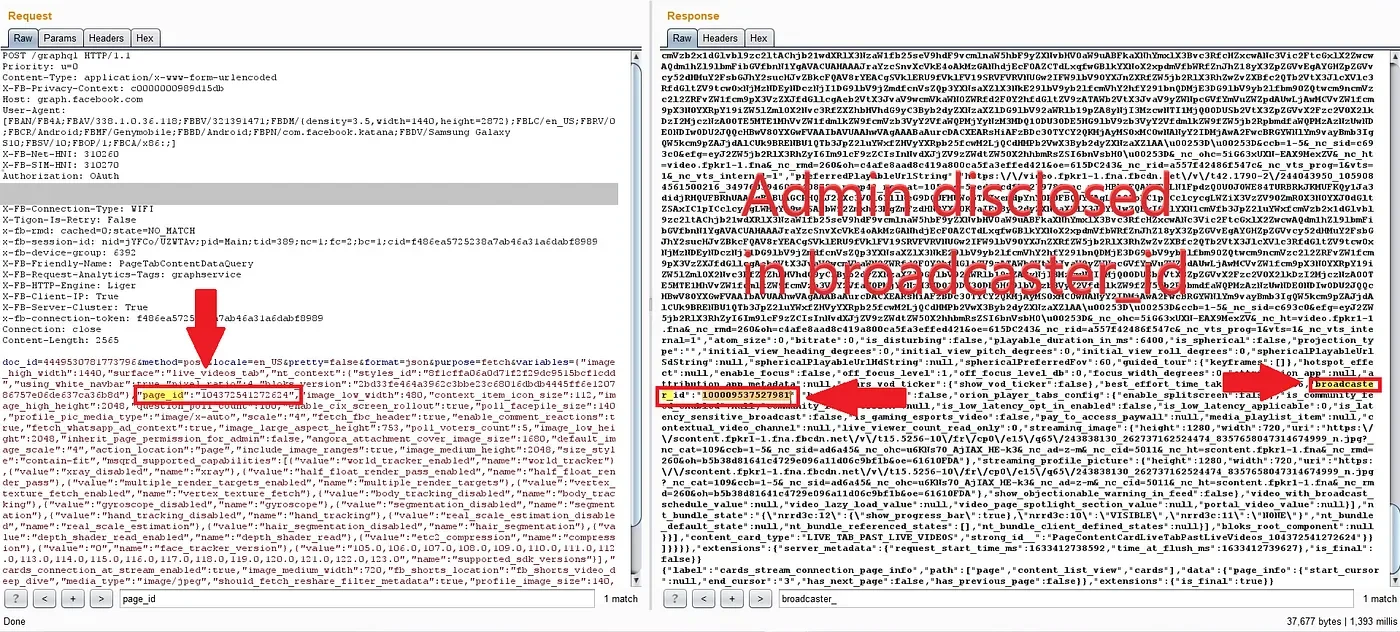
The screenshot shows the POST request to graph.facebook.com/graphql with doc_id=4449530781773796 and the edited page_id, and the response where broadcaster_id= reveals the admin.
A proof of concept video is linked in the report:
https://youtu.be/bskV-Nr64rE
Because most pages have live video, the researcher notes this could have affected most pages on Facebook. To exploit it at scale, a script could automate changing the page_id in the request, capture broadcaster_id from each response and save it to a file. Alternatively, Burp Suite's Intruder can be used: select the page_id, load a list of page IDs as payloads, run the attack, and save the admin information from the responses to a text file for targeting.
Step 2: the live_video_id variant
A second scenario uses the exact live video ID instead of the page ID. The vulnerable doc_id here is 5048752835141848. Changing the video ID to any live video's ID discloses the admin of that page in the broadcaster_id parameter of the response.
- A page conducts a live video.
- The attacker intercepts FB4A and searches for
doc_id=5048752835141848. - Change the video ID to the required page's live video ID.
- The admin of the page is disclosed in the
broadcaster_id=parameter in the response.
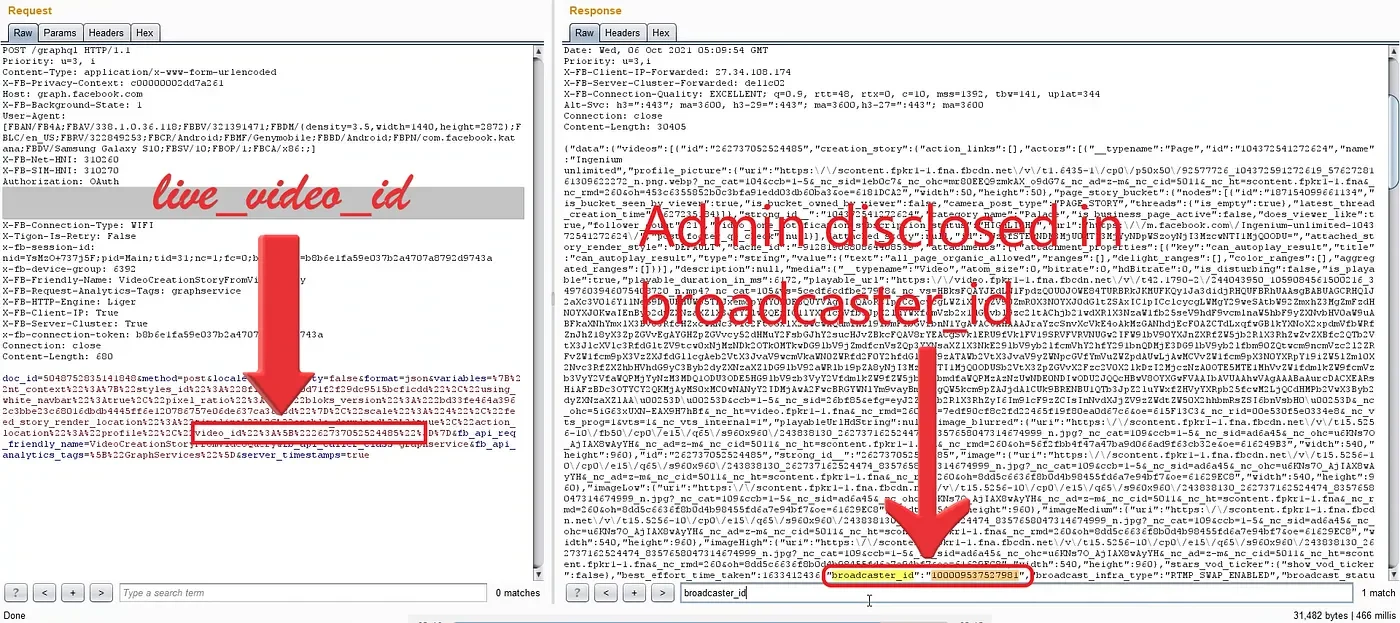
The screenshot, captioned idor2, shows the request with doc_id=5048752835141848 and the changed video ID, and the response where broadcaster_id= discloses the page's admin.
The second case was closed as a duplicate of the first because both share the same root cause.
Root cause
The two doc_id operations return the broadcaster's personal account ID in broadcaster_id for whatever object the client names, which is the classic IDOR pattern. The request takes an object identifier supplied by the client (page_id in the first case, live video ID in the second), and the response returns the admin identity for it, which is the classic IDOR pattern. The report does not describe the server-side code, so the exact missing check is inferred from behaviour rather than shown.
Impact
The bug is a privacy issue for pages: the admin's personal account information is meant to be kept private and not shown to the public. With the first variant, an attacker could enumerate page IDs and collect the admin account ID for any page with live video, which the researcher says is most pages. With the second, an attacker who knows a page's live video ID could obtain the same information. The report does not describe what further harm could follow from knowing an admin's personal account ID.
Fix
Facebook fixed the issue on October 21, 2021. A fix that would address the root cause would be to authorise the request against the object being queried and to stop returning the admin's personal account ID in broadcaster_id to callers who are not entitled to it.
Timeline
| Event | Date |
|---|---|
| Initial report sent | October 5, 2021 |
| Second scenario sent | October 6, 2021 |
| Triaged | October 7, 2021 |
| Fixed | October 21, 2021 |
| Rewarded | November 5, 2021 |
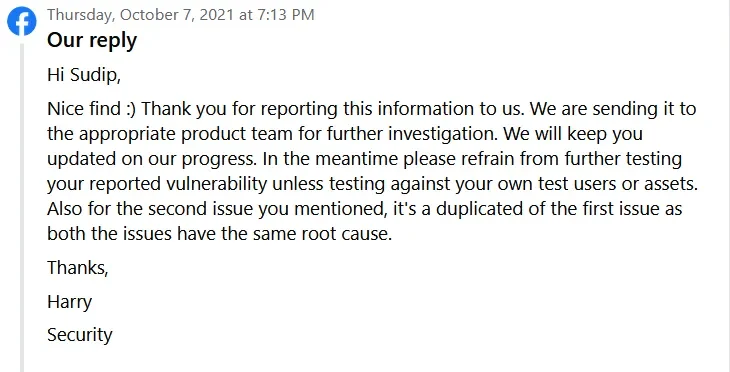
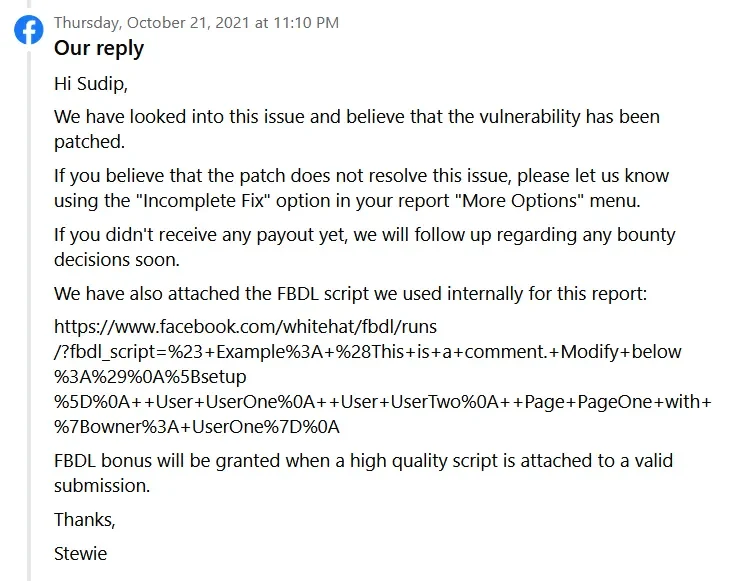
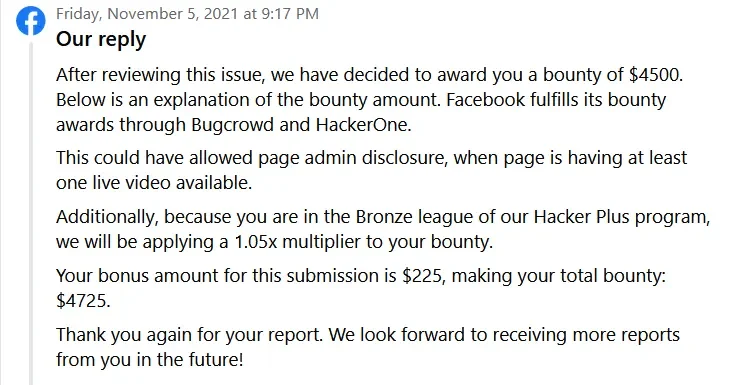
The bounty was 4500 USD, the researcher's highest on a single report at the time.
Variants to test
- Other GraphQL
doc_idoperations that take an object ID. Replace the ID with one belonging to another user or page and watch for identity fields in the response. A positive result is a field such asbroadcaster_idreturning a real account ID for an object you do not own. - Live video and broadcast endpoints. Query live video metadata by video ID or page ID from a second account. A positive result is the broadcaster's personal ID appearing where only a display name or page identity should be.
- Enumeration at scale. Use Burp Intruder with a list of page IDs on the
page_idparameter and check each response forbroadcaster_id. A positive result is a consistent mapping from page ID to admin account ID across many pages. - Mobile app traffic in general. Intercept FB4A requests as described in Facebook's testing guide and compare responses for objects you own against objects you do not. A positive result is any field that changes with the target object and reveals private account data.
What happened, in plain words
A security researcher called Sudip Shah, from Pokhara in Nepal, found a privacy bug in the Facebook app for Android. The bug let anyone who knew how to look at the app's network traffic find out the personal Facebook account ID of the admin of almost any Facebook page. The researcher reported it to Facebook, Facebook fixed it, and the researcher was paid 4500 USD.
To understand why that matters, you need a few ideas first. A Facebook page (for a business, a band, a public figure) is run by one or more people, called admins, who use their own personal Facebook accounts to manage it. Facebook deliberately keeps the link between a page and its admin's personal account private. If that link leaks, anyone can learn which real person runs a page, which is a privacy problem for that person.
The bug is an example of a vulnerability class called IDOR, which stands for Insecure Direct Object Reference. The everyday comparison: imagine a hotel where every room key is just a number, and the front desk hands you key number 12 for your room. If nobody checks that you are actually booked into room 12, you can ask for key number 13 and walk into a stranger's room. The "object" is the room, the "reference" is the number, and the problem is that the server trusts the number you supply without checking that you are allowed to use it. In software, an IDOR happens when a request contains an identifier (a page ID, a video ID, an order number) and the server looks up whatever that identifier points to and returns the data, without asking "is this person allowed to see this particular object?".
Two more terms used throughout. An API (Application Programming Interface) is the way one piece of software asks another for data. The everyday comparison: a restaurant menu and a waiter. You do not walk into the kitchen; you tell the waiter what you want from the menu, and food comes back. The Facebook app is the customer, Facebook's servers are the kitchen, and the API is the menu plus the waiter. GraphQL is a particular style of API where the app sends a request naming exactly which piece of data it wants, identified by a doc_id (a document ID, essentially the name of a saved query on Facebook's side), plus some values such as a page ID. The server runs that saved query and sends back a structured response.
Finally, intercepting traffic means putting a tool between the app and the internet so you can read, and change, every request and response. The everyday comparison: a postal worker who opens every letter you send and every reply you get, reads them, and can even swap the contents before passing them on. Facebook publishes a testing guide for researchers explaining how to do this with its Android app, and the researcher followed it.
Why the Android app
The researcher had spent around two years probing the technical side of Facebook, with many duplicate and informative results along the way. He says he was frustrated with the web version, checking requests and responses looking for something hidden, so he switched to intercepting traffic from the Facebook Android app (often abbreviated FB4A).
While browsing his captured HTTP history, he navigated to the live video section of a page. A live video is a broadcast a page streams in real time; viewers see a player, and the app has to fetch details about the broadcast from Facebook's servers to display it. In those responses he noticed a parameter called broadcaster_id, and its value was the admin's real, personal account ID. That value should never have been sent to an ordinary viewer, so it looked wrong straight away.
The bug
The vulnerable endpoint is a GraphQL POST to graph.facebook.com/graphql with doc_id=4449530781773796. The request carries a page_id. Change that value to any other page, and the response comes back with that page's admin in the broadcaster_id field.
Step 1: the page_id variant
- Send a POST request to
graph.facebook.com/graphqlwithdoc_id=4449530781773796. - Edit the
page_idin the request to any page. - In the response, the admin is disclosed in the
broadcaster_id=parameter.
The screenshot shows the POST request to graph.facebook.com/graphql with doc_id=4449530781773796 and the edited page_id, and the response where broadcaster_id= reveals the admin.
Why each step: step 1 reproduces the request the app itself makes when you open a page's live video section, so the server treats it as legitimate. Step 2 is the actual attack: the page_id is the "room number" from the hotel comparison, and the server does not check that you are entitled to that page's admin details. Step 3 is where you read the leak: broadcaster_id is meant to identify the broadcaster, but it resolves to the admin's personal account ID.
A proof of concept video is linked in the report:
https://youtu.be/bskV-Nr64rE
That link is a video recording of the exploit working. The report gives the URL and nothing more about its contents.
Because most pages have the live video feature, the researcher notes the bug could have affected most pages on Facebook. To exploit it at scale, a script could automate changing the page_id in the request, capture broadcaster_id from each response and save it to a file. Alternatively, Burp Suite's Intruder can be used: select the page_id, load a list of page IDs as payloads, run the attack, and save the admin information from the responses to a text file for targeting.
A word on those tools. Burp Suite is a program that sits between your browser or app and the internet and lets you read and edit traffic; Intruder is one of its features that takes a request and repeats it many times, each time swapping in a different value from a list you supply. The everyday comparison: instead of knocking on one door, you have a machine that knocks on every door on the street in turn and writes down which ones open. "At scale" simply means doing this for many pages automatically rather than one at a time by hand.
Step 2: the live_video_id variant
A second scenario uses the exact live video ID instead of the page ID. The vulnerable doc_id here is 5048752835141848. Changing the video ID to any live video's ID discloses the admin of that page in the broadcaster_id parameter of the response.
- A page conducts a live video.
- The attacker intercepts FB4A and searches for
doc_id=5048752835141848. - Change the video ID to the required page's live video ID.
- The admin of the page is disclosed in the
broadcaster_id=parameter in the response.
The screenshot, captioned idor2, shows the request with doc_id=5048752835141848 and the changed video ID, and the response where broadcaster_id= discloses the page's admin.
Why each step: step 1 is a precondition, because this request looks up a broadcast by its video ID, so the target page must have gone live at some point. Step 2 finds the saved query in the captured traffic. Step 3 is again the IDOR: the video ID is the reference, and the server returns the admin for whatever video you name. Step 4 is the same leak as before, just reached through a different identifier.
The second case was closed as a duplicate of the first because both share the same root cause. A duplicate in bug bounty terms means the platform treats it as the same underlying issue as an earlier report, so it is not rewarded separately.
Root cause
The two doc_id operations return the broadcaster's personal account ID in broadcaster_id for whatever object the client names, which is the classic IDOR pattern. A resolver is the piece of server code that answers a particular field in a GraphQL query: the app asks for a field, and the resolver fetches its value. The request takes an object identifier supplied by the client (page_id in the first case, live video ID in the second), and the response returns the admin identity for it, which is the classic IDOR pattern. Authorisation means deciding whether a given user is allowed to do or see a given thing; authentication is only proving who you are. The report does not describe the server-side code, so the exact missing check is inferred from behaviour rather than shown.
Impact
The bug is a privacy issue for pages: the admin's personal account information is meant to be kept private and not shown to the public. With the first variant, an attacker could enumerate page IDs and collect the admin account ID for any page with live video, which the researcher says is most pages. Enumerate here means walking through a list of identifiers one by one. With the second, an attacker who knows a page's live video ID could obtain the same information. The report does not describe what further harm could follow from knowing an admin's personal account ID.
Fix
Facebook fixed the issue on October 21, 2021. A fix that would address the root cause would be to authorise the request against the object being queried and to stop returning the admin's personal account ID in broadcaster_id to callers who are not entitled to it. In plain words: before answering, the server should check that the person asking is allowed to see this particular object's admin details, and if not, leave the personal ID out of the response.
Timeline
| Event | Date |
|---|---|
| Initial report sent | October 5, 2021 |
| Second scenario sent | October 6, 2021 |
| Triaged | October 7, 2021 |
| Fixed | October 21, 2021 |
| Rewarded | November 5, 2021 |
Triaged means the bug bounty team reviewed the report and accepted it as a valid issue worth working on. The bounty was 4500 USD, the researcher's highest on a single report at the time.
Variants to test
These are the kinds of places a researcher would look next, based on the same idea.
- Other GraphQL
doc_idoperations that take an object ID. Replace the ID with one belonging to another user or page and watch for identity fields in the response. A positive result is a field such asbroadcaster_idreturning a real account ID for an object you do not own. - Live video and broadcast endpoints. Query live video metadata by video ID or page ID from a second account. A positive result is the broadcaster's personal ID appearing where only a display name or page identity should be.
- Enumeration at scale. Use Burp Intruder with a list of page IDs on the
page_idparameter and check each response forbroadcaster_id. A positive result is a consistent mapping from page ID to admin account ID across many pages. - Mobile app traffic in general. Intercept FB4A requests as described in Facebook's testing guide and compare responses for objects you own against objects you do not. A positive result is any field that changes with the target object and reveals private account data.
Glossary
- API: the way one piece of software asks another for data, like a menu and waiter between an app and a server.
- Authentication: proving who you are.
- Authorisation: deciding whether a given user is allowed to do or see a given thing.
- Broadcaster: the person or page sending out a live video.
broadcaster_id: the response field that, in this bug, contained the admin's personal account ID.- Burp Suite: a tool that sits between your browser or app and the internet so you can read and edit traffic.
- Duplicate: a report the platform treats as the same underlying issue as an earlier one, so it is not rewarded separately.
- Endpoint: a specific address on a server that accepts requests, here
graph.facebook.com/graphql. - Enumerate: to walk through a list of identifiers one by one, for example page IDs.
- FB4A: shorthand for the Facebook app for Android.
- GraphQL: a style of API where the app names exactly which data it wants, identified by a
doc_id. doc_id: the identifier of a saved query on Facebook's side, telling the server which operation to run.- HTTP history: the log of requests and responses a tool like Burp Suite records as you use an app.
- IDOR (Insecure Direct Object Reference): a bug where a request contains an identifier and the server returns the object it points to without checking that you are allowed to see it, like asking for any hotel room key by number.
- Impact: how much harm a bug could cause if abused.
- Intercepting traffic: placing a tool between an app and the internet to read and change requests and responses.
- Intruder: a Burp Suite feature that repeats a request many times, swapping in a different value from a list each time.
- Live video: a broadcast a page streams in real time.
- Page admin: a person who manages a Facebook page using their own personal account.
- Parameter: a named value inside a request, such as
page_idorbroadcaster_id. - POST request: an HTTP request that sends data to the server, as opposed to simply asking for a page.
- Proof of concept (PoC): a demonstration that a bug really works, here a video.
- Resolver: the server code that answers a particular field in a GraphQL query.
- Root cause: the underlying reason a bug exists, as opposed to its visible symptom.
- Triaged: reviewed and accepted by the bug bounty team as a valid issue.
- Vulnerability class: a family of bugs that share the same underlying mistake, such as IDOR.



