Disclosing Facebook page admins by playing a game
A Messenger Instant Games request could be edited so that the game thread was tied to a Facebook page instead of a user, causing the page admin's personal account ID to be revealed when the admin played the game from the Creator Studio app. An attacker could therefore learn the private identity of a page admin, though the admin had to open and play the game first.
 Published on medium.com
After some time of the report the Instant Gamesfeature in messenger was removed as they were switching to Facebook Gaming Tab . You can check out this article by Leo to learn more about the migration here :https://www.facebook.com/fbgaminghome/blog/instant-games-platform-updateEngadgetand Business-Standard has also…
The full write-up lives on its author's site
It belongs to its author, so we link to it rather than copy it. The other two tabs are our own rewrites, checked against it.
Context
Facebook Messenger had a feature tied to Facebook Instant Games that let users play games with their friends through the Messenger app. The researcher found that this ability could be used to create a game session between a Page and an attacker, which is not an intended pairing, and that the session leaked the Page admin's personal account id.
The affected app was the CreatorStudio app, version 25.0.0.42.106. The bug was a medium impact privacy issue: the Page admin's personal account id is meant to stay private and is not supposed to be shown to the public.
Setup
The researcher defines four actors and one environment:
| Actor | Role |
|---|---|
| UserA | the attacker |
| UserB | any friend of UserA |
| UserC | the admin of PageX, who uses the CreatorStudio app to check the PageX inbox |
| PageX | the targeted Page |
The precondition is that UserC checks the Page inbox in the CreatorStudio app and interacts with the game message there. The attack also needs the Page side to click the game and play it, so there is user interaction involved.
Finding it
The "Play a Game" flow in Messenger sends a request that carries identifiers for the conversation context. Those identifiers, contextSourceID, context_source_id and thread_id, are replaced by the attacker in the intercepted request. If they can be swapped for a Page id, the game session is created against the Page rather than against the friend the message was originally addressed to. That mismatch, a game between a Page and an attacker, is the unintended behaviour.
Exploitation
Step 1: send a game message to a friend
UserA (attacker) sends a "Play a Game" message to UserB by going to www.messenger.com, then to www.messenger.com/t/{userB_id}, and clicking the "Play a game" option.
Step 2: intercept the request and pick a game
UserA intercepts the request and clicks on any game.
Step 3: rewrite the context identifiers
A POST request is sent with doc_id=3037811092958141. UserA replaces contextSourceID, context_source_id and thread_id with the page_id of PageX and forwards the edited request.
doc_id=3037811092958141
Step 4: the admin opens the game
UserC (the PageX admin) opens the CreatorStudio app, checks the Page inbox and clicks on the game to play it.
Step 5: a session is created
A game session between the attacker and the Page is now created.
Step 6: the score reveals the admin
The Page plays one round. The score is then sent to the attacker (UserA) by UserC instead of by PageX. UserA receives one message and a notification that {page_admins_personal_id} played the game. The game is played by the admin_personal_id rather than by the Page_id, so the Page admin is disclosed.
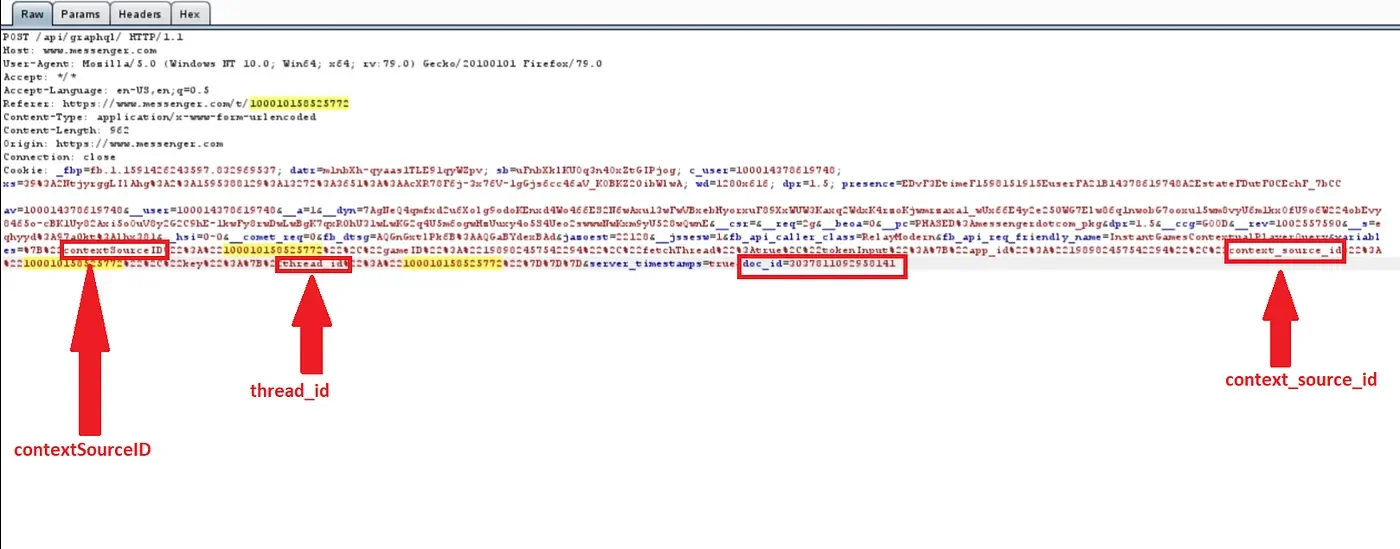
The screenshot shows the vulnerable parameters that were replaced in the request.
A proof of concept video is linked in the report:
https://youtu.be/Yt6bc41dSec
Timing condition
While working on the report the researcher found that the bug was doing something with timestamps: it was reproducible only when the request is modified within 17 to 20 seconds. That timing window is a real constraint on the attack.
Root cause
The attacker replaced contextSourceID, context_source_id and thread_id with the Page id, and a game session between the attacker and the Page was created. When the Page admin then played, the score was sent to the attacker by UserC instead of by PageX, and the attacker received a notification naming the admin's personal id. The report does not describe the server-side check that was missing; the above is the behaviour the steps demonstrate.
Impact
An attacker can disclose the personal account id of a Page admin. This is a privacy issue for the Page, and the researcher rates the impact as high because the Page's admin information is meant to be kept private and not shown to the public. The attack requires user interaction from the Page side: the admin has to click the game and play it. The researcher also found the bug was reproducible only when the request is modified within 17 to 20 seconds.
Fix
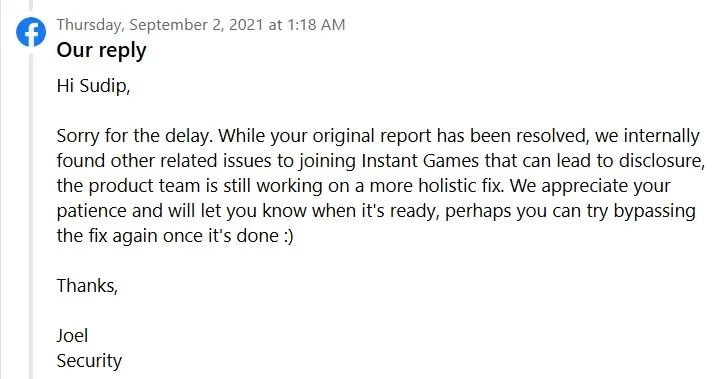
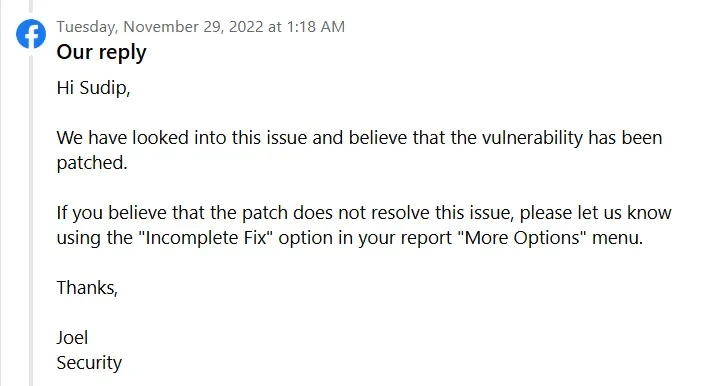
The timeline lists Fixed on March 6, 2021, Facebook working on a more holistic fix on September 2, 2021, Fixed finally on November 29, 2022, and Resolved on December 7, 2022. Separately, the Instant Games feature in Messenger was removed as Facebook was switching to the Facebook Gaming Tab. The report does not describe the code change itself.
Timeline
| Event | Date |
|---|---|
| Initial report sent | August 23, 2020 |
| Facebook asked for more info | August 29, 2020 |
| Additional info sent | August 29, 2020 |
| More info sent (timestamp finding, 17 to 20 second window) | September 11, 2020 |
| Facebook team asked for more info | September 15, 2020 |
| Sent more info with updated PoC | September 15, 2020 |
| Pre-triaged | September 21, 2020 |
| Triaged | September 25, 2020 |
| Bounty rewarded (without fix), 500 USD | January 15, 2021 |
| Bounty dispute | January 15, 2021 |
| Bounty rewarded again, 1500 USD | March 5, 2021 |
| Fixed | March 6, 2021 |
| Asked for public disclosure | May 10, 2021 |
| Facebook working on a more holistic fix | September 2, 2021 |
| Fixed finally | November 29, 2022 |
| Resolved | December 7, 2022 |
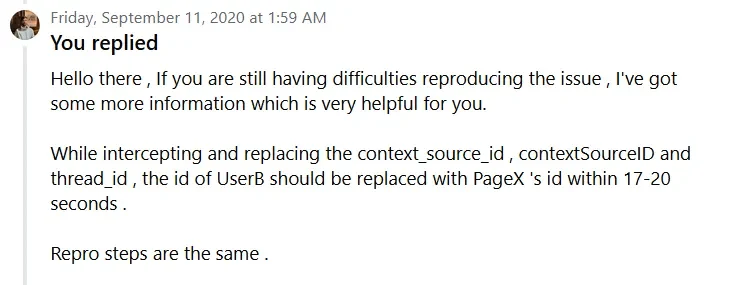
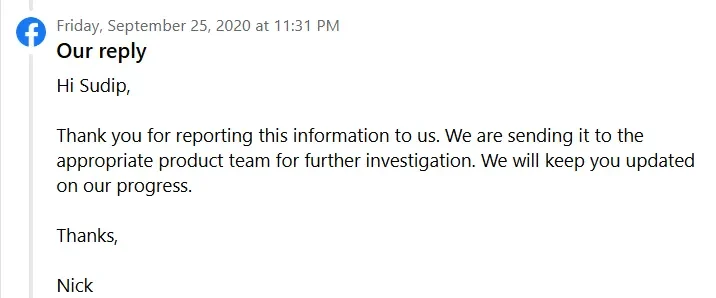
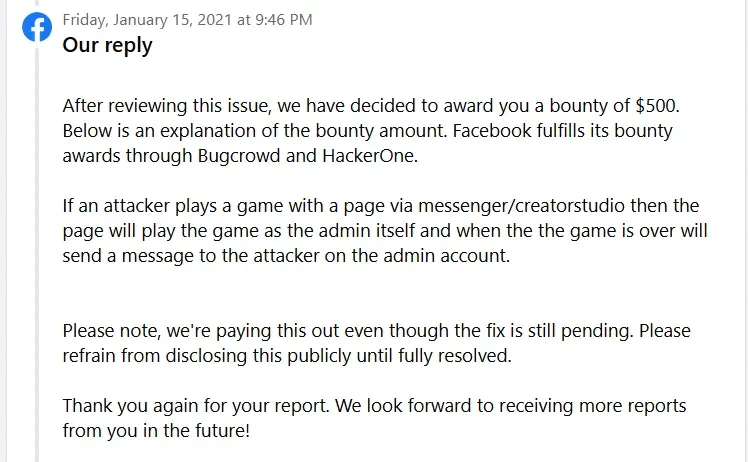
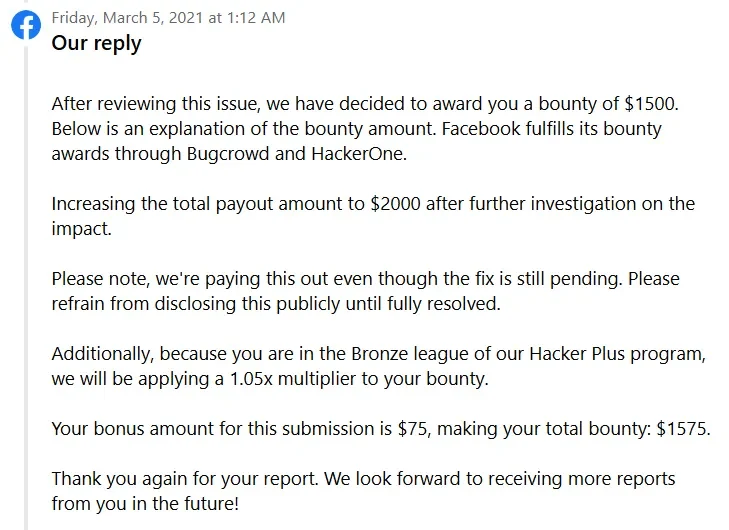
The researcher states the total bounty was 500 + 1500 + 75 = 2075 USD.
Variants to test
- Other client-supplied context fields. Look for any request that carries a conversation or thread identifier alongside a game or app document id, and try substituting a Page id. A positive result is a session created against the Page and a notification naming the admin's personal account.
- Timing windows. A positive result is a successful session outside the window the researcher observed.
- Cross-actor attribution. Check whether scores, invites or notifications from a Page-owned session are attributed to the Page or to the individual admin. A positive result is any personal identifier arriving at the attacker.
- Other surfaces using the same game flow. A positive result is the same disclosure through a different entry point.
What happened, in plain words
Facebook Messenger used to have a feature called Instant Games. It let you play a small game with a friend inside the chat: you sent a game invitation, your friend clicked it, and the two of you played a round. The score went back and forth in the conversation.
The researcher found a way to abuse that feature. Instead of starting a game with a friend, he could make the game start with a Facebook Page (the public profile a business or public figure uses). When the person who runs that Page opened the game and played a round, the score came back to the attacker carrying the Page admin's personal account id, the number that identifies their private Facebook profile. That id is supposed to stay private.
So the bug is an information disclosure: a piece of private information leaked to someone who should not have it. It is also a logic flaw: nothing crashed and no password was stolen; the feature simply allowed a combination of actions it was never designed for, a game between a Page and an outsider.
The affected app was the CreatorStudio app, version 25.0.0.42.106. CreatorStudio is a separate app that Page admins use to manage their Page, including reading the Page's inbox. The bug was rated medium impact, and the researcher argues the impact is high for the Page because admin identity is meant to be private.
The pieces you need to know first
Before the steps make sense, here are a few everyday ideas.
- A request is a message your browser or app sends to a Facebook server, like a filled-in form you hand to a clerk. The server reads it and sends back a response, like the clerk handing you a receipt.
- A POST request is a request that carries data in its body, the way a form you fill in and submit carries your answers. A GET request is more like asking a question in the URL itself.
- A parameter is one named field inside a request, for example
thread_id=123. It is a labelled box on the form: the name on the left, the value on the right. - An API is the set of doors a program is allowed to knock on at a service. When the Messenger app sends a game invitation, it is calling a Facebook API behind the scenes.
- A client is the program on your side, the browser or the app. The server is the computer on Facebook's side. Anything the client sends can, in principle, be changed by the person using the client, because it is their computer.
- Intercepting a request means catching it between your app and the server, usually with a proxy tool, so you can read it and edit it before it goes on its way. Think of a mail sorter who opens an envelope, changes a line, and seals it again.
- An id is a unique number a service uses to refer to something: a user, a Page, a conversation. It is like a customer number.
- A Page id identifies the Page itself. A personal account id (the report also calls it
admin_personal_id) identifies the human being who runs the Page. They are two different numbers, and only the first is public. - User interaction means the victim has to do something, here click the game and play a round. The attacker cannot do it alone.
- A proof of concept (PoC) is a recording or set of steps that shows the bug really works.
- A bounty is money a company pays a researcher for reporting a security bug responsibly.
The setup
The researcher describes four actors and one environment:
| Actor | Role |
|---|---|
| UserA | the attacker |
| UserB | any friend of UserA |
| UserC | the admin of PageX, who uses the CreatorStudio app to check the PageX inbox |
| PageX | the targeted Page |
The precondition is that UserC checks the Page inbox in the CreatorStudio app and interacts with the game message there. The Page side has to click the game and play it, so user interaction is part of the attack.
How the researcher found it
The "Play a Game" flow in Messenger sends a request that carries identifiers for the conversation context. Those identifiers, contextSourceID, context_source_id and thread_id, are replaced by the attacker in the intercepted request. If they can be swapped for a Page id, the game session is created against the Page rather than against the friend the message was originally addressed to. That mismatch, a game between a Page and an attacker, is the unintended behaviour.
In plain words: the request that starts a game contains boxes saying "this game belongs to this conversation". Those boxes are filled in by the app on your own device, so you can rewrite them. The researcher asked: what if I write a Page's id in those boxes instead of my friend's conversation? The edited request was forwarded and a game session between the attacker and the Page was created.
The attack, step by step
Step 1: send a game message to a friend
UserA (attacker) sends a "Play a Game" message to UserB by going to www.messenger.com, then to www.messenger.com/t/{userB_id}, and clicking the "Play a game" option.
Why this step: the attacker needs a normal game invitation to exist so there is a request to catch. Starting from a legitimate action gives a legitimate request to edit. The {userB_id} part is a placeholder for the friend's id; the attacker opens the chat with that friend and uses the game button there.
Step 2: intercept the request and pick a game
UserA intercepts the request and clicks on any game.
Why this step: clicking a game is what makes the app send the request that creates the game session. With interception switched on, the request pauses on the attacker's machine before reaching Facebook, so it can be read and changed. Any game works because the flaw is in how the session is tied to a conversation, not in a particular game.
Step 3: rewrite the context identifiers
A POST request is sent with doc_id=3037811092958141. UserA replaces contextSourceID, context_source_id and thread_id with the page_id of PageX and forwards the edited request.
doc_id=3037811092958141
Line by line:
- The attacker leaves it alone; it just says "start this game".
contextSourceID,context_source_idandthread_idare the three parameters the attacker changes. They are the conversation labels: they tell Facebook which chat this game belongs to.- Replacing all three with the Page id of PageX means the request now says "this game belongs to PageX's conversation" instead of "this game belongs to my chat with UserB".
- Forwarding the edited request sends it on to Facebook. The edited request is forwarded and a game session between the attacker and the Page is created.
Why this step: this is the heart of the bug. The server trusted values that the client supplied, so the attacker could point the game at a Page.
Step 4: the admin opens the game
UserC (the PageX admin) opens the CreatorStudio app, checks the Page inbox and clicks on the game to play it.
Why this step: the attacker cannot play on the Page's behalf. The disclosure only happens when the human behind the Page takes the bait and plays. This is the user interaction the attack depends on.
Step 5: a session is created
A game session between the attacker and the Page is now created.
A session here is one shared game instance: both sides are in the same round and see each other's moves and scores. Normally a session is between two friends. Here it is between an outsider and a Page, which the feature was never meant to allow.
Step 6: the score reveals the admin
The Page plays one round. The score is then sent to the attacker (UserA) by UserC instead of by PageX. UserA receives one message and a notification that {page_admins_personal_id} played the game. The game is played by the admin_personal_id rather than by the Page_id, so the Page admin is disclosed.
Why this matters: when a Page acts, Facebook can attribute the action either to the Page or to the person behind it. Here the score was attributed to the person, and that personal id was delivered to the attacker in a message and a notification. The attacker now knows which private account runs PageX.
The screenshot shows the vulnerable parameters that were replaced in the request.
A proof of concept video is linked in the report:
https://youtu.be/Yt6bc41dSec
This is a recording of the attack working, so a reader can watch the steps rather than only read them.
The timing condition
While working on the report the researcher found that the bug was doing something with timestamps: it was reproducible only when the request is modified within 17 to 20 seconds. That timing window is a real constraint on the attack.
A timestamp is the time recorded inside a request or a token. Some requests are only accepted if they are fresh, a bit like a ticket that expires. Here the edited request had to be sent quickly after it was captured, inside a window of 17 to 20 seconds, or the server would not accept it. That makes the attack harder to repeat reliably, because the attacker has to edit and forward the request fast.
Why it worked
The attacker replaced contextSourceID, context_source_id and thread_id with the Page id, and a game session between the attacker and the Page was created. When the Page admin then played, the score was sent to the attacker by UserC instead of by PageX, and the attacker received a notification naming the admin's personal id. The report does not describe the server-side check that was missing; the above is the behaviour the steps demonstrate.
So anyone could write someone else's account number on the form.
Impact
An attacker can disclose the personal account id of a Page admin. This is a privacy issue for the Page, and the researcher rates the impact as high because the Page's admin information is meant to be kept private and not shown to the public. The attack requires user interaction from the Page side: the admin has to click the game and play it. The researcher also found the bug was reproducible only when the request is modified within 17 to 20 seconds.
Why a leaked id matters: an id is a key that lets someone look up, reference or target an account.
The fix
The timeline lists Fixed on March 6, 2021, Facebook working on a more holistic fix on September 2, 2021, Fixed finally on November 29, 2022, and Resolved on December 7, 2022. Separately, the Instant Games feature in Messenger was removed as Facebook was switching to the Facebook Gaming Tab. The report does not describe the code change itself.
"Holistic" here means a fix that covers the whole class of problem rather than patching one request.
Timeline
| Event | Date |
|---|---|
| Initial report sent | August 23, 2020 |
| Facebook asked for more info | August 29, 2020 |
| Additional info sent | August 29, 2020 |
| More info sent (timestamp finding, 17 to 20 second window) | September 11, 2020 |
| Facebook team asked for more info | September 15, 2020 |
| Sent more info with updated PoC | September 15, 2020 |
| Pre-triaged | September 21, 2020 |
| Triaged | September 25, 2020 |
| Bounty rewarded (without fix), 500 USD | January 15, 2021 |
| Bounty dispute | January 15, 2021 |
| Bounty rewarded again, 1500 USD | March 5, 2021 |
| Fixed | March 6, 2021 |
| Asked for public disclosure | May 10, 2021 |
| Facebook working on a more holistic fix | September 2, 2021 |
| Fixed finally | November 29, 2022 |
| Resolved | December 7, 2022 |
A few of those words are worth explaining. Triaged means the security team confirmed the report is a real bug and put it in their queue; pre-triaged is an earlier check before that. A bounty dispute is the researcher disagreeing with the reward amount and asking for it to be reviewed. Public disclosure is permission to write about the bug openly once it is fixed.
The researcher states the total bounty was 500 + 1500 + 75 = 2075 USD.
Variants to test
- Other client-supplied context fields. Look for any request that carries a conversation or thread identifier alongside a game or app document id, and try substituting a Page id. A positive result is a session created against the Page and a notification naming the admin's personal account.
- Timing windows. If a request only works when replayed quickly, measure the window and test whether a slower or faster replay still binds the session. A positive result is a successful session outside the window the researcher observed.
- Cross-actor attribution. Check whether scores, invites or notifications from a Page-owned session are attributed to the Page or to the individual admin. A positive result is any personal identifier arriving at the attacker.
- Other surfaces using the same game flow. A positive result is the same disclosure through a different entry point.
Glossary
- API: the set of defined ways one program can ask another program or service to do something, like a menu of allowed requests.
- Attacker: the person trying to make a system do something it should not, here UserA.
- Bounty: money a company pays a researcher for finding and reporting a security bug.
- Bounty dispute: a researcher's request to review and change the reward amount.
- Client: the program on the user's side, such as a browser or mobile app, as opposed to the server.
- Context identifier: a value in a request that says which conversation or situation the action belongs to, such as
thread_id. - CreatorStudio app: the app Page admins use to manage their Page, including its inbox; version 25.0.0.42.106 was affected.
doc_id: the parameter that selects which game document is being started.- Holistic fix: a fix that addresses the whole class of problem rather than one specific request.
- Id: a unique number a service uses to refer to a user, Page or conversation.
- Information disclosure: a bug where private information leaks to someone who should not see it.
- Instant Games: the Messenger feature that let friends play small games inside a chat.
- Intercept: to catch a request between the app and the server so it can be read and edited.
- Logic flaw: a bug where the system works as coded but the rules allow an unintended combination of actions.
- Page: a public Facebook profile for a business or public figure, identified by a Page id.
- Page admin: the person who manages a Page; their personal account id is meant to stay private.
- Parameter: a named field in a request, written as name=value.
- Personal account id (
admin_personal_id): the number identifying a person's private Facebook profile. - POST request: a request that carries data in its body, like a submitted form.
- Pre-triaged: an early check of a report before formal triage.
- Proof of concept (PoC): a recording or set of steps demonstrating that a bug really works.
- Proxy: a tool that sits between your app and the server so you can inspect and change traffic.
- Request: a message a client sends to a server asking it to do something.
- Response: what the server sends back.
- Server: the computer on the service's side that receives requests and answers them.
- Session: one shared instance of an activity, here one game round shared between two parties.
- Thread: a conversation in a messaging app;
thread_ididentifies it. - Timestamp: the time recorded inside a request or token, often used to check freshness.
- Triaged: confirmed by the security team as a real bug and queued for handling.
- User interaction: something the victim has to do for the attack to work, such as clicking and playing.



