Page Admin Disclosed In Groups Due To Improper Session Handling In Facebook Web
A page that had been removed from a group could still add poll options to a poll post it had created while a member. On Facebook web, the poll option was attributed to the page admin's personal profile, revealing that profile as the page admin.
 Published on medium.com
A group can be joined by profiles as well as pages independently. Now, after a page gets removed from a group; it can no longer interact fully with the group posts from others.
The full write-up lives on its author's site
It belongs to its author, so we link to it rather than copy it. The other two tabs are our own rewrites, checked against it.
Context
Facebook groups can be joined by personal profiles and, independently, by pages. When a page is a member of a group it can create posts in that group, including poll posts. If the page is later removed from the group, it can no longer interact fully with the group's posts, but it can still perform light interactions on its own previous content, such as deleting comments or undoing a like.
The report describes an information disclosure issue in that leftover-interaction path: a page that is no longer a member of a group could still add poll options to a poll post it had created while it was a member. On the Facebook web client, those poll options were attributed to the personal profile of the person who administers the page, rather than to the page itself. That personal profile had never been a member of the group, so its appearance as the author of a poll option revealed it as an admin of the page.
Setup
The researcher tested with a page that had been a member of a group and had created a poll post there, and then was removed from the group. Testing was done first on FB4A (the Facebook for Android client) and then on the Facebook web client. The report does not list account names, versions or other tooling beyond the two clients and the FBDL reproduction code shown below.
The precondition for the original issue is that the page is no longer a member of the group but its poll post from the membership period still exists in the group.
Finding it
While testing the idea on FB4A, the researcher found that the page could add poll options to the poll post it had made during membership, even though it was now a non-member. On FB4A the poll options were added to the post under the page's name, which the researcher describes as intended behaviour.
On the Facebook web client the behaviour differed: when the non-member page added poll options, the options were added from the admin's personal profile, a profile that had never been part of the group. That looked wrong because it exposed the personal identity behind the page.
The reasoning for why this is a disclosure is that no other non-members are allowed to add a poll option to a poll post in a group. So if a non-member profile adds a poll option to a poll post, that profile must be an admin of the page that made the poll post. The report states this directly: if a poll option gets added to a poll_post by a non-member profile, that clearly means that he is the admin of the page that made the poll_post.
Exploitation
Step 1: reproduce the attribution on web
The report gives the reproduction steps as FBDL (Facebook Bug Description Language) code rather than as raw HTTP requests. The code is reproduced exactly as published:
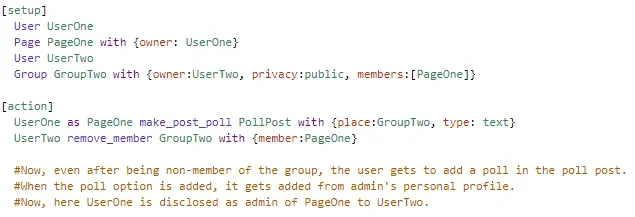
FBDL Code
The report also links a proof-of-concept video for this first issue. The FBDL code is the only reproduction artefact included in the text; the report does not show the underlying HTTP requests or responses.
Step 2: observe the result
After the page adds a poll option while it is a non-member, the web client attributes the new option to the admin's personal profile. Because only non-members who administer the page can add options to that poll post, any group member who sees the new option learns that the personal profile is an admin of the page.
Step 3: timeline of the first report
The report thread records the following dates:
| Event | Date |
|---|---|
| Reported | Tuesday, 29 December 2020 |
| Pre-Triaged | Monday, 4 January 2021 |
| Triaged | Tuesday, 5 January 2021 |
| Fixed & Fixed confirmed | Wednesday, 13 January 2021 |
| Bounty Rewarded | Monday, 1 February 2021 |
| FBDL bonus provided | Monday, 1 February 2021 |
| Bypass Achieved | June 2021 |
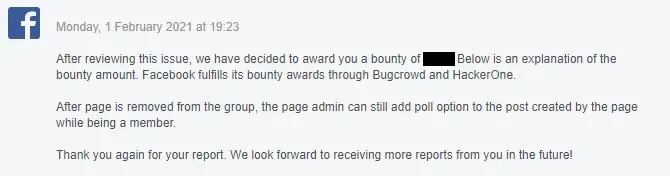
Bounty Reward ($XXX) Message From Facebook
Step 4: the bypass
At the end of the original report the researcher had also posted a note about a possible further avenue. It stayed in the report for several months without anyone trying it, so the researcher returned to it.
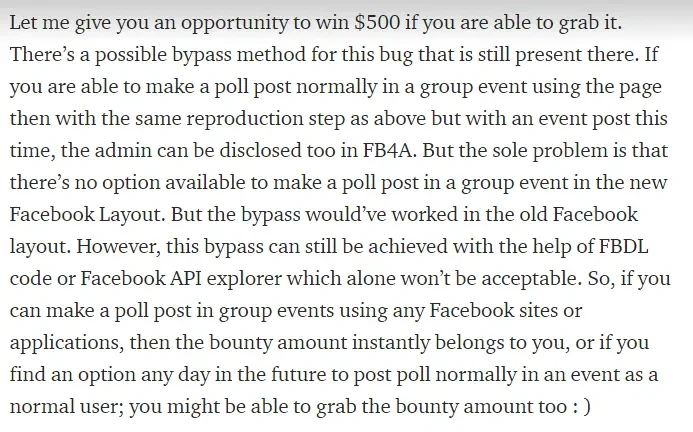
You missed it lol
The point that had been missed was this: if a page is one of the admins of the group, then the page can make a poll post in any event of the group, unlike a page that is only a normal member. The earlier attempts had only used a normal page member to make the poll post. This time the researcher used a page that had admin rights on the group, and it worked.
The same admin disclosure was achieved, this time combined with a voice indication failure vulnerability as described in Facebook's payout guidelines for page admin disclosure, at the last point. Facebook rewarded the researcher again with an even better bounty.
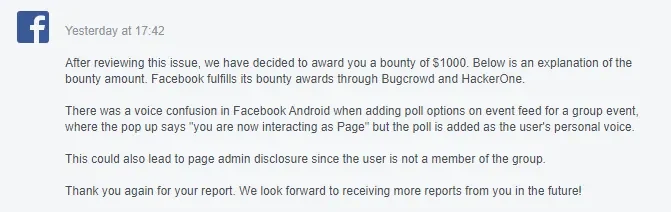
Second One
A proof-of-concept video for the bypass is linked in the report. As with the first issue, the report does not include the underlying requests or responses for the bypass.
Root cause
The report does not describe the server-side implementation. What it shows is that the web client, when a non-member page adds a poll option to its own poll post, attributes the option to the page admin's personal profile instead of the page. The FB4A client attributes the same action to the page, which suggests the two clients handle the acting identity differently for this path.
The rule that matters here is that no other non-members are allowed to add a poll option to a poll post in a group. The report states that no other non-members are allowed to do so, so the only non-member who can add an option is the admin of the page that made the post. That rule is what turns the misattribution into a disclosure: the action itself is permitted, but the identity shown for it is the wrong one.
Impact
A group member who sees a poll option added by a personal profile that is not a member of the group can infer that the profile is an admin of the page that created the poll post. The report frames this as revealing admins of ex-page_members of a Facebook group. The disclosure is limited to the situation where the page has left the group but its poll post remains, and to the web client, since FB4A attributed the option to the page.
Fix
Facebook fixed the first issue by removing the option to add polls in the poll_post after being a non-member.
Variants to test
- Test other leftover interactions by a page that has left a group, such as deleting comments or undoing a like, and check whether the web client attributes them to the page or to the admin's personal profile. A positive result is an action shown under the personal profile of someone who is not a group member.
- Repeat the poll-option test on other clients and compare attribution. A positive result is a client that shows the personal profile where another client shows the page.
- Test the same path with a page that has admin rights on the group, as in the bypass. A positive result is the same misattribution appearing through the admin-rights path.
- Look for other group actions that are permitted to a page after it leaves the group, and check whether the acting identity is preserved. A positive result is any action attributed to a personal profile that was never a member.
What happened, in plain words
Facebook lets two kinds of things join a group: ordinary personal profiles (a person's own account) and pages (an account that represents a business, a brand or a public figure, run by one or more people). A page is not a person; it is a separate identity that a person administers. The person who runs a page is called its admin.
When a page is a member of a group, it can post there, including a poll post (a post that asks a question and offers answer options that people can vote on). If the page is later removed from the group, it loses most of its ability to interact with the group. But it keeps a small amount of interaction with its own old content, for example deleting comments on it or undoing a like.
The researcher found that this leftover interaction had a gap. A page that was no longer a member could still add new answer options to a poll post it had created while it was a member. On the Android app, the new option appeared under the page's name, which is what you would expect. On the Facebook website, the same action appeared under the personal profile of the person who runs the page, a person who had never been a member of the group at all.
That is the bug. Because only the admin of the page is allowed to add options to that poll post once the page has left, anyone who sees the new option under a personal profile learns that this person is the admin of the page. The page's anonymity is broken. In security terms this is an information disclosure: no data is stolen and nothing is broken into, but a piece of information that was meant to stay hidden (who runs the page) becomes visible.
The pieces you need to understand first
Before the steps make sense, here are the ideas involved, explained from zero.
- Profile versus page. A profile is a person's own Facebook account. A page is a separate account for a brand or public figure, and it is controlled by one or more people through their personal profiles. The link between a page and the person who controls it is normally private. If it leaks, the person behind an anonymous page can be identified.
- Group membership. A group is a space where members post and comment. Both profiles and pages can be members. Membership gives permissions; leaving or being removed takes most of them away.
- Poll post. A post that contains a question and a list of options. Members vote by picking an option. In this case the page that made the poll post could add more options later.
- Client. The program you use to reach Facebook. The Android app is one client (the report calls it FB4A, short for Facebook for Android), the website in a browser is another. The same action can be handled slightly differently by each client, and that difference is exactly what this report is about.
- Attribution. Which identity an action is shown as coming from. If a page adds an option, the option should say it came from the page. Attribution is the label that says who did it.
- Information disclosure. A weakness where something that should be secret becomes visible to people who should not see it. Here the secret is the identity of the page's admin.
- FBDL. Facebook Bug Description Language, a short structured way of writing reproduction steps for a Facebook bug report. It is not a programming language and not a request you can send; it is a checklist-style description that a reviewer can follow by hand.
- PoC video. Proof of concept video: a screen recording showing the bug happening, so a reviewer can watch it instead of repeating every step.
- Bypass. A way to make the same bug happen again after the first fix. Fixes often close one path and leave a similar one open; finding that second path is called a bypass.
- Bounty. A payment a company makes to a researcher who reports a valid security bug through its bug bounty programme.
The setup
The researcher used a page that had been a member of a group and had created a poll post in that group, and then had been removed from the group. The poll post from the membership period was still in the group.
That is the precondition for the whole issue: the page is no longer a member, but its old poll post still exists. Testing was done first on the Android app (FB4A) and then on the Facebook website. The report does not list account names, app versions or any other tooling beyond those two clients and the FBDL code shown below.
Finding it
While testing the idea on FB4A, the researcher found that the page could add poll options to the poll post it had made during membership, even though it was now a non-member. On FB4A the new options were added to the post under the page's name, which the researcher describes as intended behaviour. In other words, the Android app allowed the action but labelled it correctly.
On the Facebook website the behaviour was different. When the non-member page added poll options, the options were added from the admin's personal profile, a profile that had never been part of the group. That looked wrong because it exposed the personal identity behind the page.
The reasoning for why this is a disclosure is simple. No other non-members are allowed to add a poll option to a poll post in a group. So if a non-member profile adds a poll option to a poll post, that profile must be an admin of the page that made the poll post. The report states this directly: if a poll option gets added to a poll_post by a non-member profile, that clearly means that he is the admin of the page that made the poll_post.
Exploitation
Step 1: reproduce the attribution on web
The report gives the reproduction steps as FBDL code rather than as raw HTTP requests. FBDL is a written recipe: it lists the actions in order so that a reviewer can follow them by hand in the app or on the website. The code is reproduced exactly as published:
FBDL Code
The report also links a proof-of-concept video for this first issue. The FBDL code is the only reproduction artefact included in the text; the report does not show the underlying HTTP requests or responses.
Step 2: observe the result
After the page adds a poll option while it is a non-member, the web client attributes the new option to the admin's personal profile. Because only non-members who administer the page can add options to that poll post, any group member who sees the new option learns that the personal profile is an admin of the page.
Put in everyday terms: imagine a club where only the owner of a company can add a line to the company's old notice board entry after the company has left the club. If someone who is not a club member adds a line, and the line is signed with a person's name instead of the company's name, then everyone reading the board now knows that person owns the company. The action was allowed; the signature was wrong.
Step 3: timeline of the first report
The report thread records the following dates:
| Event | Date |
|---|---|
| Reported | Tuesday, 29 December 2020 |
| Pre-Triaged | Monday, 4 January 2021 |
| Triaged | Tuesday, 5 January 2021 |
| Fixed & Fixed confirmed | Wednesday, 13 January 2021 |
| Bounty Rewarded | Monday, 1 February 2021 |
| FBDL bonus provided | Monday, 1 February 2021 |
| Bypass Achieved | June 2021 |
A few of those words need unpacking. Reported is when the researcher submitted the report. Triaged means the team accepted it as a real, valid issue. Fixed and fixed confirmed mean the change was made and then verified. Bounty rewarded is the payment.
Bounty Reward ($XXX) Message From Facebook
Step 4: the bypass
At the end of the original report the researcher had also posted a note about a possible further avenue. It stayed in the report for several months without anyone trying it, so the researcher returned to it.
You missed it lol
The point that had been missed was this: if a page is one of the admins of the group, then the page can make a poll post in any event of the group, unlike a page that is only a normal member. The earlier attempts had only used a normal page member to make the poll post. This time the researcher used a page that had admin rights on the group, and it worked.
Why does that matter? A page that is an admin of the group has broader posting rights, so it can create a poll post in any event of the group. The same admin disclosure was achieved, this time combined with a voice indication failure vulnerability as described in Facebook's payout guidelines for page admin disclosure, at the last point. Facebook rewarded the researcher again with an even better bounty.
Second One
A proof-of-concept video for the bypass is linked in the report. As with the first issue, the report does not include the underlying requests or responses for the bypass.
Root cause
The report does not describe the server-side implementation. What it shows is that the web client, when a non-member page adds a poll option to its own poll post, attributes the option to the page admin's personal profile instead of the page. The FB4A client attributes the same action to the page, which suggests the two clients handle the acting identity differently for this path.
The rule that matters here is that no other non-members are allowed to add a poll option to a poll post in a group. The report states that no other non-members are allowed to do so, so the only non-member who can add an option is the admin of the page that made the post. That rule is what turns the misattribution into a disclosure: the action itself is permitted, but the identity shown for it is the wrong one.
A useful comparison: a members-only car park where the barrier opens for one particular car. If the barrier opens and the log records the driver's home address instead of the car's number plate, the car park has not been broken into, but the driver's address is now on a public list. The rule (only that car may enter) is fine; the record of who entered is wrong.
Impact
A group member who sees a poll option added by a personal profile that is not a member of the group can infer that the profile is an admin of the page that created the poll post. The report frames this as revealing admins of ex-page_members of a Facebook group. The disclosure is limited to the situation where the page has left the group but its poll post remains, and to the web client, since FB4A attributed the option to the page.
Fix
Facebook fixed the first issue by removing the option to add polls in the poll_post after being a non-member.
Variants to test
If you want to look for similar issues yourself, these are the directions the report points to. Each one is a way of asking the same question: when a page does something after leaving a group, does the website show the page or the person behind it?
- Test other leftover interactions by a page that has left a group, such as deleting comments or undoing a like, and check whether the web client attributes them to the page or to the admin's personal profile. A positive result is an action shown under the personal profile of someone who is not a group member.
- Repeat the poll-option test on other clients and compare attribution. A positive result is a client that shows the personal profile where another client shows the page.
- Test the same path with a page that has admin rights on the group, as in the bypass. A positive result is the same misattribution appearing through the admin-rights path.
- Look for other group actions that are permitted to a page after it leaves the group, and check whether the acting identity is preserved. A positive result is any action attributed to a personal profile that was never a member.
Glossary
- Admin: the person who controls a page. The link between a page and its admin is normally private.
- Attribution: the identity an action is shown as coming from, such as a page or a personal profile.
- Bounty: a payment made by a company to a researcher who reports a valid security bug through its bug bounty programme.
- Bypass: a way to make the same bug happen again after the first fix, usually through a slightly different path.
- Client: the program used to reach a service, for example the Android app or the website in a browser.
- FBDL: Facebook Bug Description Language, a short structured format for writing reproduction steps in a Facebook bug report.
- FB4A: Facebook for Android, the Android app client.
- Fixed confirmed: the stage where the security team has verified that the change closing the bug is in place.
- Group: a Facebook space where members post and comment; both profiles and pages can be members.
- Information disclosure: a weakness where information that should stay hidden becomes visible to people who should not see it.
- Page: a Facebook account for a business, brand or public figure, run by one or more admins.
- Poll post: a post containing a question and answer options that members can vote on; the author can add options later.
- PoC (proof of concept) video: a screen recording that demonstrates a bug happening.
- Pre-triaged: the stage where the security team has looked at a report and passed it on for deeper review.
- Profile: a person's own Facebook account, as opposed to a page.
- Triaged: the stage where the security team has accepted a report as a real, valid issue.



