Arbitrary Board Preference Injection via Deck Config API
The Deck config API let any authenticated user store board-scoped configuration values for any board ID, without checking whether that user owned or could manage the board. A low-privileged user could therefore write settings such as notification preferences for boards belonging to other users.

- Triaged in 4 days
- Fixed in 3 months
- Paid in 6 months
- Disclosed after 6 months
Summary by the program
https://github.com/nextcloud/security-advisories/security/advisories/GHSA-4qq6-5jc4-336f
The report
Summary:
The Deck config API allows authenticated users to set board-scoped configuration keys for arbitrary board IDs without validating whether the user owns or has permission to manage the referenced board. I confirmed that a low-privileged user (test100_1) can successfully store board:28:notify-due in oc_preferences even though board 28 belongs to admin.
Steps To Reproduce:
-
Login to Nextcloud with a low-privileged user account: test100_1
-
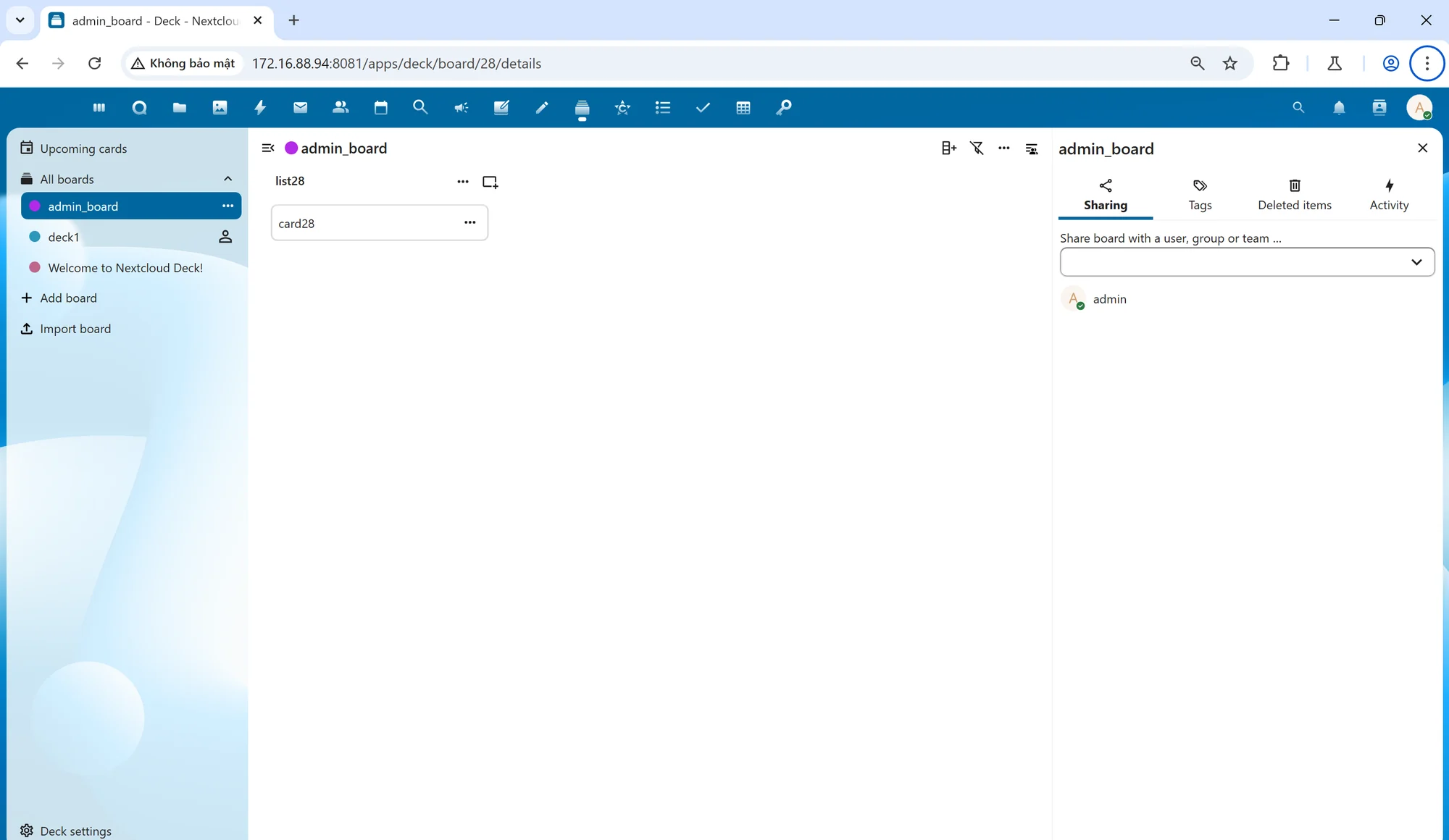
Identify a board owned by another user
For example:
- Board ID: 28
- Owner: admin
- Send the configuration request. Execute the following request with your authenticated session:
curl -i -X POST \
  'http://172.16.88.94:8081/ocs/v2.php/apps/deck/api/v1.0/config/board:28:notify-due' \
  -H 'OCS-APIRequest: true' \
  -H 'Accept: application/json' \
  -H 'Content-Type: application/json' \
  -b 'oc_sessionPassphrase=KFHmp5NgfZY%2BHJbk6pG9quGlBi2sMQPV45I%2F%2Ff7%2F0dp2xX30luSYkA3w2tkmxNQ%2B75uuu7o0D9dICjorJ5D%2Fz%2F5o32sdCW0ngwzPF3%2BDy2BxKGZJ%2BfNNSNzYSgI%2BRUTZ; nc_sameSiteCookielax=true; nc_sameSiteCookiestrict=true; ocrzkzhsljc2=806c5c11eef79e34c55f8a5cb157efe6; nc_username=test100_1; nc_token=MZY4g59OINcHMDawLMh%2B15zhbo0%2BnD%2FV; nc_session_id=806c5c11eef79e34c55f8a5cb157efe6' \
  -d '{"value": "all"}'
- Observe server response
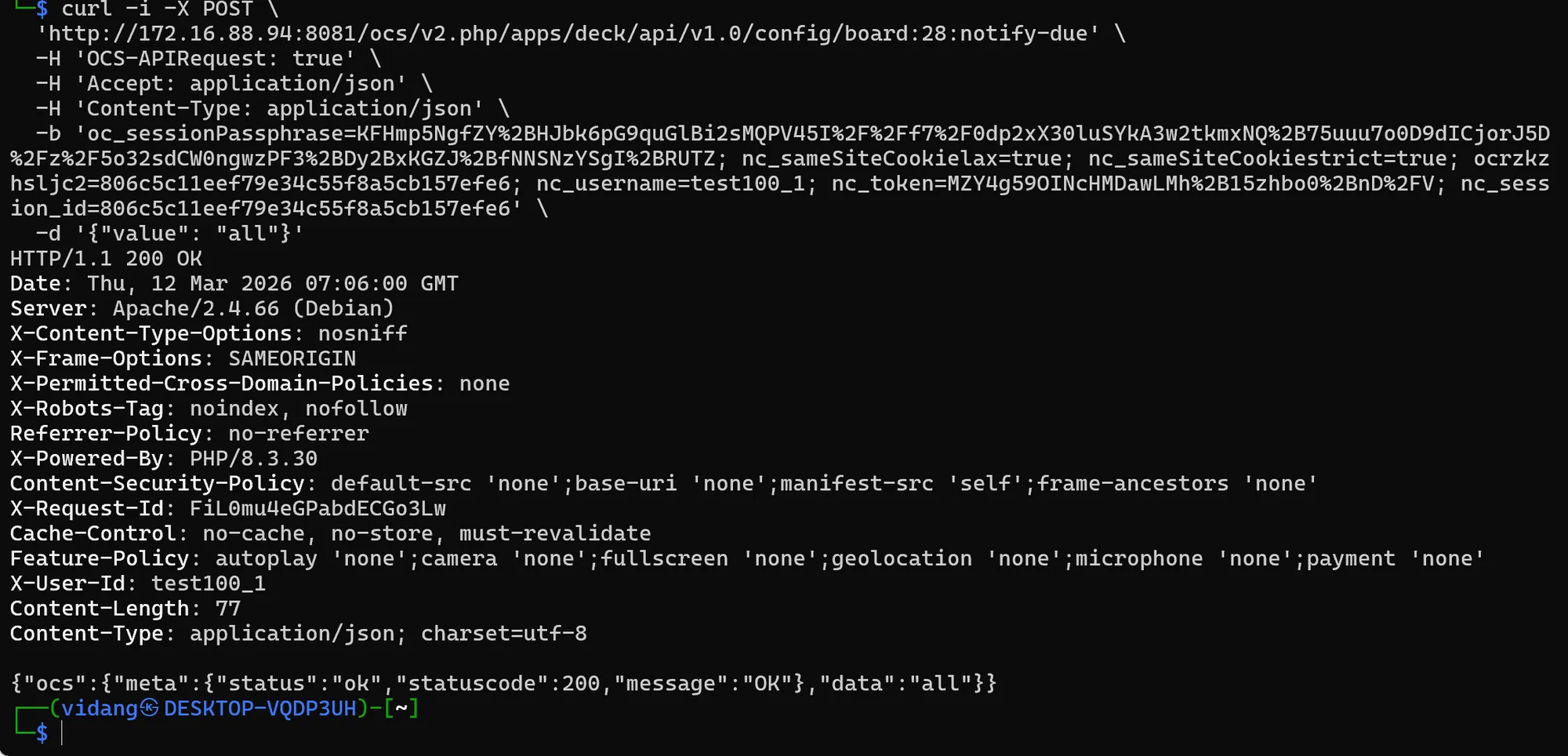
This indicates that the configuration value was stored successfully.
- Verify database entry. Check the oc_preferences table:
SELECT userid, appid, configkey, configvalue
FROM oc_preferences
WHERE configkey = 'board:28:notify-due';
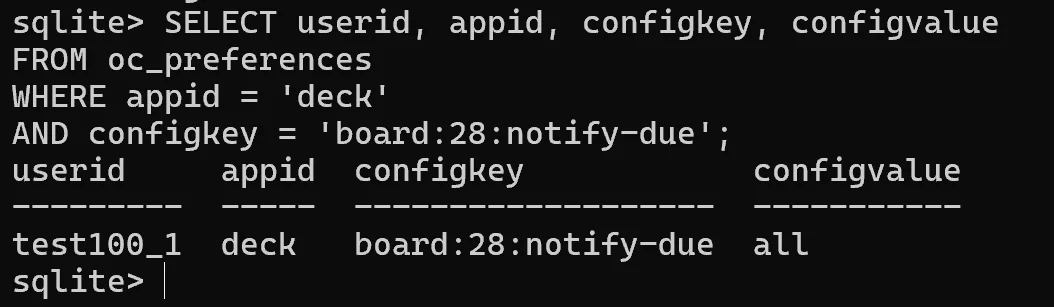
This confirms that the configuration key was written to the database even though the board belongs to another user.
Impact
This vulnerability allows authenticated users to set board-scoped configuration values for arbitrary board IDs, including boards owned by other users.
Potential impacts include:
-
Unauthorized modification of board-related settings
-
Manipulation of notification preferences associated with other users' boards
-
Integrity issues in the board configuration system
-
Potential unexpected behavior if additional board configuration keys are introduced in future versions
Because the API trusts the board:<boardId>:<key> structure without validating board access, attackers can store arbitrary board configuration entries for any board ID.
Context
Nextcloud Deck is the kanban-style board application for Nextcloud. Boards, stacks and cards are the visible objects, but Deck also keeps per-user and per-board configuration in Nextcloud's preferences store, the oc_preferences table. The Deck config API exposes those configuration keys over OCS, under the path /ocs/v2.php/apps/deck/api/v1.0/config/. Keys are namespaced by a colon-separated structure, and board-scoped keys take the form board:<boardId>:<key>, for example board:28:notify-due.
The report concerns that config endpoint: the researcher wrote a value for a board-scoped configuration key. The question the researcher asked was whether the endpoint checks that the caller is allowed to manage the board named in the key.
Setup
- Target: Nextcloud with the Deck app, reached at
http://[redacted]:8081. - Two accounts: a low-privileged user,
test100_1, andadmin, who owns the board used in the test. - Board ID 28, owned by
admin, is the victim object. - The attacker session is an ordinary authenticated Nextcloud session; the requests are sent with
curland the session cookies from that login. - Database access to
oc_preferencesis used only to confirm the write.
No version numbers are given in the report.
Finding it
The config API accepts a key of the form board:<boardId>:<key> and stores the supplied value. Nothing in the request ties the caller to the board: the board ID is just a number inside the key string. The researcher's hypothesis was that the endpoint would accept any board ID, including one belonging to another user, because the key structure is trusted as-is.
To test it, the researcher first identified a board owned by someone else. Board 28 belongs to admin:
Exploitation
Step 1: log in as a low-privileged user
The session used throughout belongs to test100_1, an account without any rights over board 28.
Step 2: pick a victim board
Board ID 28, owned by admin, is the target. The only thing the attacker needs is the numeric board ID.
Step 3: send the configuration request
With the test100_1 session, the researcher posts a value to the board-scoped key board:28:notify-due:
curl -i -X POST \
  'http://[redacted]:8081/ocs/v2.php/apps/deck/api/v1.0/config/board:28:notify-due' \
  -H 'OCS-APIRequest: true' \
  -H 'Accept: application/json' \
  -H 'Content-Type: application/json' \
  -b 'oc_sessionPassphrase=[redacted]; nc_sameSiteCookielax=true; nc_sameSiteCookiestrict=true; ocrzkzhsljc2=[redacted]; nc_username=test100_1; nc_token=[redacted]; nc_session_id=[redacted]' \
  -d '{"value": "all"}'
- The URL path ends in
config/board:28:notify-due, so the key names board 28 and the settingnotify-due. OCS-APIRequest: truemarks the call as an OCS API request.- The body
{"value": "all"}is the value to store for that key. - The cookies carry the authenticated
test100_1session.
Step 4: observe the response
The server accepts the request:
According to the report, this indicates that the configuration value was stored successfully.
Step 5: verify the database entry
The researcher then queried the preferences table directly:
SELECT userid, appid, configkey, configvalue
FROM oc_preferences
WHERE configkey = 'board:28:notify-due';
The report states this confirms the key was written even though board 28 belongs to another user. That confirms the write reached persistent storage rather than being rejected or silently dropped.
Root cause
The Deck config API trusts the board:<boardId>:<key> structure of the key and does not validate that the authenticated caller owns or may manage the referenced board. The board ID sits inside a string, and the endpoint does not validate board access. Because no board access check is applied, a low-privileged account can store board-scoped configuration entries for a board it does not own.
The report does not describe the server-side code, so the exact location of the missing check is not shown; the behaviour is consistent with the key being split and stored without an access check on the board.
Impact
Any authenticated user can set board-scoped configuration values for arbitrary board IDs, including boards owned by other users. The report lists the potential consequences as:
- unauthorised modification of board-related settings;
- manipulation of notification preferences associated with other users' boards;
- integrity issues in the board configuration system;
- potential unexpected behaviour if additional board configuration keys are introduced in future versions.
The demonstrated key is notify-due, a notification preference. The report notes potential unexpected behaviour if additional board configuration keys are introduced in future versions. The report does not demonstrate reading other users' values, only writing them, and does not show a concrete end-user effect beyond the stored preference.
Fix
The report itself does not describe the patch. The report links a security advisory for the issue. A fix would need to validate, on writes to a board:<boardId>:<key> key, that the user may manage the referenced board.
Variants to test
- Other Deck configuration keys with the same
board:<id>:<key>shape: try writing each key you can find in the client or API against a board you do not own. A positive result is a successful response and a row inoc_preferencesfor the victim board. - Other namespaced preference keys in Nextcloud apps that embed an object ID in the key (for example user, group, file or calendar identifiers). A positive result is a stored value for an object the caller cannot access.
- Board ID enumeration: try sequential IDs against the config endpoint with a low-privileged session. A positive result is acceptance for IDs that do not belong to the caller.
- Read paths: check whether the same endpoint or a sibling GET returns values for board IDs the caller does not own. A positive result is another user's configuration value in the response.
- Cross-app consistency: compare how the Deck API authorises board access on normal board endpoints with how the config endpoint does. A positive result is the config endpoint accepting a board ID the caller does not own.
Hunting notes
This kind of bug hides in generic key-value configuration endpoints where the object identifier is part of the key string rather than a path segment or body field that the framework's access checks understand. Recon signals include OCS endpoints under /ocs/v2.php/apps/<app>/api/.../config/, keys containing colons and numeric IDs, and client code that builds keys like board:<id>:<key> on the fly. If the client can construct the key, the server must still verify the object.
To show enough impact, the researcher did three things: used a genuinely low-privileged account, targeted an object owned by a different account (admin), and proved persistence with a direct database query rather than relying only on the HTTP response.
The program rated the issue medium with a CVSS score of 4.3, classified it as improper access control, and paid a bounty of 200 USD.
What happened, in plain words
Nextcloud is a piece of software that lets a group of people keep files, calendars and other shared things on a server they control. Deck is an add-on (an app) for Nextcloud that works like a kanban board: you make a board, put lists (stacks) on it, and move cards between the lists. Each board belongs to somebody, and normally only that person, or people they have shared it with, can change it.
Deck also stores small settings for each board, for example whether and when to send a notification about cards that are due. Those settings live in a database table called oc_preferences, which is Nextcloud's general store for preferences.
The bug is simple to describe. Deck has a web address (an endpoint) that lets a logged-in user save such a setting. The address contains the board number and the name of the setting, written together as one string like board:28:notify-due. The server saves the value for the board named in the string, but it never checks whether this person is allowed to change board 28.. So any logged-in user can write settings for any board, including boards that belong to other people. The researcher proved this by logging in as a low-privileged account, writing a setting for a board owned by admin, and then looking in the database to show the value really was saved.
A few words you will meet below, explained once here:
- API: a way for one program to talk to another over the network, without a human clicking buttons. Think of it as the service counter of a shop: you hand over a specific request in a specific format and get a specific answer back. A web API is just a set of web addresses that accept requests and return data.
- Endpoint: one specific address in that API, for example the one that saves a configuration value.
- Cookie: a small piece of text your browser stores for a website and sends back with every request. It is how a website remembers that you are logged in. If someone copies your cookies, they can act as you.
- Token: a long random string used in place of a password to prove who you are. Nextcloud stores one in a cookie after login.
- Access control: the rules that decide who may do what. "Improper access control" means those rules are missing or wrong somewhere, so somebody can do something they should not be allowed to do.
- Kanban board: a visual way of organising work in columns, where each card moves from left to right as it progresses.
The setup
The test ran against a Nextcloud installation with the Deck app, reached at http://[redacted]:8081. Two accounts were used: test100_1, an ordinary low-privileged user, and admin, who owns the board used as the target. The victim object is board number 28, owned by admin. The attacker's session is a normal logged-in Nextcloud session, and the requests were sent with a command-line tool called curl using the cookies from that login. Database access to oc_preferences was used only at the end, to confirm the write really happened.
The report gives no version numbers.
Finding it
The config API accepts a key of the form board:<boardId>:<key> and stores whatever value you send. Nothing in the request ties the caller to the board: the board number is just digits inside a text string. The researcher's idea was that the endpoint would accept any board number, including one belonging to somebody else, because the server trusts the shape of the key as it is.
To test that idea, the researcher first found a board owned by another account. Board 28 belongs to admin:
Exploitation
Step 1: log in as a low-privileged user
The session used for the whole test belongs to test100_1, an account with no rights over board 28.
Step 2: pick a victim board
Board number 28, owned by admin, is the target. The only thing the attacker needs is that number.
Step 3: send the configuration request
With the test100_1 session, the researcher sends a value to the board-scoped key board:28:notify-due:
curl -i -X POST \
  'http://[redacted]:8081/ocs/v2.php/apps/deck/api/v1.0/config/board:28:notify-due' \
  -H 'OCS-APIRequest: true' \
  -H 'Accept: application/json' \
  -H 'Content-Type: application/json' \
  -b 'oc_sessionPassphrase=[redacted]; nc_sameSiteCookielax=true; nc_sameSiteCookiestrict=true; ocrzkzhsljc2=[redacted]; nc_username=test100_1; nc_token=[redacted]; nc_session_id=[redacted]' \
  -d '{"value": "all"}'
Line by line:
curl -i -X POSTruns thecurlprogram, which sends web requests from a terminal.-X POSTsays this is a POST request, the kind normally used to send data to a server and create or change something.-iaskscurlto also print the response headers, the small block of metadata the server sends back before the body.- The long quoted line is the address being called.
http://[redacted]:8081is the server and port./ocs/v2.php/apps/deck/api/v1.0/config/is the Deck configuration API. The final part,board:28:notify-due, is the key: board number 28, settingnotify-due. The colons are just separators inside one string; the server splits them apart itself. -H 'OCS-APIRequest: true'adds a header. Headers are extra lines of information sent with a request. This one tells Nextcloud that the call is an OCS API request.-H 'Accept: application/json'says the client would like the answer in JSON, a plain text format for structured data.-H 'Content-Type: application/json'says the data being sent is also in JSON, so the server knows how to read it.-b '...'sends cookies. The quoted string contains the session cookies from thetest100_1login, includingnc_username=test100_1and the session and token values. This is what makes the request act as that user. Cookies are secrets: anyone holding them can act as the account, which is why they are blanked out here.-d '{"value": "all"}'is the body of the request: a small JSON object with one field,value, set toall. That is the value to store for the key.
The important parts, in short: the address names board 28 and the setting notify-due; the OCS header marks it as an API call; the body carries the value; the cookies carry the logged-in session of a user who has no rights over board 28.
Step 4: observe the response
The server accepts the request:
According to the report, this response indicates that the configuration value was stored successfully. In other words, the server did not reject the request.
Step 5: verify the database entry
The researcher then queried the preferences table directly:
SELECT userid, appid, configkey, configvalue
FROM oc_preferences
WHERE configkey = 'board:28:notify-due';
Line by line:
SELECT userid, appid, configkey, configvalueasks for four columns: who the setting belongs to, which app it belongs to, the name of the setting, and its value.FROM oc_preferencesnames the table to read: Nextcloud's store for preferences.WHERE configkey = 'board:28:notify-due'filters the rows down to the one key we care about.
The report states this confirms the key was written even though board 28 belongs to another user. That confirms the write reached permanent storage rather than being rejected or quietly dropped.
Root cause
The Deck config API trusts the board:<boardId>:<key> structure of the key and never checks that the logged-in caller owns or may manage the board it names. The board number sits inside a string, and the endpoint does not validate board access. Because no board access check is applied, a low-privileged account can store board-scoped settings for a board it does not own.
The report does not describe the server-side code, so the exact place where the check is missing is not shown. The behaviour fits a key being split and stored without any access check on the board.
Impact
Any logged-in user can set board-scoped configuration values for arbitrary board numbers, including boards owned by other people. The report lists the possible consequences as:
- unauthorised modification of board-related settings;
- manipulation of notification preferences associated with other users' boards;
- integrity issues in the board configuration system;
- potential unexpected behaviour if additional board configuration keys are introduced in future versions.
The key demonstrated is notify-due, a notification preference. The report notes potential unexpected behaviour if additional board configuration keys are introduced in future versions. The report shows writing other users' values, not reading them, and does not show a concrete effect on an end user beyond the stored preference.
Fix
The report itself does not describe the patch. The report links a security advisory for the issue. A fix would need to check, on writes to a board:<boardId>:<key> key, that the user may manage the board named in the key.
Variants to test
- Other Deck configuration keys with the same
board:<id>:<key>shape: try writing each key you can find in the client or API against a board you do not own. A positive result is a successful response and a row inoc_preferencesfor the victim board. - Other namespaced preference keys in Nextcloud apps that embed an object ID in the key (for example user, group, file or calendar identifiers). A positive result is a stored value for an object the caller cannot access.
- Board number enumeration: try numbers in sequence against the config endpoint with a low-privileged session. A positive result is acceptance for numbers that do not belong to the caller.
- Read paths: check whether the same endpoint, or a sibling one that fetches instead of saving, returns values for board numbers the caller does not own. A positive result is another user's configuration value in the response.
- Cross-app consistency: compare how the Deck API checks board access on normal board endpoints with how the config endpoint does. A positive result is the config endpoint accepting a board number the caller does not own.
Hunting notes
This kind of bug hides in generic key-value configuration endpoints where the object identifier is part of the key string rather than a path segment or body field that the framework's access checks understand. Things worth watching for during recon include OCS endpoints under /ocs/v2.php/apps/<app>/api/.../config/, keys containing colons and numeric IDs, and client code that builds keys like board:<id>:<key> on the fly. If the client can construct the key, the server must still verify the object.
To show enough impact, the researcher did three things: used a genuinely low-privileged account, targeted an object owned by a different account (admin), and proved persistence with a direct database query rather than relying only on the HTTP response.
The program rated the issue medium with a CVSS score of 4.3, classified it as improper access control, and paid a bounty of 200 USD.
Glossary
- API: a defined way for programs to talk to each other over a network, with fixed addresses, request formats and responses.
- Endpoint: one specific address in an API that performs one job, such as saving a configuration value.
- Nextcloud: self-hosted software for sharing files, calendars and similar group resources.
- Deck: a Nextcloud app that provides kanban-style boards, stacks and cards.
- Kanban board: a board with columns of cards that move from left to right as work progresses.
- Board ID: the number that identifies a particular board on the server.
- Configuration key: the name under which a setting is stored, here built from parts separated by colons.
oc_preferences: the database table where Nextcloud keeps user and app preferences.- OCS: Nextcloud's API layer, reached under
/ocs/v2.php. - Header: an extra line of metadata sent with a web request or response, such as the content type.
- Cookie: a small text value a browser stores for a site and sends back with each request, used to keep you logged in.
- Session: the server-side record of a logged-in user, identified by a cookie value.
- Token: a long random string used instead of a password to prove identity.
curl: a command-line program for sending web requests.- POST: the HTTP method normally used to send data and create or change something on a server.
- JSON: a plain text format for structured data, made of names and values.
- SQL: the language used to query and change databases.
- Access control: the rules deciding who may do what; improper access control means those rules are missing or wrong.
- Authorisation: the check that a logged-in user is allowed to perform a particular action on a particular object.
- Low-privileged user: an account with only ordinary rights, not an administrator.
- Enumeration: trying values in sequence, such as board numbers 1, 2, 3, to find ones that exist.
- Persistence: the fact that data was actually saved to storage rather than only acknowledged in a response.
- 403: the HTTP status code meaning the server understood the request but refuses to allow it.
- CVSS: a standard scoring system for the severity of a security flaw, from 0 to 10.
- Bounty: a payment made by a program to a researcher who reports a valid security flaw.
- Security advisory: an official notice published by a vendor describing a fixed vulnerability.



