Stored-XSS in campaign name displayed in Banners modal
A normal authenticated user could store HTML and JavaScript in advertiser or campaign names, which the admin Banners picker rendered without escaping. When an administrator opened that picker, the stored script ran in the admin's browser, potentially allowing session theft or silent admin actions.

- Triaged in 8 hours
- Fixed in 6 days
- Disclosed after 14 days
##Description:
A low-privilege authenticated user can create or edit advertiser/campaign names containing HTML/JavaScript. Those values are stored in the application and later rendered without proper HTML escaping in the admin Inventory → Banners advertiser/campaign picker. When an administrator opens the picker, the stored script executes in the admin’s browser, enabling account takeover, unauthorized admin actions, or sensitive data exposure.
Because any authenticated normal user can store the payload, the attack vector is remote and trivial for an attacker with a valid account.
##Steps:
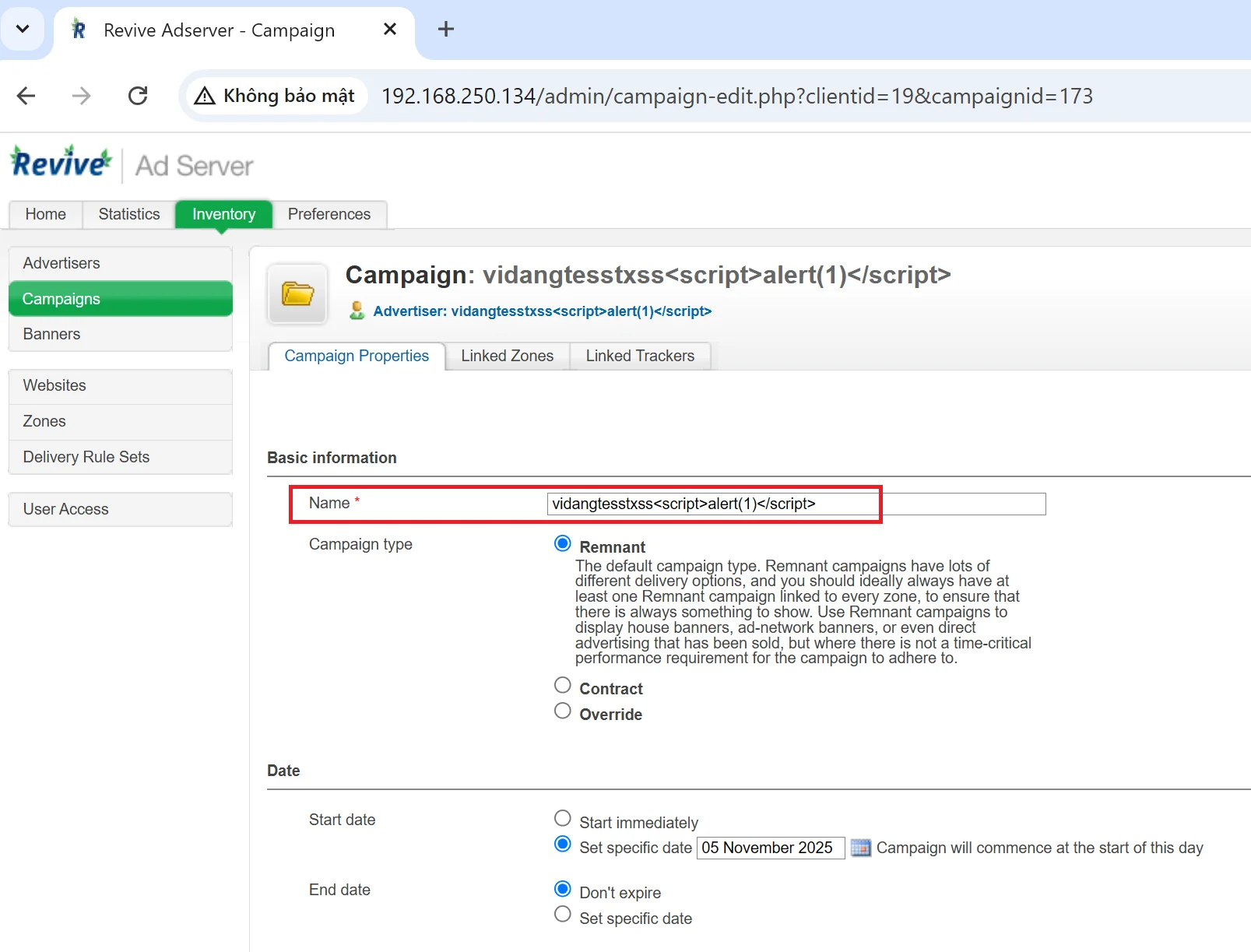
- I injected a script code XSS:
- Result:
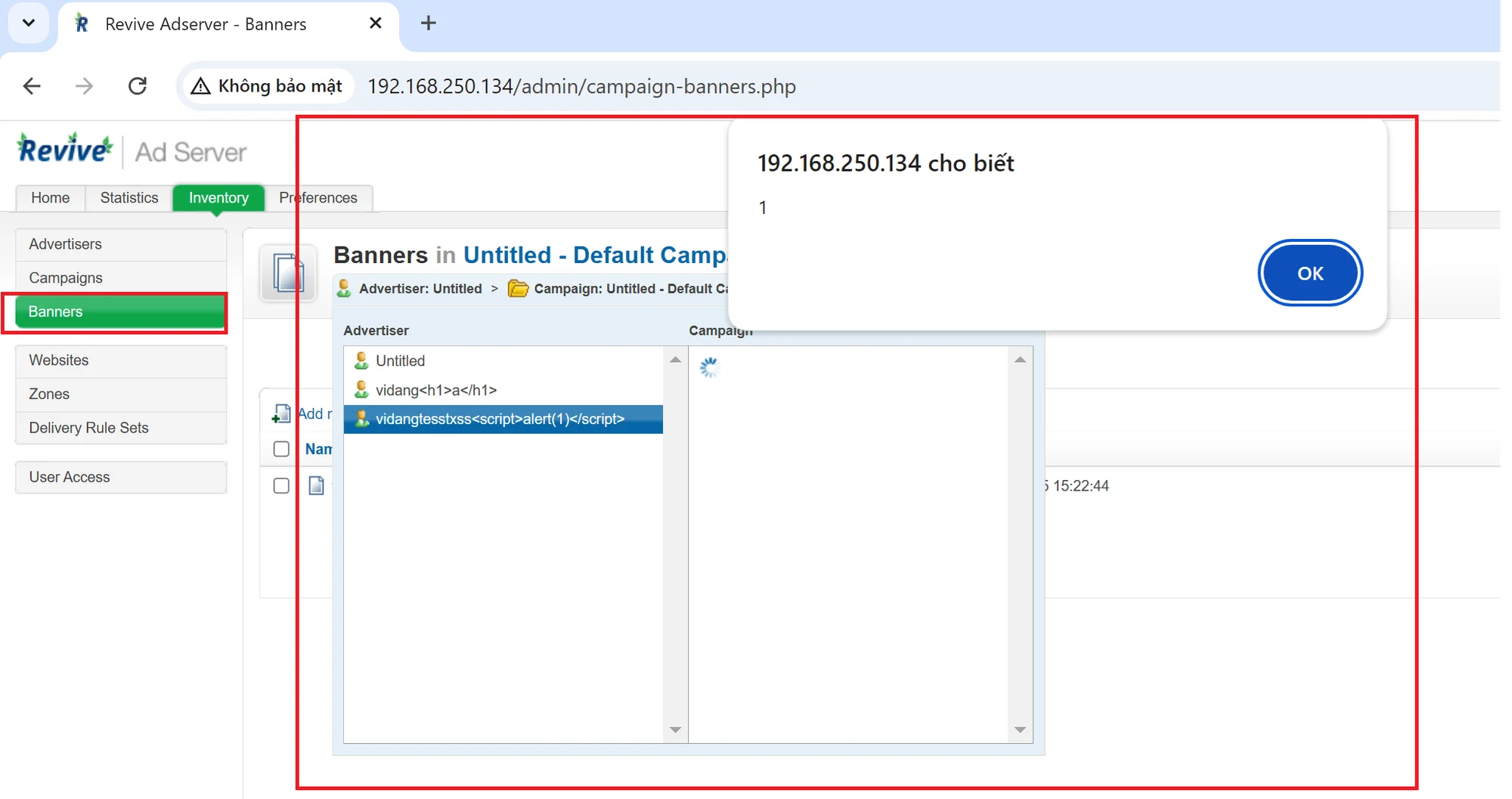
Impact
Remote authenticated attacker (normal user) places JavaScript that executes in administrator browsers. Possible consequences (depending on environment and cookie settings):
- Admin session theft (if cookies are accessible).
- Silent administrative actions performed via the admin session (create/modify/delete resources).
- Disclosure of sensitive UI data accessible to admins.
- Pivot to further compromise of infrastructure or data exfiltration.
Because the attacker only needs a normal account to persist payloads, this is highly exploitable and should be prioritized.
Not written yet. The AI write-up for this report has not been written yet. The Original tab links to the source.
How it worked
Root cause
Likely the campaign and advertiser name fields were stored without sanitisation and rendered into the admin picker without HTML encoding, so user input was treated as markup.
Impact
The script could run in an administrator's browser, and depending on the environment and cookie settings this could lead to admin session theft, silent administrative actions, disclosure of admin-visible data, or further compromise.
What the attacker needed
A valid low-privilege account; admin opens the Banners picker
How it was found
- As a normal authenticated user, enter script code into an advertiser or campaign name field.
- Save the value so it is stored by the application.
- Have an administrator open the Inventory → Banners advertiser/campaign picker, where the stored script executes.
Explained by bugbounty.wiki with AI from the original and checked against quotes from it; it can still be wrong. Read the original before relying on a detail.
Not written yet. The AI write-up for this report has not been written yet. The Original tab links to the source.
Some parts of a website save text that users type, such as a campaign name, and show it again later on other pages. If the site shows that text as if it were part of the page's code instead of plain text, any script hidden in it will run in the browser of whoever views it. Here an ordinary user could hide a script in a campaign name, and it would run when an administrator opened a certain picker screen.
What is XSS?
Script an attacker supplies runs in another user's browser, on the target's origin, with that user's session.





